Legal Alert: IRS Increases Health FSA Contribution Limit for 2018, Adjusts Other Benefit Limits

On October 20, 2017, the Internal Revenue Service (IRS) released Revenue Procedure 2017-58, which raises the health Flexible Spending Account (FSA) salary reduction contribution limit by $50 to $2,650 for plan years beginning in 2018. The Revenue Procedure also contains the cost-of-living adjustments that apply to dollar limitations in certain sections of the Internal Revenue Code.  The following summarizes other adjustments relevant to individuals and employer sponsors of welfare and fringe benefit plans.

Qualified Commuter Parking and Mass Transit Pass Monthly Limit Increase

For 2018, the monthly limitation for the qualified transportation fringe benefit is $260, as is the monthly limitation for qualified parking (in both cases, a $5 increase from the 2017 limit).

Small Employer Health Insurance Tax Credit Average Annual Wage Limit Increase

For 2018, the maximum average annual wages of employees used for determining who is an eligible small employer for purposes of the credit is $53,400 (a $1,000 increase from the 2017 threshold).  The average annual wage level at which the tax credit begins to phase out for eligible small employers is $26,700 (a $500 increase from the 2017 threshold).

Adoption Assistance Tax Credit Increase

For 2018, the amount that can be excluded from an employee’s gross income for the adoption of a child with special needs is $13,840 (a $270 increase from the 2017 limit). The maximum amount that can be excluded from an employee’s gross income for the amounts paid or expenses incurred by an employer for qualified adoption expenses furnished pursuant to an adoption assistance program for other adoptions by the employee is $13,840 (a $270 increase from the 2017 limit). The amount excludable from an employee’s gross income begins to phase out for taxpayers with modified adjusted gross income in excess of $207,580 (a $4,040 increase from the 2017 threshold) and is completely phased out for taxpayers with modified adjusted gross income of $247,580 or more (a $4,040 increase from the 2017 threshold).

Qualified Small Employer Health Reimbursement Arrangement (QSEHRA) Increase

For 2018, reimbursements under a QSEHRA cannot exceed $5,050 (single) / $10,250 (family).  This represents an increase of $50 (single) / $250 (family) from 2017.

Refundable Credit for Coverage Under a Qualified Health Plan

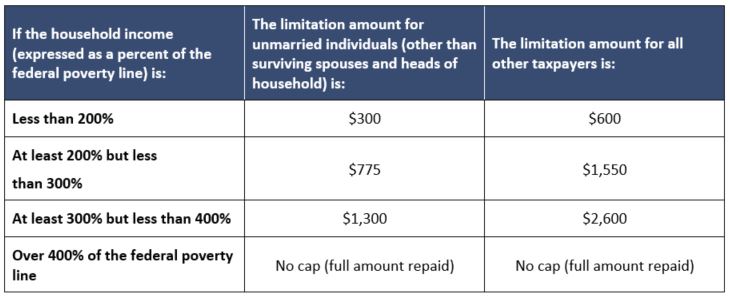
For 2018, the limit on repayment of excess advance premium credits is determined using the following table: 

In other words, individuals who were ultimately ineligible for the premium credits they received will have their repayment capped based on the table above.  

Reminder: 2018 HSA Contribution Limits and HDHP Deductible and Out-of-Pocket Limits

Earlier this year, the IRS announced the inflation adjusted amounts for 2018 relevant to HSAs and high deductible health plans (HDHPs).  The table below summarizes those adjustments.

The ACA’s out-of-pocket limits for in-network essential health benefits have also increased for 2018.  Note that all non-grandfathered group health plans must contain an embedded individual out-of-pocket limit within family coverage, if the family out-of-pocket limit is above $7,350 (2018 plan years) or $7,150 (2017 plan years).  Exceptions to the ACA’s out-of-pocket limit rule are available for certain small group plans eligible for transition relief (referred to as “Grandmothered” plans).  Unless extended, relief for Grandmothered plans ends December 31, 2018.

ACA Reporting Penalties (Forms 1094-B, 1095-B, 1094-C, 1095-C)

The following table reflects penalties for returns filed in the applicable year (i.e., the 2018 penalty is for returns filed in 2018 for calendar year 2017).  Note that failure to provide Form 1095-C to an employee and the IRS may result in two penalties of $270, as each are supposed to receive the form (doubled for willful failures, with no cap on the penalty).


About the Authors

This alert was prepared for Benefit Advisors Network by Marathas Barrow Weatherhead Lent LLP, a national law firm with recognized experts on the Affordable Care Act.  Contact Peter Marathas or Stacy Barrow at pmarathas@marbarlaw.com or sbarrow@marbarlaw.com.

This message is a service to our clients and friends. It is designed only to give general information on the developments actually covered. It is not intended to be a comprehensive summary of recent developments in the law, treat exhaustively the subjects covered, provide legal advice, or render a legal opinion.

Benefit Advisors Network and its smart partners are not attorneys and are not responsible for any legal advice. To fully understand how this or any legal or compliance information affects your unique situation, you should check with a qualified attorney.
© Copyright 2017 Benefit Advisors Network. Smart Partners. All rights reserved.


Legal Alert: President Trump Issues Executive Order on ACA, Separately Attempts to End Cost-Sharing Payments to Insurers

On October 12, President Trump signed an Executive Order directing the federal agencies in charge of implementing the Affordable Care Act (ACA) to propose new regulations or revise existing guidance to expand access to association health plans (AHPs), short-term insurance plans, and health reimbursement arrangements (HRAs).  While the order directs the agencies to consider changes that would have a sweeping effect on the health insurance industry, it has no immediate effect – any changes in rules or regulations will be subject to standard notice and comment periods. 

Separately, the President intends to stop the government’s reimbursement of cost-sharing reduction (CSR) payments made by insurance carriers that participate in the ACA’s Health Insurance Marketplaces.   A letter from Health and Human Services (HHS) to the Centers for Medicare and Medicaid Services (CMS) indicated that payments will stop immediately, effective with the payment scheduled for October 18, 2017.  The move resulted in a lawsuit filed on October 13, 2017, in federal court in the Northern District of California by a coalition of nearly twenty states against the Trump administration seeking declaratory and injunctive relief requiring that the CSR payments continue to be made.  If the CSR payments are not continued by Congress (by appropriating funds for the payments) or through judicial action (by finding that the ACA contains a permanent appropriation for the payments), it will have a much more immediate and disruptive effect on the individual market than the Executive Order.  It may also impact the small and large group markets, which rely on the individual market to provide coverage in certain cases to part-time employees, an alternative to COBRA, and encourage early retirement by offering a bridge to Medicare, as well as avoiding further cost-shifting from health care providers to private plans in response to shortfalls in public payments.

Notably, the cessation of CSR payments does not impact an employer’s obligations under the ACA’s “pay-or-play” mandate, as penalties under that mandate are triggered by a full-time employee’s receipt of a federal premium tax credit, which continue to be funded under the ACA’s permanent appropriation.

Executive Order – Expansion of Association Health Plans

The order provides that, within 60 days of October 12, the U.S. Department of Labor (DOL) should consider proposing regulations or revising guidance to allow more employers to form AHPs.  The order directs the DOL to consider expanding the conditions that satisfy the commonality of-interest requirements under current Department of Labor advisory opinions interpreting the definition of an “employer” under the Employee Retirement Income Security Act of 1974 (ERISA).  In addition, the order directs the DOL to consider ways to promote AHP formation on the basis of common geography or industry. 

While the order itself is brief and does not offer much detail, an expansion of the definition of “employer” under ERISA might mean that the administration is considering ways to allow individuals and small employers to be treated as “large groups” for purposes of the ACA’s market reforms.  Under the ACA, health plans offered to individuals and small employers generally must include coverage for services in all ten categories of essential health benefits, and the premium rates cannot vary based on health status (rates may vary based only on age, tobacco use, geographic area, and family size).  If individuals and small employers could form “associations” to purchase health insurance as “large groups,” they could offer leaner, less expensive plans that might appeal to younger, healthier individuals.  For example, large group plans may, subject to any state insurance mandates applicable to fully-insured plans, exclude coverage for mental health and substance use disorders, prescription drugs, or other costly services that tend to be used by individuals who are older or less healthy.

States traditionally have authority to regulate association health plans and insurance sold in their state and would likely challenge any rules that they perceive could damage their insurance markets.  In the past, when association coverage legislation was proposed, there has been opposition by various state governments, consumer, business, labor and health care provider and patient advocacy groups because of concerns regarding “cherry-picking” of healthier individuals (in turn, causing those with pre-existing conditions to pay more for such coverage on the open market) as well as concerns that such plans promote fraud and insolvency.  Depending on how the rules are written, associations could potentially offer plans across state lines, thus weakening states’ regulatory authority.  The extent to which any new rules regarding associations will attempt to supersede state authority remains to be seen. 

It will also be difficult under existing rules and regulations to fit non-employment based associations within the framework of ERISA, which requires an employment relationship between the plan sponsor and participants.  The order doesn’t address the potential MEWA status of AHPs.  Unless existing regulations are revised, AHPs composed of unrelated employers would still be viewed as multiple employer welfare arrangements (MEWAs) under ERISA, which means that they would be subject to state insurance laws such as solvency and licensing requirements and, except in limited situations, have additional administrative burdens (e.g., Form M-1 filing requirement).  It remains to be seen if future regulations would attempt to apply ERISA preemption to certain state requirements that may otherwise apply to MEWAs.

Executive Order – Short-Term Limited-Duration Insurance

Short-term limited-duration insurance (STLDI) is exempt from the ACA’s insurance mandates and market reforms.  It is intended to bridge gaps in coverage – for example, individuals between jobs or having just graduated from school.  Because it’s exempt from the ACA, insurers offering STLDI plans may underwrite based on medical history and charge higher premiums for individuals based on health status.  In order to prevent younger, healthier individuals from leaving the individual market, Obama-era regulations limited the coverage period for STLDI from less than 12 months to less than 3 months and prevented any extensions beyond 3 months of total coverage. 

The order provides that, within 60 days of October 12, HHS, the DOL and Treasury should consider proposing regulations or revising guidance to expand the availability of STLDI.  In particular, as long as it is supported by sound policy, the order provides that agencies should consider allowing STLDI to cover longer periods and be renewed by the consumer.  As with the section of the order dealing with association plans, states may challenge this order as infringing on their ability to regulate their insurance industry and may resist rules they consider to be disruptive or potentially damaging.

Executive Order – Health Reimbursement Arrangements (HRAs)

HRAs are tax-advantaged, account-based arrangements that employers can establish for employees to give employees more flexibility and choices regarding their healthcare.  The order provider that, within 120 days of October 12, HHS, the DOL and Treasury should consider proposing regulations or revising guidance to increase the usability of HRAs, to expand employers’ ability to offer HRAs to their employees, and to allow HRAs to be used in conjunction with individual market coverage.  This provision appears to be intended to repeal Obama-era rules that required most HRAs to be “integrated” with a group health plan and generally prohibited their use to purchase individual market coverage.  Eligible “small employers” (i.e., those with fewer than 50 full-time employees or equivalents) have been able to use HRAs (referred to as Qualified Small Employer HRAs, or QSEHRAs) to reimburse individual market premiums since the start of 2017, a change made by the 21st Century Cures Act, which was passed in December 2016 (several restrictions apply, including the requirement that an employer offer no other group health plan aside from the QSEHRA).

Cessation of Cost Sharing Reduction (CSR) Payments

Also on October 12, 2017, the Trump administration filed a notice with the U.S. Court of Appeals for the District of Columbia Circuit, informing the Court that cost-sharing reduction payments will stop because it has determined that those payments are not funded by the permanent appropriation established for the ACA’s premium tax credits.  Therefore, the upcoming payment to insurance carriers scheduled for October 18, 2017, will not occur unless a court intervenes and orders the payment to be made, or Congress appropriates the funding.

The move was met with a swift reaction from the Attorney General of California, who led a coalition of nearly 20 states in a lawsuit against the Trump administration, alleging that the sudden decision to stop the CSR payments did not evolve from “a good-faith reading of the [ACA]” and “is part of a deliberate strategy to undermine the ACA’s provisions for making health care more affordable and accessible” by making it more difficult and expensive for individuals to obtain health insurance through the ACA’s Health Insurance Marketplace. 

When Congress enacted the ACA, it intended to increase the number of Americans covered by health insurance and decrease the cost of health care.  To achieve these goals, the ACA adopted a series of mandates and reforms, including the creation of the Health Insurance Marketplace and provision of billions of dollars in federal funding to help make health insurance more affordable for low- and moderate-income Americans.  These subsidies help offset premiums as well as participant cost-sharing, such as deductibles and coinsurance.  The CSR payments to carriers reimburse them for reductions in participant cost-sharing that the carriers are required to apply under the ACA.  

The premium subsidies and CSRs are generally paid directly to insurance carriers.  The ACA requires the IRS to ensure payment of the premium tax credits and requires HHS to make “periodic and timely” payments to insurance carriers for the CSRs.  The premium credits and CSRs are paid through a single, integrated program created by the ACA.  To fund this integrated system of health insurance subsidies, the ACA established a permanent appropriation for amounts necessary to pay refunds due from the premium tax credit and CSR subsidies.  The lawsuit asserts that the Executive Branch has the authority and obligation to make premium tax credit and CSR payments to insurers on a regular basis and that no further appropriation from Congress is required.  The lawsuit also alleges that the sudden cessation of the payments is arbitrary and capricious under Administrative Procedure Act (APA), as the government failed to adequately explain their decision that they no longer have the authority to make CSR payments.  Lastly, the complaint alleges that by refusing to make the CSR reimbursement payments mandated by the ACA and its permanent appropriation, as well as taking the other actions described above, the President is violating the Take Care Clause of the U.S. Constitution, which provides that the President must “take Care that the Laws be faithfully executed.” 

It is also worth mentioning that stopping the approximately $7 billion per year in CSR payments is predicted to cost the federal government nearly $200 billion over 10 years, according to the Congressional Budget Office.  This is because the average amount of premium subsidy per person would be greater, and more people would receive subsidies in most years.

The View from MarBar

The Executive Order and the cessation of CSR payments follows a set of regulations released by the Trump administration the previous week that scaled back the ACA’s contraceptive coverage requirement.  After several attempts to repeal and replace the ACA, a seminal campaign pledge of President Trump, failed to garner enough votes in the Republican-controlled Senate, it appears that the Trump administration is turning to regulatory and sub-regulatory action to make changes to the nation’s health care system in what may be an effort to force Congress to revisit legislative action.  While some Republicans in Congress view the President’s action as expanding “free market reform,” there are those on the other side of the aisle that view it as “executive sabotage” of the ACA.  The approaches described in the Executive Order expose the Obama administration’s reliance on regulatory and sub-regulatory guidance to implement strategies to advance the ACA.  Time will tell if the Trump administration’s guidance is consistent with faithfully executing the ACA, now that it remains the law of the land for the foreseeable future. 

In the meantime, employers should wait to see how any regulations are drafted as a result of the Executive Order.  As mentioned, new rules would be subject to notice and comment periods, which should allow employers adequate time to prepare for any changes.  Lastly, employers should be concerned with the government’s cessation of CSR payments and its potential impact on the group insurance market, especially the potential increase in COBRA participation and delay of early retirement.  Health insurance industry trade groups have issued statements indicating that the payments are critical and that there are real consequences to stopping them, in that costs will rise and the insurance markets could become unstable.

References: 1The lawsuit highlights various efforts by the Trump administration aimed at weakening the Marketplace, including the administration’s substantially reduced efforts to educate and encourage individuals to sign up for health insurance through the Marketplace. In addition, HHS has reduced its advertising budget for the Marketplace program to $10 million, a 90% decrease from the $100 million allocated for the program in 2016. HHS also reduced the amount of money granted to nonprofit organizations that serve as “navigators” to help individuals enroll in health plans offered through the Marketplace to $36 million, as compared to $63 million in 2016.  HHS has also reduced the Marketplace open enrollment period from twelve weeks to six, and has announced that it will shut down the HealthCare.gov website for 12 hours every Sunday during the open enrollment period.


About the Author

 This alert was prepared for Benefit Advisors Network by Marathas Barrow Weatherhead Lent LLP, a national law firm with recognized experts on the Affordable Care Act.  Contact Peter Marathas or Stacy Barrow at pmarathas@marbarlaw.com or sbarrow@marbarlaw.com.

This message is a service to our clients and friends. It is designed only to give general information on the developments actually covered. It is not intended to be a comprehensive summary of recent developments in the law, treat exhaustively the subjects covered, provide legal advice, or render a legal opinion.

Benefit Advisors Network and its smart partners are not attorneys and are not responsible for any legal advice. To fully understand how this or any legal or compliance information affects your unique situation, you should check with a qualified attorney.

Legal Alert: Trump Administration Releases Guidance on ACA’s Contraceptive Coverage Mandate

On October 6, 2017, The U.S. Departments of Health and Human Services (HHS), Treasury, and Labor (the “Departments”) released interim final regulations allowing employers and insurance companies to decline to cover contraceptives under their health plans based on a religious or moral objection.  The new rules – which are effective immediately – scale back Obama-era regulations under the Affordable Care Act (ACA) that require non-grandfathered group health plans to cover women’s contraceptives with no cost-sharing, with limited exceptions for non-profit religious organizations or closely-held for-profit entities.

The new regulations were released in two parts, one covering employers with moral objections (the “Moral Exemption”), the other for those with religious objections (the “Religious Exemption”).  The regulations are scheduled to be published in the October 13, 2017 Federal Register.  Within hours of their release, the Departments were sued by the Attorney Generals of California and Massachusetts, and the American Civil Liberties Union (ACLU), alleging that the regulations violate the Administrative Procedure Act, the Establishment Clause of the First Amendment to the Constitution, and the Equal Protection guarantee implicit in the Fifth Amendment to the Constitution.  The lawsuits seek to stop implementation of, and invalidate, the regulations.  Other states, including Virginia and Oregon, are exploring legal options to challenge the exemptions.

Background on ACA’s Contraceptive Coverage Mandate

Originally, the bill that became the ACA did not cover certain women’s preventive services that many women’s health advocates and medical professionals believed were “critically important” to meeting women’s unique health needs.  To address that concern, the Senate adopted a “Women’s Health Amendment,” to the ACA, which added a new category of preventive services specific to women’s health based on guidelines supported by the Health Resources and Services Administration (HRSA).  Supporters of the amendment emphasized that it would reduce unintended pregnancies by ensuring that women receive coverage for “contraceptive services” without cost-sharing.

The ACA was enacted in March 2010.  In 2011, the Departments issued regulations requiring coverage of women’s preventive services provided for in the HRSA guidelines, which include all Food and Drug Administration (FDA)-approved contraceptives, sterilization procedures, and patient education and counseling for women with reproductive capacity, as prescribed by a health care provider.

Once these rules took effect in 2012, women enrolled in most health plans and health insurance policies (non-grandfathered plans and policies) have been guaranteed coverage for recommended preventive care, including all FDA-approved contraceptive services prescribed by a health care provider, without cost sharing.  Under rules released in 2013, exemptions were introduced for certain religious employers (generally churches and houses of worship), as well as “accommodations” for non-profit religious organizations that “self-certify” their objection to providing contraceptive coverage on religious grounds.  Under the accommodation approach, an eligible employer does not have to arrange or pay for contraceptive coverage.  Employers may provide their self-certification to their insurance carrier or third-party administrator (TPA), which will make contraceptive services available for women enrolled in the employer’s plan, at no cost to the women or the employer.

In 2014, regulations were published to establish another option for an employer to avail itself of the accommodation. Under these rules, an eligible employer may notify HHS in writing of its religious objection to providing coverage for contraceptive services.  HHS or the Department of Labor, as applicable, will notify the insurer or TPA that the employer objects to providing coverage for contraceptive services and that the insurer or TPA is responsible for providing enrollees in the health plan separate no-cost payments for contraceptive services.

In 2015, in response to the Supreme Court’s decision in Burwell v. Hobby Lobby Stores, Inc., regulations were released that expanded the availability of the accommodation to include a closely held for-profit entity that has a religious objection to providing coverage for some or all contraceptive services.

In May 2017, President Trump issued an Executive Order that directed the Departments to consider amending the contraceptive coverage regulations in order to promote religious liberty.  Specifically, the Executive Order instructed the Departments to “consider issuing amended regulations . . . to address conscience-based objections to the preventative-care mandate.”  These latest regulations are consistent with the Executive Order.

Overview of the Moral & Religious Objection Regulations

The Regulations expand existing exemptions to the ACA’s contraceptive care requirement. The Religious Exemption automatically exempts all employers—non-profit and for-profit organizations alike—with a religious objection to contraception from complying with the contraceptive care requirement.

The Moral Exemption exempts all non-profit employers and non-publicly traded for-profit employers with a moral objection to contraception from complying with the contraceptive care requirement. The rules also give exempted employers the authority to decide whether their employees receive independent contraceptive care coverage through the accommodation process.  In other words, by making the accommodation process voluntary for employers, employees would no longer be guaranteed the seamless coverage for contraceptive care that currently exists under the accommodation process.

Entities that qualify for the exemptions include churches and their integrated auxiliaries, nonprofit organizations, closely-held for-profit entities, for-profit entities that are not closely held, any non-governmental employer, as well as institutions of higher education and health insurers offering group or individual insurance coverage.  Publicly-traded companies, however, are not eligible for the Moral Exemption.  The rules also appear to have been drafted separately to ensure that one remains if the other is struck down.

Employers currently operating under the religious accommodation (or that operate under the voluntary accommodation in the future) who wish to revoke that status may do so and rely on the exemptions in the new regulations.  As part of any revocation, the insurer or TPA must notify participants and beneficiaries in writing.  If contraceptive coverage is being offered by an insurer or TPA through the religious accommodation process, the revocation will be effective on the first day of the first plan year that begins on or after 30 days after the date of the revocation.  Alternatively, an eligible organization may give 60 days’ advance notice under the ACA’s Summary of Benefits and Coverage rules, if applicable.

Next Steps and Impact on Employers

Although the Moral and Religious Exemptions are effective immediately, employers that plan to avail themselves of either exemption should exercise caution and consult with qualified ERISA counsel before making plan changes.  The regulations are already under challenge, regarding both their substance and their accelerated effective dates.  Also, in many states, contraceptive coverage is a state-mandated benefit.  Practically, this means that employers sponsoring fully-insured non-grandfathered group health plans may be precluded from exercising either exemption because insurance carriers in those states would be required to write policies that provide such coverage.  Moreover, an employer availing itself under either exemption may face private lawsuits from participants and beneficiaries under Title VII of the Civil Rights Act of 1964, which prohibits discrimination based on sex.


About the Author

 This alert was prepared for Benefit Advisors network by Stacy Barrow.  Mr. Barrow is a nationally recognized expert on the Affordable Care Act.  His firm, Marathas Barrow Weatherhead Lent LLP, is a premier employee benefits, executive compensation and employment law firm.  He can be reached at sbarrow@marbarlaw.com.

This message is a service to our clients and friends. It is designed only to give general information on the developments actually covered. It is not intended to be a comprehensive summary of recent developments in the law, treat exhaustively the subjects covered, provide legal advice, or render a legal opinion.

 Benefit Advisors Network and its smart partners are not attorneys and are not responsible for any legal advice. To fully understand how this or any legal or compliance information affects your unique situation, you should check with a qualified attorney.

 © Copyright 2017 Benefit Advisors Network. Smart Partners. All rights reserved. 

Legal Alert: Court Requires EEOC to Substantiate 30% Limit on Wellness Program Incentives

On August 22, 2017, a federal court in the District of Columbia ordered the Equal Employment Opportunity Commission (EEOC) to reconsider the limits it placed on wellness program incentives under final regulations the agency issued last year under the Americans with Disabilities Act (ADA) and the Genetic Information Nondiscrimination Act (GINA).  As part of the final regulations, the EEOC set a limit on incentives under wellness programs equal to 30% of the total cost of self-only coverage under the employer’s group health plan.  The court found that the EEOC did not properly consider whether the 30% limit on incentives would ensure the program remained “voluntary” as required by the ADA and GINA and sent the regulations back to the EEOC for reconsideration.

In the meantime, to avoid “potentially widespread disruption and confusion” the court decided that the final regulations would remain in place while the EEOC determines how it will proceed (e.g., provide support for its regulations, appeal the decision, or change the regulations). As background, under the ADA, wellness programs that involve a disability-related inquiry or a medical examination must be “voluntary.”  Similar requirements exist under GINA when there are requests for an employee’s family medical history (typically as part of a health risk assessment).  For years, the EEOC had declined to provide specific guidance on the level of incentive that may be provided under the ADA, and their informal guidance suggested that any incentive could render a program “involuntary.”  In 2016, after years of uncertainty on the issue, the agency released rules on wellness incentives that resemble, but do not mirror, the 30% limit established under U.S. Department of Labor (DOL) regulations applicable to health-contingent employer-sponsored wellness programs.  While the regulations appeared to be a departure from the EEOC’s previous position on incentives, they were welcomed by employers as providing a level of certainty.

However, the American Association for Retired Persons (AARP) sued the EEOC in 2016, alleging that the final regulations were inconsistent with the meaning of “voluntary” as that term was used in ADA and GINA.  AARP asked the court for injunctive relief, which would have prohibited the rule from taking effect in 2017.  The court denied AARP’s request in December 2016, finding that AARP failed to demonstrate that its members would suffer irreparable harm from either the ADA or the GINA rule, and that AARP was unlikely to succeed on the merits.  This was due in part to the fact that the administrative record was not then available for the court’s review.

In its recent decision, the court reviewed the administrative record and found the EEOC’s regulations were arbitrary and capricious, in that the EEOC failed to provide a reasoned explanation for its decision to interpret the term “voluntary” to permit a 30% incentive level.  As part of its analysis, the court evaluated numerous reasons the EEOC gave for choosing the 30% level and noted that, having chosen to define “voluntary” in financial terms (30% of the cost of self-only coverage), the EEOC “does not appear to have considered any factors relevant to the financial and economic impact the rule is likely to have on individuals who will be affected by the rule.”

The court has allowed the final regulations to remain in place while the EEOC determines how it will proceed, to avoid disruption to employers and others who have relied on them.  If the court had vacated the regulations, employers would have been at risk of violating the ADA despite having designed their wellness programs to comply with the 30% limit on incentives. 

Next Steps and Impact on Employers

It is unknown at this time how the EEOC will respond to the court’s decision. If the EEOC wishes to continue its application of the rule, it will need to supplement the administrative record with some evidence that participation in a wellness program remains “voluntary” even when an employer can penalize employees 30% of the total cost of coverage if they don’t participate.  However, the EEOC may decide, instead, to withdraw its rule or promulgate new rules lowering the incentive limit (further distancing it from the HIPAA limits).  It is likely that any new rules would provide for a transition period during which employers would be able to review and revise their wellness programs so that they comply.  Given that the Trump Administration’s nomination for EEOC Commission Chair awaits Senate confirmation, it may be a considerable amount of time until the EEOC decides how to proceed, leaving employers without the clarity they desire on this issue. 

It is also possible, though given other priorities unlikely, that Congress may intervene to pass legislation harmonizing the ADA with the HIPAA/ACA rules, which would render the court’s decision moot. 

In the short term, employers may continue to rely on the EEOC’s final regulations.  Wellness programs designed to comply with existing rules, specifically the 30% cap, are unlikely to be challenged by the federal governmental agencies.  However, it is possible the court’s decision may open the door for employees to bring a private lawsuit against an employer challenging under the ADA the “voluntariness” of a wellness program that includes an incentive up to the 30% limit.  One would expect that any employer facing such an action would defend it arguing its good faith reliance on the EEOC’s regulation.

In the longer term, employers are again faced with uncertainty as to their wellness program incentives.  Employers designing and maintaining wellness programs should continue to monitor developments and work with employee benefits counsel to ensure their wellness programs comply with all applicable laws.  


About the Author

This alert was prepared by Stacy Barrow.  Mr. Barrow is a nationally recognized expert on the Affordable Care Act.  His firm, Marathas Barrow Weatherhead Lent LLP, is a premier employee benefits, executive compensation and employment law firm.  He can be reached at sbarrow@marbarlaw.com.

This message is a service to our clients and friends. It is designed only to give general information on the developments actually covered. It is not intended to be a comprehensive summary of recent developments in the law, treat exhaustively the subjects covered, provide legal advice, or render a legal opinion.

Benefit Advisors Network and its smart partners are not attorneys and are not responsible for any legal advice. To fully understand how this or any legal or compliance information affects your unique situation, you should check with a qualified attorney.
© Copyright 2017 Benefit Advisors Network. Smart Partners. All rights reserved

Legal Alert: Senate Republicans Release Updated Discussion Draft of ACA Repeal Bill

On Thursday, June 22, 2017, Senate Majority Leader Mitch McConnell of Kentucky released a 142-page healthcare “Discussion Draft” of legislation, called the Better Care Reconciliation Act of 2017 (BCRA), which is the Senate version of the Affordable Care Act (ACA) “repeal-and-replace” legislation American Health Care Act (AHCA) passed by the U.S. House of Representatives last month.  An updated “Discussion Draft” of the BCRA was released on June 26, 2017 with the intention of calling for a vote on the bill before the Fourth of July recess. However, Senator McConnell had to delay that vote after it became clear that it would not get the 51 votes required under the Budget Reconciliation rules to pass.  A further updated Discussion Draft of the BCRA was released on July 13, 2017.  A summary of the updated July 13 draft of the BCRA by the U.S. Senate Committee on the Budget is available here and a section-by-section summary of the July 13 version is available here and here.

The July 13 Discussion Draft largely mirrors the previous draft and its primary revisions are unlikely to have a significant impact on employer-sponsored group health plan coverage.  The revisions to the BCRA in the July 13 Discussion Draft are intended to garner enough support from certain key swing votes by senators who previously expressed reservations about supporting the prior version after the Congressional Budget Office previously reported that it would leave 22 million more uninsured by 2026 than under the ACA while providing tax cuts to the wealthy.  Primary revisions in this most recent version include:

  • Addition of a provision that would allow people to use their health savings accounts (HSAs) to pay for individual market health coverage to the extent that premiums exceed any tax credit amounts allowed under the law;
  • Revisions to keep the 3.8% net investment income tax and 0.9% Medicare payroll tax, which previous versions had proposed repealing;
  • Additional funding for state-based reforms that are intended to help cover out-of-pocket costs and additional funding for opioid programs;
  • Addition of a provision that would allow all individuals purchasing health insurance in the individual market the option to purchase a lower premium catastrophic plan (that covers at least 3 primary care visits a year) effective plan years beginning on or after January 1, 2019 and allow individuals to use premium tax credits towards the purchase of such catastrophic plans; and
  • Addition of a provision developed by Senator Ted Cruz (R-TX) that would allow insurers to offer non-Exchange plans that do not comply with many of the ACA mandates so long as the insurer offers “sufficient minimum coverage” through a public Exchange that remains subject to federal mandates in the ACA.  Because the policies that meet the ACA mandates would likely attract individuals with adverse health conditions, the bill would create a fund to make payments to insurers for the costs of covering high risk individuals enrolled in such plans. 

Except for the taxes noted above and the “Cadillac” tax on high-cost employer-sponsored coverage, which would be delayed through 2025, the updated Senate bill would repeal virtually all of the tax increases imposed by the ACA, including the individual and employer mandates, effective as of January 1, 2016.

The major substantive change in the prior updated Discussion Draft released on June 26 was to add a new Section 206, beginning in 2019, that would subject an individual who has a break in continuous “creditable coverage” for 63 days or more in the prior year to a six-month waiting period (in the individual market) before coverage begins.  This provision remains unchanged in the current version of the bill and is intended to provide an incentive for young and healthier individuals to maintain health insurance since the bill would eliminate the individual mandate.  The AHCA proposed imposing a 30% surcharge on those without continuous creditable coverage, but there were concerns over whether that provision could pass Senate parliamentary rules.

The Congressional Budget Office is expect to release its score of the legislation next week and, if there are enough votes, a formal debate of the bill on the Senate floor could follow.  It remains unclear whether the Republicans will be able to secure enough votes to advance the bill.  It has already been reported that Senator Rand Paul (R-KY) and Senator Susan Collins (R-ME) intend to vote against beginning debate next week.   Also on July 13, Senators Bill Cassidy (R-LA) and Lindsey Graham (R-SC) announced that they are developing an “alternative” health plan that would keep much of the federal taxes in place (though it would repeal the individual and employer mandates) and would send much of the federal tax dollars to the states to control.

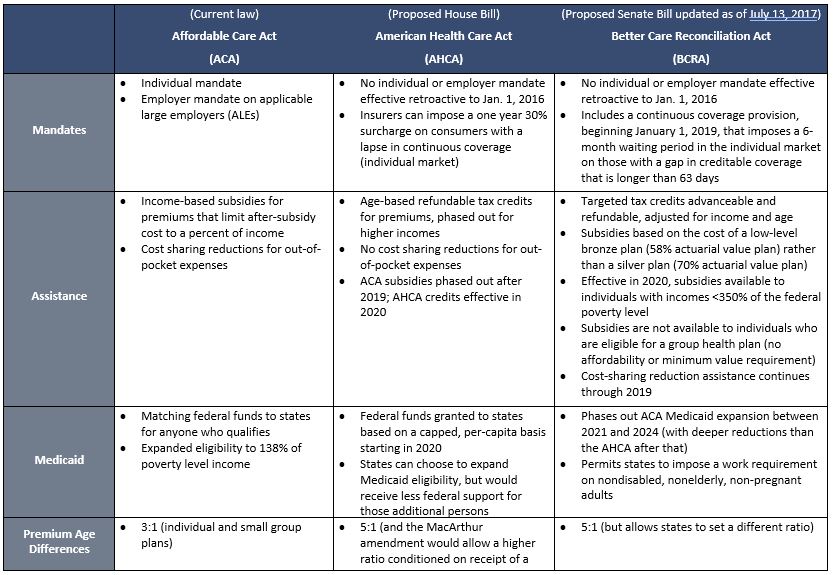
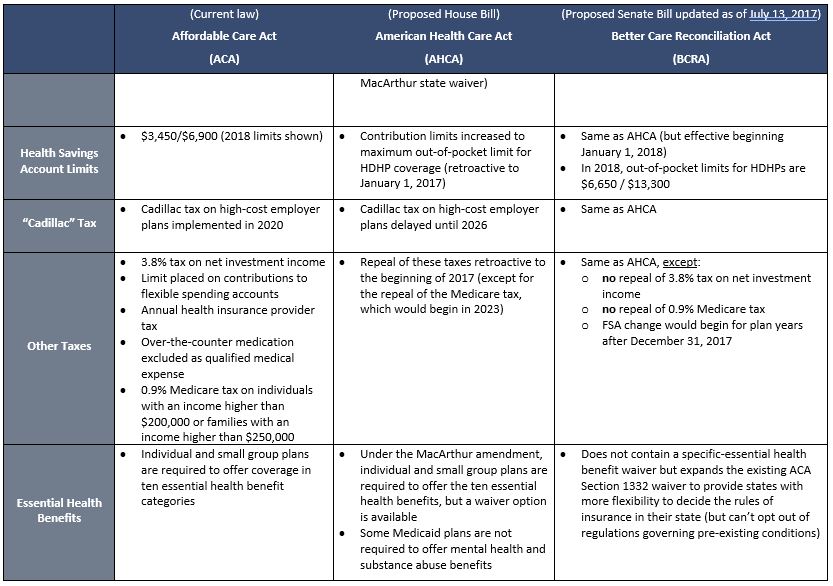
A comparison of the House passed AHCA and the updated versions of the Senate bills can be found below. 

Key Issues for Employers

As noted above, the most recent Discussion Draft of the BCRA largely mirrors the previous draft and the primary revisions to the prior versions are unlikely to significantly impact employer-sponsored group health plan coverage.  For employers, the most significant change made by the AHCA to the ACA that was retained by the various versions of the BCRA is the repeal of the employer mandate penalties effective January 1, 2016.  The updated BCRA retains other significant AHCA changes for employers, including unlimited flexible spending accounts, and enhancements to health savings accounts (HSAs).

Of note for employers sponsoring fully-insured group health plans, beginning in 2020 the updated bill retains the provision from the prior version that requires states to set their own medical loss ratio rebating rules.  It also retains the provision from the prior version that would add a structure under ERISA (by adding a new Part 8) that would allow for the establishment of association health plans for small businesses or individuals (Small Business Health Plans or SBHPs), allowing them to be treated as large group plans exempt from the community rating and essential health benefit requirements that are currently applicable to small group and individual plans.  This new section of ERISA would preempt any and all state laws that would preclude an insurer from offering coverage in connection with an SBHP and would go into effect one year after enactment (and implementing regulations would be required to be promulgated within six months of enactment).

Also significant is that the updated bill does not include a provision capping the tax exclusion for employer provided health insurance.  Many employers were concerned that the exclusion would be capped or removed as a way to increase revenue to pay for other tax cuts in the bill.  Nor does the bill repeal the Sections 6055 and 6056 reporting requirements.  It will remain to be seen whether, if the BCRA is passed, the IRS may continue to use the existing ACA information reporting system to determine whether an individual is eligible for a premium tax credit or is prohibited from receiving one in 2018 or 2019 because such an individual has an offer in 2018 or 2019 of affordable, minimum value employer-sponsored coverage.  Or, whether in 2020 and thereafter, the IRS would need information to assess whether an individual has any offer of employer-sponsored coverage to determine eligibility for the premium tax credit. 

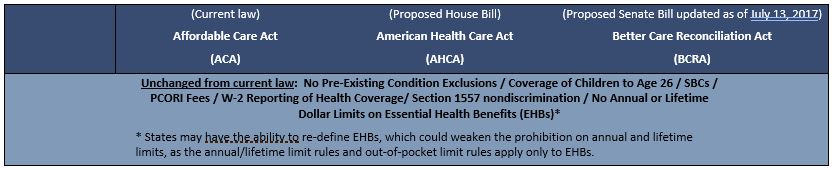
Other provisions of the ACA that are not changed by either the House AHCA or any of the Senate proposals are: 

  • W-2 reporting of health coverage;
  • Comparative effectiveness research fees paid annually to fund the Patient-Centered Outcomes Research Institute (PCORI) through 2019;
  • Group health plan coverage mandates (e.g., dependents to age 26, no annual or lifetime limits);
  • Rules for non-grandfathered group health plans (e.g., coverage of preventive services with no cost-sharing, external appeals, etc.);
  • Summary of Benefits and Coverage (SBCs); and
  • Section 1557 nondiscrimination rules.

Key Issues for Individuals

For individuals, while the July 13th Discussion Draft of the BCRA includes some revisions to Medicaid, like the prior version, it would repeal the ACA’s Medicaid expansion, but at a slower rate than proposed by the AHCA and would tighten the eligibility criteria for premium subsidies (beginning in 2020, only those earning up to 350% of the poverty level would qualify rather than the 400% threshold in the ACA); however, subsidies would open up for enrollees below the poverty level living in states that did not expand Medicaid.  The bill would allocate money for cost-sharing subsidies through 2019, which are used to offset the costs for insurers to offer low-income individuals with coverage that has lower out-of-pocket costs.  There had been uncertainty whether these payments would continue, which was causing instability in the individual insurance market.  

However, under the July 13 Discussion Draft of the Senate bill, higher-income individuals would not see relief from the 0.9% Medicare surtax or the 3.8% net investment income tax that in prior versions of both the House and Senate bill would have been repealed.

Next Steps

The Republicans are trying to pass the bill through the budget reconciliation process since it allows them to avoid a Democratic filibuster and to pass the bill with a simple majority (rather than 60 votes).  However, the Republicans have only 52 Senate seats, which means that to pass, Senator McConnell can only afford to lose 2 votes (Vice President Pence can be the tie breaker).  It remains to be seen whether the most recent changes to appease the bill’s critics will be enough to move the bill forward for debate on the Senate floor, where it is expected that senators will propose amendments.  As noted above, it has been reported that Senators Paul Rand and Susan Collins have already stated that they intend to vote against letting the bill go forward and Senators Lindsey Graham and Bill Cassidy announced that they are working on an alternative health plan, further complicating the process.  

Majority Leader Senator McConnell recently decided to delay the Senate’s August recess so that the Senate could continue to work on legislation including the BCRA.  If the Senate passes a bill, it will either have to be approved by the House (the two chambers would have to reconcile their differences in a conference committee), or the House could pass a new version and send it back to the Senate for approval.

Comparison of the ACA, AHCA, and BCRA

The chart below compares some of the significant changes proposed by the BCRA to the ACA and the proposed House bill.

Employers and other stakeholders should continue to stay the course on ACA compliance at this time while they monitor for changes as the BCRA continues to make its way through the legislative process.


About the Author

 This alert was prepared for Benefit Advisors Network by Stacy Barrow.  Mr. Barrow is a nationally recognized expert on the Affordable Care Act.  His firm, Marathas Barrow Weatherhead Lent LLP, is a premier employee benefits, executive compensation and employment law firm.  He can be reached at sbarrow@marbarlaw.com.

This message is a service to our clients and friends. It is designed only to give general information on the developments actually covered. It is not intended to be a comprehensive summary of recent developments in the law, treat exhaustively the subjects covered, provide legal advice, or render a legal opinion.

Benefit Advisors Network and its smart partners are not attorneys and are not responsible for any legal advice. To fully understand how this or any legal or compliance information affects your unique situation, you should check with a qualified attorney.
© Copyright 2017 Benefit Advisors Network. Smart Partners. All rights reserved.