Legal Alert: Employee Benefit Changes in the Tax Cuts and Job Acts of 2017

On December 22, 2017, President Trump signed what is popularly known as the Tax Cuts and Jobs Act (H.R. 1) (the “Bill”), overhauling America’s tax code for both individuals and corporations and providing the most sweeping changes to the U.S. Tax Code since 1986. The House and Senate Conference Committee provided a Policy Highlights of the major provisions of the Bill, and the Joint Committee on Taxation provided a lengthy explanation of the Bill.

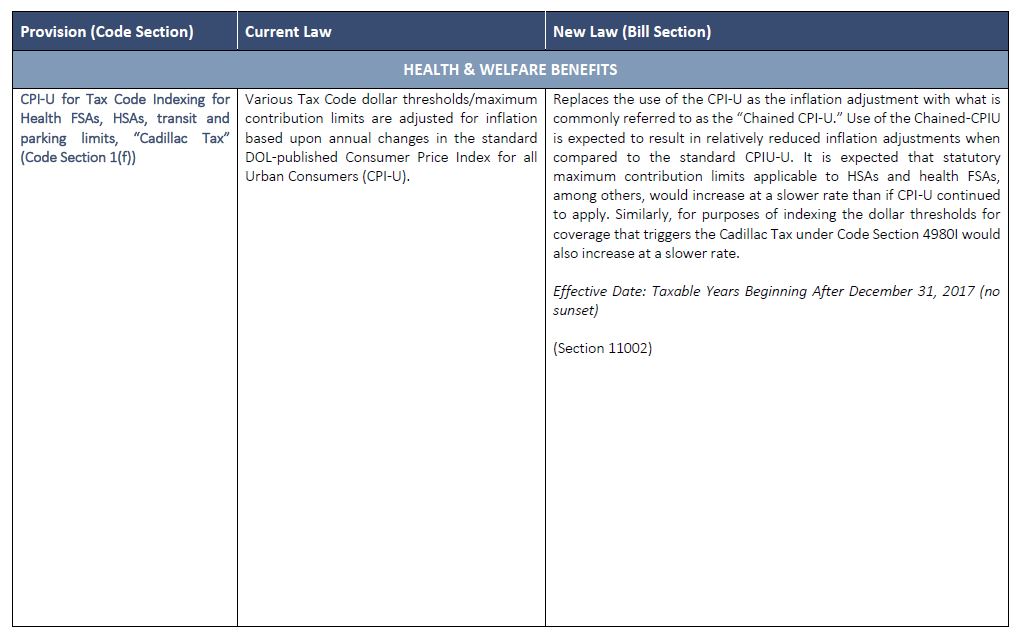
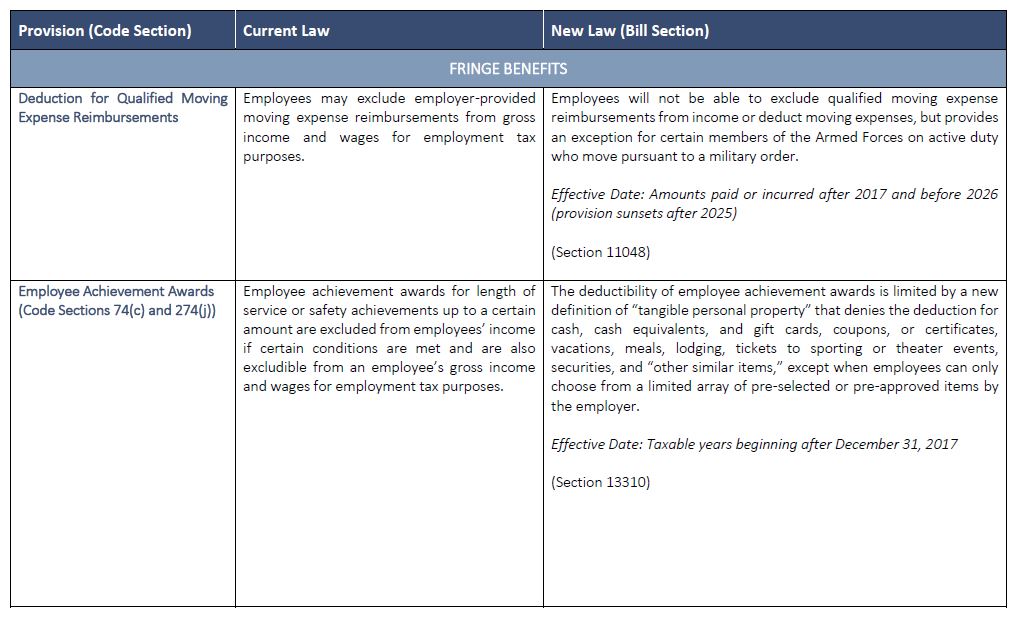
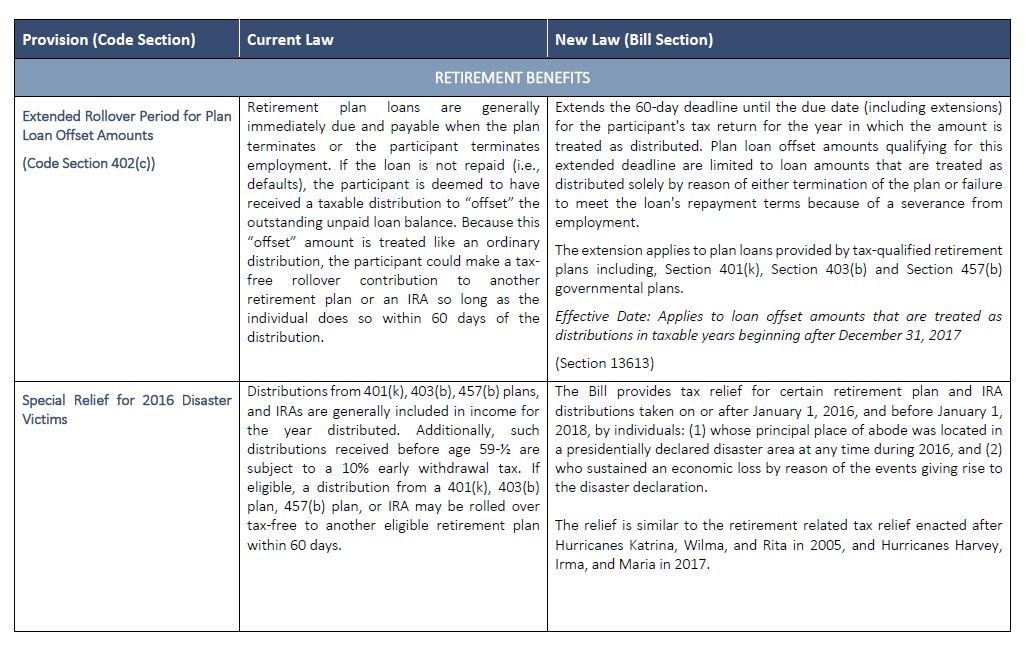
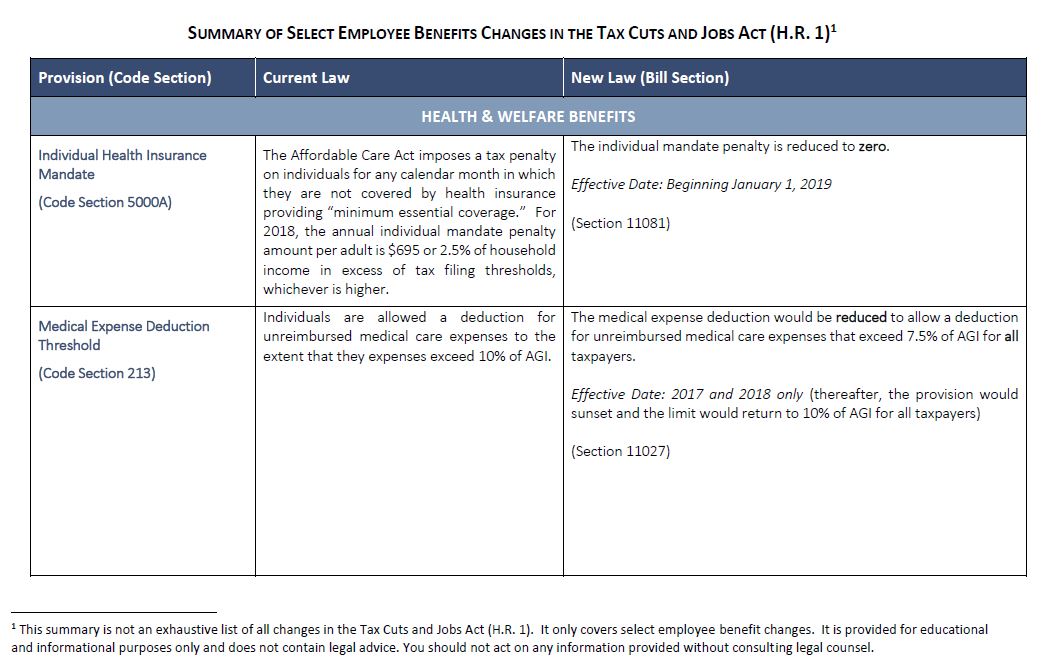
Compared to initial proposals, the final Bill generally does not make significant changes to employee benefits. The chart that follows highlights certain broad-based health and welfare, fringe and retirement plan benefit provisions of the Bill (comparing them to current law). Notable changes include:

  • Repeal of the Individual Mandate penalty beginning in 2019;
  • Elimination/changes of employer deductions for certain fringe benefits, including qualified transportation fringes, moving expenses, and meals/entertainment;
  • New tax credit for employers that pay qualifying employee while on family and medical leave, as described by the Family Medical Leave Act;
  • Extended rollover periods for deemed distributions of retirement plan loans; and
  • Tax relief for retirement plan distributions to relieve 2016 major disasters.

In addition, the Bill makes certain narrowly-tailored changes (which we did not include in the chart that follows) impacting only certain types of employers or compensation. For instance, the Bill:

  • Modifies the $1 million compensation deduction limitation under Code Section 162(m) for publicly traded companies (expanding the type of compensation which will be applied against the limitation, the individuals who will be considered covered employees, and the type of employers that will be subject to the limitation), with transition relief for certain performance-based compensation arrangements pursuant to “written binding contracts” in effect as of November 2, 2017, so long as such arrangements are not “modified in any material respect”; and
  • Creates a new “qualified equity grant” by adding a new Code Section 83(i), which allows employees of non-publicly traded companies to elect to defer taxation of stock options and restricted stock units (“RSUs”) for up to five years after the exercise of such stock options or the vesting of RSUs.

The Bill also has specific provisions impacting employers that are tax-exempt organizations. For instance, it imposes a new excise tax for highly compensated non-profit employees, and changes the way non-profits calculate unrelated business income tax (UBIT).

What’s Not Changing

ACA Employer Mandate & Reporting

While the individual mandate penalty has been reduced to zero beginning in 2019, at this time, the employer mandate and employer reporting requirements under the Affordable Care Act (ACA) remain in effect.

In addition, there were no changes to other ACA taxes and requirements. For example, the bill does not eliminate (or delay) the 40% excise tax on high-cost plans (Cadillac Tax) that is scheduled to be effective beginning in 2020, nor does it eliminate the comparative effectiveness research fees paid annually to fund the Patient-Centered Outcomes Research Institute (PCORI) through 2019. However, the Trump Administration has indicated its intention to renew ACA repeal and replace efforts in 2018, which may result in additional changes at a later date.

It has been recently reported that Republican legislators are targeting a further delay of two ACA-created taxes – a 2.3% excise tax on medical devices, and an annual fee imposed on health insurers known as the HIT tax – for inclusion in a spending bill that must be passed by January 19. Both of these taxes are scheduled to go into effect beginning in 2018 after a delay was incorporated in a 2015 year-end tax extenders deal. Employer groups have been lobbying for an elimination or delay of the Cadillac Tax and relief on the employer mandate. It remains to be seen whether these tax relief items will be included as part of a spending bill later this month.

FSAs, HSAs, Adoption Assistance and Education Assistance Programs

Earlier versions of the Bill in both the House and Senate included provisions that would have significantly impacted the tax treatment of many employee benefits. However, the final Bill makes no changes to the tax treatment of HSAs, dependent care FSAs, health FSAs, adoption assistance programs, or qualified education assistance programs. Although, it has been reported that repealing restrictions on using FSAs, HSAs and other account-based plans to purchase over-the-counter medications could also be considered during negotiation of the spending bill.

Unsubsidized/Pre-Tax Qualified Transportation Fringe Benefits

While the Bill eliminated the employer deduction for qualified transportation fringe benefits, this change would appear to have the most impact on employers who subsidize transit and parking expenses since they may no longer claim a deduction for subsidized transit expenses (but such amounts would still be exempt for payroll tax purposes). For the majority of employers who do not subsidize transit expenses but offer pre-tax qualified transportation fringe programs that allow employees to enter into salary reduction agreements and receive transit expense reimbursements on a tax-free basis, the Bill should not have an impact on those programs. Tax-exempt employers will be taxed on the value of providing qualified transportation fringe benefits (such as payments for mass transit) by treating the funds used to pay for the benefits as UBIT.

For the majority of employers who do not subsidize transit expenses but offer pre-tax qualified transportation fringe programs that allow employees to enter into salary reduction agreements and receive transit expense reimbursements on a tax-free basis, the Bill should not have an impact on those programs. Employees may continue to receive transit expenses (other than bicycle commuting expenses) on a tax-free basis under such programs.

Structural Changes to Qualified Retirement Plans and Deferred Compensation Plans

In addition, there were no major changes to the general structure of qualified retirement plans, such as the “Rothification” of pre-tax deferrals in 401(k) plans, nor reductions in the limits that could be contributed tax-free. Nor were other changes that were initially proposed in the House version of the bill to retirement provisions (e.g., changing the minimum age of in-service distribution in retirement plans, modifying non-discrimination rules for “soft-frozen” defined benefit plans, and changes to 401(k) and 403(b) hardship withdrawal rules) included in the final bill.

Earlier versions of the Bill would have also completely upended how deferred compensation by companies to executives is paid by taxing such compensation when it vested. But this provision did not survive in the final Bill.

Next Steps

Only time will tell the full impact of the Bill on employers and employees. For instance, the repeal of the individual mandate beginning in 2019 may result in fewer “healthy” individuals enrolling in health coverage, resulting in increased premiums. Fewer individuals may enroll in Exchange coverage, reducing potential employer mandate penalty (both “A” and “B”) exposure, which is triggered when a full-time employee receives a premium subsidy for Exchange coverage.

Given the changes to the corporate tax rates, it remains to be seen whether employers will alter how they compensate their employees, particularly, highly compensated employees, and how they will handle their pension, 401(k)/profit sharing plans, and other employee benefits.

In addition, it is likely that there will be a correction bill (and IRS guidance) in 2018 to address unintended consequences, omissions, ambiguities, and drafting errors in the Bill. We will continue to monitor for further legislative and other developments impacting employee benefits as a result of the passage of the Bill.

In the meantime, we suggest that employers work with their payroll departments and vendors, accountants, finance, counsel and other advisors to assess the impact of the Bill to its benefit programs and implement necessary changes to their systems and practices.
About the Authors

This alert was prepared for Benefit Advisors Network by Marathas Barrow Weatherhead Lent LLP, a national law firm with recognized experts on the Affordable Care Act. Contact Peter Marathas, Stacy Barrow or Tzvia Feiertag.

This message is a service to our clients and friends. It is designed only to give general information on the developments actually covered. It is not intended to be a comprehensive summary of recent developments in the law, treat exhaustively the subjects covered, provide legal advice, or render a legal opinion.

Benefit Advisors Network and its smart partners are not attorneys and are not responsible for any legal advice. To fully understand how this or any legal or compliance information affects your unique situation, you should check with a qualified attorney.

Legal Alert: Court Vacates EEOC’s Wellness Program Incentives Rules Effective January 1, 2019

In an opinion dated December 20, 2017, in American Association for Retired Persons (AARP) v. EEOC, the federal court in the District of Columbia vacated, effective January 1, 2019, the portions of the final regulations that the EEOC issued last year under the Americans with Disabilities Act (ADA) and the Genetic Information Nondiscrimination Act (GINA) addressing wellness program incentives.  The current regulations will remain effective for 2018 while the EEOC reconsiders and promulgates new rules.

Background

As background, under the ADA, wellness programs that involve a disability-related inquiry or a medical examination must be “voluntary.”  Similar requirements exist under GINA when there are requests for an employee’s family medical history (typically as part of a health risk assessment).  For years, the EEOC had declined to provide specific guidance on the level of incentive that may be provided under the ADA, and their informal guidance suggested that any incentive could render a program “involuntary.”  In 2016, after years of uncertainty on the issue, the agency released rules on wellness incentives that resemble, but do not mirror, the 30% limit established under U.S. Department of Labor (DOL) regulations applicable to health-contingent employer-sponsored wellness programs.  While the regulations appeared to be a departure from the EEOC’s previous position on incentives, they were welcomed by employers as providing a level of certainty.

However, the AARP sued the EEOC in 2016, alleging that the final regulations were inconsistent with the meaning of “voluntary” as that term was used in ADA and GINA.  AARP asked the court for injunctive relief, which would have prohibited the rule from taking effect in 2017.  The court denied AARP’s request in December 2016, finding that AARP failed to demonstrate that its members would suffer irreparable harm from either the ADA or the GINA rule, and that AARP was unlikely to succeed on the merits.  This was due in part to the fact that the administrative record was not then available for the court’s review.

In August 2017, the court ordered the EEOC to reconsider the limits it placed on wellness program incentives under final regulations under the ADA and GINA.  As part of the final regulations, the EEOC set a limit on incentives under wellness programs equal to 30% of the total cost of self-only coverage under the employer’s group health plan.  The court found that the EEOC did not properly consider whether the 30% limit on incentives would ensure the program remained “voluntary” as required by the ADA and GINA and sent the regulations back to the EEOC for reconsideration.  To avoid “potentially widespread disruption and confusion,” the court decided at that time that the final regulations would remain in place while the EEOC determined how it would proceed. 

In September 2017, the EEOC filed a status report with the court stating that the EEOC did not intend to issue new proposed regulations until August 2018, did not intend to issue final rules until August 2019, and did not expect the new rules to take effect until early 2021.

Current Decision

In its recent decision, the court found that the EEOC’s proposed timetable to reissue new regulations was not timely enough. The court was concerned about the slow timeframe that the EEOC proposed for devising a replacement rule. “If left to its own devices, … EEOC will not have a new rule ready to take effect for over three years—not what the Court envisioned when it assumed that the Commission could address its errors ‘in a timely manner.’”  

The court thought that vacating the rule for a 2018 effective date would be disruptive. But “there is plenty of time for employers to develop their 2019 wellness plans with knowledge that the Rules have been vacated.” In addition, the court reasoned, “[i]t is far from clear that EEOC will view a 30% incentive level as sufficiently voluntary upon reexamination of the evidence presented to it.”

In a separate order (also issued on December 20, 2017), the court ordered the EEOC to provide a status report to the court and to the AARP no later than March 30, 2018. In its opinion, the court said it would “hold EEOC to its intended deadline of August 2018 for the issuance of a notice of proposed rulemaking. But an agency process that will not generate applicable rules until 2021 is unacceptable. Therefore, EEOC is strongly encouraged to move up its deadline for issuing the notice of proposed rulemaking, and to engage in any other measures necessary to ensure that its new rules can be applied well before the current estimate of sometime in 2021.”

Impact on Employers

For 2018, employers may continue to rely on the EEOC’s final regulations.  Wellness programs designed to comply with existing rules, specifically the 30% cap, are unlikely to be challenged by the federal governmental agencies.  However, it is possible the court’s decision may open the door for employees to bring a private lawsuit against an employer challenging under the ADA the “voluntariness” of a wellness program that includes an incentive up to the 30% limit.  One would expect that any employer facing such an action would defend it arguing its good faith reliance on the EEOC’s regulation.       

For 2019 and beyond, employers are again faced with uncertainty as to their wellness program incentives.  Employers designing and maintaining wellness programs should continue to monitor developments, including the issuance of any new wellness program regulations, and work with employee benefits counsel to ensure their wellness programs comply with all applicable laws.  


About the Authors

This alert was prepared for Benefit Advisors Network by Marathas Barrow Weatherhead Lent LLP, a national law firm with recognized experts on the Affordable Care Act.  Contact Peter Marathas or Stacy Barrow at pmarathas@marbarlaw.com or sbarrow@marbarlaw.com.

This message is a service to our clients and friends. It is designed only to give general information on the developments actually covered. It is not intended to be a comprehensive summary of recent developments in the law, treat exhaustively the subjects covered, provide legal advice, or render a legal opinion.

Benefit Advisors Network and its smart partners are not attorneys and are not responsible for any legal advice. To fully understand how this or any legal or compliance information affects your unique situation, you should check with a qualified attorney.

© Copyright 2017 Benefit Advisors Network. Smart Partners. All rights reserved

Legal Alert: IRS Extends Deadline for Furnishing Forms 1095, Extends Good Faith Transition Relief

The Internal Revenue Service (IRS) has released Notice 2018-6, extending the deadline for furnishing Forms 1095-B and 1095-C to individuals from January 31, 2018 to March 2, 2018, as well as penalty relief for good-faith reporting errors.

The due date for filing the forms with the IRS was not extended and remains February 28, 2018 (April 2,2018 if filed electronically).  Despite the repeal of the “individual mandate” beginning in 2019 as part of the Tax Cuts and Jobs Act, at this time, the ACA’s information reporting requirements remain in effect (the IRS will continue to use the reporting to administer the employer mandate and premium tax credit program).

The instructions to Forms 1094-C and 1095-C allow employers to request a 30-day extension to furnish statements to individuals by sending a letter to the IRS with certain information, including the reason for delay.  However, because the Notice’s extension of time to furnish the forms is as generous as the 30-day extension contained in the instructions, the IRS will not formally respond to requests for an extension of time to furnish 2017 Forms 1095-B or 1095-C to individuals.  

Employers may still obtain an automatic 30-day extension for filing with the IRS by filing Form 8809 on or before the forms’ due date.  An additional 30-day extension is available under certain hardship conditions.  The Notice encourages employers who cannot meet the extended due dates to furnish and file as soon as possible, and advises that the IRS will take such furnishing and filing into consideration when determining whether to abate penalties for reasonable cause.  

Extension of Good-Faith Relief

As with calendar year 2015 and 2016 reporting, the IRS will not impose penalties on employers that can show that they made good-faith efforts to comply with the requirements for calendar year 2017. In determining good faith, the IRS will consider whether employers have made reasonable attempts to comply with the requirements (e.g., gathering and transmitting the necessary data to an agent or testing its ability to transmit information) and the steps that have been taken to prepare for next year’s reporting. 

Note that the relief applies only to furnishing and filing incorrect or incomplete information, and not to a failure to timely furnish or file.  However, if an employer is late filing a return, it may be possible to get penalty abatement for failures that are due to reasonable cause and not willful neglect. In general, to establish reasonable cause the employer must demonstrate that it acted in a responsible manner and that the failure was due to significant mitigating factors or events beyond its control.

As in past years, individuals can file their personal income tax return without having to attach the relevant Form 1095.  Taxpayers should keep these forms in their personal records.  Taxpayers should note that for 2017, the IRS will not consider a return complete and accurate if the taxpayer does not report full-year coverage, claim a coverage exemption, or report a shared responsibility payment.

Employers should note that the IRS does not anticipate extending transition relief – either with respect to the due dates or with respect to good faith relief from penalties – to reporting for 2018.


About the Authors 

This alert was prepared for Benefit Advisors Network by Marathas Barrow Weatherhead Lent LLP, a national law firm with recognized experts on the Affordable Care Act.  Contact Peter Marathas or Stacy Barrow at pmarathas@marbarlaw.com or sbarrow@marbarlaw.com.

This message is a service to our clients and friends. It is designed only to give general information on the developments actually covered. It is not intended to be a comprehensive summary of recent developments in the law, treat exhaustively the subjects covered, provide legal advice, or render a legal opinion.

Benefit Advisors Network and its smart partners are not attorneys and are not responsible for any legal advice. To fully understand how this or any legal or compliance information affects your unique situation, you should check with a qualified attorney.

© Copyright 2017 Benefit Advisors Network. Smart Partners. All rights reserved. 

Legal Alert: Massachusetts Releases Proposed Regulations on EMAC Supplement; HIRD Form Returns

On August 1, 2017, Massachusetts Governor Charlie Baker signed H.3822, which increases the existing Employer Medical Assistance Contribution (EMAC) and imposes an additional fee (EMAC Supplement) on employers with employees covered under MassHealth (Medicaid) or who receive subsidized coverage through ConnectorCare (certain plans offered through Massachusetts’ Marketplace).  The increased EMAC and the EMAC Supplement are effective for 2018 and 2019 and are intended to sunset after 2019.

On November 6, 2017, the Massachusetts Department of Unemployment Assistance (DUA) released proposed regulations on the EMAC.  Also on November 6, Governor Baker signed H.4008, which includes a provision that requires Massachusetts employers to submit a health insurance responsibility disclosure (HIRD) form annually.

The increased EMAC and the EMAC supplement are intended to be offset by a reduction in the increase of unemployment insurance rates in 2018 and 2019.  The unemployment insurance relief is estimated to save employers $334 million over the next two years. 

The EMAC itself is relatively new, having been created in 2014 after the repeal of Massachusetts’ “fair share” employer contribution.  The EMAC applies to employers with six or more employees working in Massachusetts and applies regardless of whether the employer offers health coverage to its employees.  Currently, the EMAC is .34% of wages up to $15,000, which caps out at $51 per employee per year.  For 2018 and 2019, it will increase to .51%, or $77 per employee per year.  In 2018, the EMAC and EMAC Supplement are expected to raise $75 million and $125 million in revenue, respectively.

Proposed Regulations on EMAC Supplement

The EMAC Supplement applies to employers with 6 or more employees in Massachusetts.  Under the EMAC Supplement, employers must pay 5% of annual wages up to the annual wage cap of $15,000, or $750 per affected employee per year, for each non-disabled employee who obtains health insurance coverage from MassHealth (excluding the premium assistance program) or ConnectorCare.  

An employer becomes subject to the EMAC Supplement beginning with the first calendar quarter of 2018 in which the employer employs six or more employees.  The number of employees in a calendar quarter is calculated by dividing the total number of employees employed during the quarter by three.  For these purposes, employees are included if they worked or received wages for any part of the pay period that includes the 12th of the month.  

Excluded Employees

Employees must be covered under MassHealth or ConnectorCare for a continuous period of at least fourteen days in the quarter for the EMAC Supplement to apply in that quarter.  The EMAC Supplement will not apply to any employee who has MassHealth coverage as a secondary payer because such employees are enrolled in employer-sponsored insurance.  

Under ConnectorCare rules, only individuals with household incomes that do not exceed 300% of the Federal Poverty Level (FPL) may qualify for ConnectorCare.  Therefore, employees with income between 300% – 400% FPL may be able to obtain tax credits for subsidized coverage through the Massachusetts Health Connector; however, they will not be eligible for ConnectorCare and thus cannot trigger an EMAC Supplement.  In addition, employees are not eligible for ConnectorCare if they are eligible to enroll in an employer’s affordable, comprehensive health insurance plan.

EMAC Supplement Payments 

Any required EMAC Supplement payment owed will be added to an employer’s Unemployment Insurance (UI) liability statement (but is not taken into account for purposes of determining the employer’s Massachusetts UI contribution rate).  After the EMAC Supplement has been calculated, the DUA will make information available online so employers can determine if the DUA’s calculation of their EMAC Supplement payment matches their records.  However, EMAC Supplement payments are not considered UI contributions for purposes of receiving credit under the Federal Unemployment Insurance Contribution Act (FUTA).  Nor are they reported on the Form 940 worksheet as UI contributions for Massachusetts.

Employers will see the increased EMAC and any EMAC Supplement payments on their first quarter statements in April 2018.  EMAC Supplement payments are due quarterly, by the last day of the month following the end of the applicable quarter.  

Successor employers involved in a change in ownership, including without limitation, changes occurring due to acquisition, consolidation, partial transfer, or whole successorship, during a calendar quarter, are liable for the EMAC Supplement payment for any applicable employee during that quarter and is not allowed credit for any EMAC Supplement paid by the predecessor employer.

Appeal Process

If an employer disagrees with the DUA’s determination that the employer is liable for the EMAC Supplement, it may request a hearing with the DUA if it files a request within ten days after receiving notice of the determination.  After the hearing, the DUA will issue a written decision affirming, modifying, or revoking the initial determination.  Further appeal to Superior Court is available.  

As part of the appeal process, the DUA may provide an employer with access to information pertaining to MassHealth and ConnectorCare beneficiaries, which is required to be kept confidential by the employer.

Interest and Penalties

Interest and penalties will apply to any EMAC Supplement obligation not remitted to the DUA and will be charged in the same fashion as for delinquent UI contributions.

Additional penalties, including fines and imprisonment, could apply to any employer who:

  1. Willfully attempts to evade or defeat any contribution, interest, or penalty payment; 
  2. Knowingly makes any false statement or misrepresentation to avoid or reduce any financial liabilities;
  3. Knowingly fails or refuses to pay any such contribution, interest charge, or penalty; or
  4. Attempts to coerce any employee to misrepresent his or her circumstances so that the employer may evade payment of an EMAC Supplement.

Unemployment Experience Rate Schedule Changes

To offset the EMAC increase and EMAC Supplement, Massachusetts has modified the unemployment insurance schedule, effectively reducing scheduled increases to employer contributions for 2018 and 2019.  The previously scheduled automatic jump from Schedule C to Schedule F will be replaced with an increase to Schedule D for 2018 and Schedule E for 2019.  

Non-profit organizations that choose to self-insure their unemployment benefits will not benefit from the reduction in scheduled premium increases but remain subject to the EMAC Supplement nonetheless. 

Employer HIRD Form

The new HIRD requirement differs from the prior version that was repealed in 2013, under which employers collected forms from employees who waived coverage.  The new HIRD form requires employers with 6 or more employees in Massachusetts to annually complete and submit a form indicating whether the employer has offered to pay or arrange for the purchase of health insurance and information about that insurance, such as the premium cost, benefits offered, cost sharing details, eligibility criteria and other information deemed necessary by the DUA.  The law directs the DUA to create a form for this purpose.  Employers that knowingly falsify or fail to file the form may be subject to a penalty of $1,000 – $5,000 for each violation.  It’s likely that employers will first file the form toward the end of 2018 (or perhaps after the end of the year); more guidance on the form and when/how to file will be forthcoming.

Next Steps

Based on the proposed regulations, employers have several avenues for reducing exposure to an EMAC Supplement payment. In general, employees earning in excess of 138% of the FPL ($16,642 for an individual in 2017) are not eligible for MassHealth, and those earning over 300% of the FPL ($36,180 for an individual in 2017) are not eligible for ConnectorCare.  Employees eligible for affordable, comprehensive health insurance from their employer also are not eligible for ConnectorCare, and employees who receive MassHealth premium assistance toward their employer’s group health plan do not trigger an EMAC Supplement. 

Now that proposed regulations have been released, employers can better assess their exposure to an EMAC Supplement and begin to budget for it or make other eligibility or contribution changes.


About the Authors

This alert was prepared for Benefit Advisors Network by Marathas Barrow Weatherhead Lent LLP, a national law firm with recognized experts on the Affordable Care Act.  Contact Peter Marathas or Stacy Barrow at pmarathas@marbarlaw.com or sbarrow@marbarlaw.com.

This alert was prepared by Stacy Barrow. Mr. Barrow is a nationally recognized expert on the Affordable Care Act and BAN’s Compliance Director. His firm, Marathas Barrow Weatherhead Lent LLP, is a premier employee benefits, executive compensation and employment law firm. He can be reached at sbarrow@marbarlaw.com.

This message is a service to our clients and friends. It is designed only to give general information on the developments actually covered. It is not intended to be a comprehensive summary of recent developments in the law, treat exhaustively the subjects covered, provide legal advice, or render a legal opinion.

Benefit Advisors Network and its smart partners are not attorneys and are not responsible for any legal advice. To fully understand how this or any legal or compliance information affects your unique situation, you should check with a qualified attorney.

© Copyright 2017 Benefit Advisors Network. Smart Partners. All rights reserved. 

UPDATED Legal Alert: IRS Updates Employer Mandate FAQs: Indicates that Penalty Letters are Imminent

This is an update of our November 7, 2017 Alert to include issuance of Form Letter 226J.

The Internal Revenue Service (IRS) has updated its list of frequently asked questions (FAQs) on the Affordable Care Act’s employer shared responsibility provisions – also known as the “pay or play” mandate.  In particular, questions 55 through 58 provide guidance for employers who may be subject to shared responsibility payments.  The FAQs indicate that the IRS will begin sending penalty letters to applicable large employers (ALEs) that owe penalties for the calendar year 2015 “in late 2017.”  Around this time last year, the IRS had indicated that penalty letters for 2015 would be coming “in early 2017;” however, those letters never materialized.  Based on the latest update to its FAQs, it appears that the IRS has worked out the kinks in its systems and is prepared to begin sending penalty letters. 

The general procedures the IRS will use to propose and assess the employer shared responsibility payment are described in Letter 226J, which is the initial proposal of the penalty that may be owed. The IRS recently published Understanding your Letter 226J for ALEs to understand what they need to do and what they may want to do if they receive Letter 226J.

Background

Starting in 2015, the ACA requires ALEs to either “play” by offering affordable health coverage to their full-time employees, or “pay” a penalty if the employer fails to provide affordable health coverage and at least one full-time employee receives a premium tax credit to help purchase coverage through the Health Insurance Marketplace. ALEs are generally those with 50 or more full-time employees, including full-time equivalent employees.  Transitional relief was available for 2015 (and, for non-calendar year plans, any portion of the 2015 plan year that fell in 2016) for ALEs with fewer than 100 full-time employees that satisfied the conditions of such transitional relief.

In general, there are two potential penalties (both non-deductible for tax purposes) that could be imposed on an ALE for failure to satisfy the mandate.  The first penalty, known as the “no coverage” penalty, is based on whether an ALE fails to offer group health plan coverage to at least 95% (70% during 2015 plus, for non-calendar year plans, any calendar months of 2016 that fell within the 2015 plan year) of its full-time employees. In this case, the annual penalty is $2,000 per full-time employee minus 30 (minus 80 for 2015, plus any calendar months of 2016 that fell within the 2015 plan year) full-time employees if at least one employee receives a premium tax credit for Marketplace coverage. The second penalty, known as the “unaffordability” penalty, applies when an employer offers coverage that fails to meet certain affordability and minimum value requirements. In that case, the annual penalty is $3,000 for each full-time employee who receives a premium tax credit for Marketplace coverage, but no more than what the “no coverage” penalty would be if it applied.  As noted above, several types of transition relief applied for 2015 (for non-calendar-year plans, some aspects of the relief continued for months of the 2015 plan year that fell in the 2016 calendar year).  This transition relief delayed application of the penalties for certain ALE members and reduced the penalty amount for others. This transition relief has now expired.

The annual penalties are prorated on a monthly basis and are indexed each year for inflation, as shown in the following table:

The IRS’ Penalty Process

The FAQs indicate that the IRS will use Letter 226J to propose and assess penalties.  Letter 226J will be issued if the IRS determines that, for at least one month in the year, at least one of the ALE’s full-time employees was enrolled in subsidized coverage through the Marketplace and the ALE did not qualify for an affordability safe harbor (or other relief for the employee).  The letter will include, among other things, the following: 

  • a brief explanation of the pay-or-play provisions;
  • a table itemizing the proposed penalty by month and whether the liability is under the “no coverage” provision, the “unaffordability” provision or neither;
  • an employer shared responsibility response form (Form 14764 – ESRP Response);
  • a list of full-time employees who received subsidized Marketplace coverage each month (Form 14765 – Employee Premium Tax Credit List) and for whom the ALE did not qualify for an affordability safe harbor or other relief;
  • a description of the actions the ALE should take if it agrees or disagrees with the proposed payment amount in Letter 226J; and
  • a description of the actions the IRS will take if the ALE does not respond timely.

The response to Letter 226J will be due by the response date shown on that letter, which generally will be 30 days from the date of Letter 226J.  The letter will contain the name and contact information of a specific IRS employee that the ALE should contact if it has questions about the letter.  At this time, a copy of Letter 226J is not available on the IRS website.

A copy of Letter 226J can be found here: https://www.irs.gov/pub/notices/ltr226j.pdf.

Employer Response

ALEs will have an opportunity to contest any proposed penalty notices.  ALEs that receive a Letter 226J may respond to the IRS about the proposed payment, including requesting a pre-assessment conference with the IRS Office of Appeals.  The letter will provide instructions for how the ALE should respond in writing, either agreeing with the proposed penalty amount or disagreeing with all or a portion of it.  ALEs may allow someone to contact the IRS on their behalf so long as they send the IRS a Form 2848 (Power of Attorney and Declaration of Representative) that states specifically the year and that it is for the Section 4980H Shared Responsibility Payment.

If an ALE agrees with the penalty determination, it must complete and return a Form 14764, ESRP Response, that is enclosed with the letter, and include full payment by check or money order for the penalty amount assessed (or, if enrolled in the Electronic Federal Tax Payment System (EFTPS), pay electronically).

If an ALE disagrees with the penalty determination, the enclosed Form 14764, ESRP Response, will also include a Form 14764 to send to the IRS and it will need to include a signed statement explaining the basis for the disagreement.  The ALE may include any documentation (e.g., offer of coverage records) with the supporting statement.  The statement must also include what changes the ALE would like to make to the Forms 1094-C and/or 1095-C on the enclosed “Employee PTC Listing.” However, the instructions state that an ALE should not file a corrected Form 1094-C or 1095-C.  The Letter 226J includes additional, specific instructions on making changes to the Employee PTC Listing.

If the ALE responds to Letter 226J, the IRS will acknowledge the ALE’s response with one of five versions of Letter 227 (which, in general, acknowledge the ALE’s response and describe further actions the ALE may need to take).  If, after receipt of Letter 227, the ALE disagrees with the proposed or revised employer shared responsibility payment amount, it may request a pre-assessment conference with the IRS Office of Appeals.  The ALE should follow the instructions provided in Letter 227 and Publication 5 for requesting a conference with the IRS Office of Appeals.  A conference should be requested in writing by the response date shown on Letter 227, which generally will be 30 days from the date of Letter 227.

If the ALE does not respond to either Letter 226J or Letter 227, the IRS will assess the amount of the proposed penalty and issue a notice and demand for payment (Notice CP 220J).  Notice CP 220J will include a summary of the ALE’s payment responsibility and will reflect payments made, credits applied, and the balance due, if any.  The notice will instruct the ALE how to make payment, if any.  ALEs will not be required to include the employer shared responsibility payment on any tax return that they file or to make payment before notice and demand for payment.  ALEs may have the ability to make installment payments, as described in Publication 594.  

Next Steps

There were numerous legislative efforts by the Trump administration earlier this year to repeal and replace the ACA, including retroactively eliminating the individual and employer shared responsibility mandates.  Recently, there have been discussions that Republicans may again try to repeal those mandates as part of their tax reform bill.  However, to date, no such repeal bills have passed, and the most recent proposed tax reform bill does not include a repeal of the mandates. In the absence of a repeal, employers should be prepared to respond to any IRS penalty letters and continue to prepare for 2017 reporting (in 2018).

The IRS will be determining penalty responsibility based on an employer’s ACA reporting (Forms 1094-C and 1095-C), along with information regarding an individual’s receipt of a premium tax credit.  ALEs who have been offering affordable, minimum value coverage to full-time employees should ensure that they have all information necessary to appeal any proposed penalty assessments, including payroll records and documentation regarding how offers of coverage are made.  While the IRS FAQs indicate that the IRS plans to issue Letter 226J for the 2015 calendar year (which generally applied to ALEs with 100 or more full-time employees), it is a good time for ALEs in later years to start reviewing and gathering information that they may need to respond to Letter 226J as well.

Employers that receive Letter 226J should review it carefully and consider whether there is a basis to pursue an appeal, including whether the employee was full-time for ACA purposes in each month for which a penalty is assessed.  For example, employers may need to demonstrate to the IRS that they were using permissible measurement and stability periods and that the employee in question qualified as a “variable hour employee,” if the employer is claiming that an employee who worked 130 hours in a particular month was not full-time for ACA purposes. Employers who receive Letter 226J should be mindful of the response deadline, which will generally be 30 days from the issuance date appearing on the letter, and should consider taking steps now (such as working with human resources, legal, benefits, payroll, and finance departments as well as outside vendors housing your ACA data) to set up a process to ensure timely review and response to any Letter 226J.  Depending on mailing delays and internal routing, an employer may have a very short timeframe before the due date to respond, so advanced planning is critical.

Employers that receive subsidy notification letters from the Marketplace during the year should consider appealing them when there is a basis to do so.  In many cases, employers receive Marketplace subsidy letters for individuals who are not full-time for ACA purposes, and thus there is no basis for an appeal.  In other words, an employer would not appeal a premium subsidy notice for a part-time employee to whom the employer did not offer coverage (that person would be a prime candidate for subsidized coverage).

Employers should also be reminded that the ACA Section 1558 prohibits retaliation against employees who receive premium tax credits.  Among other things, employers are prohibited from discharging or discriminating against an employee because the employee received a premium tax credit.  Employers violating Section 1558 may be required to reinstate the employee to his or her former position (and provide back pay) and may be subject to compensatory damages, costs and expenses (including attorneys’ fees) incurred by the employee in connection with the bringing of a complaint.

Employers that have questions regarding Letter 226J or IRS response letters should consult with qualified benefits counsel so that the relevant facts and circumstances can be reviewed.


About the Authors

  This alert was prepared for Benefit Advisors Network by Marathas Barrow Weatherhead Lent LLP, a national law firm with recognized experts on the Affordable Care Act.  Contact Peter Marathas or Stacy Barrow at pmarathas@marbarlaw.com or sbarrow@marbarlaw.com.

Stacy Barrow, Esq. Compliance Director

This alert was prepared by Stacy Barrow. Mr. Barrow is a nationally recognized expert on the Affordable Care Act and BAN’s Compliance Director. His firm, Marathas Barrow Weatherhead Lent LLP, is a premier employee benefits, executive compensation and employment law firm. He can be reached at sbarrow@marbarlaw.com.

This message is a service to our clients and friends. It is designed only to give general information on the developments actually covered. It is not intended to be a comprehensive summary of recent developments in the law, treat exhaustively the subjects covered, provide legal advice, or render a legal opinion.

Benefit Advisors Network and its smart partners are not attorneys and are not responsible for any legal advice. To fully understand how this or any legal or compliance information affects your unique situation, you should check with a qualified attorney.

© Copyright 2017 Benefit Advisors Network. Smart Partners. All rights reserved.