BAN Blog

A Cautionary Tale: Self-Funded Plan Administrators Must Meaningfully and Effectively Communicate With Plan Participants and Their Providers on Appeal

Sponsors of self-funded ERISA plans have fiduciary obligations to plan participants, which includes the obligation to provide a full and fair review of claims and effectively and meaningfully communicate or engage with plan participants regarding claims denials. One district court recently clarified that this obligation may include the need for the plan administrator, which is usually the plan sponsor, to engage in a dialogue with health care providers who are providing health care services to plan participants when there is a dispute over denied claims.

In K.D. v. Anthem Blue Cross and Blue Shield, Group Health Plan of United Technologies Corporation, the plaintiff sued the plan administrator and Blue Cross and Blue Shield, the group health plan’s third party administrator (“TPA”), in the United States District Court for the District of Utah due to the plan’s denial of continued inpatient mental health treatment and transitional care for alleged lack of medical necessity. Plaintiff further alleged a violation of the Mental Health Parity and Addiction Act of 2008 (“MHPAEA”). This alert will focus on the ERISA claims review and appeals process and not the MHPAEA claims in the lawsuit.

As described in the District Court opinion, the terms of the plan sponsor’s medical plan generally required a medical necessity determination for continued inpatient/residential mental health treatment for plan participants, and provided that medically necessary services are those that are necessary for the participant and that are “rendered in the least intensive setting that is appropriate for the delivery of health care.” Once residential treatment is determined to be medically necessary, then there is a predetermined length of stay, and such benefits are then subject to concurrent review which may result in approval for additional care above and beyond those originally approved by the plan.

The District Court Magistrate reviewed the TPA’s own internal clinical guidelines and policies and procedures, which provide that mental health residential treatment is appropriate when the patient’s behavioral health condition is such that the patient demonstrates they are a danger to themselves or others, or it “causes a serious dysfunction in daily living.” If such conditions are present, then the guidelines provide that continued residential care should be approved if the condition is likely to deteriorate without continued treatment at the same level of care or if continued care at the current level is necessary. The clinical guidelines also provide that treatment should be available when “necessary, appropriate, and not feasible at a lower level of care.” If a claim is denied, then there are two levels of appeal that the plan participant must undergo before filing a lawsuit.

As set forth in the District Court’s opinion, the plan participant had a history of mental illness and the TPA initially determined that residential treatment was medically necessary. The participant underwent residential treatment in a program that could last from 9 – 12 months, though not all of it was intended to be residential, as the participant would step down from residential into transitional living. Ultimately, the participant’s discharge from treatment was contingent upon, and determined by, their progress on goals, participation, and clinical recommendations. The participant was initially approved for seven (7) days of residential treatment and then an additional nine (9) days. At that time, the TPA requested additional information from the provider via a peer-to-peer discussion, which the provider did not attend. Thus, the TPA independently reviewed the medical information and denied the claim for additional residential treatment based on a lack of medical necessity. Transitional living treatment claims were also denied for failing to obtain precertification.

After appealing the determinations, the participant sued for violation of ERISA and the MHPAEA. In asserting their claim for ERISA violations, the plaintiff alleged that the plan’s denial of their claims was arbitrary. The defendants alleged that while they were obligated to consider the letters and other records submitted as part of the claims appeal process, there was no obligation to “affirmatively respond” to them. The District Court magistrate disagreed and applied other, contrary caselaw that requires a plan administrator to “engage with and address” the opinions of the treating providers. As such, the District Court found that the TPA or plan administrator should have provided an explanation for rejecting health care provider opinions. As an example, the court suggested the claims administrator (the TPA) should have addressed why they did not find the treating providers’ opinions to be persuasive and provided factual support. The court reasoned that the plan and TPA had a fiduciary duty to plan beneficiaries to communicate the bases for their decisions, which includes addressing the provider opinions and communicate “effectively and meaningfully” with participants regarding the factual bases for denying coverage.

Ultimately the case was remanded back to the plan administrator for a new determination and the plaintiffs could seek recovery of their attorneys’ fees.

This case serves as a cautionary tale for plan sponsors to ensure they, or their claims administrators, are actively engaging with plan participants and/or their providers and meaningfully responding to their concerns when claims are denied. While it is unclear whether the participant will ultimately be entitled to the benefits sought under the plan, addressing why the claims administrator denied the claims and providing factual support for their rationale could have saved the claims administrator and/or plan administrator costs and legal fees.


About the Author. This alert was prepared for [Agency Name] by Barrow Weatherhead Lent LLP, a national law firm with recognized experts on the Affordable Care Act. Contact Stacy Barrow or Nicole Quinn-Gato at sbarrow@marbarlaw.com or nquinngato@marbarlaw.com.

The information provided in this alert is not, is not intended to be, and shall not be construed to be, either the provision of legal advice or an offer to provide legal services, nor does it necessarily reflect the opinions of the agency, our lawyers, or our clients. This is not legal advice. No client-lawyer relationship between you and our lawyers is or may be created by your use of this information. Rather, the content is intended as a general overview of the subject matter covered. This agency and Barrow Weatherhead Lent LLP are not obligated to provide updates on the information presented herein. Those reading this alert are encouraged to seek direct counsel on legal questions.

© 2024 Barrow Weatherhead Lent LLP. All Rights Reserved.

Meet the Member: Jeff LeClaire

As Senior Vice President of The Insurance Center in Onalaska, WI, Jeff directs his team forward to achieve the agency’s purpose of fighting for the highest possible good of their clients, co-workers, and community. He focuses on the overall operations and business development for the life, health, and commercial benefits side of the business.

What is your background and how did you get into this line of work?
During college, I worked the summers for a local agency selling Medicare and final expense. After graduation, I ended up starting a new office for an agency in Colorado and worked the entire state, mainly focusing on life insurance and Medicare. I then moved back to Wisconsin and started my own agency for several years before being recruited by Federated Insurance. Worked for Federated for eight years as a sales leader in Minneapolis and Indianapolis before moving back to my hometown and partnering with The Insurance Center, Inc. (TIC) and headed up their L&H operation. Now I am a 25% partner and lead business development for the organization.

What are your leadership principles?
Serve others over all else. If you lead with the mind of being a servant, others will follow. Fight for the highest possible good of those you serve and you will build trust and influence. “Belongships Values” include: Be Ethical, Be Authentic, Be Intentional, Be Empowered, and Be Dynamic.

Why are you passionate about BAN? What value has it brought you/your business?
Collaboration with high-quality people is powerful. The main value it has brought our business is the “phone-a-friend” mentality. We don’t know everything but the answer is usually there. BAN helps with this as great members have great ideas and are able to execute them successfully.

With ongoing inflation, higher interest rates, and a shaky economy, are you worried about the economy? If so, are you taking steps to prepare for a recession?
Yes, this is a concern. In benefits and workers comp especially, revenue is driven by employment. If layoffs happen, our revenue goes down. We are strengthening our position by being debt free as much as possible and looking for ways to grow organically.

Where do you see the industry headed for the balance of 2023 and in 2024?
I see a continued focus on proactive services, risk management, and other value-added solutions being the focus of driving growth and retention. I see continued rate pressure in benefits driving more to consider alternative ways to benefit employees and creating disruption in the industry. And, a strong move toward self-funding for smaller to mid-sized organizations.

What are the industry’s biggest challenges?
Being stuck in the old way of business. We need a hyper-focus on what the agency of the future will look like and how we can harness AI and other tech to achieve efficiencies. I also see Payroll/HR players continuing to come into the benefits space to achieve a one-stop shop mentality.

For the younger generation, what are one or two lessons you’ve learned that you can share with them?
I can think of a million cliches like “it’s a marathon, not a sprint” but I think one thing that is of utmost importance is to continue to focus on overall health. Focus on your mental and spiritual health as much as your physical and financial health and good things will happen. Also, swim against the norm. Think outside the box and disrupt in any way possible!

Follow Jeff on LinkedIn | Download vCard | Learn More About The Insurance Center

_____________________

The Crucial Role of Comparative Analyses Under the Mental Health Parity Proposed Rule and Technical Guidance

On July 25, 2023, the agencies released an extensive proposed rule related to the Mental Health Parity and Addiction Equity Act (the “Proposed Rule”) as well as a Technical Release requesting comments on certain proposed data requirements for nonquantitative treatment limitations (“NQTLs”) and the potential for an enforcement safe harbor if certain data requirements are met. The Proposed Rule clarifies and solidifies requirements for group health plans and health insurance issuers (“plans and issuers”) to perform comparative analyses of the NQTLs imposed under their plans. To do this, plans and issuers must collect and evaluate data to reasonably assess the impact of NQTLs on access to mental health and substance use disorder (“MH/SUD”) benefits and medical/surgical (“Med/Surg”) benefits and demonstrate compliance with the MHPAEA as written and in operation. The Proposed Rule focuses on the following, which will directly impact plan design and analyses of those designs:

  • Applying the “substantially all” standard to NQTLs
  • Revising comparative analysis requirements
  • Enhancing definitions to better assist plans
  • Solidifying compliance deadlines

Applying the “substantially all” standard to NQTLS

The first significant change under the Proposed Rule is the application of the “substantially all” standard to NQTLS. Previously, this standard applied only to quantitative treatment limitations (QTLs). Specifically, group health plans that provide both Med/Surg and MH/SUD benefits may not apply any treatment limitation to MH/SUD benefits in any classification that is more restrictive (as written or in operation) than the predominant treatment limitation that applies to substantially all Med/Surg benefits in the same classification. The standard or test is determined separately for each type of treatment limitation.  As a reminder, the six permitted classifications under the MHPAEA are: (1) inpatient, in-network; (2) inpatient, out-of-network; (3) outpatient, in-network; (4) outpatient, out-of-network; (5) emergency care; and (6) prescription drugs. Additionally, there is a special rule for outpatient sub-classifications. For purposes of determining parity for outpatient benefits (in-network and out-of-network), a plan or issuer may divide its benefits furnished on an outpatient basis into two sub-classifications: (1) office visits; and (2) all other outpatient items and services. Accordingly, separate sub-classifications for generalists and specialists are not permitted.

Thus, any NQTL that imposes conditions, terms, or requirements that limit access to benefits under the terms of the plan or coverage is considered restrictive, and an NQTL that applies to MH/SUD benefits can be no more restrictive than those that apply to Med/Surg benefits. The Proposed Rule provides an illustrative, non-exhaustive list of NQTLs, which includes medical management standards such as medical necessity or prior authorization, formulary design for prescription drugs (including multi-tier networks), network composition and standards, preferred provider networks, methodology for determining out-of-network rates, fail first or step-therapy requirements, and geographic location or provider type restrictions.

Moreover, an NQTL is considered to apply to substantially all Med/Surg benefits in a classification of benefits if it applies to at least two-thirds of all Med/Surg benefits in that classification (determined without regard to whether the nonquantitative treatment limitation was triggered based on a particular factor or evidentiary standard).  If the NQTL does not apply to at least two-thirds of all Med/Surg benefits in a classification, then that type of NQTL cannot be applied to MH/SUD benefits in that classification. 

When MH/SUD benefits are offered in any classification of benefits for that MH/SUD condition must be provided in every classification in which Med/Surg benefits are provided.  Such benefits must be meaningful benefits for treatment of the condition or disorder in each such classification, as determined in comparison to the benefits provided for Med/Surg conditions in the classification.  If the plan provides benefits in a classification and imposes any separate financial requirement or treatment limitation (or separate level of a financial requirement or treatment limitation) for benefits in the classification, then the rules apply separately with respect to the classification for all treatment limitations (or financial requirements).

Revising Comparative Analyses Requirements

The devil is in the details, and the Proposed Rule enhances the content requirements for the comparative analyses required under the CAA, 2021 and existing DOL guidance.  Comparative analyses must include a high level of detail to demonstrate a plan’s compliance with the MHPAEA (as written and in operation).  Some exceptions apply to independent professional medical or clinical standards and standards to prevent and prove fraud, waste, and abuse.

Generally, plans are required to:

  • describe NQTLs applicable to MH/SUD and Med/Surg benefits with regard to the benefits in each classification;
  • identify the factors used and evidentiary standards relied upon to design the NQTLs (including the source from which each evidentiary standard is derived);
  • describe how the factors are used in the design and application of the NQTL;
  • demonstrate comparability and stringency as written and in operation; and
  • address the findings and conclusions as to the comparability of the processes, strategies, evidentiary standards, and other factors used in designing and applying the NQTL to MH/SUD benefits and Med/Surg benefits within each classification, and the relative stringency of their application, both as written and in operation.

The Proposed Rule expands upon each of the above categories to describe the information the DOL expects to see demonstrated in the comparative analyses. Further, the Proposed Rule requires the use of outcomes data when NQTLs are designed so that plans can establish that relevant data was used in a manner reasonably designed to assess the impact of any NQTL on access to MH/SUD benefits and Med/Surg benefits and to determine whether the plan complies in operation. This includes analyses of claims denials, in-network and out-of-network utilization rates (including provider claim submissions), network adequacy (time and distance data, information on providers accepting new patients), and provider reimbursement rates relevant to any NQTLs. As the Proposed Rule suggests, any material difference in this data for Med/Surg and MH/SUD benefits would be a strong indicator of noncompliance and, therefore, plans would be required to both take reasonable action to address the material differences in access and document any such action that has been taken to mitigate these material differences in access to MH/SUD benefits.

Accordingly, the comparative analyses must:

  • Identify the relevant data collected and evaluated;
  • Evaluate the outcomes that resulted from the application of the NQTL to MH/SUD benefits and Med/Surg benefits, including the relevant data set forth in the Proposed Rule
  • Provide a detailed explanation of material differences in those outcomes that are not attributable to differences in the comparability or relative stringency of the NQTL as applied to MH/SUD benefits and Med/Surg benefits and the bases for such a conclusion; and
  • Discuss any measures that have been or are being implemented by the plan or issuer to mitigate any material differences in access to MH/SUD benefits as compared to Med/Surg benefits, including the actions the plan or issuer is taking to address material differences in access to ensure compliance with MHPAEA.

The Technical Release addresses the requirements for completing comparative analyses but seeks feedback on, among other things, the required data elements, the difficulty in providing data elements, information technology needed to collect the data elements (including cost), and whether plans have access to these data elements.  Moreover, the Technical Release addresses the potential for an enforcement safe harbor if specific standards and data elements are met or exceeded by plans.

Enhancing Definitions to Better Assist Plans

To better facilitate complete, clear comparative analyses and compliance generally, the Proposed Rule aims to define terms previously not defined under the law and regulations.  Specifically, Proposed Rule newly defines certain terms to help guide plans and carriers to ensure parity in aggregate lifetime and annual dollar limits, financial requirements, and quantitative and nonquantitative treatment limitations between mental health and substance use disorder benefits and medical/surgical benefits.  This includes definitions for “DSM”, “ICD”, “evidentiary standards,” “processes”, “strategies, and “factors” and modifies the definitions of other terms for clarity, including “mental health,” “medical/surgical benefits”, treatment limitations, and “substance use disorder benefits.”

Solidifying Compliance Deadlines

The Proposed Rule solidifies the compliance deadlines for providing the comparative analyses to the DOL upon request.  Specifically, they must be provided:

  • Within 10 business days of receipt of a request (unless an additional period of time is specified by the DOL)
  • If additional information is required after the comparative analyses are deemed insufficient, then the DOL will specify additional information that must be submitted, and it must be submitted so within 10 business days (unless an additional period of time is specified by the DOL)
  • If the plan is determined to be out of compliance, the plan must respond to the DOL and specify the actions the plan will take to bring the plan into compliance and provide additional comparative analyses meeting the requirements within 45 calendar days after initial determination of noncompliance.
  • If the DOL makes a final determination of noncompliance, within 7 calendar days of the receipt of the final determination, the plan must notify all participants and beneficiaries enrolled in the plan or coverage that the plan has been determined to be out of compliance with the MHPAEA.  The plan must also provide the DOL, and any service provider involved in the claims process, with a copy of the notice provided to participants.  Content requirements for the notice are included in the Proposed Rule.

The Proposed Rule specifies that copies of the comparative analyses may be requested (and must be provided to) participants and beneficiaries (or their provider or authorized representatives) who have received an adverse benefit determination related to MH/SUD benefits and any state authorities. 

Conclusion

Once finalized, these requirements will apply to plan years beginning on or after January 1, 2025. Until then, the proposed rules require plans to continue to comply with existing MHPAEA laws and regulations, including completing their comparative analyses.

At this point, it is not a question of “if” the agencies will finalize the Proposed Rule, it is “when” it will be finalized.  While the Proposed Rule and Technical Guidance go a long way to advise plans, third party administrators (TPAs) and pharmacy benefit managers (PBMs) of the goals of the agency, the Proposed Rules is unlikely to resolve many of the frustrations self-funded plan sponsors have dealt with since 2021 in either obtaining draft comparative analyses from their TPAs or PBMs or ensuring the comparative analyses meet the DOL’s expectations.

TPAs and PBMs hold virtually all of the information necessary to complete the analyses, but much of the details are kept as closely guarded secrets until the DOL requests the information.  Accordingly, self-funded plan sponsors must be more assertive with their TPAs and PBMs to ensure (1) the analyses are completed, (2) the analyses are made available as required, and (3) that the analyses include all of the required detail, data, and elements in the CAA, 2021 and the Proposed Rule.  One way to do this is by negotiating the plan’s ability to access or request all necessary data and documentation from the TPA or PBM during the contract negotiation process.  Finally, as we wait release of the MHPAEA final rule plans are encouraged to ensure current MHPAEA comparative analyses are updated to meet the Proposed Rule requirements (even before it’s finalized) as it brings the plan one step closer to meeting the expectations of the DOL

_____________________________________

About the Author. This alert was prepared by Barrow Weatherhead Lent LLP, a national law firm with recognized experts on the Affordable Care Act. Contact Stacy Barrow or Nicole Quinn-Gato at sbarrow@marbarlaw.com or nquinngato@marbarlaw.com.
The information provided in this alert is not, is not intended to be, and shall not be construed to be, either the provision of legal advice or an offer to provide legal services, nor does it necessarily reflect the opinions of the agency, our lawyers, or our clients. This is not legal advice. No client-lawyer relationship between you and our lawyers is or may be created by your use of this information. Rather, the content is intended as a general overview of the subject matter covered. This agency and Barrow Weatherhead Lent LLP are not obligated to provide updates on the information presented herein. Those reading this alert are encouraged to seek direct counsel on legal questions. © 2023 Barrow Weatherhead Lent LLP. All Rights Reserved.

Member Spotlight: Jason Swindle

As CEO of TIG Advisors in Missouri, Jason is focused on positioning TIG to accomplish our mission to help our clients manage risk and achieve greater success. He is primarily focused on the agency’s strategic leadership and growth, creating a positive impact culture, and expanding our product lines and service offerings.

Status quo health plans have handcuffed employers. Jason passionately helps them chart a new path toward savings, sustainability, and success by engaging transparent partners, ensuring protection through contractual risk management, leveraging actionable health intelligence, and implementing relevant cost-containment solutions. Jason helps employers balance their employee needs with their bottom line by crafting, deploying, and optimizing benefits programs—utilizing the Health Rosetta principles as a guide.

What is your background, and how did you get in the EB business?
I made the leap to EB (from pharmaceutical industry) in 2001. Like most everyone, I never planned to get into this business, but it found me. Or rather, I met my wife and married into our agency. I was (and still am) attracted to the entrepreneurial element of our business, and the never-ending opportunity to solve complex problems for clients.

What are your leadership principles?
Leadership vs Management: Leadership is doing the RIGHT thing and management is doing things right.
My eagle scout days taught me to be prepared–to have a plan. I like to think that my leadership is reflected in our TIG values (Make It Better, Care Deeply, Deliver Meaningful Solutions).

What are you looking forward to achieving as a BAN member?
Collaboration with brightest minds. Sharing of best practices. Building out our laser light show for larger cases (via the resources/solutions BAN has vetted).

How are you advising your clients regarding ongoing inflation, higher interest rates and a shaky economy? Are you concerned about a recession?
We are clients to have a sense of urgency. Health insurance costs are high because health CARE costs are higher. We must aggressively address UNIT costs of care in the coming years. The inflationary impact is real and is rearing its ugly head (example: hospital labor costs soared over the last few years due to the reliance on travel nurses, etc.). Mildly concerned about a recession, but the reality is, whether we are officially labeling our economic state as a recession or not, it doesn’t really matter. Tough sledding ahead.

What is your outlook for your agency in 2024?
We anticipate growth of 12-15% in 2024.

What is this industry’s largest challenge?
Amongst the many challenges—new talent: in this hypercompetitive climate for talent, we must create pathways for success with prospective talent.

What are two lessons that you learned during your career that you can pass along to future leaders in the insurance industry?
1) Meaningful = Hard. If I’ve done something that looks easy–it’s because I got lucky. Very few things that are meaningful are easy. Don’t settle for easy.
2) Refine your communication skills. People buy what is clearer, not necessarily what is best (this applies to YOU too). If you confuse, you’ll lose.

Follow Jason on LinkedIn | Download vCard

____________________________________________

TIG Advisors is an independent insurance agency with offices in Columbia, Jefferson City, and St. Louis, Missouri. Established in 1898 as Rollins & Rollins, today they are a diverse advisory firm anchored by expertise in Business Insurance, Benefits and Employer Services, and Personal Solutions.

Learn more about TIG Advisors at https://tigadvisors.com.

Benefit Advisors Network Partners with ProAct to Offer Pharmacy Benefit Management to Members

CLEVELAND, OH and EAST SYRACUSE, NY (10/24/23) – Benefit Advisors Network (BAN), an international network of progressive and visionary employee benefit brokers and consulting firms from across the United States and Canada – announces it is partnering with ProAct, a fully integrated, employee-owned Pharmacy Benefit Management (PBM) company.

Under the terms of the new partnership, ProAct will offer BAN member firms affordable and flexible prescription drug benefit solutions for self-funded clients. They combine industry-leading client service with the latest in PBM technology.

“The ProAct team is a great addition to our bank of reputable partners. With overall prescription drug spending rising nearly 10% in 2023, our members will benefit from their expertise and custom-built plans as well as solutions to manage high-cost medications,” says Perry Braun, President & CEO of the Benefit Advisors Network.

Braun continues, “In addition, ProAct focuses on the mid-market sized employer group, making them a much better PBM partner for our members versus a mega-PBM vendor.”

“We recognize so many people can’t afford prescription medication and at times are forced to choose between necessities,” says Mike Grinnell, Sales Director at ProAct. “This is why we are excited to partner with BAN to support their member firms as they seek to provide employer clients with the most cost-effective pharmacy benefit needs.”

About Benefit Advisors Network
Founded in 2002, BAN is an exclusive, premier, international network of independent, employee benefit brokerage and consulting companies. BAN delivers industry leading tools, technology, and expertise to member firms so that they can deliver optimum results to their employee benefit customers. BAN intentionally limits membership because of the highly collaborative interactions. For more information, visit: www.benefitadvisorsnetwork.com or follow them on LinkedIn.

About ProAct

ProAct is a 100% employee-owned, fully integrated Pharmacy Benefit Management company providing benefits since 1999. Aiming to serve midmarket sized employers that are often underserved, ProAct offers flexible solutions for cost-effective prescription drug benefits. ProAct services a diversified client base consisting of manufacturers, unions, universities, municipalities, hospitals, corporations, not-for-profit organizations, long-term care facilities, financial institutions, and more. Through an organic growth strategy, ProAct has been able to provide clients with an offering that couples competitive pricing with a high-touch service model that only an employee-owned PBM could provide.

ProAct manages the dispensing of prescription drugs through its mail-order pharmacy, ProAct Pharmacy Services, as well as through its national retail pharmacy network consisting of over 64,000 pharmacies in the United States, Puerto Rico, Guam, and the Virgin Islands. For more information visit: https://proactrx.com.

Benefit Advisors Network Partners with Truveris, Prescription and Pharmacy Benefit Management Experts

FOR IMMEDIATE RELEASE
Contact:
Jessica Tiller
jtiller@pughandtillerpr.com

CLEVELAND, OH (9/12/23) – Benefit Advisors Network (BAN), an international network of progressive and visionary employee benefit brokers and consulting firms from across the United States and Canada – has developed a strategic partnership with Truveris, a leading healthcare technology company focused on transforming and reducing pharmacy spend.

Under the terms of the new partnership, Truveris will offer BAN member firms its end-to-end pharmacy solution that uses proprietary technology to achieve the best pharmacy options for each employer client. The Truveris platform replaces traditional PBM procurement and oversight models by creating dynamic bid competition among PBM, enabling a direct comparison of contract terms to achieve price transparency, and providing 100% claims analysis throughout the contract term to verify that the awarded PBM is meeting their commitments outlined in the agreement. BAN members will also receive access to Truveris’ proprietary content, thought leadership, and educational events.

“We are excited to partner with Truveris. Adding them to our list of reputable partners provides our members with an expert who can help them and their employer clients navigate a very complex issue. We are confident our members will derive value out of this important partnership,” says Perry Braun, President & CEO of the Benefit Advisors Network.

Braun continues, “Plan sponsors are experiencing a dramatic rise in pharmacy costs and feel helpless in controlling their pharmacy benefits. Truveris creates PBM pricing transparency through an independent platform that drives competition and reduces pharmacy costs for employers.”

”BAN and Truveris have built our organizations around innovation and collaboration, especially to support the work of employee benefits firms,” says Nanette Oddo, CEO of Truveris. “Rising pharmacy costs, along with a lack of transparency and control, continue to be top priorities for employers and their plan members.  We’re excited to partner with BAN to support their member firms as they seek to provide employer clients with the most cost-effective pharmacy programs to fit their unique member needs.”

BAN will host an introductory call with Truveris for members on September 19. Steve White, Portfolio VP at Truveris, will lead this session. The agenda will provide a detailed overview of Truveris, the solutions available to BAN members, and when and how to access our partners at Truveris.

About Benefit Advisors Network
Founded in 2002, BAN is an exclusive, premier, international network of independent, employee benefit brokerage and consulting companies. BAN delivers industry leading tools, technology, and expertise to member firms so that they can deliver optimum results to their employee benefit customers. BAN intentionally limits membership because of the highly collaborative interactions. For more information, visit: www.benefitadvisorsnetwork.com or follow them on LinkedIn.

About Truveris

Truveris is a leading healthcare technology company focused on transforming and reducing pharmacy spend. Truveris has built the only independent, data-led tech platform that creates complete PBM pricing transparency and drives competition to reduce costs for employers. Our solutions replace traditional pharmacy procurement and renewal models for self-insured employers by providing deep insights, comparative procurement, 100% claims analysis, and member engagement solutions. For more information on our solutions, visit www.truveris.com.

Tenth Circuit Court of Appeals Hands Down a Big Win for ERISA Preemption

After several failed attempts by pharmacy benefit managers (“PBM”) to challenge state laws regulating PBMs, the 10th Circuit Court of Appeals (in Pharmaceutical Care Management Association v. Mulready) handed down a big win for PBMs and, by extension, self-funded ERISA plans, when it held that provisions under an Oklahoma insurance law that established strict network adequacy standards and over-broad “any willing provider” requirements for PBMs were preempted by ERISA.  Certain provisions of the law were also successfully challenged as being preempted by Medicare Part D; however, the scope of this alert is limited to the portions of the 10th Circuit’s opinion related to ERISA preemption.

The Oklahoma PBM law at issue in the case, (1) sets forth stringent geographic parameters for making brick-and-mortar pharmacies available to plan participants, (2) limits the use of mail-order pharmacies as a replacement for brick-and-mortar pharmacies, (3) bars PBMs from promoting in-network pharmacies by offering financial incentives such as copay or cost sharing reductions, (4) requires PBMs to admit any provider willing to accept the PBM’s preferred network terms and conditions, and (5) prohibits PBMs from refusing to allow pharmacies with pharmacists on probation with the state regulatory agency from being in the PBMs’ network. 

When challenged at the district court level, the lower court determined that none of these provisions impacted plan design or choices for plan administrators and upheld the law.  However, on appeal, the 10th Circuit wholeheartedly disagreed, finding that these restrictions, among other things, infringe upon central matters of plan administration.  The court recognized that the Oklahoma PBM law network restrictions, “home in on PBM pharmacy networks – the structures through which plan beneficiaries access their drug benefits.  And they impede PBMs from offering plans some of the most fundamental network designs, such as preferred pharmacies, mail order pharmacies, and specialty pharmacies.”  Further, the court recognized that restricting PBMs from denying, limiting, or terminating a plan’s pharmacy contract because of licensure issues (i.e., allowing them to limit the network when a pharmacy has a pharmacist who is on probation with the state licensure agency) essentially forces the PBM to consider all pharmacies over any safety concerns the plan may choose to impose.

Thus, while the Oklahoma law does not directly regulate ERISA plans, but rather PBMs, the court recognized that ERISA plans are virtually compelled to use PBMs to administer their prescription drug benefits and, therefore, held that the Oklahoma law is preempted by ERISA as it impermissibly impacts and/or relates to ERISA plans by interfering with plan administrators’ ability to administer their plans uniformly.

Conclusion

PMBs have been a target of state regulation for some time, and we don’t anticipate that this decision will discourage them further, particularly in states outside the purview of the 10th Circuit.  In the meantime, it’s possible the case could ultimately be appealed to the U.S. Supreme Court.  We will continue to monitor state PBM laws and the progress of this case.

_____________________________________

About the Author. This alert was prepared by Barrow Weatherhead Lent LLP, a national law firm with recognized experts on the Affordable Care Act. Contact Stacy Barrow or Nicole Quinn-Gato at sbarrow@marbarlaw.com or nquinngato@marbarlaw.com.
The information provided in this alert is not, is not intended to be, and shall not be construed to be, either the provision of legal advice or an offer to provide legal services, nor does it necessarily reflect the opinions of the agency, our lawyers, or our clients. This is not legal advice. No client-lawyer relationship between you and our lawyers is or may be created by your use of this information. Rather, the content is intended as a general overview of the subject matter covered. This agency and Barrow Weatherhead Lent LLP are not obligated to provide updates on the information presented herein. Those reading this alert are encouraged to seek direct counsel on legal questions. © 2023 Barrow Weatherhead Lent LLP. All Rights Reserved.

Meet the Board: Barry Richter

Barry joined Hausmann Group in 2010 and was later named President in 2014. During his time as President, the agency has been named on the lists of 10 Best Workplaces in Insurance (2015), 50 Best Workplaces for Giving Back (2016), and Best Small Workplaces (2016, 2017, 2018, 2019 and 2020) by Fortune. Prior to joining Hausmann Group, Barry gained insurance industry experience as a commercial agent after concluding a long career playing professional hockey.

Barry is a graduate of the University of Wisconsin–Madison School of Business, and holds a BBA in Marketing. He played hockey for the Badgers during that time, went on to represent Team USA in the 1994 Olympic Games, and played professionally for 15 years. He sits on the American Family Children’s Hospital’s advisory board and is co-chair of the Benefit Advisors Network’s board of directors. Additionally, he and his father run a golf outing each year for Easter Seals and have raised over $1,000,000 for the children at Camp Wawbeek.

Barry enjoys fishing, golfing, and going up north with his family. He and his wife Kim have 4 children and reside in Verona, WI.

What is your background and how did you get into this line of work?
I was a marketing major from the University of Wisconsin that had an opportunity to play professional hockey for 15 years in the NHL, AHL and overseas in Sweden and Switzerland. I stopped playing in 2008 and had to get a “real job” as my dad said. This was during the recession (fun times) and the only company that was hiring was a small P&C agency where I knew the owner. In 2010, I proceeded to move over to a larger agency that had both EB and P&C and started to consult on both, with the help of awesome account managers that made me look good. Later on I became President in 2014.

What are your leadership principles?
There are too many to list as I have learned from many great leaders and coaches over the years. Principles that really stick out to me are: Lead by example as everyone is watching what you do and how you do it. Communication needs to be at a high level to be an effective leader. You must continually improve yourself as what worked 2 years ago may not work today. Be humble and work hard. Listen actively. Make sure you appreciate the individuals around you that keep the lights on in your agency.

Why are you passionate about BAN? What value has it brought you/your business?
I have made great relationships over the years with other independent agencies around the nation. Everyone is eager to help each other and collaborate for the greater good. If we are stuck with a situation, we reach out to our reps at BAN and they guide and connect us with other members that have the knowledge to help.

With ongoing inflation, higher interest rates, and a shaky economy, are you worried about the economy? If so, are you taking steps to prepare for a recession?
It seems that with the latest data, the risk is diminishing of the economy heading into a recession. Inflation has edged lower in recent months, which is good news, but we are cautious as an agency. I don’t think we are out of the woods yet and there are still problems (localized) out there that are lurking in the weeds.

What are the industry’s biggest challenges?
I am not as active as I use to be in consulting with our clients, but it seems that the Rx landscape has dramatically changed over the years. The loss ratio for Rx was usually around 10-15% of the total premium for employer groups and now that number has grown to 20-25%. This ties into how the yearly increases for our clients are not sustainable and we all have to be creative and educated enough to offer up calming solutions. This is where BAN can help.

What are one or two lessons you’ve learned that you can share with the younger generations?
Always be learning and try and be the best version of yourself professionally and personally. Ask for honest feedback on how others see you and how to improve. Add some grit and this will take you a long way. Not sure if this is two or three lessons, but that is what you get when you use Chat GPT.

Barry can be reached at brichter@myhaus.com or (608) 257-3795.

Follow Barry on LinkedIn | Download vCard

Agencies Release Proposed Regulations on Fixed Indemnity Insurance, Seek Comments on Level Funded Plans

On July 12, 2023, the IRS, DOL and HHS (collectively, “the Agencies”) released proposed regulations that modify the conditions for hospital indemnity and other fixed indemnity insurance to be considered an “excepted benefit.” Maintaining “excepted benefit” status is important for fixed indemnity plans, as it exempts them from having to comply with the ACA’s insurance mandates and market reforms, which is not feasible for these types of arrangements.

The proposed regulations also modify the definition of short-term limited-duration insurance (“STLDI”) and clarify the tax treatment of certain benefit payments in fixed amounts received under employer-provided accident and health plans. Lastly, the Agencies solicit comments regarding specified disease or illness coverage and level-funded plan arrangements.

The Agencies released the proposed regulations in response to multiple executive orders released by the President to, among other things, protect and strengthen the ACA, improve the comprehensiveness of coverage, protect consumers from low-quality coverage, and help reduce the burden of medical debt on households.

While these regulations are merely proposed at this time, once finalized they may significantly impact coverage offerings available to employers, particularly those who do not offer comprehensive medical coverage. Moreover, they signal that the Agencies have level-funded plans on their radar and may soon seek to define and regulate them differently than traditional self-funded plans.
The proposed changes are described in more detail below.

Fixed-Indemnity Insurance
Under current law and regulations, the ACA’s market reforms do not apply to individual or group health plan coverage that is an excepted benefit. For purposes of fixed indemnity and hospital indemnity coverage, to be an excepted benefit in the group market, the following requirements must be met: (1) the benefits are provided under a separate policy, certificate, or contract of insurance; (2) there is no coordination between these benefits and those under the employer’s group health plan (including any exclusions under the plan); (3) the individual can access the benefits under the plan regardless of whether they obtain coverage under any of the employer’s other group health plans (or by a policy issued by the same issuer for individual coverage); and (4) the plan must pay a fixed dollar amount per day (or other period) of hospitalization or illness and/or per service, regardless of the amount of expenses incurred. Different requirements apply in the individual market.

The Agencies expressed concern over whether the marketing for these benefits misleads individuals into believing they have comprehensive coverage and whether these plans are being used as a substitute for comprehensive coverage without individuals fully understanding the limitations of these plans.

To address these concerns, the proposed rules modify the basis under which hospital indemnity or other fixed indemnity insurance will be considered excepted benefits. Essentially, these benefits will not be excepted unless they pay benefits in a fixed dollar amount per day (or per other time period) of hospitalization or illness (for example, $100/day) regardless of the actual or estimated amount of expenses incurred, services or items received, severity of illness or injury experienced by a covered participant or beneficiary, or other characteristics particular to a course of treatment received by a covered participant or beneficiary, and not on any other basis (such as on a per item or per-service basis).

Further, the proposed regulations clarify in the examples how current regulations in the group market, which prohibit fixed indemnity insurance from coordinating between the provision of benefits and any exclusion of benefits under any other health coverage maintained by the same plan sponsor, may negate the ability of fixed indemnity coverage to maintain excepted benefit status. For example, coordination between fixed indemnity coverage and other coverage sometimes offered by employers, such as minimum essential coverage (MEC) plans ( i.e., a plan that only covers ACA-recommended preventive care) will cause fixed indemnity coverage to lose its excepted benefit status as it would be considered to coordinate with the exclusions under the MEC plan, regardless of whether there is a formal coordination of benefits arrangement between the fixed indemnity insurance and the other coverage.
New notices have also been proposed for current and future plans or policies issued, though the content and form of the notice is not yet finalized.

Once the final rules are issued, these excepted benefits requirements will be effective at different times depending on the effective date of the policies. If the policy was sold prior to 75 days after the publication of the final rule, the new requirements will not apply until coverage periods beginning on or after January 1, 2027. If the policy is sold on or after 75 days after the date of publication of the final rule, it will apply at the time the policy is effective. Regardless of when the policy is sold, the notice requirements will be effective for any plan years beginning on or after the effective date of the final rule.

Taxation of Hospital Indemnity and Fixed Indemnity Insurance
The proposed rule clarifies that benefits paid from employer-provided hospital indemnity or other fixed indemnity benefits are not excluded from an employee’s gross income if they are payable regardless of whether the covered individual incurs medical expenses or regardless of whether the plan has substantiated that the individual incurred qualified medical care expenses.

This will generally result in benefits under fixed indemnity policies being taxable to employees when premiums are paid pre-tax or the plan does not substantiate that the benefits are paid only for qualified medical expenses actually incurred.

These requirements will be effective on the later of: (a) the date the final rules are published, or (b) January 1, 2024.

Level-Funded Plans
In the preamble to the proposed rules, the Agencies recognize that many employers are utilizing level-funded plan arrangements. While “level-funded” is currently not a defined term under ERISA or other applicable federal law, the preamble describes these benefits as arrangements where the plan sponsor makes set monthly payments to a service provider to cover estimated claims costs, administrative costs, and premiums for stop-loss insurance for claims that surpass a maximum dollar amount beyond which the plan sponsor is no longer responsible for paying claims. The Agencies believe that a number of employers with level-funded plans utilize stop-loss insurance to limit the plan sponsor’s financial responsibility.

The proposed regulations do not make any changes regarding level-funded plans but pose a number of questions about level-funded plans for which they are seeking comments or information, some of which question how sponsors of level-funded plans are complying with applicable laws and regulations, including ACA filing requirements, consumer protection requirements under the ACA through stop-loss insurance, how refunds from stop loss providers are determined and distributed (to participants and/or the plan sponsor), and why these arrangements are becoming increasingly popular.

The goal appears primarily focused on information gathering so that the government may determine how and when to begin regulating these plans in the future.

STLDI
STLDI is a type of health insurance coverage primarily designed to fill a gap in coverage that occurs when someone transitions from one plan or coverage to another. It is typically not employer sponsored. STLDI has been the subject of prior regulations, including HIPAA portability regulations finalized in 2016 (which limited the duration of STLDI to a maximum coverage period of three months, which could be extended by participants, and required employers and issuers to provide certain notices to members, participants, and beneficiaries). In 2018 regulations, the maximum STLDI duration was extended to less than twelve months after the original date of the contract and allowed individual participants to elect to extend coverage for up to 36 months.

The new proposed regulations reduce the maximum duration of STLDI coverage from 12 months back to a contract term of no more than 3 months, and taking into account any renewals or extensions, a maximum duration of no more than 4 months. Moreover, only one policy can be issued by a carrier within the same 12-month period, which is intended to prevent “stacking” of multiple policies to avoid the duration limit.

Once finalized, the rule will not impact STLDI policies, certificates, or contracts of insurance sold or issued before the effective date of the final rule and will apply to all new STLDI policies sold on or after the effective date of the final rule, which will be 75 days after the date the final rule is publicized.

Both new and existing policies will have new notice requirements to inform participants that STLDI is not comprehensive coverage and is intended to be for a limited duration. The content of the revised notices will be released with the final rules, though a template proposed notice and potential, alternative notice were included in the proposed regulations.

Conclusion
At this time, employers are not required to take any action. Comments to the proposed rules are due on or before September 10, 2023; however, the final rules will not be released until sometime after that date. Once regulations are finalized, employers with employer sponsored fixed indemnity plans should review their programs to confirm their status as an “excepted benefit.”

The tax changes for hospital indemnity and other fixed indemnity benefits may be effective sooner, as they apply on the effective date of the final rules (or January 1, 2024 if the final rules are released before then).


About the Author. This alert was prepared for [Agency Name] by Barrow Weatherhead Lent LLP, a national law firm with recognized experts on the Affordable Care Act. Contact Stacy Barrow or Nicole Quinn-Gato at sbarrow@marbarlaw.com or nquinngato@marbarlaw.com.

The information provided in this alert is not, is not intended to be, and shall not be construed to be, either the provision of legal advice or an offer to provide legal services, nor does it necessarily reflect the opinions of the agency, our lawyers, or our clients. This is not legal advice. No client-lawyer relationship between you and our lawyers is or may be created by your use of this information. Rather, the content is intended as a general overview of the subject matter covered. This agency and Barrow Weatherhead Lent LLP are not obligated to provide updates on the information presented herein. Those reading this alert are encouraged to seek direct counsel on legal questions.
© 2023 Barrow Weatherhead Lent LLP. All Rights Reserved.

Meet the Board: Tom Murphy

Tom Murphy is a veteran Benefits Consultant and Managing Partner at Sonus Benefits. After over 30 years in the benefits space, Tom knows what it takes to supply clients with a comprehensive partnership and superior results.

Tom also serves as one of four partners at MSMF, Sonus Benefits’ parent company, and runs his own personal financial services practice. He sits on numerous professional and charitable boards and routinely speaks to professional associations and employer groups on topics that relate to employee benefits and healthcare reform.

Tom started his insurance career as a group insurance wholesaler and later advanced to hold the position of Regional Vice President with a major insurance company managing as many as 11 regional sales offices throughout the Midwest. In 2002, he made the transition to the Employee Benefits Consulting side. Tom is Past-President of the St. Louis Association of Health Underwriters and a past officer of the Missouri Association of Health Underwriters.

Tom lives in Eureka with his wife, Dee Dee, and 3 daughters, Caitlin, Maddie, and Emma, and always enjoys spending time with family and friends.

He holds a Bachelor of Science in Organizational and Business Communication from Missouri State University and is an Accredited Investment Fiduciary (AIF®).

What is your background and how did you get into this line of work?
Probably being a bartender in college is the best thing that prepared me on running an agency. You got to hear everyone’s problems and try to make them happy. Seriously, I started as a group representative fresh out of college and worked for insurance carriers for 17 years. I was able to see how many others ran their firms and could see who did it best. I was fortunate to have some great mentors that built strong organizations. When I decided to start my own Employee Benefit consulting firm in January 2022, I tried to take a little bit of all those that I respected and build a firm with the simple principle of putting others first.

Speaking of principles, what are your leadership principles?
It is important to have a purpose. A purpose is different than a mission statement in that it is the “WHY” behind what you do. Our firm’s “purpose” is “Solutions For a Happy Life,” which means that we work towards finding the best outcome, no matter the stakeholder. Whether I am working with the “C” suite, HR, an employee at a group, a carrier partner, or one of my great team members, I am looking at how I can provide the best experience. It is important to seek to understand what challenges they are dealing with and what they are trying to accomplish. Then I work to find a pathway to success.

Why are you passionate about BAN? What value has it brought you/your business?
I am passionate about the people. The #1 value BAN has brought to me and my firm is collaboration. Knowing you have others around the country that are dealing with or have dealt with similar issues that we or our clients are facing is comforting. Having others that are there that are always willing to help is invaluable. Also being part of something bigger than just ourselves and knowing some really smart individuals are willing to assist when asked.

With ongoing inflation, higher interest rates, and a shaky economy, are you worried about the economy? If so, are you taking steps to prepare for a recession?
With the 24/7 nature of our news cycle, it is hard not to worry a bit about the economy. But also we must understand that this is not unique. If you look back in history we have gone through many tragedies and bad economic conditions, but the great thing about America is that we are resilient and innovative. It is important to put it all in perspective. I am sure our grandparents worried about our parents, no different than our parents worried about us and we worry about our children or grandchildren. It is important to have faith that each generation will figure it out, as they have for many centuries.

Where do you see the industry headed for the balance of 2023 and in 2024?
This is a tough one. We are still seeing some effects of “covid hang-over” in not only delayed healthcare but also in our workforce. It seems as though rates are rising faster than they have been in the past couple of years. As an industry, we need to continue to find innovative ways to assist our clients and their members to hold down costs. With many carriers closing their sales offices and shifting their service models, it is incumbent on us to be there even more for our client partners. It is sometimes challenging to be optimistic but our job is to find solutions and I am confident we will continue to do just that.

What are the industry’s biggest challenges?
My biggest concern is the continued rising cost of care, especially when it comes to pharmacy. It is a tough balance because what makes us great is the innovations and advancement of health care. What may have been a terminal condition just years ago can now be cured. The advancements are incredible, but the costs are growing at an unsustainable rate. Unfortunately, each of the different stakeholders seems to point the finger at the other as being the “problem” or cause. We need to continue to find ways to come together to ensure care is affordable for all.

We continue to see the cost of care rising and this has a great impact on employers and their members. Inherently employers want to do their best for their associates and provide them with fair wages and strong benefits programs. As an industry, we need to continue to strive to find the best solutions that provide both comprehensive and competitive benefit programs. I also feel we need to all work together to better educate others to be better consumers of healthcare.

For the younger generation, what are one or two lessons you’ve learned that you can share with them?

  • Spend more time listening than talking. Take the time to understand what others are saying. It is ok to ask questions to seek better understanding.
  • Be servient and put others first. If you take care of others, you will never have to worry about being rewarded.

Tom can be reached at tmurphy@sonusbenefits.com or 314-677-2550.

Follow Tom on LinkedIn

Meet the Board: David Fischer

Please allow us to introduce David Fischer. David’s specialty is transforming organizations into market leaders that deliver sustained growth and profitability. Fusing a high-energy sales, business development, change management, and operations background with a lifelong work ethic and leadership built within the US Marine Corps, David has ignited multimillion-dollar growth across a range of industries and settings, including startups, Fortune 500, and PE/VC-backed ventures.  David is an innovator and natural leader that attracts and develops new businesses, expands market opportunities, and builds trust across the entire business ecosystem.

After serving eight years as an officer in the U.S. Marine Corps, David spent twelve years in the high-tech public sector with an emphasis on international sales providing manufacturing software solutions to the Fortune 100. He then moved into the private sector where he led innovative startups from launch to acquisition. Currently, David is the Chief Revenue Officer at Gregory and Appel Insurance, where he leads the organization’s sales development, revenue sustainability, and go-to-market strategies. David earned his degree in Economics and Marketing at the University of St. Thomas in St. Paul, Minnesota in 1987.

What is your background and how did you get into this line of work?

I have had a very diverse professional career. After graduating college, I served eight years as an officer in the U.S. Marine Corps.  My combat billets were infantry, parachute, and special operations while my non-combat billets were finance and logistics.  My experience in the military also included a diplomatic tour as a General’s aide.

I then spent twelve years with large publicly traded organizations in the high-tech market where I focused on international sales, sales leadership, and revenue operations. I have spent the last fifteen years in the private sector across many industries and developed go-to-market strategies for emerging companies, led two financial recoveries, and executed multiple M&A events.

My last two roles have both been in the insurance industry serving in leadership and organizational transition, and I have to admit, I never thought I would be in the “insurance business.” Now that I am here, I LOVE it. We are in a fascinating industry — and the best part is that we get to help people.

What are your leadership principles?

Integrity, authenticity, communication, intentionality, and action.

Why are you passionate about BAN? What value has it brought you/your business?

It’s only natural to be passionate about BAN membership!  It brings an incredible peer group of agencies that are open to collaboration and sharing of best practices.  Each interaction with the agencies and members has led to mutual learning that is beyond measurable and ultimately helped create better outcomes for our clients.  In addition to professional growth and relationships, I value the newly developed friendships.

With ongoing inflation, higher interest rates, and a shaky economy, are you worried about the economy?  If so, are you taking steps to prepare for a recession?

I am not worried about the economy minus a catastrophic global event between world leaders and warring nations — then we will all have to face a much different set of issues.  The economy has a proven track record of cyclicality: do not over-enjoy the “ups” and do not dwell on the “downs” as both shall pass.  So, no, I am not taking steps to prepare for a recession but rather ensuring that I have put my organization in a position to withstand any economic condition.  The same goes for my personal life.

Where do you see the industry headed for the balance of 2023 and in 2024?

We are seeing a tremendous amount of activity coming out of the pandemic on all sides of our agency and we planned for the increase in activity.  During COVID, organizations were only addressing the parts of their business that were in critical need.  An employee benefits program change was not high on the list of adjustments to make during COVID unless it was categorically not working or not supporting employees.  Now, all bets are off and it is a blessing and a curse. Tenured clients are exploring options just out of curiosity to understand what the market now has to offer.  This puts current clients at risk but opens discussions and opportunities for new clients.

    We have also seen a significant increase in alternative risk solutions being adopted.  I anticipate that trend to continue if not outright accelerate.   

    What are the industry’s biggest challenges?

    An aging workforce coupled with a limited talent pool is being recruited into our industry.  Every forum, seminar, conference or leadership discussion I have been a part of centers around three critical components: one, retaining, developing, and engaging the talent we have; two, recruiting new talent; three, bringing people back into the office while maintaining a hybrid environment.

    My highest priority and concern for my agency is recruiting.  We will not continue our scale and growth trajectory without increasing our talent pool and onboarding them successfully to build a career. 

    For the younger generation, what are one or two lessons you’ve learned that you can share with them?

      1. Have a growth mindset in all aspects of your life.  Never stop learning.  Never stop pushing.  Never stop challenging.
      2. Be BOLD.  Take calculated risks.
      3. Be reflective and learn from your mistakes.  Embrace them, don’t run away from them.

      _____________________

      IRS Releases 2024 HSA Contribution Limits and HDHP Deductible and Out-of-Pocket Limits

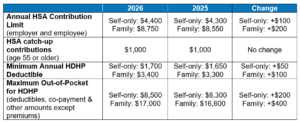
      In Rev. Proc. 2023-23, the IRS released the inflation-adjusted amounts for 2024 relevant to Health Savings Accounts (HSAs) and high deductible health plans (HDHPs). The table below summarizes those adjustments and other applicable limits.

       20242023Change
      Annual HSA Contribution Limit (employer and employee)Self-only: $4,150 Family: $8,300Self-only: $3,850 Family: $7,750Self-only: +$300 Family: +$550
      HSA catch-up contributions (age 55 or older)$1,000$1,000No change
      Minimum Annual HDHP DeductibleSelf-only: $1,600 Family: $3,200Self-only: $1,500 Family: $3,000Self-only: +$100 Family: +$200
      Maximum Out-of-Pocket for HDHP (deductibles, co-payment & other amounts except premiums)Self-only: $8,050 Family: $16,100Self-only: $7,500 Family: $15,000Self-only: +$550 Family: +$1,100

      Out-of-Pocket Limits Applicable to Non-Grandfathered Plans

      The ACA’s out-of-pocket limits for in-network essential health benefits have also been announced and have increased for 2024. 

       20242023Change
      ACA Maximum Out-of-PocketSelf-only: $9,450 Family: $18,900Self-only: $9,100 Family: $18,200Self-only: +$350 Family: +$700

      Note that all non-grandfathered group health plans must contain an embedded individual out-of-pocket limit within family coverage if the family out-of-pocket limit is above $9,450 (2024 plan years) or $9,100 (2023 plan years). Exceptions to the ACA’s out-of-pocket limit rule have been available for certain non-grandfathered small group plans eligible for transition relief (referred to as “Grandmothered” plans) since policy years renewed on or after January 1, 2014.  Each year, CMS has extended this transition relief for any Grandmothered plans that have been continually renewed since on or after January 1, 2014.  However, in its March 23, 2022 Insurance Standards Bulletin, CMS announced that the limited nonenforcement policy will remain in effect until CMS announces that such coverage must come into compliance with relevant requirements.   Thus, we will no longer see annual transition relief announced.

      Next Steps for Employers

      As employers prepare for the 2024 plan year, they should keep in mind the following rules and ensure that any plan materials and participant communications reflect the new limits: 

      All non-grandfathered plans (whether HDHP or non-HDHP) must cap out-of-pocket spending at $9,450 for any covered person. A family plan with an out-of-pocket maximum in excess of $9,450 can satisfy this rule by embedding an individual out-of-pocket maximum in the plan that is no higher than $9,450. This means that for the 2024 plan year, an HDHP subject to the ACA out-of-pocket limit rules may have a $8,050 (self-only) / $18,900 (family) out-of-pocket limit (and be HSA-compliant) so long as there is an embedded individual out-of-pocket limit in the family tier no greater than $9,450 (so that it is also ACA-compliant).

      Industry Veterans Comprise Benefit Advisors Network Board of Directors

      Leading Employee Benefits and Executive Compensation Lawyer Peter Marathas Joins Board

      FOR IMMEDIATE RELEASE
      Contact:
      Jessica Tiller at jtiller@pughandtillerpr.com or 443.621.7690

      CLEVELAND, OH (5/16/23) – Benefit Advisors Network (BAN) – the premier international network of independent employee benefit firms – is announcing its updated Board of Directors, including new board member, Peter Marathas.

      Sheri Alexander, Retired: Sheri Alexander, Retired Healthcare Strategist: Sheri has decades of experience in the employee benefits world.  Before retiring in 2022 Sheri served as Chief Strategy Officer and President of Employee Benefits for Gregory & Appel Insurance in Indianapolis.  Prior to joining Gregory & Appel in 2005, she spent 15 years with Marsh & McLennan/Mercer and nearly 10 years with Gardner & White. Throughout her tenure, she has cultivated experience in group captives, employer clinics, value-based and reference-based benefits design, price transparency tools, voluntary benefits, benefits administration, joint-purchase programs, and more. Additionally, she has served on the Advisory Councils of Anthem, Boston Mutual, and United Healthcare, to name a few—not to mention countless memberships and board service for industry-related organizations and not-for-profits.

      David Fischer, Chief Revenue Officer, Gregory & Appel Insurance: Currently, David is the Chief Revenue Officer at Gregory and Appel Insurance, where he leads the organization’s sales development, revenue sustainability, and go-to-market strategies. David’s specialty is transforming organizations into market leaders that deliver sustained growth and profitability. Fusing a high-energy sales, business development, change management, and operations background with a lifelong work ethic and leadership built within the US Marine Corps, David has ignited multimillion-dollar growth across a range of industries and settings, including startups, Fortune 500, and PE/VC-backed ventures. 

      Mark Fisher, CEO, President, Benefits Advisor, Advanced Benefits: As company founder, Mark manages client relationships, oversees business operations, and is a chief visionary for the company. Mark combines his passion for people with his deep industry experience and knowledge to provide client partners with a trusted advisor in all matters of human capital management. He also has a variety of specialized certifications and licenses.

      Peter Marathas, Chief Legal Officer, Alera Group: Peter Marathas is the Chief Legal Officer of Alera Group, Inc., one of the country’s largest private insurance and financial services providers.  Mr. Marathas not only serves as Alera Group’s Chief Legal Officer he was one of the individuals who founded that company and has overseen its significant growth over the last six years.  As Alera Group’s Chief Legal Officer, Mr. Marathas oversees all legal matters, including mergers and acquisitions.  He and his team have closed over 175 acquisitions in the insurance, financial services and consulting services arena since 2017.  In addition to his role at Alera Group, Mr. Marathas has acted as Benefit Advisors Network’s legal advisor since its inception in the early 2000’s.  Along with Mr. Braun and others, Mr. Marathas has help BAN to grow and become one of the country’s premiere benefits/HR services consortiums.

      Tom Murphy, Managing Partner, Sonus Benefits: Thomas Murphy AIF®, CEO, Sonus Benefits: Tom leads a team of industry specialists to provide custom benefits solutions for business owners, CFOs, and HR directors. In addition to his role at Sonus Benefits, Tom serves as one of three partners at MSMF, a wealth management firm and a Registered Representative offering securities through Cetera Financial Specialists LLC. He sits on numerous professional and charitable boards and routinely speaks to professional associations and employer groups on topics that relate to employee benefits and healthcare reform. Tom is Past-President of the St. Louis Association of Health Underwriters and a past officer of the Missouri Association of Health Underwriters.

      Barry Richter, President and Principal, Hausmann Group: Barry joined Hausmann Group Insurance in 2010 and was later named President in 2014. During his time as President, the agency has been named on the lists of 10 Best Workplaces in Insurance (2015), 50 Best Workplaces for Giving Back (2016), and Best Small Workplaces (2016, 2017, and 2018) by Fortune. Prior to joining the Hausmann Group, Barry gained insurance industry experience as a commercial agent after concluding a long career playing professional hockey. He also sits on the American Family Children’s Hospital’s advisory board.

      “We are grateful to our board for their continued guidance and look forward to their valuable contributions as BAN moves into its next chapter,” says Perry Braun, President & CEO, Benefit Advisors Network (BAN). “They each bring a diverse set of skills and expertise and can provide meaningful counsel. I am confident that these talented individuals will be a great asset in setting the strategic vision and of the organization.”

      In April, Perry Braun acquired the Benefit Advisors Network from Alera Group.

      BAN intentionally limits membership to top-tier firms only. The organizational philosophy of collaboration while providing world-class resources, such as preferred pricing arrangements and direct access to underwriters, has helped its members continue to grow, thrive, and succeed.

      About Benefit Advisors Network

      Founded in 2002, BAN is an exclusive, premier, international network of independent, employee benefit brokerage and consulting companies. BAN delivers industry-leading tools, technology, and expertise to member firms so that they can deliver optimum results to their employee benefit customers. BAN intentionally limits membership because of the highly collaborative interactions. For more information, visit:  www.benefitadvisorsnetwork.com or follow them on LinkedIn.

      Agencies Informally Indicate that the Outbreak Period Tied to the COVID-19 National Emergency Ends July 10, 2023

      On April 10, 2023, the President signed H.J.Res. 7, which ended the COVID-19 national emergency on April 10, 2023, approximately one month earlier than anticipated.  However, prior to the passage of H.J. Res. 7, the DOL and other federal agencies issued guidance in the form of FAQs that indicate an end date of May 11, 2023 for the national emergency and public health emergency.  Based on informal statements by officials at the DOL and other agencies, the agencies intend to stand by the May 11 end date for the national emergency and the corresponding July 10, 2023 end date for the outbreak period.  It is not clear whether the agencies will issue any additional formal written guidance.  This means that despite the President ending the national emergency on April 10, the DOL and other agencies will rely on the previously communicated May 11 end date as described in their FAQs to determine the end of the national emergency and public health emergency.

      As a reminder, the national emergency relief disregards the following deadlines until the earlier of one year from the date the individual was first eligible for the relief, or until 60 days after the end of the national emergency:

      • The 30-day period (or 60-day period, if applicable) to request a special enrollment;
      • The 60-day election period for COBRA continuation coverage;
      • The deadline for making COBRA premium payments;
      • The deadline for individuals to notify the plan of a qualifying event or determination of disability;
      • The deadline within which employees can file a benefit claim, or a claimant can appeal an adverse benefit determination, under a group health plan’s or disability plan’s claims procedures;
      • The deadline for claimants to file a request for an external review after receipt of an adverse benefit determination or final internal adverse benefit determination; and
      • The deadline for a claimant to file information to perfect a request for external review upon finding that the request was not complete.

      Conclusion

      Plans sponsors taking a cautious approach will administer their plans in accordance with the May 11 end date specified in the FAQs and continue to disregard the normal deadlines until after July 10, 2023.  Participant communications should be reviewed to ensure that the correct deadlines are communicated.

      Agencies Release Revised Instructions for 2022 Reference Year RxDC Reporting

      On March 3, 2023, federal agencies released revised Prescription Drug Data Collection (RxDC) Reporting Instructions applicable to the 2022 reference year.  RxDC reporting for the 2022 reference year is due on or before June 1, 2023.   

      Background

      The Consolidated Appropriations Act, 2021 (“CAA, 2021”) includes a provision that requires group health plans and health insurance issuers (collectively “plans and issuers”) to report certain specified data related to prescription drug and other health care spending, including, but not limited to: (1) general information regarding the plan or coverage; (2) the 50 most frequently dispensed brand prescription drugs; (3) the 50 most costly prescription drugs by total annual spending; (4) the 50 prescription drugs with the greatest increase in plan expenditures over the preceding plan year; (5) total spending by the plan or coverage broken down by the type of costs; (6) the average monthly premiums paid by participants, beneficiaries, and enrollees and paid by employers; and (7) the impact of premiums on rebates, fees, and other remuneration paid by drug manufacturers to the plan or coverage or its administrators or service providers, including the amount paid with respect to each therapeutic class of drugs and for each of the 25 drugs that yielded the highest amount of rebates and other remuneration under the plan or coverage from drug manufacturers during the plan year. 

      While the deadline for reporting 2020 and 2021 reference years was extended to January 31, 2023, the deadline for reference year 2022 reporting is June 1, 2023.

      2022 Reference Year Reporting Changes

      In anticipation of the June 1, 2023 deadline for reference year 2022 reporting, the agencies took into consideration some of the complexities from the 2020-2021 reference year reporting and made some changes to the filing requirements.  These changes are summarized below:

      • Multiple vendors may now submit the same data file on behalf of the same plan, issuer, or carrier.  For example, a plan’s medical benefit issuer could submit the same file as the plan’s behavioral health benefit issuer, though each entity would need indicate to which data the file relates (ex. medical or behavioral health benefits).
      • While discouraged, reporting entities that must create multiple HIOS submissions in the same reference year will be able to do so if the content is mutually exclusive, meaning each plan in the plan lists and data files will only be included in one submission.  Multiple submissions with overlapping content are not permitted, and the reporting entity would be required to edit and delete the submissions.
      • A new column has been added to the plan list P2 to collect information about, and briefly describe, benefit carve-outs (i.e., benefits administered, offered, or insured by an entity that is different than the entity that administers, offers, or insures the majority of the plan’s other benefits) when multiple reporting entities are reporting on information about the same plan (this column replaces the previous column for the Plan ID).  This column is optional for reference year 2022.
      • Plan list instructions have been rearranged to separately address P1, P2, and P3.
      • For clarity purposes only, certain columns are renamed, specifically:
        • Columns A and B in the data files (D1 – D8) are renamed from “Issuer or TPA Name” and “Issuer or TPA EIN” to “Company Name” and “Company EIN” so that it is clear that data at the plan sponsor, carrier, reporting entity, or other company level can be aggregated at this level, rather than only the issuer or TPA level.
        • Column C in the data files (D1 – D8) is renamed “Aggregation State” (rather than “State”) to more clearly differentiate from the column labeled “States in which the plan is offered” in plan lists P2 and P3.
        • Column J in D1 is renamed as “Admin Fees Paid” (rather than “ASO/TPA Fees Paid”) to reflect that self-funded plans pay administrative fees to other types of companies, such as PBMs.
      • As with reporting for prior reference years, due to the difficulties of having multiple reporting entities for a plan in certain instances, reporting entities may aggregate, within a state and market segment, at a less granular level than the reporting entity that submitted D2. For example, within a state and market segment, a PBM submitting D3 – D8 may aggregate to the issuer or TPA level even if an entity submitting D2 aggregates at the plan sponsor level.
      • For purposes of determining premium equivalents in D1, the instructions clarify the following, among others, should be subtracted from the premium equivalent:
        • Prescription drug rebates, regardless of whether the rebate received in the reference year is retrospective or prospective.
        • Stop-loss reimbursements (Note, however, that the stop loss premium paid by the plan to the stop loss carrier should be included).
      • For purposes of determining and reporting total spending in D2, the instructions clarify that stop loss reimbursements, among others, should NOT be subtracted from total spending; however, prescription drug rebates expected but not yet received should be subtracted (for prescription drugs covered either under a medical or pharmacy benefit).

      Additionally, the new guidance clarifies that RxDC reporting does not apply to retiree-only plans; however, it does apply for plans located in U.S. Territories (in addition to all 50 states and D.C.).  Note for self-funded plans: When calculating premium equivalents, a self-funded plan may use the same types of costs that are used to develop COBRA premiums; however, it should report the total dollar amount actually paid for the reference year, rather than the amounts used to set the COBRA rate.

      Conclusion In our experience, carriers, TPAs, PBMs, and other vendors have varying requirements and expectations of what they need from plan sponsors to successfully complete the reporting, and some may even be delegating some of the reporting responsibility to the plan sponsor.  For example, if your insurance company, TPA, or PBM sent you a survey or questionnaire to collect information about plan numbers, premium, or funding types, it is likely that they are reporting the P2 and D1 files on your behalf.  Therefore, it is important to respond to any requests for information you may receive from the carrier, TPA, PBM, or other vendor and to coordinate with them to understand their expectations to ensure all reporting is completed in full on behalf of the plan.  If your vendor sent you a letter telling you to create a HIOS account or stating that they will not submit P2 and D1 on your behalf, that means you must submit P2 and D1 directly to CMS (or engage a third party to submit them for you).

      Benefit Advisors Network Spins-Off from Alera Group, Perry Braun to Lead Organization as President & CEO

      FOR IMMEDIATE RELEASE
      CONTACT:
      Jessica Tiller
      jtiller@pughandtillerpr.com

      Cleveland, OH (4/3/2023) Benefit Advisors Network (BAN) –  an international network of progressive and visionary employee benefit brokers and consulting firms from across the United States and Canada – and the National Benefits Center (NBC), are spinning off from Alera Group, a top independent, national insurance and wealth services firm, to become an independent organization.  Perry Braun, who previously held the role of BAN’s Executive Director, will lead the organization moving forward.

      Most recently serving as Managing Director of Business Consulting at Alera Group, Braun will acquire BAN from Alera Group.  Effective April 1, 2023, Braun will assume the position of President and Chief Executive Officer of BAN.  He will use his extensive expertise to oversee the transition of BAN to an independently owned company.

      Prior to joining Alera Group, Braun was part of the team that helped launch Alera Group in 2017. In his role as Managing Director of Business Consulting, he focused on a number of key initiatives, including working with managing partners to improve business performance contributing directly to stronger results, and partnering with the property casualty team to build a new premium finance program for Alera Group’s Property & Casualty partners.

      “I’m very excited for BAN’s next chapter and even more excited to be back working with the team, members, and partners,” says Perry Braun, President and Chief Executive Officer of BAN.

      “Becoming an autonomous and independent organization after five years as part of Alera Group will mutually benefit both companies and allow BAN to ramp up and re-focus on providing members with the resources they need to deliver standout services to their clients,” says Braun.

      Braun continues, “As the market continues to evolve and change, so must our way of looking at our industry. The strategic actions we are taking now will provide the opportunity for a long-term sustainable company.”

      BAN intentionally limits membership to the “best of the best” in their respective markets. The organizational philosophy of collaboration while providing world-class resources, such as preferred pricing arrangements and direct access to underwriters, has helped its members continue to grow. To become a member, companies have to pass a stringent screening process that includes scrutiny of the firm’s business ethics, industry knowledge, and commitment to providing the highest quality services.

      About Benefit Advisors Network
      Founded in 2002, BAN is an exclusive, premier, international network of independent, employee benefit brokerage and consulting companies. BAN delivers industry-leading tools, technology, and expertise to U.S. and Canadian member firms so that they can deliver optimum results to their employee benefit customers. BAN intentionally limits membership because of the highly collaborative interactions. For more information, visit the company’s website at www.benefitadvisorsnetwork.com or follow them on LinkedIn.

      Most Employers Are Required to File Electronic Information Returns Beginning in 2024

      On February 21, 2023, the IRS released Final Rules amending the existing requirements related to mandatory e-filing of information returns, including Forms 1094-C and 1095-C, among others.  The final rules are effective for all applicable returns due on or after January 1, 2024.  While the final rule requires electronic filing for a number of different information returns, such as Forms W-2 and 1099, which were previously allowed to be paper filed by employers of a certain size, this alert addresses the changes applicable to Forms 1094 and 1095, which must be filed by applicable large employers (ALEs) as well as non-ALEs who sponsor self-funded health plans.

      Under the final rules, employers filing 10 or more returns must file Forms 1094 and 1095 (and their other applicable returns) electronically.  The 10-form threshold is determined based on the total number of forms the employer must file with the IRS, including Forms 1094 and 1095, as well as other information returns, such as Forms W–2 and Forms 1099, income tax returns, excise tax returns, and employment tax returns, including those that are not required to be e-filed, such as forms 940 and 941.  Previously, employers who filed less than 250 of the same ACA reporting forms were allowed to choose whether to file their applicable Forms 1094 and 1095 (either the B or C forms, as applicable) by paper or electronically.

      The final rules allow employers to seek a waiver in cases of undue hardship.  Per the final rules, a key factor in determining whether hardship exists is whether the cost for filing the returns electronically exceeds the cost of filing the return on paper.  Entities seeking a waiver must specify the type of filing to which the waiver applies, the period to which it applies, and the entity must follow any applicable procedures, publications, forms, instructions, or other guidance, including postings to the IRS.gov website, when requesting the waiver. Further, the final rules allow the IRS to grant exemptions from the requirements in certain instances.

      Conclusion

      All ALEs and many non-ALEs (who report due to sponsoring a self-funded health plan) will be impacted by these changes and will be required to file their tax year 2023 Forms 1094 and 1095 electronically unless they seek and are granted a hardship exception by the IRS.  Impacted entities should take the time between now and next year to engage a filing vendor that can assist them with their electronic filing obligations.

      Honoring Martin Luther King, Jr. Day

      Written by: Andrea Dunn and Miracle Gladney from Alera Group

      Many of us consider Martin Luther King Jr. (MLK) to be a leader in the movement to end racial segregation in the United States, and a hero in the fight for civil rights for black and brown citizens during the 1950s and 1960s. Martin Luther King Jr. sought equality and human rights for African Americans, the economically disadvantaged, and all victims of injustice through peaceful protest.  

      MLK Day is a time of reflection and acknowledgment of shifting moments in history, including the “I Have a Dream” speech, the Montgomery Bus Boycott, and the 1963 March on Washington, which helped bring about such landmark legislation as the Civil Rights Act and the Voting Rights Act. This day holds space to celebrate MLK’s life and legacy, along with the fight for freedom and justice. MLK Day is the only federal holiday designated as a “National Day of Service” – encouraging individuals to celebrate his legacy by volunteering and/or participating in local community programs and outreach. 

      Dr. King’s widow Coretta Scott King so eloquently defined this holiday by stating, 

      “This is not a black holiday; it is a peoples’ holiday. And it is the young people of all races and religions who hold the keys to the fulfillment of his dream.” 

      Although King was killed more than fifty years ago, it took years for Martin Luther King Jr. Day (MLK Day) to be declared and then recognized as an official holiday. MLK Day was first signed into law in 1983 but was only observed three years later. Still, many states resisted observing the holiday, giving it different names, or combining it with other holidays. A petition only needs 150 signatures to be searchable within the White House database, and to cross the second threshold and require a response, a petition must reach 100,000 signatures within 30 days. Six million signatures were collected in a petition to Congress to pass the law, making Martin Luther King, Jr. Day a federal holiday. Stevie Wonder helped to achieve this feat by releasing his iconic single, “Happy Birthday,” raising awareness of the fact that there should be a day commemorating Dr. King’s life and questioning why those in authority would not support the urge to celebrate someone who fought for peace and justice. In 2000, MLK Day was officially observed in all 50 states for the first time. While this is a special day for black and brown people, it is celebrated by all people across the world! 

      The Martin Luther King, Jr. holiday honors the life and legacy of a man who brought promise and healing to America. Dr. King is famous for his principles and practices of non-violence that he mastered, practiced, and taught. He used these principles to destroy injustice during the hostile Jim Crow era of the south which demeaned the value, dignity, and humanity of black American citizens. Dr. King’s non-violent stance against inequality and injustice dignified his advancements toward inclusion, equality, freedom, and justice for all. As a result of his approach and the magnitude of his reach, black Americans experienced positive change within legal, educational, and transportation systems, including the right to fair and equitable employment. For this, we observe his life, his service, and his work. 

      Excerpt from A letter from the Birmingham Jail written by Dr. Marin Luther King Jr., April 16th, 1963:  

      “Injustice anywhere is a threat to justice everywhere. We are caught in an inescapable network of mutuality, tied in a single garment of destiny. Whatever affects one directly, affects all indirectly.”  

      MLK Day is now an Alera Group holiday, and many offices also further MLK’s message and spirit by providing colleagues with volunteer opportunities. As an example, TRUEbenefits spends a day in community service as a team. In the United States people spend an average of 52 hours a year in volunteer service. Giving colleagues the opportunity to volunteer individually or in a team setting drives employee engagement, and provides vital support to local communities.  

      Ways to Support MLK Day 

      We invite you to take this day (and week!) to reflect on the impact Dr. King made, take the time to share your favorite MLK quote in the comments below, learn about Dr. King’s Fundamental Philosophy of Nonviolence or share what you did to celebrate this special day. For those with children, consider taking 15 minutes to talk to them about the legacy of Dr. Martin Luther King Jr (here’s a great conversation starter from Parents).  You might also:  

      • Spend the day volunteering; 
      • Read a book on King’s legacy or review the additional resources below; 
      • Listen to King’s speeches, such as his I Have a Dream speech
      • Watch MLK documentaries;  
      • Or teach your kids about MLK. 

      Additional Resources 

      Written by: Andrea Dunn and Miracle Gladney 

      CAA, 2023 Eliminates MHPAEA Exemption for Self-Funded Non-Federal Governmental Health Plans

      CAA, 2023 Eliminates MHPAEA Exemption for Self-Funded Non-Federal Governmental Health Plans

      On December 29, 2022, the President signed the Consolidated Appropriations Act, 2023  (“CAA, 2023”), into law.  The CAA 2023, which is largely a bipartisan spending bill, sunsets provisions of the Public Health Service Act which permitted large, self-funded, non-federal governmental plans (i.e., self-funded state and local governmental plans) to opt out of the Mental Health Parity and Addiction Equity Act (“MHPAEA”). Essentially, this means any self-funded state and local governmental plans that have not previously elected to opt out of the MHPAEA will no longer be able to submit an election to opt out.  Further, any self-funded state and local governmental plans that previously elected to opt out of the MHPAEA will be unable to renew their election once it expires.

      There is an exception for certain collectively bargained, non-federal governmental plans with existing opt outs that are subject to multiple collective bargaining agreements (“CBA”) with varying lengths. These plans may extend their opt out elections until the date on which the term of the last CBA expires.

      Background

      The MHPAEA prohibits a group health plan from applying financial requirements (e.g., deductibles, co-payments, coinsurance, and out-of-pocket maximums), quantitative treatment limitations (e.g., number of treatments, visits, or days of coverage), or non-quantitative treatment limitations (such as restrictions based on facility type) to its mental health and substance use disorder benefits that are more restrictive than those applied to the plan’s medical and surgical benefits. 

      With limited exceptions, the MHPAEA applies to both self-funded, fully insured, grandfathered and non-grandfathered group health plans offering medical/surgical benefits and mental health and substance use disorder benefits. Certain plans may be exempt from the MHPAEA requirements, including: (1) self-insured plans sponsored by employers with 50 or fewer employees, (2) group health plans and group or individual health insurance coverage consisting only of excepted benefits, (3) retiree-only group health plans, and (4) group health plans and health insurance issuers who are exempt due to an increased cost.  Note, small employer plans that are fully insured are indirectly required to comply with the MHPAEA by meeting the essential health benefit requirements of the Affordable Care Act.

      Large, self-funded non-federal governmental employers were previously also able to opt out of MHPAEA compliance by filing a HIPAA Exemption Election with CMS prior to the beginning of each plan year, issuing a notice of opt-out to their enrollees at the time they first enrolled and annually thereafter, and filing an opt-out notice or certification of that the opt out notice has been provided to participants with CMS.

      CAA, 2023 Sunset

      The CAA, 2023, sunsets the HIPAA Exemption Election opt out from MHPAEA requirements for large, self-funded non-governmental employers by eliminating the ability for plans that have not previously sought an exemption from applying for a new exemption after December 29, 2022, and by eliminating the ability of large, self-funded non-federal governmental employers who have a current exemption from renewing that exemption once such exemption election expires (i.e., for exemption elections that expire 180 days from the date the CAA, 2023 is enacted). 

      A limited exception applies for non-federal governmental plans subject to multiple CBAs with varying lengths. These plans may seek to have their exemption elections renewed until the date on which the term of the last CBA expires. Essentially, this means non-federal governmental employers will be able to honor their CBA commitments for the remainder their current CBA terms.

      Conclusion

      Any large, self-funded state or local governmental plan sponsors who have a current exemption election from the MHPAEA requirements should coordinate with their broker and third-party administrators to understand how these changes may be implemented and any potential resulting impact to their plan terms and costs.

      ___________________________

      About the Authors.  This alert was prepared by Barrow Weatherhead Lent LLP, a national law firm with recognized experts on the Affordable Care Act.  Contact Stacy Barrow or Nicole Quinn-Gato at sbarrow@marbarlaw.com or nquinngato@marbarlaw.com.

      This email is a service to our clients and friends.  It is designed only to give general information on the developments actually covered.  It is not intended to be a comprehensive summary of recent developments in the law, treat exhaustively the subjects covered, provide legal advice, or render a legal opinion.

      Benefit Advisors Network and its members are not attorneys and are not responsible for any legal advice.  To fully understand how this or any legal or compliance information affects your unique situation, you should check with a qualified attorney.

      © Copyright 2023 Benefit Advisors Network. All rights reserved.

      IRS Adjusts Health Flexible Spending Account and Other Benefit Limits for 2023

      On October 18, 2022, the Internal Revenue Service (IRS) released Revenue Procedure 2022-38, which increases the health flexible spending account (FSA) salary reduction contribution limit to $3,050 for plan years beginning in 2023, an increase of $200 from 2022.  Thus, for health FSAs with a carryover feature, the maximum carryover amount is $610 (20% of the $3,050 salary reduction limit) for plan years beginning in 2023.

      The Revenue Procedure also contains the cost-of-living adjustments that apply to dollar limitations in certain other sections of the Internal Revenue Code. 

      Qualified Commuter Parking and Mass Transit Pass Monthly Limit

      For 2023, the monthly limits for qualified parking and mass transit are increased to $300 each, an increase of $20 from 2022.

      Adoption Assistance Tax Credit Increase

      For 2023, the credit allowed for adoption of a child is $15,950 (up $1,060 from 2022). The credit begins to phase out for taxpayers with modified adjusted gross income in excess of $239,230 (up $15,820 from 2022) and is completely phased out for taxpayers with modified adjusted gross income of $279,230 or more (up $15,820 from 2022).

      Qualified Small Employer Health Reimbursement Arrangement (QSEHRA) Increase

      For 2022, reimbursements under a QSEHRA cannot exceed $5,850 (single) / $11,800 (family), an increase of $400 (single) / $750 (family) from 2022.

      Reminder: 2023 HSA Contribution Limits and HDHP Deductible and Out-of-Pocket Limits

      Earlier this year, in Rev. Proc. 2022-24, the IRS announced the inflation-adjusted amounts for HSAs and high deductible health plans (HDHPs).

      The ACA’s out-of-pocket limits for in-network essential health benefits have also been announced and have increased for 2023.  Note that all non-grandfathered group health plans must contain an embedded individual out-of-pocket limit if the family out-of-pocket limit is above $9,100 (2023 plan years). Exceptions to the ACA’s out-of-pocket limit rule are available for certain small group plans eligible for transition relief (referred to as “Grandmothered” plans). While historically CMS has renewed the transition relief for Grandmothered plans each year, it announced in March that the transition relief will remain in effect until it announces that all such coverage must come into compliance with the specified requirements.

      A Reporting Penalties (Forms 1094-B, 1095-B, 1094-C, 1095-C)

      The table below describes late filing penalties for ACA reporting.  The 2024 penalty is for returns filed in 2024 for the calendar year 2023, and the 2023 penalty is for returns filed in 2023 for the calendar year 2022.  Note that failure to issue a Form 1095-C when required may result in two penalties, as the IRS and the employee are each entitled to receive a copy.

      _______________________________

      About the Authors.  This alert was prepared for [insert agency name] by Barrow Weatherhead Lent LLP, a national law firm with recognized experts on the Affordable Care Act.  Contact Stacy Barrow or Nicole Quinn-Gato at sbarrow@marbarlaw.com or nquinngato@marbarlaw.com.

      This email is a service to our clients and friends.  It is designed only to give general information on the developments actually covered.  It is not intended to be a comprehensive summary of recent developments in the law, treat exhaustively the subjects covered, provide legal advice, or render a legal opinion.

      Benefit Advisors Network and its members are not attorneys and are not responsible for any legal advice.  To fully understand how this or any legal or compliance information affects your unique situation, you should check with a qualified attorney.

      © Copyright 2022 Benefit Advisors Network. All rights reserved.

      IRS Releases Final Rule to Fix ACA’s Family “Glitch”

      On October 13, 2022, the IRS finalized regulations (the “Final Rule”) intended to revise the method of determining affordability under the Affordable Care Act (ACA) for an employee’s family members by considering whether the coverage offered by the employer to the employee and their family members is affordable. The final regulations are effective on December 12, 2022. 

      In addition, the IRS released Notice 2022-41 (the “Notice”), which is effective for cafeteria plan elections effective on or after January 1, 2023, and facilitates the changes under the Final Rule by permitting plans to update their change in status rules to allow employees to prospectively revoke their election under a group health plan (excluding health FSAs) for their family members who have enrolled or intend to enroll in Marketplace coverage. Most notably, for applicable large employers, the requirement to offer “affordable” coverage to full-time employees remains tied to the cost of employee-only coverage.  The rule does not require employers to make family coverage “affordable.”

      The details of the Final Rule and Notice are discussed in more detail below.

      Background

      The ACA provides for a premium tax credit (PTC) for coverage purchased in the Marketplace if individuals do not have affordable, minimum value coverage available to them under an employer-sponsored group health plan.  After the ACA was enacted, the IRS interpreted the law to require affordability to be determined based on the lowest cost, self-only coverage offered to the employee by the employer.  In other words, an employer’s offer of family coverage was “affordable” if the employee’s cost for self-only coverage did not exceed 9.5% (as indexed) of the employee’s income.  Therefore, if self-only coverage offered to the employee was affordable, the employee’s family members would not be eligible for a PTC if they purchased coverage in the Marketplace even if the cost of family coverage was not affordable.

      Over the years, this caused significant hardship to many families as the cost of family coverage offered by employers is often significantly higher than that of self-only coverage, and many family members were denied access to PTCs if the employee declined the employer’s offer of coverage for his or her family members because the coverage was cost prohibitive.  Advocacy groups routinely reached out to the Executive Branch regarding their concerns about the interpretation of the law. 

      On January 28, 2021, President Biden issued Executive Order 14009 which directed the IRS to, among other things, review existing regulations and agency actions to determine whether the regulations or actions were inconsistent with “the policy to protect and strengthen the ACA” and to examine policies or practices that may reduce the affordability of coverage or financial assistance for coverage, including for dependents. Accordingly, the IRS began to reevaluate the prior interpretation of the law, and, in April 2022, the IRS released proposed regulations intending to address affordability of coverage for family members.  Based on a renewed interpretation of the law, the proposed regulations provided that, for purposes of determining eligibility for PTCs, affordability of employer coverage for family members (referred to as “individuals eligible to enroll in the coverage because of their relationship to an employee of the employer” or “related individuals”) would be determined based on the cost of covering the employee and those family members.  Therefore, the portion of the annual premium the employee must pay for coverage of the employee and eligible family members would be used to determine whether the employee’s family members would be eligible for a PTC.

      After the ACA was enacted, the IRS released Notice 2014-55 which was intended to address, among other things, the ability of employees to prospectively revoke their election in an employer’s group health plan to enroll in Marketplace plans during the Marketplace’s open enrollment or the employee is eligible for a special enrollment in the Marketplace. In this situation, if the employee was not eligible for Marketplace coverage, they could not revoke coverage for their family members to enroll in the Marketplace and would have to wait until the employer’s next open enrollment period.

      IRS Releases Final Rule to Fix ACA’s Family “Glitch”

      On October 13, 2022, the IRS finalized regulations (the “Final Rule”) intended to revise the method of determining affordability under the Affordable Care Act (ACA) for an employee’s family members by considering whether the coverage offered by the employer to the employee and their family members is affordable. The final regulations are effective on December 12, 2022. 

      In addition, the IRS released Notice 2022-41 (the “Notice”), which is effective for cafeteria plan elections effective on or after January 1, 2023, and facilitates the changes under the Final Rule by permitting plans to update their change in status rules to allow employees to prospectively revoke their election under a group health plan (excluding health FSAs) for their family members who have enrolled or intend to enroll in Marketplace coverage. Most notably, for applicable large employers, the requirement to offer “affordable” coverage to full-time employees remains tied to the cost of employee-only coverage.  The rule does not require employers to make family coverage “affordable.”

      The details of the Final Rule and Notice are discussed in more detail below.

      Background

      The ACA provides for a premium tax credit (PTC) for coverage purchased in the Marketplace if individuals do not have affordable, minimum value coverage available to them under an employer-sponsored group health plan.  After the ACA was enacted, the IRS interpreted the law to require affordability to be determined based on the lowest cost, self-only coverage offered to the employee by the employer.  In other words, an employer’s offer of family coverage was “affordable” if the employee’s cost for self-only coverage did not exceed 9.5% (as indexed) of the employee’s income.  Therefore, if self-only coverage offered to the employee was affordable, the employee’s family members would not be eligible for a PTC if they purchased coverage in the Marketplace even if the cost of family coverage was not affordable.

      Over the years, this caused significant hardship to many families as the cost of family coverage offered by employers is often significantly higher than that of self-only coverage, and many family members were denied access to PTCs if the employee declined the employer’s offer of coverage for his or her family members because the coverage was cost prohibitive.  Advocacy groups routinely reached out to the Executive Branch regarding their concerns about the interpretation of the law. 

      On January 28, 2021, President Biden issued Executive Order 14009 which directed the IRS to, among other things, review existing regulations and agency actions to determine whether the regulations or actions were inconsistent with “the policy to protect and strengthen the ACA” and to examine policies or practices that may reduce the affordability of coverage or financial assistance for coverage, including for dependents. Accordingly, the IRS began to reevaluate the prior interpretation of the law, and, in April 2022, the IRS released proposed regulations intending to address affordability of coverage for family members.  Based on a renewed interpretation of the law, the proposed regulations provided that, for purposes of determining eligibility for PTCs, affordability of employer coverage for family members (referred to as “individuals eligible to enroll in the coverage because of their relationship to an employee of the employer” or “related individuals”) would be determined based on the cost of covering the employee and those family members.  Therefore, the portion of the annual premium the employee must pay for coverage of the employee and eligible family members would be used to determine whether the employee’s family members would be eligible for a PTC.

      After the ACA was enacted, the IRS released Notice 2014-55 which was intended to address, among other things, the ability of employees to prospectively revoke their election in an employer’s group health plan to enroll in Marketplace plans during the Marketplace’s open enrollment or the employee is eligible for a special enrollment in the Marketplace. In this situation, if the employee was not eligible for Marketplace coverage, they could not revoke coverage for their family members to enroll in the Marketplace and would have to wait until the employer’s next open enrollment period.

      Final Rule and Notice 2022-41

      Final Rule Related to Affordability and Eligibility for Premium Tax Credits

      Under the final rule, for purposes of determining eligibility for a PTC, affordability of employer coverage for eligible family members is determined based on the employee’s share of the cost of covering the employee and those family members. In the preamble to the rule, the IRS explains that they believe the new reading represents a better reading of the relevant statutes and is consistent with Congress’s overall goal of expanding access to affordable health care coverage when enacting the ACA.

      Additionally, the final regulations include, among other things, amendments to the rules relating to the determination of whether employer coverage provides minimum value.

      Notice 2022-41

      Consistent with the changes in determining affordability for family members’ coverage, effective for plan years beginning in 2023, Notice 2022-41 expands current election change rules by allowing for elections for family members’ coverage under an employer’s non-calendar year cafeteria plan, to be prospectively revoked if the following conditions are met:

      • One or more related individuals are eligible for a special enrollment period to enroll in Marketplace coverage pursuant to guidance issued by HHS and any other applicable guidance during the Marketplace’s annual open enrollment period; and
      • The revocation of the election of coverage under the group health plan corresponds to the intended enrollment of the related individual or related individuals in new Marketplace coverage that is effective immediately following termination of coverage under the group plan.

      If adopted by the employer’s cafeteria plan, this new permitted election change does not apply to employee-only coverage.  Employees would still have to meet the eligibility specified in IRS Notice 2014-55 to revoke their own election under the employer’s plan, which requires the employee to be eligible for Marketplace open enrollment or special enrollment.   If the employee’s family members qualify for a special enrollment period under the Marketplace (or enroll in Marketplace coverage during the Marketplace open enrollment), the employee would be permitted to revoke their coverage and either enroll in self-only coverage offered by the employer or Marketplace coverage, if enrolling during a Marketplace open enrollment or special enrollment period. 

      The employer can rely on the reasonable representation of the employee that the employee’s family members have enrolled or intend to enroll in Marketplace coverage for new coverage that is effective immediately following termination of group health plan coverage.

      If an employer intends to adopt this new permitted election change, then the employer must amend their cafeteria plan to permit these changes and adopt this amendment no later than the last day of the plan year that begins in 2024.  The amendment can be retroactive/effective as of the first day of the 2023 plan year as long as the cafeteria plan operated in accordance with the changes within the 2023 plan year and notified employees of the changes for the 2023 plan year; however, the plan cannot be operated in a manner to allow revocation of coverage retroactively.

      Next Steps for Employers

      Employers do not need to make any changes to the way they determine affordability of coverage offered to employees, as affordability for purposes of the ACA’s employer shared responsibility provision (ESRP) has not changed.  Whether coverage offered by the employer is “affordable” for ESRP purposes will still be determined using the lowest cost, self-only coverage offered by the employer.  Employers are not penalized for failing to offer coverage that is affordable for an employee’s spouses or dependents.  

      Additionally, if for the 2023 plan year, the employer intends to allow mid-year election changes pursuant to IRS Notice 2022-41, employers must communicate the change to employees effective not later than the beginning of the 2023 plan year and operate the plan in accordance with this change.  Further, the employer must adopt an amendment to the plan no later than the last day of the plan year that begins in 2024.

      __________________________________

      About the Authors.  This alert was prepared by Barrow Weatherhead Lent LLP, a national law firm with recognized experts on the Affordable Care Act.  Contact Stacy Barrow or Nicole Quinn-Gato at sbarrow@marbarlaw.com or nquinngato@marbarlaw.com.

      This email is a service to our clients and friends.  It is designed only to give general information on the developments actually covered.  It is not intended to be a comprehensive summary of recent developments in the law, treat exhaustively the subjects covered, provide legal advice, or render a legal opinion.

      Benefit Advisors Network and its members are not attorneys and are not responsible for any legal advice.  To fully understand how this or any legal or compliance information affects your unique situation, you should check with a qualified attorney.

      © Copyright 2022 Benefit Advisors Network. All rights reserved.

      Benefit Advisors Network, Sparrow Form Partnership
      Sparrow’s Leave Management Solution to be Offered to All BAN Members

      FOR IMMEDIATE RELEASE
      CONTACT:
      Jessica Tiller
      jtiller@pughandtillerpr.com or 443-621-7690

      San Francisco, CA and Beachwood, OH (10/12/2022)Benefit Advisors Network (BAN) – a national network of independent employee benefits firms – has partnered with Sparrow, the first high-tech, high-touch leave management solution for employers. This strategic partnership will enable BAN to provide a superior leave management solution that BAN members can offer to their employer clients. 

      Under the terms of the new partnership, Sparrow’s leave management solution will be offered to all of BAN’s 120+ member firms in the U.S. and Canada.

      “We are thrilled to enter into a partnership with Sparrow and cannot wait to offer their services to our members. As if employers weren’t tackling enough issues over the past few years, employers are also faced with the complex maze of employee leave policies,” says Bobbi Kloss, Director, Human Capital Management Services for Benefit Advisors Network. “There are currently federal leave laws such as the FMLA, ADA, and USERRA, as well as religious observations. In addition, there are 396 state-specific and 67 county-specific leave laws that change regularly. It has become nearly impossible to navigate this regulatory landscape with in-house expertise alone, which is why we are partnering with Sparrow to provide these services to our member clients.”

      “In the last 10 years, navigating federal, state, and local leave regulations has only gotten more complex,” says Deborah Hanus, Co-founder, and CEO of Sparrow. “As companies across the US accommodate remote work, managing leave without compliance errors has become a major pain point for people teams. Sparrow’s high-tech, high-touch approach ensures that employee leave is stress-free.”

      “Companies are recognizing that leave benefits and management of administration are an important component of a comprehensive benefits program to attract and retain talent. These companies rely on their benefits advisors to recommend best-in-class solutions in this emerging space,” said Paul Park, Chief Revenue Officer of Sparrow.

      Continues Park, “Our partnership with BAN will allow Sparrow to extend our reach to clients who are dealing with increasingly complex workforce demands and their employees who expect a white glove level of support during a critical moment in their lives.”

      About Sparrow
      Sparrow is the first end-to-end leave management solution for modern employers to care for their people during major life events. Sparrow’s high-tech, high-touch approach automates the most painful parts of employee leave management, while our world-class leave specialist team ensures a premium experience for all types of leaves across the United States and Canada. By partnering with Sparrow, caring companies, such as Headspace Health, Figma, and Aurora, reduce compliance risks, enhance the employee experience, and contain costs.

      Learn more at trysparrow.com and LinkedIn, Twitter, and Facebook.

      About Benefit Advisors Network
      Founded in 2002, BAN is an exclusive, premier, international network of independent, employee benefits brokerage and consulting companies. BAN delivers industry-leading tools, technology, and expertise to U.S. and Canadian member firms so that they can deliver optimum results to their employee benefits customers. BAN intentionally limits membership because of the highly collaborative interactions. For more information, visit the company’s website at www.benefitadvisorsnetwork.com.

      Compensation Practices, Pay Equity, and Pay Equality

      An integral component of company culture is understanding the compensation strategy that your organization is paying employees. Many employees are asking for transparency. A company can no longer make wage pay decisions based on their geographic location, what competitors are paying, and what an employee was previously making. While this may have been a simplified approach to competitive pay, it is no longer a viable method.

      To be competitive in the marketplace, a company’s culture should include having a strategic compensation plan, e.g., one which defines the corporate culture as the philosophy behind the organization’s pay strategy.

      With a goal that will meet the organization’s ability to attract and retain quality employees, and one that establishes a culture aligning the mission of the organization to its employees, the following suggestions are best practices to follow to audit the current pay practices and determine if:

      1. Employees are being paid and incentivized fairly based on the requirements of their position, and the skills and experience they bring to the position.
      2. The pay is competitive with the labor market and competition for employees is being generated.
      3. The pay practices follow federal/state/local non-discrimination, pay equity, and wage laws.

      Understanding the Wage Requirements

      A developed compensation plan should address both Pay Equity and Pay Equality. They are different in the following ways:

      Pay Equity – Determines if and why employees are being paid differently.

      Pay Equality – Determines if equal work is receiving equal pay.

      While this article does not fully address compensation plans in total but ensures that employers are considering basic compliance requirements.

      Employers need to be paying at least federal minimum wage (each state’s wage increase laws may be different) – $7.25 per hour for non-exempt employees and $684.00 per week for most exempt employees. Exceptions do occur and your trusted advisor’s HCM resources can provide federal and geographical salary guidance.

      Federal wage requirements are slowly increasing. However, to meet the demands of inflation, many states have set their own minimum pay requirements and where state law is higher, employers are responsible for the higher wages. Employers need to also review applicable local/city wage rates to ensure compliance with minimum wage requirements. Minimum wage Laws in certain states such as California are even more confusing:

      • Size of the employer may dictate your minimum wage

      • Certain cities have minimum wage rates that are higher than the state’s

      In consideration of where an organization would establish its market position, Human Resource professionals rely on the following definitions for market placement, according to SHRM:

      a. Matching the Market. Targeting the 50th percentile means that an organization wants to pay in the middle of all organizations that have a similar position. In other words, 50 percent of the organizations should be paying less than that market rate, and 50 percent should be paying more than the market rate. “Matching the market” is the formal name for this approach.

      b. Market Leader. If an organization chooses to focus on the 75th percentile and take a “market leader” position, it will pay higher than 75 percent of other organizations with similar positions. Organizations competing for employees with specialized skill sets in a tight labor market or organizations that want to be a high payer in the market typically select a marker-leader position. Organizations with less robust variable compensation or benefits programs may also select a market leader base pay position to end up with an overall 50th percentile total compensation program.

      c. Market Lag. If an organization chooses to focus on the 25th percentile and take a “market lag” position, it will pay higher than only 25 percent of other organizations with similar positions. Organizations with strong variable compensation or benefits programs, or those encountering financial difficulties, may opt for a market lag position.

      d. Lead-Lag. As an additional variation, some organizations may choose to lead the base pay market for the beginning of the fiscal year and then lag at the end of that year. “Lead-lag” is the formal name for this approach to base pay management.

      Salary Ranges and Caps

      The next determination is where to set the ranges for the positions. Considerations for making effective annual adjustments are an important strategic step for an effective compensation plan in establishing the ranges, bonuses, raises, and COLA. Employers may set salary caps (not including those set by government or labor contracts) which establish the highest salary that an employer will pay for specific positions. Salary caps have pros and cons including:

      PRO–Determining and maintaining organizational budgets and establishing equality.

      CONS–“Red-circle” jobs reach the top limits in pay for their position, causing retention challenges.

      As employers move to remote or hybrid workforces, salary ranges and caps are integral to the geographic landscape of your organization. Employers need to not only consider where the applicants are being sourced out originally but if a replacement position, relocation, or new geographic position is necessary and how do the ranges and caps work within the recruiting strategy.

      Organizations are taking time now in the highly competitive job market to review their compensation strategies by at minimum benchmarking their current pay structure. For those who have not established a developed plan, now is the time to do so to ensure competitiveness and to maintain compliance requirements with wage and hours laws and your organization’s internal wage equity.

      Agencies Issue Guidance Regarding Coverage of Family Planning Services and Emergency Contraceptives Under the Affordable Care Act After Dobbs

      On July 28, 2022, the DOL, HHS, and the IRS (collectively, the “Agencies”) released FAQs About Affordable Care Act Implementation Part 54, which, according to the Agencies, is intended to make it clear that, despite the Supreme Court’s ruling in Dobbs, the ACA’s preventive care mandate requires non-grandfathered group health plans and health insurance issuers to cover birth control/contraception, including emergency contraception, and family planning counseling without any cost sharing.

      Background

      The ACA requires non-grandfathered group health plans and health insurance issuers offering non-grandfathered group or individual health insurance coverage to cover (without the imposition of any cost-sharing requirements) certain items or services, including evidence-based items and services having a rating of “A” or “B” by the United States Preventive Services Task Force (USPSTF). For women, infants, children, and adolescents, non-grandfathered plans must also cover evidence-informed preventive care and screenings provided for in comprehensive guidelines supported by the Health Resources and Services Administration (HRSA).  Items and services required to be provided without cost-sharing include any items or services “integral to the furnishing of the recommended preventive services” as well.

      The HRSA-supported Women’s Preventive Services Guidelines (2019 HRSA-Supported Guidelines), recommend that adolescent and adult women have access to the full range of female-controlled FDA-approved contraceptive methods, effective family planning practices, and sterilization procedures to prevent unintended pregnancy and improve birth outcomes.  As set forth in the guidelines, contraceptive care should include contraceptive counseling, initiation of contraceptive use, and follow-up care, and that instruction in fertility awareness-based methods, including the lactation amenorrhea method, should be provided for women desiring an alternative method.

      On December 30, 2021, the HRSA-Supported Guidelines were updated with regard to a number of items, including breastfeeding services and supplies, well-woman preventive care visits, access to contraceptives and contraceptive counseling, screening for human immunodeficiency virus, and counseling for sexually transmitted infections, and expand the 2019 recommendation to encompass contraceptives that are not female-controlled, such as male condoms.

      Per the ACA, non-grandfathered health plans must implement any new HRSA recommendations for plans years that begin on or after 1 year from the date the recommendation or guideline is issued.  For calendar year plans, this means January 1, 2023.

      Guidelines Addressed in the FAQs

      The recently issued FAQs provide the following:

      (1) Anesthesia services integral to the furnishing of recommended preventive services must be covered without cost sharing.  For example, anesthesia provided in conjunction with a tubal ligation procedure.

      (2)  Pursuant to the HRSA guidelines, contraceptive care for adolescent and adult women must include access to the full range of female-controlled FDA-approved contraceptive methods (as well as FDA-approved contraceptives that are not female-controlled for in plan years beginning in 2023), effective family planning practices, and sterilization procedures, which includes, among many other items, birth control methods such as IUDs, oral contraceptives, contraceptive patches, rings, and sponges, female condoms, and emergency contraception.  Note:  As explained in number 10 below, at least one form of contraception in the various categories must be covered by a plan or issuer.

      (3) Any contraceptive services and FDA-approved, cleared, or granted contraceptive products that an individual and their attending provider have determined to be medically appropriate for the individual, even if not listed specifically in the HRSA guidelines, such as newly FDA cleared contraceptive products, must also be covered without cost-sharing; however, reasonable medical management techniques may be employed by the plan or issuer if multiple, substantially similar services or products that are not included in a category described in the Guidelines are available and are medically appropriate for the individual (though at least one such service or product must be provided without cost sharing).  The agencies clarify that the plan or issuer must defer to the determination of the attending provider, and make available an easily accessible, transparent, and sufficiently expedient exceptions process that is not unduly burdensome so the individual or their provider can obtain coverage for the medically necessary service or product without cost sharing.

      (4)  Instruction in fertility-awareness-based methods, including lactation amenorrhea must also be covered without cost sharing, as they are forms of “counseling and education.”

      (5)  Coverage for FDA-approved emergency contraceptives without cost-sharing includes coverage for over-the-counter (OTC) emergency contraceptives.  The plan or issuer must cover any OTC emergency contraceptives that are prescribed and are encouraged to cover any OTC emergency contraceptives purchased without a prescription.

      (6)  HRAs, health FSAs, and HSAs can also reimburse FDA-approved OTC emergency contraceptives, but only to the extent they are not paid or reimbursed by another plan or coverage (such as the employer’s medical plan).  If the plan sponsor does not want to reimburse OTC emergency contraceptives that are not prescribed by a physician, then they must indicate such in the plan materials.

      (7) Plans and issuers may reimburse up to a 12-month supply of contraceptives at one time, though they are not required to do so.

      (8) These requirements under the ACA preempt any contrary state law.  Accordingly, if state law bans a particular contraceptive method, the ACA would preempt that contrary state law.

      (9) Unless HRSA guidelines specify a frequency, method, treatment or setting within a specified category of contraception, plans may use reasonable medical management techniques within that specified category. The reasonableness of the medical management technique will be determined based on the relevant facts and circumstances.

      (10) Plans and issuers must cover, without cost sharing, at least one form of contraception in each category that is described in the HRSA-Supported Guidelines or, for contraceptive categories not described in the HRSA-Supported Guidelines, at least one form of contraception in a group of substantially similar services or products.

      (11) Plans must have an exceptions process; however, it must not be unduly burdensome for participants, beneficiaries, or enrollees.  Requiring participants, beneficiaries, or enrollees to appeal adverse benefit determinations using the plan or issuer’s internal claims and appeals process to seek an exception is not a reasonable medical management technique.  Moreover, the process the plan uses for exceptions, including the type of information required to be provided when seeking an exception, should be transparent to participants and beneficiaries.  The FAQs provide that plans can satisfy this requirement by, at a minimum, prominently displaying the exceptions process in plan documents and SPDs as well as in any other plan materials that describe how the plan covers contraceptive items and services, such as a prescription drug formulary.  

      Next Steps for Employers

      Employers, particularly those with self-funded plans, should be mindful of these guidelines when working with their TPAs and when making plan design choices.  For employers who sponsor HRAs and health FSAs, if the employer’s plan covers all Code Section 213(d) expenses, employers should not need to make any changes to the plan. If the employer wishes to exclude OTC emergency contraception that is not prescribed by a medical doctor, then the employer should specify this as an exclusion in the plan materials.

      _________________________________

      About the Authors.  This alert was prepared by Barrow Weatherhead Lent LLP, a national law firm with recognized experts on the Affordable Care Act.  Contact Stacy Barrow or Nicole Quinn-Gato at sbarrow@marbarlaw.com or nquinngato@marbarlaw.com.

      This email is a service to our clients and friends.  It is designed only to give general information on the developments actually covered.  It is not intended to be a comprehensive summary of recent developments in the law, treat exhaustively the subjects covered, provide legal advice, or render a legal opinion.

      Benefit Advisors Network and its members are not attorneys and are not responsible for any legal advice.  To fully understand how this or any legal or compliance information affects your unique situation, you should check with a qualified attorney.

      © Copyright 2022 Benefit Advisors Network. All rights reserved.

      Employee Assistance Programs

      BAN Director of HCM Services, Bobbi Kloss, recently teamed up with Lucy Henry, Vice President of Stakeholder Relations from First Sun EAP to provide updated information on the importance of EAPs, which the National Association of Health Underwriters published in the June edition of their Benefits Specialist Magazine.

      Read the full article here

      IRS Releases 2023 HSA Contribution Limits and HDHP Deductible and Out-of-Pocket Limits

      In Rev. Proc. 2022-24, the IRS released the inflation-adjusted amounts for 2023 relevant to Health Savings Accounts (HSAs) and high deductible health plans (HDHPs). The table below summarizes those adjustments and other applicable limits.

       20232022Change
      Annual HSA Contribution Limit (employer and employee)Self-only: $3,850 Family: $7,750Self-only: $3,650 Family: $7,300Self-only: +$200 Family: +$450
      HSA catch-up contributions (age 55 or older)$1,000$1,000No change
      Minimum Annual HDHP DeductibleSelf-only: $1,500 Family: $3,000Self-only: $1,400 Family: $2,800Self-only: +$100 Family: $200
      Maximum Out-of-Pocket for HDHP (deductibles, co-payment & other amounts except premiums)Self-only: $7,500 Family: $15,000Self-only: $7,050 Family: $14,100Self-only: +$450 Family: +$900

      Out-of-Pocket Limits Applicable to Non-Grandfathered Plans

      The ACA’s out-of-pocket limits for in-network essential health benefits have also been announced and have increased for 2023. 

       20232022Change
      ACA Maximum Out-of-PocketSelf-only: $9,100 Family: $18,200Self-only: $8,700 Family: $17,400Self-only: +$400 Family: +$800

      Note that all non-grandfathered group health plans must contain an embedded individual out-of-pocket limit within family coverage if the family out-of-pocket limit is above $9,100 (2023 plan years) or $8,700 (2022 plan years). Exceptions to the ACA’s out-of-pocket limit rule are available for certain small group plans eligible for transition relief (referred to as “Grandmothered” plans). While historically CMS has renewed the transition relief for Grandmothered plans each year, it announced in March that the transition relief will remain in effect until it announces that all such coverage must come into compliance with the specified requirements.

      Next Steps for Employers

      As employers prepare for the 2023 plan year, they should keep in mind the following rules and ensure that any plan materials and participant communications reflect the new limits: 

      • HSA-qualified family HDHPs cannot have an embedded individual deductible that is lower than the minimum family deductible of $3,000.
      • The out-of-pocket maximum for family coverage for an HSA-qualified HDHP cannot be higher than $15,000.
      • All non-grandfathered plans (whether HDHP or non-HDHP) must cap out-of-pocket spending at $9,100 for any covered person. A family plan with an out-of-pocket maximum in excess of $9,100 can satisfy this rule by embedding an individual out-of-pocket maximum in the plan that is no higher than $9,100. This means that for the 2023 plan year, an HDHP subject to the ACA out-of-pocket limit rules may have a $7,500 (self-only)/$15,000 (family) out-of-pocket limit (and be HSA-compliant) so long as there is an embedded individual out-of-pocket limit in the family tier no greater than $9,100 (so that it is also ACA-compliant).

      ______________________________________

      About the Authors.  This alert was prepared by Marathas Barrow Weatherhead Lent LLP, a national law firm with recognized experts on the Affordable Care Act.  Contact Stacy Barrow or Nicole Quinn-Gato at sbarrow@marbarlaw.com or nquinngato@marbarlaw.com.

      This information is a service to our clients and friends.  It is designed only to give general information on the developments actually covered.  It is not intended to be a comprehensive summary of recent developments in the law, treat exhaustively the subjects covered, provide legal advice, or render a legal opinion.

      Benefit Advisors Network and its members are not attorneys and are not responsible for any legal advice.  To fully understand how this or any legal or compliance information affects your unique situation, you should check with a qualified attorney.

      © Copyright 2022 Benefit Advisors Network. All rights reserved.

      Congress Passes Another Temporary Telehealth Safe Harbor

      On March 15, 2022, the President signed the Consolidated Appropriations Act, 2022 (H.R. 2471) into law (“CAA 2022”).  The CAA 2022 is largely a spending bill but also includes, among other things, a much-anticipated new telemedicine safe harbor similar to that which was created under the Coronavirus Aid, Relief, and Economic Security Act (CARES Act).  The safe harbor allows high deductible health plans (HDHPs) to cover medical and behavioral health treatment before participants meet their deductibles (i.e., without cost-sharing).  The safe harbor applies from April 1, 2022, through December 31, 2022, regardless of the plan year.

      Background on Telehealth Safe Harbor under the CARES Act

      On March 27, 2020, the CARES Act became law. While the CARES Act was largely an economic package intended to stabilize individuals and employers during COVID-19-related shutdowns, it also included several measures directly related to employee benefits. One specific provision was the safe harbor under which HDHPs could cover telehealth and other remote care without cost-sharing. As a result, no-cost telehealth could be provided to plan participants for any reason–not just COVID-19 related issues–without disrupting HSA eligibility.

      The CARES Act safe harbor was a temporary measure, applying only to plan years beginning on or before December 31, 2021, which means, for calendar year plans, the safe harbor expired on December 31, 2021.  Without the safe harbor, telehealth programs that provide “significant benefits” in the nature of medical care or treatment generally disrupt HSA eligibility.  Whether benefits are “significant” is a facts and circumstances determination.  That said, in cases where a telehealth program provides robust benefits, such as medical advice and diagnosis for a broad range of non-emergency, common medical illnesses, general referrals to other provider types (including the emergency room), and certain prescription drugs for common medical illnesses, it may be difficult to support an argument that it does not provide “significant” benefits, in the absence of specific IRS guidance. 

      New Telemedicine Safe Harbor

      The safe harbor under the CARES Act was well-received, and as the December 31, 2021, deadline approached, there was a strong effort among stakeholders to encourage lawmakers to either extend the safe harbor or make it a permanent measure.

      Accordingly, on March 10, 2022, Congress passed the CAA, 2022, which was subsequently signed into law on March 15, 2022.  The new safe harbor under the CAA, 2022 is identical to the CARES Act safe harbor, except that it applies for the period of April 1, 2022, through December 31, 2022, only (i.e., it is tied to the calendar year, not a plan year). 

      Many carriers and other administrators assumed that, if passed, the measure would have a retroactive effect (back to January 1, 2022); however, for calendar year plans or plans with plan years ending prior to March 2022, there is a gap from January 1, 2022, through March 31, 2022, in which HDHPs may not be treated as an HDHP if covering certain medical or behavioral health telemedicine services without cost-sharing, which impacts HSA eligibility for individuals.

      Conclusion

      Depending on the applicable plan year, the following applies for employers:

      • For 2022 plan years that began before April 1, 2022 (e.g., calendar year plans), there is a gap period for which HDHPs were not authorized to maintain their status as an HDHP if covering telehealth services without a participant first meeting the applicable deductible (assuming the telehealth services are “significant benefits” for HSA purposes).  Therefore, from January 1, 2022, through March 31, 2022, if a HDHP covered participant’s virtual medical or behavioral health care without cost sharing, the plan may not be treated as a qualified high deductible health plan. Beginning April 1, 2022; however, this changes, and telemedicine service can be covered without cost-sharing through the end of the calendar year, unless the safe harbor is further extended.  An extension would require another change in law by Congress.
      • For non-calendar year plans which began on or after April 1, 2021, the safe harbor under the CARES Act will be extended by the CAA, 2022 beyond the end of the plan’s applicable plan year and apply through the end of the calendar year (December 31, 2022). 

      Employers are encouraged to discuss this optional relief with their insurance broker, medical plan carrier, or third-party administrator to ensure proper administration.

      _____________________________

      About the Authors.  This alert was prepared by Marathas Barrow Weatherhead Lent LLP, a national law firm with recognized experts on the Affordable Care Act.  Contact Stacy Barrow or Nicole Quinn-Gato at sbarrow@marbarlaw.com or nquinngato@marbarlaw.com.

      This is a service to our clients and friends.  It is designed only to give general information on the developments actually covered.  It is not intended to be a comprehensive summary of recent developments in the law, treat exhaustively the subjects covered, provide legal advice, or render a legal opinion.

      Benefit Advisors Network and its members are not attorneys and are not responsible for any legal advice.  To fully understand how this or any legal or compliance information affects your unique situation, you should check with a qualified attorney.

      © Copyright 2022 Benefit Advisors Network. All rights reserved.

      The Great Resignation

      In the April 2020 newsletter edition, I spoke about attracting qualified…or just candidates, these
      days. Groan if you are still having problems with finding qualified candidates these days.

      According to the latest Bureau of Labor and Statistics Jolt Report as of December 2021, there are 10.9
      million positions that need to be filled within the U.S. while the total number of separations went down to 5.9 the percentage rate was still at 4.0% and the number of quits was still at 2.9%.

      Why Are So Many Job Openings Not Being Filled?
      When we look at the reality of having millions of available workers and millions of jobs available there
      is clearly still a disconnect.

      What’s is the disconnect? Can we realistically consider:
      • Whether to vaccinate or not;
      • Low wage jobs;
      • Customer service jobs that interact with, at times, an angry public who “attack;”
      • Poor benefits, if any;
      • Lack of positive culture; and
      • Millennials and Gen Z’s continue to be prejudged as entitled.

      With so many reasons to throw blame around, a new one has been added into the mix – The Cancel
      Culture Movement. What is the cancel culture movement and how does that affect the Great Resignation
      Era?

      The Cancel Culture Movement
      Merriam Webster’s dictionary defines cancel culture as “the practice or tendency of engaging in mass
      canceling as a way of expressing disapproval and exerting social pressure.”

      Generations are shifting and as we may be reminded from our own generational rebelliousness
      against those who came before us, this is normal behavior. If you are a Baby Boomer, you were a trendsetter railing against the traditionalist. The same was and is true with Gen X and Millennials, as well
      as the newest generation entering the workforce, Gen Z.

      Making up roughly 24% of the workforce in 2020 and being a generation that is larger than the
      millennials, Gen Z’s are willing to put in the effort at work, yet they question incongruities in employer
      messaging i.e questioning the status quo. Why is a company investing in new (fill in the blank) but not willing to pay competitively or give out a raise? Why is one person chosen over another to do “easier” or “better” work? If the answer is not provided or is not a reasonable response, Gen Z’s are leaving for another company with a culture that includes effective communication, and most importantly, inclusiveness.

      The expansion of social media provides the opportunity for boycotts and protesters to far extend the
      reach that once existed in the local community. Nowadays a video can be shot within the exact moment a
      perceived “wrong” is being committed and posted to be viewed worldwide. It is not unusual for postings
      to reach 1 million + people in seconds with just the tap of a button. This tactic has led to culture changes
      within companies such as Google, Amazon, Whole Foods, and other large corporations as they try to avoid being in the center of the negative spotlight that often starts with the social media posting of employees. The expectation is that public shaming will either change a practice or the audience will “cancel” that company, product, or person by withdrawing financial support.

      Preserving the Brand
      This leaves employers facing the greatest challenges in finding candidates, especially in the hourly
      work sectors. Brand, mentorship, doing the right thing, and transparency are all key components of a
      culture that is drawing Gen Z’s. Human Resources has been sharing this message over the past several
      years and employers are just now seeing the effects that their lack of attention to developing a culture that will attract and retain employees is producing.

      To reiterate, we can see there are many workforce dynamics—the outside influences that impact the
      continuity of business operations—that are in play here. Whether one or many is personally affecting
      your workforce, how does an employer keep themselves front and center stage in the midst of the hiring
      frenzy? The solutions are largely “tried and true” but necessary now more than ever.

      Here are a few strategies to consider:
      • Employees are the greatest asset a company has and that should be the focus of strategic initiatives
      used to attract and retain a viable workforce.
      • Ensure that your company values and mission match the culture.
      • Market your company brand as “The Best Place to Work.”
      • When the competition is no longer just about the next-door company but now across the country, the
      competition is growing.
      • Evaluate your total rewards program.
      • Is your company paying competitively for the work expected?
      • Be creative in work-life balance. COVID-19 taught us we can virtually work from anywhere in the
      country or world and be just as productive with accommodations, flexibility, and ingenuity.
      • Expand those who can be in the role and consider if accommodations can be more readily available
      to get the job done.

      Marketing The Community
      Once an employer has worked to develop their inclusive and holistic culture, the next step worth
      adopting in their recruiting and retention strategy: marketing their community. This is about the
      opportunities that exist to live out the lifestyle that embodies the work-life balance they seek.

      Not only does this strategic branding opportunity highlight the multitude of benefits of a specific
      region or city, but it also means marketing the internal community that brings your employees together.

      Once the story is created, the next step is to generate the interest of applicants. How does this
      information get shared? Employers should promote it on the company website or job board advertising.
      The goal is to be creative. Companies can create videos walking around the internal and external
      community.

      Be enthusiastic about the opportunity that is offered. Today it is not only about what the candidate
      brings to the table, but also about what the employer has to benefit the candidate.

      Conclusion
      Human Resources is in that position to influence the employer and show how the profitability of the
      employer is impacted by marketing the company culture. What an opportunity to promote: a fostered
      happier, healthier, and productive workforce.

      ___________________________

      Bobbi Kloss is the Director of Human Capital Management Services for Benefit Advisors Network – an exclusive, national network of independent employee benefits brokerage and consulting companies. Bobbi can be contacted at bkloss@benefitadvisorsnetwork.com, or visit www.benefitadvisorsnetwork.com.

      Good News for DC Pension Plans in Ontario

      Good news! As of February 11, 2022, pension fund audits are no longer required for Defined Contribution Pension Plans in Ontario.  You can find the official regulatory change here.

      We note that this applies somewhat retroactively, so for example a DC pension plan with a December 31, 2021 year-end that would have filed their audit by June 30, 2022, falls under these new rules and doesn’t need to get an audit done.  DC plans will simply need to file a copy of the unaudited pension fund financial statements going forward.

      Note that FSRA can still order an audit be performed in exceptional circumstances – presumably if they’ve lost faith in the pension plan administrator/custodian/recordkeeper – so everyone still needs to be doing a good job even if not audited!

      Also, Statements of Investment Policies and Procedures (SIPPs) are no longer required for member-directed DC pension plans in Ontario.

      Feel free to reach out if you have any questions.

      Thanks,
      Jason.

      Jason Vary, FCIA, FSA
      President

      Straight Talk: It’s Not Just Verbal

      The HR buzz today is around having a company culture that attracts and retains quality employees. We
      talk about performance management, succession planning, training, and development, all devised
      upon supporting the short-and long-term success of the employee. We support holistic wellbeing
      strategies focusing on programs for the physical, emotional, social, and 􀀠financial wellbeing of our employees which in turn strengthens the long-term health of the organization. We seek to have an effective communication strategy that is an essential value for our organizations and evidence of a distinctive culture in the workplace promoting our HR and health and welfare strategies.

      Traditionally, we define communication in the workplace by how we talk to each other. Books are
      written, trainings held, we subject applicants and employees to workplace personality assessments, all
      telling us who we are and how we need to be communicated with in order to co-exist peacefully and
      productively in the workplace. Yet, every day, in a variety of industries and companies ranging from small to large, private to public, for-profit and non-profit, we see where miscommunication, lack of communication, and just plain bad communication results in turnover, social media memes, and fodder for the comic strips.

      “The Economist Intelligence Unit conducted a survey on turnover and found that “44 percent of U. S.
      respondents believe communication barriers lead to project delays, failures, and cancellation. Low morale
      was cited because of communication barriers by 31 percent of respondents, while a quarter said that
      communication barriers result in missed performance goals.” Are we though just talking about verbal
      communication?

      Environmental Communication
      When as employers we think about communication, we should understand that verbal communication
      is not the only form of communication that represents the value an organization places on its employees.
      Communication comes in all formats from the company website to the job placement and branding of an
      open position, to the of􀀠ice’s physical environment.

      Physical location – when an applicant drives up to the company offices, can they picture themselves
      going to that of􀀠ice day after day? Are there cigarette butts all over the driveway and in the grass? Is the
      building clean and inviting, or old, dingy, and smelly? Are historical records stored in boxes surrounding the cubicles? Are cabinets over􀀠lowing and set-up side by side as long dark pathways down the halls?
      In considering the of􀀠ices and cubicle areas, are the desks, chairs and tables piled high with papers that
      no one has looked at since COVID started when everyone was sent home to work remote? Yet, when walking back in the office they continue to be left about. Is the paint on the walls chipped and dirty? Do the offices have poor lighting and unwashed windows (if there are windows at all)? Do employees 􀀠fight over the temperature because shared spaces have one area that is too hot and another area that is too cold?

      These may sound like working conditions that are far and few between. However, these are many of
      the mainstream local businesses that we invite candidates into and allow employees to work within or to
      create themselves.

      Employee Engagement
      Why is it so important that we keep a clean, inviting office? For a couple of very important reasons. First
      from a compliance standpoint. The Occupational Safety and Health Act (OSHA) requires an employer under the General Duty Clause to provide “employment and a place of employment which are free from recognized hazards that are causing or are likely to cause death or serious physical harm to his employees.” We want to ensure that we are providing a safe workplace, preventing accidents from occurring, and keeping health and safety costs to a minimum.

      Secondly, from an employee productivity standpoint, a survey conducted by Stratus Building Services
      64% of participants responded when asked “How Much Is Your Productivity Compromised By A Dirty
      And/or Disorganized Of􀀠ice?” that they cannot focus, their productivity is ruined, it makes the day a struggle, and depending upon the day, it is a problem.

      We all want employees engaged and productive. So do the employees. The Future Workplace Wellness
      Study has shown that air, light, and temperature have an influence on employee engagement.

      Do we spend too much time thinking of wellbeing in relation to work-life balance, gym memberships, and
      paid time off policies? Not to say that we should not, however, are we being strategic and looking at all
      opportunities to improve the wellbeing of our employees? We should listen to what the employees are
      saying. In fact, in the same Workplace Wellness study, only 16% of employees surveyed rated fitness facilities as a priority while 58% prioritized air quality as their top influencer as a performance enhancer.

      Healthy Environment = Healthy Business
      What does it say to our employees when we do not place a value on the environment in which they are
      working? That they are not worth the time, and the investment to us? As HR professionals, CEO’s and other business owners, we walk around and really see our office environment. You could be surprised. And remember, increased productivity means increased revenue.

      U.S. Supreme Court Stays OSHA’s ETS for Private Employers with 100 or More Employees; Upholds CMS’ Interim Final Rule for Health Care Workers

      On January 13, 2022, the United States Supreme Court released its much anticipated opinions in the ongoing challenges to OSHA’s November 5, 2021 Emergency Temporary Standard (ETS) requiring private employers with 100 or more employees to either mandate employees be vaccinated or submit to weekly testing and mask mandates, and CMS’ November 5, 2021 Interim Final Rule requiring health care workers working at facilities that receive funding from Medicare or Medicaid to be vaccinated unless they are eligible for a medical or religious exemption.

      OSHA ETS

      In a 6 to 3 majority, with only Justices Kagan, Breyer, and Sotomayor dissenting, the Supreme Court held that the petitioners (various states and private businesses) were likely to succeed on the merits of their claims that OSHA’s ETS exceeds OSHA’s statutory authority and is otherwise unlawful. 

      Among other things, the majority recognized that OSHAs statutory authority is limited to occupational hazards, and a global pandemic extends well beyond the workplace, such as creating risks in schools, at home, in churches, and in recreational facilities.  Therefore, OSHA has no statutory authority to regulate workplaces with a public health mandate using such a broad stroke; however, the Court recognized OSHA may have the authority to address COVID-19 risks in the workplace for specific, targeted industries, such as workplaces where research on COVID-19 is being conducted. 

      Accordingly, the OSHA ETS is stayed for private employers with 100+ employees while the issue is fully reviewed and briefed in the 6th Circuit and any resulting petitions for writ of certiorari to the U.S. Supreme Court, if any, are resolved.  Therefore, OSHA cannot enforce its ETS at this time, and may not be able to do so for months, if at all. 

      CMS Interim Final Rule

      On the other hand, the Court upheld the Centers for Medicare and Medicaid Services (CMS) Interim Final Rule, which added a new requirement to existing conditions of participation in Medicare and Medicaid, that requires facilities to ensure that their staff who work on site are vaccinated against COVID–19 unless a staff member is exempt for religious or medical reasons.  This requirement was successfully challenged by two groups of states in two separate federal courts; however, the United States Supreme Court held that CMS has the statutory authority to, among other things, impose conditions on entities that receive funding from Medicaid and Medicare that “the Secretary finds necessary in the interest of the health and safety of individuals who are furnished services.”  Further, vaccine mandates for health care workers are not a new concept and many health care workers are already required to receive a number of other vaccines, subject to the same medical and religious exemptions applicable to the COVID-19 vaccine mandate. 

      Accordingly, the Court lifted the stay for the remainder of the appeals pending in the 5th Circuit Court of Appeal and the 8th Circuit Court of Appeal, as well as any resulting challenge upon writ of certiorari presented to the United States Supreme Court.  Therefore, health care facilities/employers subject to the CMS Interim Final Rule may require employees to be vaccinated unless a medical or religious exemption applies.

      What Does This Mean for Employers?

      Employers with 100+ employees who are not subject to the Health Care rule are not required to move forward with developing a plan to implement a vaccine mandate or weekly testing and mask mandate for their employees at this time.  This would only change if OSHA is successful on the underlying merits of the case pending before the 6th Circuit, which may take months to conclude, and the U.S. Supreme Court upholds that decision.  In essence, OSHA has a very steep uphill battle ahead of it should it wish to continue pursuing the ETS.  For employers/facilities subject to the CMS Interim Final Rule, they must comply with the vaccine mandate for employees who are not eligible for an exemption for religious or medical reasons.

      _______________________________________

      About the Authors.  This alert was prepared by Marathas Barrow Weatherhead Lent LLP, a national law firm with recognized experts on the Affordable Care Act.  Contact Stacy Barrow or Nicole Quinn-Gato at sbarrow@marbarlaw.com or nquinngato@marbarlaw.com.

      This notice is a service to our clients and friends.  It is designed only to give general information on the developments actually covered.  It is not intended to be a comprehensive summary of recent developments in the law, treat exhaustively the subjects covered, provide legal advice, or render a legal opinion.

      Benefit Advisors Network and its members are not attorneys and are not responsible for any legal advice.  To fully understand how this or any legal or compliance information affects your unique situation, you should check with a qualified attorney.

      © Copyright 2022 Benefit Advisors Network. All rights reserved

      Agencies Issue FAQs Regarding Coverage of Over the Counter COVID-19 Diagnostic Tests

      On December 2, 2021, President Biden announced that federal agencies would soon issue guidance regarding the availability of coverage/reimbursement from group health plans and health insurance carriers for individuals who purchase over the counter, at-home COVID-19 diagnostic tests (“OTC COVID-19 tests”).  Accordingly, on January 10, 2022, the agencies released “FAQs About Affordable Care Act Implementation Part 51, Families First Coronavirus Response Act (FFCRA) and Coronavirus Aid, Relief, and Economic Security Act (CARES Act) Implementation” which, among other things, requires group health plans and health insurance carriers to reimburse participants, beneficiaries, or enrollees (“Individuals”) for no less than eight (8) OTC COVID-19 tests per calendar month beginning on January 15, 2022 (i.e., for tests purchased on or after January 15, 2022).

      Background

      During the COVID-19 public health emergency, the FFCRA requires group health plans (self-funded, fully-insured, grandfathered, and non-grandfathered plans, but not excepted benefits such as dental or vision) and health insurance issuers (“Plans and Carriers”) to cover testing or certain other items or services intended to diagnose COVID-19 without cost sharing (deductibles, copays, or coinsurance), prior authorization, or other medical management requirements.  It also permits the agencies to implement the FFCRA through sub-regulatory guidance, program instruction, or otherwise.  The CARES Act expanded the FFCRA to, among other things, include a broader range of reimbursable COVID-19 diagnostic items and services that must be covered without cost-sharing, prior authorization, or medical management during the public health emergency. 

      In 2020, the agencies implemented several FAQs intended to serve as statements of policy to implement the above-referenced requirements under the FFCRA and CARES Act.  Since that time, the FDA has authorized at-home OTC COVID-19 diagnostic tests that individuals can self-administer and self-read to diagnose COVID-19.  Accordingly, per the agencies, the FAQs issued on January 10, 2022 are intended to address both the FDAs approval of at-home OTC COVID-19 tests and the President’s request for additional guidance on group health plan coverage for these tests to address the ongoing COVID-19 public health emergency.

      FAQ Guidance

      Pursuant to the FAQs, Plans and Carriers must cover OTC COVID-19 tests that meet the criteria specified under the FFCRA even if they are not ordered by a health care professional, and must cover such tests without imposing cost-sharing, prior authorization, or medical management requirements.  This is so even if there is no order from a health professional for an Individual.

      Coverage by the plan may be accomplished by directly reimbursing Individuals for their purchase upon submission of a claim by the Individual, or by reimbursing the entity who sold the OTC COVID-19 test directly, though the agencies strongly encourage plans to adopt the latter approach.

      Note, however, there is no requirement for Plans or Carriers to provide coverage of OTC COVID-19 tests that are intended for employment testing, such as weekly testing an unvaccinated Individual is required to undergo pursuant to the OSHA Emergency Temporary Standard (“ETS”) or an employer’s own mandated testing program.

      Plans and Carriers are required to reimburse OTC COVID-19 tests purchased from any retailer or pharmacy if the test meets the FFCRA statutory criteria, but if the test is administered without a health care provider’s assessment or order for testing and purchased from out-of-network pharmacies or retailers, then the Plan or Carrier may limit reimbursement to the lower of the actual price or $12 per test if the Plan or Carrier arranges for direct coverage (meaning the Individual who purchases the OTC COVID-19 test is not required to seek reimbursement post-purchase or make any up-front out-of-pocket expenditures) of OTC COVID-19 tests that meet the FFCRA criteria through both its pharmacy network and a direct-to-consumer shipping program.  Per the agencies, the direct-to-consumer shipping program may be provided through one or more in-network provider(s) or another entity designated by the Plan or Carrier.

      In order to limit reimbursements for tests purchased from non-preferred providers, Plans and Carriers must ensure there are an adequate number of retail locations (in-person and online) with access to OTC COVID-19 tests and communicate necessary information about the direct coverage program, including when it is available and which retail pharmacies are available.

      Per the agencies, whether access is adequate is determined based on all relevant facts and circumstances, including where Individuals are located and current utilization of the Plans’ or Carrier’s pharmacy network by Individuals.  Further, if there are significant delays for individuals to receive the OTC COVID-19 tests, such as through the shipping program, the Plan or Carrier must allow Individuals to purchase (and be reimbursed for) their OTC COVID-19 tests from any retailer.

      The agencies also recognize the important need for adequate testing to be available to health care providers who are diagnosing and treating COVID-19, and that everyone has reasonable access to OTC COVID-19 tests.  Thus, to prevent stockpiling and provide adequate safeguards, the agencies permit Plans and Carriers to limit OTC COVID-19 tests purchased by Individuals without a health care provider’s involvement or assessment, the agency provides a safe harbor from agency enforcement action for Plans or Carriers that limit the number of OTC COVID-19 tests eligible for reimbursement per Individual to no less than eight (8) tests per 30-day period or per calendar month.  Plans and Carriers are not permitted to limit Individuals to a smaller number of tests over a short period of time (such as limiting Individuals to four (4) tests per 15-day period).  Plans can choose to be more generous by reimbursing a larger number of OTC COVID-19 tests (i.e., more than 8) per calendar month if they prefer.

      Testing for Employment Purposes

      Plans and Carriers are permitted to address suspected fraud and abuse, such as taking reasonable steps to ensure OTC COVID-19 tests are purchased for an Individual’s (or their covered family member’s) own personal use as long as the steps do not create significant access barriers.  This may include requiring attestations that the OTC COVID-19 test was purchased by the Individual for personal, non-employment related use, will not be reimbursed by another source, and will not be made available for resale as long as the attestation process is reasonable and does not result in undue delay of reimbursement.  Plans and Carriers may also require reasonable documentation as proof of purchase, such as the UPC code from the OTC COVID-19 test, when claims are submitted.

      Finally, Plans and Carriers may assist Individuals by providing education and information resources to support Individuals seeking OTC COVID-19 testing as long as the materials clearly indicate the Plan or Carrier is required to cover all OTC COVID-19 tests that meet FFCRA criteria (subject to the safe harbors referenced previously).  The FAQs provide some examples of potential education and information resources Plans and Carriers may use.

      What Does This Mean for Employers?

      Employers are encouraged to work with their carriers or third-party administrators and stop-loss carriers to ensure these new requirements are implemented and to determine whether the plan will implement any of the permitted safe harbors so that this can be effectively communicated to employees and their family members.

      The agencies clarified that they will not take enforcement action against Plans or Carriers for modifying health insurance coverage mid-year to meet these requirements or for failing to meet the 60-day advance notice requirements (for changes made to information required to be included in SBCs) if notice of these changes is provided as soon as reasonably practicable.

      Finally, employers should clearly articulate to employees that the employer’s testing policy adopted pursuant to the OSHA ETS, if any, is not subject to this requirement and, employees are expected to pay out of pocket for weekly COVID-19 tests without seeking reimbursement from the employer’s group health plan if the employer does not pay for the applicable testing.  Further, pursuant to the OSHA ETS, while the employer may allow an OTC COVID-19 test to be used for purposes of applicable employment testing, the test may not be both self-administered and self-read unless observed by the employer or an authorized telehealth proctor.

      ______________________________________________________

      About the Authors.  This alert was prepared by Marathas Barrow Weatherhead Lent LLP, a national law firm with recognized experts on the Affordable Care Act.  Contact Stacy Barrow or Nicole Quinn-Gato at sbarrow@marbarlaw.com or nquinngato@marbarlaw.com.

      This notice is a service to our clients and friends.  It is designed only to give general information on the developments actually covered.  It is not intended to be a comprehensive summary of recent developments in the law, treat exhaustively the subjects covered, provide legal advice, or render a legal opinion.

      Benefit Advisors Network and its members are not attorneys and are not responsible for any legal advice.  To fully understand how this or any legal or compliance information affects your unique situation, you should check with a qualified attorney.

      © Copyright 2022 Benefit Advisors Network. All rights reserved

      2022 Advice and Reminders for Comp and Benefits Managers

      Trends and developments to follow in the year ahead

      By Stephen Miller, CEBS

      January 5, 2022

      s the new year gets underway,SHRM Online has collected the following predictions from experts on how compensation, benefits and workplace culture are likely to change.

      Take Steps to Counter the Great Resignation

      Employers facing worker shortages are now open to enacting certain changes, such as:

      • Marketing the company as a “Best Place to Work.” With the rise in remote work, thecompetition is no longer just about the company next door, but also about the company across the country.
      • Adopting a total rewards strategy. This involves expanding benefits beyond traditional health, dental, vision, disability and life insurance plans.
      • Considering increased salaries if possible. Is your company paying competitively for the work it expects?
      • Relaxing policies as appropriate. Amazon, for instance, is no longer screening for marijuana during drug testing.
      • Being creative with work/life balance benefits. The pandemic showed that office employees can work virtually from anywhere in the country or the world and be just as productive as long as they have accommodations and flexibility.

      —Bobbi Kloss is the director of human capital management services for the Benefit Advisors Network, a national network of independent employee benefits brokerage and consulting companies.

      Expect Challenges Around DE&I and the Future of Work

      Many workforce trends that will continue into the new year have implications for diversity, equity and inclusion (DE&I) strategies and outcomes. Examples include the following:

      • Hybrid workplaces could lead to disparities. Having some employees working remotely and others performing their jobs onsite can create subtle inequities. Companies will need to be intentional about tracking promotions, pay scales and opportunities to ensure that remote employees are not treated less favorably.
      • The Great Resignation shows no signs of stopping. In 2021, we saw people leave their jobs in droves in search of more money, more flexibility and more happiness. In response, we’ll see employers pressured to make changes such as offering increased wages, hiring incentives and competitive benefits to attract talent, and they’ll also focus on internal mobility, reskilling and upskilling to retain existing employees.
      • Companies can no longer ignore mental health. The COVID-19 pandemic worsened workers’ mental health and emotional well-being. To create an environment that supports mental health, companies can appoint a senior leader in charge of mental health initiatives, offer mental health benefits that are on par with physical health benefits, ensure easy access to resources without stigma and measure how well they’re meeting employees’ needs.
      • Parental leave will take center stage. The pandemic brought to light the challenges working parents and caregivers face. We’ll continue to see discussions around parental leave as workers demand better policies that put families first.

      —Mandy Price is CEO and co-founder of Kanarys, a technology company that provides organizations with tools to address DE&I challenges.

      Address Virtual Care and Health Equity Issues

      Employers will seek increased telehealth availability and improved mental health while working toward health equity—ensuring the same access and quality of health care to all employees, including those from historically disadvantaged groups. Among these trends:

      • Virtual health is here to stay, but integration with in-person care is key. Virtual health has a growing role in primary care and the management of chronic conditions. Harnessing its full value will mean helping patients to integrate care they received in person at a doctor’s office or clinic with care they receive via a telehealth service, as these providers may not be sharing clinical data. It will also be important to create a level playing field with regard to how insurers reimburse care providers.
      • Virtual mental health services are expanding. The pandemic has exacerbated long-standing challenges pertaining to mental health and emotional well-being, including lack of locally available therapists and the stigma that often prevents people from seeking in-person care. Employers have responded by providing digital therapy, which can bridge access gaps for employees. Employers, however, must remain focused on the quality of these resources.
      • Increased health equity is a focus. Employers are seeking to achieve health equity by offering inclusive and affordable health benefits and well-being programs, using health provider networks that are representative of the population, and analyzing claims for signs of unequal treatment. The aim is to mitigate differences in health outcomes across the workforce, including among those in under-resourced or marginalized groups.

      —Ellen Kelsay is president and CEO of Business Group on Health.

      Reminder: Expiring Benefits Plan Relief Provisions Under pandemic relief rules, employers can let participants in health care flexible spending accounts (FSAs) or dependent care FSAs carry over unused balances from a plan year ending in 2021 to a plan year ending in 2022, or extend to 12 months the grace period for spending unused FSA funds for plan years ending in 2021. Employers can choose to provide either or neither of these extensions. Other relief provisions ended at the close of 2021, even though the pandemic has not ended. Expired relief provisions include: The amount that employees can reduce their salary to fund a dependent care FSA goes back to the statutory limit of $5,000 in 2022, down from $10,500, for single taxpayers and married couples filing jointly. It reverts back to $2,500 for a married person filing separately, down from $5,250. Employees can no longer change their salary reduction elections to a health or dependent care FSA in the middle of the year unless the change in election is due to a change in status event such as marriage, divorce or new child; such midyear election changes were permitted in 2021. If an employee leaves a job in 2022 without using all the dollars in a health FSA, the employee will have to forfeit that unused amount; in 2020 and 2021, employers could allow terminated employees to access those unused amounts for health expenses until the end of the plan year. High-deductible health plans linked to health savings accounts (HSAs) will no longer be able to subsidize telehealth services before the deductible limit is met. In 2020 and 2021, insurance coverage that subsidized the cost of telehealth services pre-deductible did not prevent a worker from making HSA contributions. Despite these relief provisions ending as 2022 begins, it’s important to show employees the value of continuing to participate in employer-sponsored FSA and HSA programs. —William Sweetnam is the legislative and technical director at the Employers Council on Flexible Compensation.


      Related SHRM Article:

      As Work Changed in 2021, Employee Pay and Benefits Stepped UpSHRM Online, December 2021

      Wishful thinking: Brokers predict 2022’s top headlines

      If the pandemic were to magically disappear on 12/31, what news would benefits advisors like to see make headlines in 2022?

      By BenefitsPRO Editors | December 29, 2021 at 09:46 AM

      If the pandemic were to mysteriously disappear on the last day of 2021, what big trends or topics would you like to see take its place in the headlines during 2022?

      Extra, extra!

      Here are some themes I think it would be nice to see:

      Reiterating the importance of maintaining/resuming preventive services that were disrupted by the COVID-19 pandemic. For example, the pandemic led to a significant decrease in cancer screening, which could mean that some early cancers may have gone undetected, leading to later diagnoses and worse (and more costly) outcomes. Getting preventive services back on track should be a major priority.

      The other thought I had was a focus on embracing and expanding employee access to mental health benefits. It’s no secret the pandemic wreaked havoc on the average person’s mental health. Many even turned to drugs and alcohol to cope. So it should come as no surprise to employers when they see a major increase in demand for mental health benefits. Nor should it be surprising to employers to find themselves falling behind in attracting and retaining top employees should they fail to provide the appropriate resources.

      Here’s a headline I hope to see in the near future:

      “Employers refocus efforts on improving employee health care consumerism, see major breakthrough: benefits literacy rates climb, health care costs plunge”

      Matt Derus, content attorney & market analyst, Zywave

      Refocus

      In 2022, I hope that as benefits professionals, we will stop and reflect on what access actually means. Having insurance or being eligible for a health plan does not equal access to care. Unfortunately, it is not enough to just offer a benefit for the sake of offering it; that’s shortsighted, expensive and unsustainable.

      We have to focus on the outcomes we’re trying to achieve, and build the programs from there. When we do that, we are better able to address (or plan around) weak links early on. Focusing on access and outcomes means we have to understand the supply chain. In health care, as we’re seeing today with mental health resources, the strength or weakness of each link of the chain affects access to care. We also see these issues in other areas of health care, including critical access to specialists. On a related note, when we fail to diversify our vendors, there’s so much we miss–issues that could have been addressed early on that were not seen or contemplated.

      Uche Enemchukwu, co-founder and CEO, Nelu Diversified Consulting Solutions

      Addition by subtraction?

      Here’s the message I’d like to see from Mark Zuckerberg in 2022:

      “Since its inception, Facebook has done a world of good as a conduit of social networking, helping to establish and re-establish relationships. But people today can connect in a myriad of different ways. Where Facebook was once a unique, singular beacon of constructive pathways, it has turned dark. It’s morphed into an ugly ‘too big to fail’ behemoth.

      “Though I’m immensely proud that I achieved my goals, a toxic atmosphere has permeated my organization, both inside and out: racism, sexism, political and religious antagonism/hatred, homophobia, etc. Also, the crass monetization of those very things. I’m a wealthy man because of Facebook. And because I am, I can afford to shut it down, which I’m doing so effective immediately (Dec 31, 2021).

      “With the pandemic now over, please take advantage of every opportunity to meet your friends and loved ones in person, and cherish the time you and your fellow citizens of the world have to spend together in unity and harmony. Life’s too short for impersonal and irrational hatred. Peace and love to all!”

      Jason Marcewicz, content and communications specialist, Advanced Medical Strategies LLC

      Looking ahead

      I’d love to see better HSA investment vehicles. Target-date funds have changed 401(k)s by making it easy, and by increasing allocation to stocks, which do better over time, all with low fees. Something similar for HSA dollars could help boost HDHP enrollments, the percentage of people who invest their HSA balances, and HSA savings. As little as $150/month, invested to hedge health care inflation, goes a long way to neutralizing out-of-pocket costs in retirement.

      Joe Andelin, founder, Olavi Group

      Outside the box

      If fueled by economic stagnation and monetary inflation, 2022 will drive employers to seek alternative funding strategies. The introduction of cost transparency will inject a new sense of “consumerism” at the C-suite level, resulting in fundamental change and executing on long-term strategic initiatives. We will also see a hastening of larger benefit practices also embracing the health care cost-containment train.

      As a result of greater pricing transparency, the PPO value will begin to weaken not only for employers, but also for providers. Through more direct engagements, providers will strengthen relationships with stakeholders (employers), driving greater value for each party while benefiting the community as a whole. Patients benefit by gaining access to quality providers at little to no cost, with some expectation of an improved health care experience.

      Doug Hetherington, CEO & program architect, HealtH2Business

      Accentuate the positive

      Although I predict 2022 headlines to continue grasping at the ugly to attract audiences with clickbait, my evolutionary story in 2022 dreams of a less radical society with words like “harmony,” “generosity,” “kindness,” and “honesty” dominating the headlines. Particularly at this challenging time, let’s all work to emphasize the positive, reflect on the constructive and ignore the unpleasant.

      Let’s change “If it bleeds, it leads” to “Good, better, best….never let it rest.”

      Rina Tikia, managing director, Risk Strategies Company

      Time to reconnect

      Poof! It’s January 1st, 2022 and all of those hopeful pleas for normalcy to return have suddenly been answered. The phrases “masking up,” “covid testing,” “quarantining,” “social distancing,” etc. aren’t quite a distant memory but are less prevalent. Now that we can return to more “normal” conditions, there are plenty of initiatives I’m excited to see reoccur in the workplace:

      • On-site biometric screenings so employees can be proactive about their health. We’ve seen too many employees defer preventive and wellness visits. Let’s catch those potentially dangerous and costly conditions early!
      • Provide in-person dietician-led sessions to teach employees some healthy recipes and prep ideas to set them up for a successful day of eating. In addition to Domino’s Pizza stock price soaring over the past 18 months, so did people’s waist sizes. The U.S. already had an issue with obesity pre-COVID; lets get in front of this issue and help people eat healthier diets.
      • Organize yoga in the park to stretch our minds and bodies.
      • Help employees relax with chair massages.
      • Invite employees out for happy hour, meals or appetizers as a way to reconnect with employees.
      • Plan a “bring your child to work” day as a fun way to show off your workplace to your family and let your coworkers meet your children.

      As we head into the new year, I’m excited to help employers get back to some in person activities that promote healthy physical and mental living while reestablishing the human connection.

      Brian Lacher, vice president, employee benefits, Nielsen Benefits Group

      The business of health equity

      I’d love to see us focus on health equity as a solution to cost waste and quality deficiencies. Employers should be at the center of leading this effort, as they are uniquely positioned to leverage their own data to get a view on race/ethnicity, medical claims, short-term disability etc. They are paying more than $22,000 per family in premiums, therefore having the financial leverage with medical systems and health plans to get real action steps in place. It should not be left up to the health care system to “own” this, as it has been for our lifetimes and beyond. The problem has to be disrupted by purchasers/patients and employers at the top!

      Frankly, centering health equity is centering our front-line doctors who are burnt out, depressed and disenfranchised. There are many solutions created and led by people of color who consider these issues, yet they aren’t getting in the door at the rate of other innovators.

      Equity is the top economic, social, and human-centered opportunity of this era! Those who think of it and approach it as merely an option will contribute to capping our potential in this country, and will be accountable for the many lives lost and harmed physically, emotionally, and financially. Bad care costs us billions upon billions. This is a business issue.

      Jessica Brooks Woods, President & CEO, Pittsburgh Business Group on Health Founder

      Wishful thinking

      “HR strategists are given an extra week of paid time off” “Ping pong tables are back in the rec room” “Mask? What’s a mask?”

      Bobbi Kloss, director, Human Capital Management Services for the Benefit Advisors Network (BAN)

      Be happy

      I believe one ideal will ring true… people will find their happiness.

      We just went through a time that gave us the awareness of what we truly value in our lives, it’s time to take action and achieve. Life is too short.

      I believe happiness should be free or at least low-cost. I do believe there will be more cost-effective mental health solutions that give people much easier and affordable access to therapy. It’s no longer a taboo subject, and if it is to you, I urge you to take an internal look and realize everyone has struggles. No one has a perfect mindset all the time, doesn’t our society laugh at “happy people” all the time anyway? That just shows how normal it is to not be the best version of ourselves.

      It’s time we take care of each other and our neighbors and seek to understand and respond rather than to judge. Plus, it feels better when we can fill each other’s cups. Let’s be happy together.

      Ed Ligonde, executive vice president, Nielsen Benefits Group

      Back on track

      Multiple studies have demonstrated that when the pandemic hit, people delayed critical preventive health care, and many continue to do so. Moving into a 2022 without COVID-19, it would be great to see everyone get back on track with their health and well-being and get the care they may have put off for the past 18+ months. Ideally, this would start with biometric screenings to measure any changes since early 2020. Along the same lines, I would envision a surge in wellness and related program utilization as we now have even more capabilities than we did pre-pandemic to personalize employees’ experiences to get the right content and care for their health and well-being goals.

      Marcia Otto, vice president, product strategy, Health Advocate

      Roaring 20’s, take 2

      I’d like to see more headlines focusing on economic growth, prosperity, employment gains and increased savings rates for all Americans. The data we’re seeing today amid inflation, rising health care costs, and more is painting a bleak picture of what tomorrow may bring. At the same time, I think that all of this will help to push many to just do better – and hopefully be nicer. Here’s to brighter days ahead, and a fun Roaring 20’s 2.0.

      Derek Winn, benefits consultant, Business Benefits Group

      Time to hit the books

      After the holiday vacations are over, it’s back to school with health literacy in 2022. As new transparency rules are in place, multi-generational employees will be looking to get more from their benefits, and ongoing education will be critical in health care. Despite ongoing efforts by employers and advisors alike, it’s important to understand that health care is still complicated for most employees and consumers.

      Advisors should be ready to support clients by promoting ongoing education to employees and improving the consumer experience with their benefit plans by leveraging technology, engagement, and decision support tools. Similar to consumers shopping online for nearly everything they purchase, they should have the same access and information for health care, written in language blue collar, white collar and everyone in between can easily understand. While some consumers–usually those of the younger generations – are more comfortable with technology, the reality is they still rely on their providers for guidance and direction. Let’s get back to helping employees take control of their health care journey.

      Denise Stefanoff, interim executive director, Benefit Advisors Network (BAN)

      Time to hit the books

      After the holiday vacations are over, it’s back to school with Health Literacy in 2022. As new transparency rules are in place, multi-generational employees will be looking to get more from their benefits, and ongoing education will be critical in healthcare. Despite ongoing efforts by employers and advisors alike, it’s important to understand that health care is still complicated for most employees and consumers. Advisors should be ready to support clients by promoting ongoing education to employees and improving the consumer experience with their benefit plans by leveraging technology, engagement, and decision support tools.

      Similar to consumers shopping online for nearly everything they purchase, they should have the same access and information for healthcare, written in language blue-collar, white-collar, and everyone in between can easily understand. While some consumers – usually those of the younger generations – are more comfortable with technology, the reality is they still rely on their providers for guidance and direction. Let’s get back to helping employees take control of their healthcare journey

      Bobbi Kloss, director, human capital management services, Benefit Advisors Network (BAN)

      IRS Proposes Permanent 30-day Extension to ACA Reporting Deadline

      On November 22, 2021, the IRS filed a Notice of Proposed Rulemaking (“Proposed Rule”) that among other things, provides for an automatic 30-day extension of the deadline for applicable large employers (“ALEs”) to furnish annual Forms 1095-C to individuals for calendar years beginning after December 31, 2021.  Further, the Proposed Rule allows ALEs to voluntarily adopt this extension for calendar years beginning after December 31, 2020, which means this would apply to the calendar year 2021 Forms 1095-C, which are due in 2022.

      Generally, the deadline is January 31 each year, and current regulations allow the IRS to grant an extension of time of up to 30 days to furnish Forms 1095-B and 1095-C to individuals for good cause shown; however, recognizing the current January 31 deadline is difficult to meet, the Proposed Rule eliminates the good cause shown standard and simply allows for an automatic 30-day extension to March 2, 2022.  In years where the deadline falls on a weekend or holiday, the forms are due the next business day.  

      The deadline to file the Forms 1094-B or C and 1095-B or C with the IRS are not extended and will remain February 28 for paper filings and March 31 if filed electronically, though pursuant to current regulations, companies may receive an automatic 30-day extension of time to file the forms with the IRS by submitting Form 8809, Application for Extension of Time to File Information Returns, on or before the due date for filing the forms.

      Additionally, because the penalty for the individual mandate is currently $0, for any calendar year in which it remains $0, the Proposed Rule provides relief (consistent with relief provided for tax years 2019 and 2020) from furnishing Forms 1095-B to individuals, if the responsible reporting entity:

      1. Posts a clear and conspicuous notice in location on its website that is reasonably accessible to individuals stating that individuals may receive a copy of their 1095-B upon request, accompanied by an email address, phone number and a physical address the request can be sent;
      2. Furnish an individual with a Form 1095-B within 30 days of a request; and
      3. Retain the notice in the same location of its website until October 15 – or the first business day following October 15 if October 15 falls on a weekend or holiday – of the next calendar year. This would be October 15, 2023 for the tax year 2021 Form 1095-B.

      The website notice must be written in plain, non-technical terms and with letters of a font size large enough, including any visual clues or graphical figures, to call a viewer’s attention that the information pertains to tax statements reporting that individuals had health coverage.  Per the IRS a statement or link on the company’s main page reading “Tax Information”, which takes users to a secondary page that includes a statement in capital letters such as “IMPORTANT HEALTH COVERAGE TAX DOCUMENTS”, would meet this requirement.  This relief from providing the B-series forms typically applies to insurance companies (who are required to file and furnish Forms 1095-B to participants in their fully insured plans), non-ALEs with self-insured plans, and ALEs who provide coverage under a self-insured plan to individuals who were not full-time employees during any part of the year (e.g., part-time employees, or retirees or COBRA participants in the year following retirement or termination of employment).

      ALEs are still required to furnish Form 1095-C to their full-time employees. They must also complete Part III if the employee is enrolled in self-insured coverage. Further, the relief from furnishing Form 1095-B does not extend to IRS reporting.  Forms 1095-B must still be submitted to the IRS, as applicable. 

      Finally, consistent with Notice 2020-76, per the Proposed Rule, the IRS intends to eliminate the good faith effort to comply relief that was in effect from tax years 2015-2020.  The good-faith effort to comply provided reporting entities relief from accuracy-related penalties if they could show a good faith effort to comply. However, for the calendar year 2021 reporting and beyond, reporting entities will no longer have this relief available and must ensure accurate information is reported. Employers who are penalized for accuracy-related errors may have an opportunity to appeal under the “reasonable cause” standard, which is stricter than the good faith standard.

      Conclusion

      Based on the Proposed Rule, ALEs have until March 2, 2022, to furnish Forms 1095-C to individuals, but still must meet the February 28 (paper filing) or March 31, 2022 (electronic filing) deadlines to file Forms 1095-C with the IRS.  Moreover, as long as the individual mandate penalty remains $0, insurance carriers, non-ALEs with self-funded plans, and ALEs with self-funded plans who provide coverage to part-time employees or non-employees, are not required to furnish Forms 1095-B to individuals if they meet the requirements for posting information regarding how individuals may receive copies of their Form 1095-B.

      Further, because there is no longer good-faith relief from reporting errors, it is important for employers to review the Forms 1094-B or C or 1095-C before they are filed with the IRS to ensure information is accurate and correct any inaccurate information as soon as possible after discovery of the error.

      ______________________________________

      About the Authors.  This alert was prepared by Marathas Barrow Weatherhead Lent LLP, a national law firm with recognized experts on ERISA-governed and non-ERISA-governed retirement and welfare plans, executive compensation, and employment law.  Contact Stacy Barrow or Nicole Quinn-Gato at sbarrow@marbarlaw.com or nquinngato@marbarlaw.com.

      The information provided in this alert is not, is not intended to be, and shall not be construed to be, either the provision of legal advice or an offer to provide legal services, nor does it necessarily reflect the opinions of the agency, our lawyers, or our clients.  This is not legal advice.  No client-lawyer relationship between you and our lawyers is or may be created by your use of this information.  Rather, the content is intended as a general overview of the subject matter covered.  This agency and Marathas Barrow Weatherhead Lent LLP are not obligated to provide updates on the information presented herein.  Those reading this alert are encouraged to seek direct counsel on legal questions.

      © 2021 Marathas Barrow Weatherhead Lent LLP.  All Rights Reserved.

      Sharing Success: Owen & Associates

      From Elisabeth Nunes

      https://owenandassoc.com/group-benefits/

      Just 6 months ago, in April of 2021, Benefit Advisors Network expanded its membership across the border with our first two Canadian firms. The addition of Owen & Associates and The Leslie Group has been a pivotal step towards facilitating the opportunities and connections our North American members need to collectively provide seamless international service to their customers.

      This Summer, our team set up a call with Owen & Associates to hear more about their approach to the Employee Benefits industry and the journey that led them to join BAN Canada as one of its founding members. Michael Owen, the owner and CEO of Owen & Associates, and Steven Owen, who stepped into the President role in June of 2021 were more than happy to answer all of our questions.

      Background

      Owen & Associates (O&A) is a consulting and brokerage firm based out of Toronto, Canada; with additional locations in Collingwood, Ontario, and Kelowna, British Columbia. Established on a referral basis, their business sees a 98% client retention rate. They continue to service 400+ national clients with 20,000+ insured lives.

      Their business model places clients and their needs at the center of all that they do. They strive to meet the unique demands of each business by providing both individual and group solutions for their customers.

      On the home page of their website, you’ll see the tagline “Local Service. Global Perspective.”, Our conversation with Michael and Steven clearly highlighted how they embody that statement as a company.

      A Unique Approach with First-Class Service

      Many Canadian benefits companies are not designed to handle small groups with big brand needs – that’s where O&A comes in to fill the gap in the market. Their focus does not reside on the number of insured lives, but rather on addressing all aspects of their client’s needs. Quality of service continues to remain at its absolute forefront in all operations.

      Historically, many of the companies they’ve served have been start-ups based in California’s Bay Area. Recognizing that some of these businesses may be two-life groups forever, they also know that occasionally they turn into 500, 1,000, or 2,000-life groups. Companies such as Yahoo, Square, Spotify, and Yelp have grown at incredible rates while supported by O&A as their partner.

      Steven notes that in “the environment we work with, every client has the potential to be a unicorn”. O&A supports the up-front investment they make, by delivering first-class scalable services. This approach has allowed them to hold onto those fast-growing start-ups that scale up to become large companies and has led to their team receiving countless referrals.

      O&A approaches business with a holistic technique, to act as a single point of contact for group benefits, group retirement, and third-party administration services. Through this method, their goal is to simplify the client relationship and streamline potential cross-functional enhancements and communication opportunities.

      As they were working with global clients, Michael and Steven recognized two reoccurring factors. First, for many clients, Canada represents a smaller population and marketplace. Second, as companies trended toward centralization of HR and administrative functions with international providers, there was a need for Canadian expertise and support.

      Administrative responsibilities can create significant financial liabilities if not performed in a timely and accurate fashion and they were identifying gaps in the services provided by carriers. Michael and Steven developed a special service where the O&A team acts as an extension of their client’s HR teams and handles the benefits administration in Canada. They advocate on behalf of their employees and are the dedicated point of contact for all things benefits related in Canada. This reduces the administrative function for the employer and allows them to build stronger relationships with their clients and directly with their employees.

      The company now sits at just under 30 full-time employees working with clients across North America, Europe, East Asia, and Australia.

      Once they joined Benefit Advisors Network, O&A wasted no time in making connections. They have had the opportunity to work with several U.S. members such as Alera Group Northeast in Hartford, CT; Benico Ltd. in Huntley, IL; Clark & Lavey Benefit Solutions in Merrimack, NH; GCG Financial in Deerfield, IL; and Genesys Enterprises in Atlanta, GA to support their Canadian operations.

      The Owen and Associates Legacy

      Michael (Mike) Owen started his career with Standard Life as one of the first Toronto hires given the challenge of establishing Standard Life as a viable group life and health carrier with consulting firms and brokerages. Later on, through his involvement in international business at Standard Life, it became clear to Mike that clients were underserved in the Canadian market, and that this was a niche he was interested in pursuing.

      In his career, Mike has held various senior roles at Standard Life, WF Corroon, and Liberty Health, through which he helped establish their businesses in the Toronto marketplace. As a result of his experience in these areas “It was clear that the clients were underserved by both the carriers and on the consulting side of the business. Service was a key element that was missing and this was what led me to establish Owen and Associates – a firm whose vision was to put clients first, find solutions for their issues, and does so regardless of size.” Michael and Steven both believe that this was and remains the key to their success to this day.

      “Our broker and consulting partners include the major houses, international networks, many of whom we have worked with since the mid-eighties. We continue to expand our business services, knowledge of the global market, and clients’ needs. We relish the challenge and the excitement of dealing with global companies and solving their issues.”

      Prioritizing Relationships & Prioritizing People

      Mike has always seen people as one of their business’s greatest long-term investments. Specifically, in regard to the strategic opportunity found in forming relationships with their southern neighbors in the United States. “We always believed that the United States is the greatest exporter of business globally”

      Those relationships, paired with a strong service delivery, led to more opportunities and now O&A works through various international networks and their international relationships span 25+ years.

      O&A has created client rapport that often results in recurring or longstanding relationships and opportunities. They’ve been serving their client Aligntech since 2002 when they were starting out with just 2 employees. Though just one of their client contacts, they have been led to 9 new engagements over the past 5 years, even as she moved through various employers to assist with global expansions.

      All of this to summarize we have seen an average year over year fully organic growth of approximately 15% which has held consistent through the pandemic. Most of all, these longstanding relationships are a testament to the value and strength of our services

      We are so delighted to expand the BAN network by partnering with our first set of Canadian members and giving that edge to each of our partners so that we can provide better coverage to our clientele.

      Start collaborating today and utilize their expertise! Reach out to Maria Stephens or Steven Owen to connect with our Canadian members today.

      For information on Owen & Associates, please contact:

      Steven Owen

      (866) 251-2841

      steven.owen@owenandassoc.com

      For information on joining BAN Canada, please contact:

      Steve Yarcusko

      (216) 789-6147

      syarcusko@benefitadvisorsnetwork.com

      OSHA Emergency Temporary Standard for COVID-19 Vaccine and Testing Stayed By 5th Circuit Court of Appeals

      On September 9, 2021, President Biden announced that he ordered OSHA to develop an emergency temporary standard (ETS) that would require private employers with 100 or more employees to mandate that employees either receive one of the three available COVID-19 vaccines or submit to weekly COVID-19 testing.  On November 5, 2021, OSHA published its COVID-19 Vaccination and Testing Emergency Temporary Standard, which included a summary, fact sheet, and FAQs.  The ETS was immediately challenged by a number of petitioners, including states and private companies, seeking to permanently enjoin enforcement of the ETS.  On November 6, 2021, the United States Court of Appeals for the Fifth Circuit (the 5th Circuit), temporarily stayed enforcement of the ETS pending briefing by the parties and expedited judicial review. 

      After completing its expedited review, on November 12, 2021, the 5th Circuit affirmed its initial stay, holding that petitioners met all four factors to establish the need for a further stay, and ordered OSHA to take no further steps to implement or enforce the ETS pending adequate judicial review of the request for a permanent injunction.  The U.S. Department of Justice disagreed that an immediate stay was necessary given that a “multi-circuit lottery” will occur on or about November 16, after which all lawsuits challenging the ETS will be heard by one federal appeals court. 

      OSHA ETS

      As a reminder, the ETS requires employers with 100 or more employees to develop and implement a mandatory, written COVID-19 vaccination policy by December 5, 2021, or a written policy requiring employees to either be vaccinated or produce a negative COVID-19 test result and wear a face covering at work. Employers are required to begin enforcing the policy on January 4, 2022, meaning most employees of covered employers would have to submit to regular testing and wear a face covering or be fully vaccinated by January 4, 2022.

      The ETS permits covered employers to allow for reasonable accommodation for employees who cannot be vaccinated and/or wear a face-covering due to a disability, as defined by the ADA, or if vaccination, and/or testing for COVID-19, and/or wearing a face-covering conflicts with an employee’s sincerely held religious belief, practice, or observance.

      Further, the ETS requires employers to provide employees with time off for obtaining their vaccinations.  Specifically, the ETS requires employers to provide employees with a reasonable amount of paid time (up to 4 hours at their regular rate of pay per dose, as applicable) to travel to and receive their COVID-19 vaccine dose(s).  Further, employers are required to provide reasonable time and paid sick leave to employees who need the time to recover from the side effects of either dose, as applicable, of the vaccine.

      Temporary Injunction Order

      As the 5th Circuit recognized, OSHA rarely implements an ETS, as this is an extraordinary power provided to the agency.  The OSHA ETS powers have only been used ten times in fifty years.  Six ETS’s were challenged in court; only one survived.  In this instance, the 5th Circuit found many issues with the ETS, including that it appears to be overly broad as it applies to employers in almost all industries and workplaces in the country without accounting for obvious differences in risks facing employees given these differences, and for not addressing how the ETS purports to save workers from grave danger in workplaces with 100 or more employees, but workers, including vulnerable workers, in workplaces with fewer than 100 employees do not require similar protection.

      While OSHA attempted to address its basis for focusing on larger employers in its ETS (i.e., larger employers it believed would be better equipped to administer the mandate), the 5th Circuit points out that the agency’s mission is to ensure “safe and healthy working conditions and to preserve human resources.”  Thus, if COVID-19 is a true workplace emergency, then it should be targeted to ensure workplace safety for all employees. Moreover, the 5th Circuit recognized that taking almost two months (from the date of the President’s directive) to develop an ETS when we are almost two years into the pandemic calls into question the true “emergent” need for the ETS.

      In its motion to oppose the stay, OSHA explained that it acted now because voluntary safety measured proved ineffective, COVID grew more virulent (e.g., the Delta variant), and fully approved vaccines and tests are increasingly available.  OSHA believes the contention that it incorrectly applied the ETS to all job sites and employees of all ages disregards OSHA’s explanation, supporting evidence, and permitted exemptions (e.g., for those working from home, alone, or outdoors).  OSHA noted that its standards are not required to operate on an employer-by-employer basis or employee-by-employee basis.  

      Moreover, OSHA believes the petitioners did not show that their claims would outweigh the harm of staying the ETS, which OSHA believes will save thousands of lives and prevent hundreds of thousands of hospitalizations.  OSHA’s analysis indicates that the stay would likely cost dozens or even hundreds of lives per day.  OSHA believes that the petitioners’ claims are speculative and remote and do not outweigh the interest in protecting employees from COVID-19 while the case progresses. 

      What Does This Mean for Employers?

      With the temporary stay in effect, covered employers are, at this time, not required to meet the December 5, 2021, and January 4, 2022 deadlines to, among other things, develop their vaccine policies and require employees to be fully vaccinated or submit to regular testing and wearing face coverings at work, respectively.

      It is unclear when the ETS will, if at all, be effective and enforceable against covered employers, though it is likely that this issue will move quickly through the courts.  The next step for the ETS involves consolidating all outstanding lawsuits challenging it via a “multi-circuit lottery” to determine which federal appeals court will decide them.  The lottery is expected to occur on or about November 16, 2021. 

      It is worth noting, however, the 5th Circuit’s order only applies to OSHA’s ETS and does not prevent employers from mandating on their own that their employees be vaccinated, subject to the ADA and Title VII if a reasonable accommodation is required. Employers have already successfully implemented such mandates that have withstood challenges in federal court.  In the meantime, employers should be prepared to implement a mandatory vaccine policy if the 5th Circuits temporary stay is lifted or overturned.

      Finally, because the ETS does not apply to federal contractors (who must comply with the President’s Executive Order and the Safer Federal Workforce Task Force COVID19 Workplace Safety: Guidance for Federal Contractors and Subcontractors) or employees providing healthcare services or healthcare support services who are subject to the Healthcare ETS while the Healthcare ETS is in effect, the 5th Circuits stay does not impact employers covered by these requirements.  Employers and employees subject to these requirements must continue to comply at this time.

      ___________________________________________

      About the Authors.  This alert was prepared by Marathas Barrow Weatherhead Lent LLP, a national law firm with recognized experts on the Affordable Care Act.  Contact Stacy Barrow or Nicole Quinn-Gato at sbarrow@marbarlaw.com or nquinngato@marbarlaw.com.

      This article is a service to our clients and friends.  It is designed only to give general information on the developments actually covered.  It is not intended to be a comprehensive summary of recent developments in the law, treat exhaustively the subjects covered, provide legal advice, or render a legal opinion.

      Benefit Advisors Network and its members are not attorneys and are not responsible for any legal advice.  To fully understand how this or any legal or compliance information affects your unique situation, you should check with a qualified attorney.

      © Copyright 2021 Benefit Advisors Network. All rights reserved.

      Marketing Your Community to Attract New Employees

      The latest numbers from the U.S. Bureau of Labor Statistics show that there are 10.4 million job openings across the U.S. No wonder the topic of employee attraction has been a key topic this year for employers with businesses of all sizes, industries, and geographic locations. The labor market and the multi-generations currently in the workforce – including Baby Boomers, Gen Xers, Millennials, and Gen Z’s – has certainly made the ability to attract quality employees more difficult than ever. We’ve addressed many of the best practices that employers need to be focused in on establishing their recruiting strategies, including:

      • Understanding the difference in the needs of each generation in the workforce.
      • Elevating HR within the organization to be strategic versus task-oriented.
      • Recognizing that outside influences (workforce dynamics) disrupt business continuity and play a vital role in the ability to attract and retain quality employees.
      • Employees are the greatest asset a company has and that should be the focus of strategic initiatives used to attract and retain a viable workforce.

      Another practice that may not even be on the employer’s radar, but is certainly worth adopting in their recruiting and retention strategy: marketing their community. This strategic branding opportunity helps highlight the multitude of benefits of a specific region or city while demonstrating to employees the opportunities that exist to live out the lifestyle that embodies the work life balance they seek.

      During the COVID-19 shutdowns, many employees choose to isolate in place. With an opportunity to try out a new location, others found alternative places to isolate, whether it was with family members or other attractive places across the country. In fact, United States Postal Service change-of-address data from February to July 2020 shows a 27% increase in temporary movers compared to 2020. The top five areas that lost the most people were major metropolitan areas: New York City; Brooklyn, NY; Chicago, IL; San Francisco, CA; and Los Angeles, CA.

      This geographic shift in the ability to pull employees from outside the local area brings new opportunities for a business to continue to market itself. In addition to marketing the perks and benefits of working for a particular company, such as the mission, culture, and benefits, employers should also be marketing their community and the culture of that community.

      What does it take to market your community? It is about knowing your audience and understanding what population(s) you are looking to hire and what would attract them. Is your city vibrant with younger communities and activities or is it a more family-oriented suburban area or small town?

      What is the tie between your company and the community? Does your company have a longstanding history in the community? Is it a family grown organization with roots? Is it an entrepreneurial company that settled there because of economic advantages or does it provide a solution to challenges within the community? Use whatever story exists to connect the community to the history of the workplace.

      A good place to gather information to use in promoting the community to prospective candidates is the local chamber of commerce. From schools to home pricing to social services, local chambers have a plethora of information that would provide vital information to use as marketing tools and is informational for applicants considering a specific area.

      If the company is civic-minded, how do employees engage with local charities and team-building activities in the community? It can be surprising today to find that many companies may only sponsor an event around the winter season holidays and forget that employee engagement can occur all year round. These year-round events provide great opportunities to engage employees, their families, and the community as a whole, in turn providing a sense of social well-being for the betterment of all.

      Companies in rural areas may find it hard to attract candidates when the nearest town is miles away. However, the sense of community may be stronger in these smaller communities. Look to find out what events are held for singles, families, etc. Consider sponsoring events and joining with other businesses as a way to meet prospective candidates.

      No matter where a company is located, employee engagement and culture committees can assist in providing opportunities. Internal committees should be filled with representation from all departments – from line to leadership – to bring a variety of ideas to the table.

      Use a company website or intranet to promote these local benefits and use links to tie into the chambers or other reference sites.

      Once the story is created, the next step is to generate the interest of applicants. How does this information get shared?

      Use it on the company website or job board advertising. The goal is to be creative. Companies can create videos walking around the community, having civic leaders share the story – create the visual story.

      Remember the relocation package. When considering relocation packages, employers have so many options, ranging from a “hands-off” approach by providing direct services to employees to offering thousands of dollars to have employees move from one location to another. The less burdensome and the more resources a company can provide to make the move easier for all involved, the better the outcome is for everyone. Let the offering become part of the storyline

      Do not let the story die there. Talk about it with candidates, sell the job, the company, the community. Be enthusiastic about the opportunity offered. No longer is it about a company having what a candidate needs. In today’s labor market, the applicants have what employers need. Jobs are plentiful and people are choosy. They have decisions and opportunities available today more than ever and companies have to sell themselves to establish the company as The Best Place to Work.

      ________________________________________

      Bobbi Kloss is the Director of Human Capital Management Services for the Benefit Advisors Network, an exclusive, national network of independent employee benefits brokerage and consulting companies. For more information, please visit: www.benefitadvisorsnetwork.com or email the author at bkloss@benefitadvisorsnetwork.com.

      OSHA Releases Emergency Temporary Standard for COVID-19 Vaccine and Testing

      On September 9, 2021, President Biden announced that he ordered OSHA to develop an emergency temporary standard (ETS) that would require private employers with 100 or more employees to mandate that employees either receive one of the three available COVID-19 vaccines or submit to weekly COVID-19 testing.  On November 4, 2021, OSHA released an unpublished version of the COVID-19 Vaccination and Testing Emergency Temporary Standard.  The published version is set to be released on November 5, 2021.  A summary, fact sheet, and FAQs are also available.

      Background

      On August 23, 2021, the U.S. Food and Drug Administration (FDA) approved the Pfizer-BioNTech COVID-19 vaccine, one of the three COVID-19 vaccines approved for emergency use in the United States.  Due to this approval and the rampant spread of the COVID-19 Delta variant, on September 9, 2021, President Biden announced that OSHA will issue an ETS mandating employers with 100 or more employees to either be vaccinated or submit to weekly testing.  At that time, there were many unanswered questions about how the ETS would apply – how the headcount is determined, who pays for the testing, what type of documentation would be permitted to show proof of the vaccine, etc.  

      On November 4, 2021, OSHA released its COVID-19 Vaccination and Testing ETS which is described more fully below.  We expect the ETS will be challenged, particularly in states where state law prohibits employers from mandating vaccines; however, the ETS is intended to preempt inconsistent state and local requirements relating to these issues, including requirements that ban or limit employers’ authority to require vaccination, face-covering, or testing, regardless of the number of employees.  In the meantime, employers should familiarize themselves with the ETS, begin developing their written policies, and communicate the requirements and expectations to employees.

      Below summarizes the specific requirements of the ETS.

      COVID-19 Vaccination and Testing ETS

      With certain limited exceptions, the ETS requires employers with 100 or more employees to develop, implement, and enforce a mandatory, written COVID-19 vaccination policy, or a written policy requiring employees to either be vaccinated or elect to undergo regular COVID-19 testing and wear a face covering at work in lieu of vaccination.

      If employers have employees who request a reasonable accommodation because they cannot be vaccinated and/or wear a face-covering due to a disability, as defined by the ADA, or if vaccination, and/or testing for COVID-19, and/or wearing a face-covering conflicts with an employee’s sincerely held religious belief, practice, or observance the employee may be entitled to reasonable accommodation.

      Employers must begin complying with the requirements of the ETS within 30 days from the date of publication, which means employers will need to, among other things, develop their written policies by that time.  The deadline for employers to begin testing employees who are not vaccinated is 60 days from the date the ETS is posted in the Federal Register, which is January 4, 2022.

      Essentially, this means employees must be fully vaccinated by January 4, 2022.  Fully vaccinated means the individual received the second dose (of a two-dose vaccine or combination of two doses of a vaccine) or the first dose (of a single-dose vaccine) 2 weeks prior to January 4, 2022.  For two-dose vaccines (Moderna or Pfizer), the doses must have been provided within at least the minimum recommended interval between doses, in accordance with the approval, authorization, or listing by the FDA or WHO, or administered as part of a clinical trial at a U.S. site (if the recipient is documented to have primary vaccination with the “active” (not placebo) COVID-19 vaccine).

      The ETS requires employers to provide employees with time off for obtaining their vaccinations.  Specifically, the ETS requires employers to provide employees with a reasonable amount of paid time (up to 4 hours at their regular rate of pay) to travel to and receive their COVID-19 vaccine doses (first and second doses, as applicable).  To be clear, it is four (4) hours total that must be paid for a two-dose shot.  Further, employers are required to provide reasonable time and paid sick leave to employees who need the time to recover from the side effects of either dose, as applicable, of the vaccine.  

      The ETS sets minimum standards within the workplace, though employers are permitted to implement additional measures (subject to collective bargaining for union employees).

      Note the ETS does not apply to federal contractors (who must comply with the President’s Executive Order and the Safer Federal Workforce Task Force COVID19 Workplace Safety: Guidance for Federal Contractors and Subcontractors) or employees providing healthcare services or healthcare support services who are subject to the Healthcare ETS while the Healthcare ETS is in effect.

      Exemptions from Vaccinations

      Employers are not required to mandate employees receive the vaccine if:

      • It is medically contraindicated;
      • Medical necessity requires a delay in vaccination; or
      • They are legally entitled to a reasonable accommodation under federal civil rights laws because they have a disability or sincerely held religious beliefs, practices, or observances that conflict with the vaccination requirement.

      Covered Employers

      The ETS applies to employers who have a total of 100 or more employees at “any time the ETS is in effect” regardless of where the employees report to work and applies for the duration of the ETS even if the employer’s headcount subsequently falls below 100 employees. For purposes of reaching the headcount, employees include part-time employees, remote employees, employees who do not report to the worksite, and employees working exclusively outdoors. 

      Even if an employer does not have 100 employees as of the effective date of the ETS, if the employer reaches the 100-employee threshold while the ETS is in effect, it must comply for the remainder of the ETS even if the count later drops below 100. Further, the count applies to different corporate structures and settings as follows:

      • For a single corporate entity with multiple locations, all employees at all locations are counted.
      • In a traditional franchisor-franchisee relationship in which each franchise location is independently owned and operated, the franchisor and franchisees would be separate entities.  In such case, the franchisor would only count “corporate” employees, and each franchisee would only count employees of that individual franchise.  Therefore, if the franchisor has 100 employees, but none of the franchisees do, then only the franchisor must comply.
      • Two or more related entities that handle safety matters as one company may be regarded as a single employer, in which case the employees of all entities making up the integrated single employer must be counted.
      • Where employees of a staffing agency are placed at a host employer location, only the staffing agency would count these jointly employed workers.
      • For a typical multi-employer worksite such as a construction site, each company represented – the host employer, the general contractor, and each subcontractor – would only need to count its own employees; however, each employer must count the total number of workers it employs regardless of where they report for work on a particular day. The ETS provides the following example:
        • If a general contractor has more than 100 employees spread out over multiple construction sites, that employer is covered under this ETS even if it does not have 100 or more employees present at any one worksite.

      Workplace Definition

      A workplace is defined as a physical location (fixed or mobile) where the employer’s work or operations are performed. It does not include an employee’s own home.

      State or Local Government Employers

      The ETS does not apply to state and local government employers in states without State Plans, because state or local government employers and employees are exempt from OSHA coverage under the OSH Act.  In states with OSHA-approved State Plans, however, the State Plans must adopt requirements that are at least as effective as the requirements in OSHA’s ETS.  Therefore, state and local government employers with 100 or more employees in states with State Plans will be required to comply with those state occupational safety and health requirements. 

      Exclusion for Remote Employees and Employees Working Outdoors

      While remote employees, employees working exclusively outdoors, and employees who do not report to a workplace where other coworkers or customers are present must be counted for determining the employer’s headcount, such employees are not required to be vaccinated.  This is different from the standards applicable to federal contractors and many employers with remote employees may find relief with this decision.  A list of occupations with workers who work outdoors is included in Table IV.B.1 of the ETS.

      Obtaining Proof of Vaccination

      Employers are required to determine the vaccination status of all employees.  Accordingly, the ETS provides that employers must require each vaccinated employee to provide acceptable proof of vaccination status, including whether they are fully or partially vaccinated. Acceptable proof of vaccination status include:

      • The record of immunization from a health care provider or pharmacy;
        • A copy of the COVID-19 Vaccination Record Card;
        • A copy of medical records documenting the vaccination
        • A copy of immunization records from a public health, state, or tribal immunization information system; or
        • A copy of any other official documentation that contains the type of vaccine administered, date(s) of administration, and the name of the health care professional(s) or clinic site(s) administering the vaccine(s)

      Note, employers should be cautious about using the approach in the third and final bullets, as this could result in the employer having access to medical diagnoses or genetic information protected by the ADA or GINA. If employers allow these approaches, at the very least, they should ask employees to redact any additional medical information included in the record before providing it to the employer.

      If an employee is unable to provide acceptable proof of vaccination, then they must be required to submit a signed statement that includes an attestation:

      • Of their vaccination status (fully vaccinated or partially vaccinated); and
      • That they have lost and are otherwise unable to produce proof required by this section.

      The signed statement must include this statement: “I declare (or certify, verify, or state) that this statement about my vaccination status is true and accurate. I understand that knowingly providing false information regarding my vaccination status on this form may subject me to criminal penalties.”

      Further, the employee should, to the best of their recollection, include the following in their attestation:

      • The type of vaccine administered;
      • Date(s) of administration; and
      • The name of the health care professional(s) or clinic site(s) administering the vaccine(s).

      If an employee does not provide acceptable proof of receipt of the vaccine (or the signed statement meeting the above requirements), then they must be treated as not fully vaccinated.

      How Does Paid Time Off Work

      The ETS provides that the four hours of paid time off to receive the COVID-19 vaccine must be paid at the employees’ regular rate of pay and cannot be offset by any other leave the employee has accrued (i.e., other PTO, sick leave, or vacation time offered by the employer).  If more than four hours are needed, then the time is not required to be paid but is protected leave.

      On the other hand, if an employee needs time off to recover from the COVID-19 vaccine side effects, then they may be required to use their accrued and unused sick leave (or PTO if the employer does not distinguish between sick leave and vacation time).  If they do not have sick leave or PTO time available, then the employer must provide the time and pay for it. Employers cannot require employees to accrue negative paid sick leave or borrow against future paid sick leave to recover from vaccination side effects.  The ETS does not provide a specific amount of time that must be provided to recover from the effects of the COVID-19 vaccine, though the employer must provide a “reasonable” amount of time.  OSHA suggests two (2) days of paid sick time is “reasonable.”

      Paid time off is not required for employees who must be removed from the workplace for failure to be vaccinated or failure to submit to the required testing.  Paid time off is also not required by the ETS if an employee is removed from the workplace due to a positive COVID-19 diagnosis or test result, though employers would have to comply with any other applicable law, ordinance, regulation, or collective bargaining agreement that requires such time be paid.

      Employers are not, however, required to retroactively provide PTO for the time used to receive the vaccine or recover from the side effects of the vaccine to employees who received the vaccine prior to the ETS.  Moreover, employers are not required to reimburse employees for transportation costs (e.g., gas money, train/bus fare, etc.) incurred to receive the vaccination, including the costs of travel to an off-site vaccination location (e.g., a pharmacy) or travel from an alternate work location (e.g., telework) to the workplace to receive a vaccination dose.

      If an employee chooses to receive the vaccine outside of work hours, employers are not required to grant paid time to the employee for the time spent receiving the vaccine during non-work hours; however, the employee must still be provided reasonable time and paid sick leave to recover from side effects that they experience during scheduled work time.

      How Must Testing be Administered

      If an employer opts to allow employees to be tested in lieu of vaccination, then the testing applies to any employee who reports at least once every 7 days to a workplace where other individuals such as coworkers or customers are present.  In such cases, the employee:

      • Must be tested for COVID-19 at least once every 7 days; and
      • Must provide documentation of the most recent COVID-19 test result to the employer no later than the 7th day following the date on which the employee last provided a test result.

      The following applies for employees who do not report during a period of 7 or more days to a workplace where other individuals such as coworkers or customers are present (e.g., teleworking for two weeks prior to reporting to a workplace with others):

      • The employee must be tested for COVID-19 within 7 days prior to returning to the workplace; and
      • The employee must provide documentation of that test result to the employer upon return to the workplace.

      If an employee does not provide documentation of a COVID-19 test result, the employer must keep that employee removed from the workplace until the employee provides a test result.  The employer is not required to pay employees for this time.

      If an employee is diagnosed with COVID-19 or receives a positive COVID-19 test, then they are not required to submit to weekly testing for 90 days following the positive test result of the diagnosis.

      What Tests Can be Used

      If the employer will allow employees to be tested in lieu of vaccination, the employer’s written policies must specify how testing will be conducted (e.g., testing provided by the employer at the workplace, employees independently scheduling tests at point-of-care locations, etc.), how employees should provide their COVID-19 test results to the employer, and what tests are permitted. 

      Tests authorized by the employer must be, (1) cleared, approved, or authorized, including in an Emergency Use Authorization (EUA), by the FDA to detect current infection with the SARS-CoV-2 virus (e.g., a viral test, (2) administered in accordance with the authorized instructions; and (3) not both self-administered and self-read unless observed by the employer or an authorized telehealth proctor.

      Examples of tests that satisfy this requirement include tests with specimens that are processed by a laboratory (including home or on-site collected specimens which are processed either individually or as pooled specimens), proctored over-the-counter tests, point of care tests, and tests where specimen collection and processing is either done or observed by an employer.  Therefore, the employer cannot accept an at-home test administered by the employee or his or her family member. 

      Who Pays for the Testing

      The ETS provides that the employer is not required to cover any costs associated with the testing, though employers may have to comply with other laws, ordinances, regulations, or collective bargaining agreements that mandate the employer pay for testing. Thus, depending on the facts, the employer may require employees to pay for their testing.  Note, testing that is not due to an employee having recent, known exposure to COVID-19, ordered by a health care provider, or due to an employee experiencing symptoms of COVID-19 would not be covered by the employer’s health plan.  If an employer chooses to pay for the testing, it would be at the employer’s own expense and not paid through the health plan.

      Records Retention

      Employers are required to maintain a roster of vaccinated employees, maintain a record of each employee’s vaccination status, and preserve the acceptable proof of vaccination for each fully or partially vaccinated employee.  Further, employers who offer testing in lieu of vaccination option must maintain a record of each test result provided by each employee or obtained by the employer’s own testing.  All of these records are considered medical records and, therefore, would need to be maintained separately from an employee’s personnel file and are not subject to further disclosure by the employer except as otherwise required under the ETS or other applicable federal law.  Records are only required to be preserved while the ETS is in effect.

      Face Coverings/Face Masks

      If the employer chooses to allow testing in lieu of vaccination, they must ensure that all non-fully vaccinated employees wear a face covering when indoors and when occupying a vehicle with another person for work purposes, unless the following apply:

      • The employee is alone in a room with floor to ceiling walls and a closed door.
      • The employee is eating or drinking (for a limited period of time) at the workplace or for identification purposes in compliance with safety and security requirements.
      • The employee is wearing a respirator or facemask.
      • The employer can show that the use of face coverings is infeasible or creates a greater hazard that would excuse compliance with this paragraph (e.g., when it is important to see the employee’s mouth for reasons related to their job duties, when the work requires the use of the employee’s uncovered mouth, or when the use of a face covering presents a risk of serious injury or death to the employee).

      Face coverings must completely cover an employee’s nose and mouth and must be:

      • Made with two or more layers of a breathable fabric that is tightly woven (i.e., fabrics that do not let light pass through when held up to a light source);
      • Secured to the head with ties, ear loops, or elastic bands that go behind the head. If gaiters are worn, they should have two layers of fabric or be folded to make two layers;
      • Fitted snugly over the nose, mouth, and chin with no large gaps on the outside of the face; and
      • A solid piece of material without slits, exhalation valves, visible holes, punctures, or other openings.

      Per the ETS, face coverings also include clear face coverings or cloth face coverings with a clear plastic panel that, despite the non-cloth material allowing light to pass through, and which may be used to facilitate communication with people who are deaf or hard-of-hearing or others who need to see a speaker’s mouth or facial expressions to understand speech or sign language respectively.

      Face coverings must be worn by the employee to fully cover the employee’s nose and mouth and must be replaced when wet, soiled, or damaged (e.g., is ripped, has holes, or has broken ear loops). Face shields may be worn in addition to face coverings.

      Employers are prohibited from preventing any employee from voluntarily wearing a face covering or facemask unless the employer can demonstrate that doing so would create a hazard of serious injury or death, such as interfering with the safe operation of equipment. Further, employers must permit employees to wear a respirator instead of a face covering whether required or not. In addition, the employer may provide respirators to the employee, even if not required. In such circumstances, the employer must also comply with applicable law. Finally, employers cannot prohibit customers or visitors from wearing face coverings.

      Employers are not required to pay for the face coverings unless required by other applicable laws or regulations or collective bargaining agreements.

      Written Policy Requirements

      Employers’ written policies should address all of the applicable requirements in the ETS, including: (1) whether the employer will require the vaccine or whether there will be a testing/face covering option and any applicable exclusions that may apply for an employee due to medical contraindications, medical necessity requiring a delay in vaccination, or applicable reasonable accommodations; (2) information on how the employer will determine an employee’s vaccination status and how this information will be collected; (3) paid time off and sick leave for vaccination purposes; (4) notification of positive COVID-19 tests and removal of COVID-19 positive employees from the workplace; (5) how the employer will make required information available to as described in the next section, and (6) disciplinary action for employees who do not abide by the policy.

      The written policy should also include all relevant information regarding the policy’s effective date, which employees are required to comply, deadlines for being vaccinated or submitting vaccination information, testing requirements and deadlines (if applicable), and procedures for compliance and enforcement.

      Informing Employees

      Employers must inform each employee, in a language and at a literacy level the employee understands, about (1) the requirements of the ETS as well as any employer policies and procedures established to implement this section, (2) COVID-19 vaccine efficacy, safety, and the benefits of being vaccinated, (3) protections against retaliation and discrimination, and (4) laws that provide for criminal penalties for knowingly supplying false statements or documentation.  The following document must be provided with their policy:   “Key Things to Know About COVID-19 Vaccines,” available at https://www.cdc.gov/coronavirus/2019- ncov/vaccines/keythingstoknow.html.

      Records Disclosure

      Employers must provide a copy of its written policy to OSHA as well as the aggregate number of fully vaccinated employees at the workplace and the total number of employees at the workplace within 4 hours of a request and must provide OSHA all other records required to be maintained by the end of the next business day.

      Further, they must make available for inspection and copying any individual COVID-19 documentation and test results by the end of the next business day after receiving a request. The employee or anyone having written authorized consent may request this information.  Additionally, an employee or employee representative may request the aggregate number of fully vaccinated employees at the workplace and the total number of employees at the workplace, which the employer must provide by the end of the next business day after the request is made. 

      Conclusion In conclusion, employers subject to the ETS must determine whether they will take a vaccine-only or combined vaccine and testing/face covering approach to compliance and must develop the required written policies and communicate those policies to employees, so they have ample time to receive their COVID-19 vaccines.  Employers should work with legal counsel to develop their written policies and to address any reasonable accommodation requests received by employees.

      ___________________________________

      About the Authors.  This alert was prepared by Marathas Barrow Weatherhead Lent LLP, a national law firm with recognized experts on the Affordable Care Act.  Contact Stacy Barrow or Nicole Quinn-Gato at sbarrow@marbarlaw.com or nquinngato@marbarlaw.com.

      This notice is a service to our clients and friends.  It is designed only to give general information on the developments actually covered.  It is not intended to be a comprehensive summary of recent developments in the law, treat exhaustively the subjects covered, provide legal advice, or render a legal opinion.

      Benefit Advisors Network and its members are not attorneys and are not responsible for any legal advice.  To fully understand how this or any legal or compliance information affects your unique situation, you should check with a qualified attorney.

      © Copyright 2021 Benefit Advisors Network. All rights reserved.

      Times are changing (and so is open enrollment)

      Experts share practical advice on how to improve the enrollment process despite an uncertain future.

      By Alan Goforth | October 13, 2021 at 09:54 AM

      Every pain point may present an opportunity, but easing that pain is easier said than done. (Illustration by Sjored van Leeuwen)

      Brokers often prepare for open enrollment as if it were a 100-meter dash, only to find they would have been better off training for a marathon.

      “One thing I always remind employers and brokers alike is that because benefits are so complicated, we can’t focus on them just once a year,” says Kim Buckey, vice president of client services for DirectPath. “It’s a year-round process. We need to put tools, mechanisms and systems in place where there is a good mix of push and pull communications throughout the year. If you have those systems in place and make use of them during the year, open enrollment is going to be much less painful.”

      Related: Back-to-school: A preview for open enrollment season

      Despite careful preparation, open enrollment brings a number of pain points, even in the best of times. The ongoing pandemic has only added more of them.

      “One of the biggest challenges is that we are trying to serve a large, diverse audience with something that is very complex,” Buckey says. “Add to that constantly changing regulations about what we can and cannot provide and how these various plans can be communicated, and it’s a challenge.”

      Brian Uhlig, senior partner, employee benefits, for Alera Group agrees.

      “First and foremost, the carriers don’t make it easy—especially for smaller clients—-by not releasing renewal information far enough in advance to allow sufficient time to work closely with the client on any changes or the communications that would be required for those changes,” he says. “Additionally, there is the aspect of today’s multigenerational workforce and all of the differences employees have when it comes to communication preferences.

      “Older generations might still prefer to have an actual brochure to read and review, while younger generations do not want to read anything. They prefer videos or possibly even an artificial intelligence app that helps walk them through the benefits and allows questions to be asked through a chat-box feature. The challenges lie in the timing of renewals and the multiple generations that inhabit today’s workforce.”

      The pandemic triggered a number of changes in 2020 that will continue to be felt this year. “COVID forced an almost unilateral shift to online open enrollment,” says Bart Sheeler, CEO and cofounder of Benezon. “Much of this is likely to remain online, so the challenge will be in advanced messaging and preparation prior to open enrollment to leverage opportunities, streamline the process for employers, and maximize engagement participation with employees.”

      Although many of these changes may prove to be positive in the long run, they add to the short-term complexity for brokers.

      “In light of the pandemic, what we are starting to see across our book of business is higher-than-normal increases in the renewals from prior years,” Uhlig says. “And we believe that much of that is due to some of the catchup on claims that were avoided during the lockdowns in 2020 and 2021, as well as the lack of employees seeking preventive care, whether that be through normal annual checkups, cancer screenings or other regular visits with their physicians.”

      These impacts are beginning to show up in higher emergency department utilization and inpatient admissions.

      “The other component driving these trends is an almost universal increase in specialty drug utilization that is starting to get close to 50% of overall pharmacy spend for many of our clients,” Uhlig says. “What we are finding with employers is that due to the challenging environment of both hiring and retaining employees, most are absorbing these increases and not passing them on to employees.”

      Providing relief

      Every pain point may present an opportunity, but easing that pain is easier said than done. Industry leaders shared their recommendations to not only make open enrollment smoother this fall, but also to set the stage for a successful 2022.

      Ease clients’ pain. Remember that open enrollment can be as stressful for clients as it is for brokers. Understanding client needs must come before delivering solutions.

      “Technology is rapidly changing how we interact within the health care and insurance industries,” says John Kelly, founder and CEO of Nexben. “Most consumers have a smartphone, and they are used to checking it regularly to gather information and communicate frequently with family, friends and even businesses. Consumers don’t think twice about purchasing anything online, from cars to running shoes. Why can’t buying health insurance online be like buying a car online?

      “The face of the health insurance consumer is changing, and they are demanding a more streamlined and efficient way to use technology to purchase goods and consume services. These consumer needs are a driving force for change to occur in health insurance, too. Brokers must understand this and adapt to these changes so they can continue to provide value to their clients.”

      Lean in to technology. Technology that has become essential during the pandemic will continue to boost efficiency and convenience in the future.

      “We learned during the pandemic that, when forced to use technology, we can step up to the plate,” says Bobbi Kloss, director of human capital management services for Benefit Advisors Network. “Advisors need to use the same technologies and processes that they are suggesting for their clients: Be present on Zoom or other meeting platforms, and use whiteboards and other creative tools.”

      Keep the personal touch. An emphasis on technology should never come at the expense of the personal touch, though.

      “There is still tremendous value in having benefit counselors participate in the enrollment process,” Uhlig says. “If they are easily accessible to employees, they can help them enroll in plans that are best suited for their individual needs. Personal touch is all about providing options for all different types of needs. One person’s personal touch is not another’s. The key is multichannel communications to meet the needs of all different individuals.”

      Address the fear. Some employees would rather go to the dentist than think about benefits. “Understand that benefits are scary for many people,” Buckey says. “Anything we can do to simplify the process, make benefits more appealing and help employees understand how the decisions they make are going to affect not just their wallets, but their overall well-being, is critically important. Brokers have a key role in helping the employer put together a package that meets both employer and employee needs, and then changing hats and helping employees understand what’s available and why they should care about it.”

      Plan ahead. Some benefits remain the same year in and year out, so there is no reason to put off planning ahead for them.

      “Start working on the communication pieces for those aspects that you know will not change in order to get them done and ‘cleaned up’ before the renewal process even starts,” Uhlig says. “When it comes to being able to communicate with all of the different generations, you should be working with marketing specialists or benefit communications specialists to help create clear and concise open enrollment and new-hire guides. There are dozens of benefit communication apps that are available to help with this process, as well.”

      Emphasize voluntary benefits. Working from home around their spouses, children and pets has many employees rethinking their benefits mix.

      “Because of COVID, they may be questioning whether their coverage is still adequate and wondering what their disability coverage looks like,” Buckey says. “They are asking, ‘What else is available to protect my family if I am in the hospital for three weeks?’

      “I have had a number of clients this year tell me they are adding hospital indemnity and critical illness in particular, and they are also expanding their mental health programs. The nice thing about voluntary benefits is that because they are voluntary and paid after taxes, the enrollment period doesn’t necessarily have to coincide with open enrollment. If someone is late to the game and would like to add them, they can do so later.”

      Challenge clients’ thinking. “More and more employers need to push their brokers and consultants for different ideas if they are continuing to remain in a traditional, fully bundled health insurance plan,” Uhlig says. “Employers who are working with forward-thinking brokers and consultants are seeing improved plan designs, improved employee satisfaction and lower annual increases.”

      Educate and engage. “Education and engagement are key to driving successful outcomes,” Sheeler says. “Technology permits communication and engagement to happen in one centralized place, both during open enrollment and then throughout the year as the benefits are needed or as questions arise at the member level. Put all the information in one place and make it convenient, and adoption rates will increase.”

      Play to strengths. Never underestimate the value that a good broker can bring to an organization.

      “Brokers’ expertise is really put on display during open enrollment,” Kelly says. “Brokers have a unique opportunity to enhance their relationships with their clients by tuning into the pain points these HR teams are facing. HR professionals need more hours in the day, better benefit offerings for their employee base and ways to control costs.

      “Brokers can lessen the load for their HR partners by incorporating technology solutions into their portfolio of options. They need to weed through the various technology options available and then determine what will provide the most value and be the least disruptive to all of their HR partners.”

      In short, perhaps the best way for brokers to ease their own pain during open enrollment is to first look for ways to do the same for the partners they work with and the clients they serve.

      “Times are changing,” Kelly says. “Now’s the time to embrace new solutions that can make the jobs of both the brokers and their clients easier.”

      Read more: 

      Open Enrollment Considerations: An HR Perspective

      Published in America’s Benefit Specialist Magazine, October 2021

      Life has felt like a proverbial rollercoaster over the past year and a half. It seems no matter how much more prepared the industry is or how much better it gets, the more outside forces continue to disrupt business continuity, constantly challenging the industry to think differently and more strategically as employers plan their annual benefit offerings. Couple this with the most hectic time of year—the fourth quarter— and health and welfare insurance agencies are feeling the pressure from all angles.

      These influencing forces, typically called workforce dynamics, can hit employers globally, nationally, regionally, or even locally.

      For the 2021-2022 open-enrollment period, examples of such dynamics are COVID-19, damaging hurricanes in the south and east, ongoing fires in the western portion of the United States, and workplace violence.

      Cultural and generational changes also impact the way we view plan designs for the year, such as gender diversity, Baby Boomers aging out and Generation Z entering the workforce. Last but not least, the labor market has seen its share of ups and downs over the past year and a half. The unprecedented labor shortage may leave employers wondering how to design their benefit plans to attract and retain qualified employees in such a competitive market. Trusted advisors are needed to be knowledgeable on all these considerations as employers are looking for a one-stop strategic agency.

      MEDICAL SPEND INCREASE

      With COVID-19 and its variants continuing to plague the globe and confound the medical community, U.S. health plan carriers are making this fourth quarter a bit more of a challenge as they navigate through skyrocketing healthcare costs. While carriers had waived deductibles and copayments for COVID-19 related treatments for insureds, these waivers are ending and it is anticipated that premium increases are on the rise. According to PWC, medical spend is expected to increase six percent for 2022—higher than it was between 2016 and 2020.1 Driving factors in the cost increases are a result of COVID-19 expenses, increased mental-health and substance-abuse services, return to regular care that had been deferred, and health of the overall population, which worsened due to a lack of exercise, isolation and increase substance abuse during COVID-19. Employers will be weighing all their options and strategizing if and how they can pass on increases to their workforce.

      TO SURCHARGE OR INCENTIVIZE

      Advisors are being called upon to provide guidance on the question “Should employers incentivize or pass on surcharges to employers to encourage vaccinations?” Not only does this question generate serious compliance concerns over equal employment opportunity, HIPAA privacy rules, and the ACA, it also spotlights challenges with employee relations. In a labor market where it is difficult to attract and retain quality employees, would employers be further damaging their ability to maintain or grow their workforce by penalizing unvaccinated workers through surcharges, mandates for only vaccinated hires, or incentivizing the vaccinated? Who is being affected? It is both internal staff and external candidates. It is important to also question whether it is the disenfranchised who are only being affected by policy decisions. Advisors should engage their human resources consultant for a holistic approach to plan and policy development alongside the company culture, turnover, and organizational growth.

      PLAN DESIGN

      Typically when we think of plan design, we think of stereotypical employees and their medical needs. Gender diversification, parental needs, generations leaving and entering the workforce, and the emotional wellbeing of employees working through workforce dynamics are a primary are a focus of this fourth quarter for employers. We should also be promoting a holistic well-being culture. Be fluid, resourceful, and strategic, and think holistically.

      Physical, emotional, financial, and social wellbeing create a productive and profitable culture in the workforce—no matter the size of the client.

      COMMUNICATION

      In addition to the potential of carrier increases and plan-design considerations, advisors are still faced with the continuing challenges of timing, communication, participation, and compliance with new legislation. Lessons learned throughout the pandemic continue to be strategies to put into play to work through these challenges.

      Don’t assume because the client is small that it doesn’t need technology to be more efficient. Smaller clients are run on tighter staff and tighter budgets and could use the added assistance. Also, many employees are still working remotely and need access to current technologies that will allow them to do their jobs efficiently and effectively.

      Challenges exist for employers in the age of technology, including budgets and employee access. Brokers should align themselves with resources that can vet the most efficient, cost-effective technology solutions.

      Effective communication is key to making sure benefit plans are clearly, concisely presented. Be creative and flexible with presentations and style. Engagement surveys show employees don’t know or understand their benefits. Communicate and educate in ways that make it easy, fun, and impactful to learn.

      THE TOTAL PACKAGE

      Benefits are part of a total rewards package. Broadening your scope of services to offer human capital management solutions is necessary to continue to be competitive in today’s marketplace. Total rewards encompass compensation, well-being, benefits, recognition, and development. Together, these lead to optimal organizational performance.

      IN CONCLUSION

      Be innovative, be strategic, and think holistically. Remember that health and welfare is a competitive market—not only against the traditional competitors but HR consultants are also now at the playground, and they have friends in benefits. If advisors are not talking about and presenting strategies and creative ideas to clients concerning holistic thinking in innovation, organizational growth, flexibility, technology, and compliance, someone else is.

      1 http://www.pwc.com/us/en/industries/health-industries/library/behind-the-numbers.html

      ___________________________________________

      Bobbi Kloss has served as BAN’s director of human capital management services since 2014. She also oversees all HR-related functions for BAN internal practices. She has a deep

      understanding of the increasingly complex and diverse HR industry, with more than 20 years of human resource generalist and executive-level human capital management experience. Bobbi began her career as an employment law compliance paralegal for a national PEO after graduating with high honors from the Career Institute for Paralegals. She has a passion for service and has helped establish two nonprofit organizations in

      Texas, co-founding Teenage Parent Program Scholarships in Houston and founding Heritage Children San Antonio in 2003 to help at-risk youth develop necessary life skills. She currently volunteers her time mentoring women in addictive behavior recovery.

      ANNOUNCEMENT: HR COVERED AND HR PRIMED HAVE MERGED

      Dear BAN members and friends

      I am pleased to announce that HRprimed Inc. has entered into a definitive merger agreement with HR Covered Inc., a leading provider of Human Resources Products and Support based in Ontario, Canada. HR Covered has a proven track record in offering customized solutions to every aspect of HR and H&S document and tools development, online training, and expert HR on-call support.  HR Covered shares our commitment to the integrity of our HR products as well as an aggressive value-based approach to make expert HR affordable for all sizes of companies across Canada.

      The merger will create a large team of experienced HR experts who are dedicated to serving the human resources needs of emerging and growth-oriented companies like yours, across the country.

      This merger with HR Covered will allow us to offer our clients access to an HR Research and Policy Development Department, as well as their own customer service representative and IT support. The combination of HRprimed’s HR consulting expertise and HR Covered’s impeccable HR services will provide our clients with an end-to-end HR experience. This partnership is also expected to result in greater efficiencies and a significant increase in our market value.

      For our BAN members and their clients, nothing changes.  BAN members will still receive all of the expert HR support we currently offer.  In addition, you will have access to greater resources, new consulting, recruiting services, and HR products.

      Now part of HR Covered, the focus will always be on customer experience. We assure you that our pricing, product, and support procedures will remain unchanged for now. Existing commitments and pricing remain unchanged and strong. Upon renewal, you may continue on with your existing service and price or select from HR Covered’s core membership options. We are excited about expanding to all the avenues of HR by incorporating some exciting service lines including Recruitment, Payrolling and Consultation. HR Covered is all set to be your One Stop Solution for everything HR.

      If you have questions about our upcoming services or need more information on the merger, please feel free to write back to me.

      Sincerely,

      Darcy Michaud

      CEO, HRprimed

      Managing Director of HR Consulting, HRCovered

      IRS Issues Affordability Percentage Adjustment for 2022

      The Internal Revenue Service (IRS) has released Rev. Proc. 2021-36, which contains the inflation-adjusted amounts for 2022 used to determine whether employer-sponsored coverage is “affordable” for purposes of the Affordable Care Act’s (ACA) employer shared responsibility provisions and premium tax credit program. As shown in the table below, for plan years beginning in 2022, the affordability percentage for employer mandate purposes is indexed to 9.61%.  Employer shared responsibility payments are also indexed.

      *Section 4980H(a) and (b) penalties 2022 are projected.

      **No employer shared responsibility penalties were assessed for 2014.

      Under the ACA, applicable large employers (ALEs) must offer affordable health insurance coverage to full-time employees. If the ALE does not offer affordable coverage, it may be subject to an employer shared responsibility payment. An ALE is an employer that employed 50 or more full-time equivalent employees on average in the prior calendar year. Coverage is considered affordable if the employee’s required contribution for self-only coverage on the employer’s lowest-cost, minimum value plan does not exceed 9.61% of the employee’s household income in 2022 (prior years shown above). An ALE may rely on one or more safe harbors in determining if coverage is affordable: W-2, Rate of Pay, and Federal Poverty Level. 

      If the employer’s coverage is not affordable under one of the safe harbors and a full-time employee is approved for a premium tax credit for Marketplace coverage, the employer may be subject to an employer shared responsibility payment.

      Note that as of January 1, 2019, the individual mandate penalty imposed on individual taxpayers for failure to have qualifying health coverage was reduced to $0 under the Tax Cuts and Jobs Act, effectively repealing the federal individual mandate. A previous lawsuit challenging the constitutionality of the ACA due to this change to the individual mandate penalty was unsuccessful. The employer mandate has not been repealed and the IRS continues to enforce it through Letter 226J. The IRS is currently enforcing employer shared responsibility payments for tax year 2018, with enforcement of 2019 expected to begin this fall.

      Next Steps for Employers

      Applicable large employers should be aware of the updated, reduced affordability percentage for plan years beginning in 2022, and should consider it along with all other relevant factors when setting contributions.

      President Orders OSHA To Develop Mandatory Vaccine Requirement for Large Employers

      On September 9, 2021, President Biden announced that he ordered OSHA to develop emergency temporary standards (ETSs) that would require employers with 100 or more employees to mandate that employees either receive one of the three available COVID-19 vaccines or submit to at least weekly COVID-19 testing.  Employers who do not comply with these requirements could be fined approximately $13,650 per employee.  The President also announced the OSHA ETSs will require employers to offer paid time off to employees to receive the vaccine, as well as any time necessary to recover from a reaction to the vaccine.

      The President also issued executive orders requiring federal executive branch employees to be fully vaccinated (i.e., no weekly testing option) and federal contractor employees under new or newly extended/newly optioned contracts to comply with vaccine safety protocols.  He also announced (1) health care workers at certain facilities that receive Medicaid or Medicare funding must be fully vaccinated, (2) that the Department of Transportation will double its fines for individuals who refuse to wear masks on public transportation, and (3) increased testing availability for individuals either at home (through certain, chosen retailers who will sell the kits at cost) [1] and at pharmacies.

      The pending OSHA ETSs, and approaches large employers (i.e., 100 or more employees) and small employer (i.e., fewer than 100 employees) can take to incentivize vaccines are the focus of this alert.

      Background

      On August 23, 2021, the U.S. Food and Drug Administration (FDA) approved the Pfizer-BioNTech COVID-19 vaccine, one of the three COVID-19 vaccines approved for emergency use in the United States.  Due to this approval and the rampant spread of the COVID-19 Delta variant, employers recently began implementing different approaches to encourage individuals to receive the COVID-19 vaccine.  Some implemented incentives for employees who are vaccinated, while others took a more aggressive approach by penalizing those not vaccinated with higher health insurance contributions or outright mandating the vaccine as a condition of employment. 

      In the meantime, on September 9, 2021, President Biden announced that OSHA will issue ETSs mandating employers with 100 or more employees require employees to either be vaccinated or submit to weekly testing.  At this time, these rules have not been implemented, so there are no details about how “employees” are defined, how employer size will be determined, whether there will be exceptions for employees who work remotely, when the mandate is effective, how employers are required to implement testing, whether traditional reasonable accommodation requirements apply  for individuals with disabilities or sincerely held religious beliefs against vaccinations, and whether testing can be paid for through the employer’s group health plan or whether it must be paid directly by the employer.  We expect the OSHA ETSs will address these issues.

      While the OSHA ETSs will likely provide significant cover for employers who mandate vaccines for employees, some large employers may still choose to incentivize employees to receive the vaccine in lieu of pursuing or implementing a potentially burdensome weekly testing requirement.  Moreover, employers with fewer than 100 employees may still consider mandating vaccines for their workforce, or incentivizing employees to get vaccinated.

      As discussed below, any of the above approaches may implicate one or more federal laws and may also implicate state or local laws and regulations.

      Until guidance from OSHA is released, employers can rely on recent guidance from the U.S. Equal Employment Opportunity Commission (EEOC) – What You Should Know About COVID-19 and the ADA, the Rehabilitation Act, and Other EEO Laws – related to the COVID-19 vaccine. 

      Mandating the COVID-19 Vaccine as a Condition of Employment

      Employers with fewer than 100 employees may choose to mandate that all employees receive the vaccine, while large employers will have to consider how they will implement the mandate.  There are a few different approaches employers can take.  They can: (1) contract with a provider to administer the vaccine onsite, (2) contract with a designated provider to administer the vaccine offsite, or (3) instruct employees to get the vaccine from a provider of their choice and provide proof of vaccination status to the employer.

      Providing Vaccines Onsite or Through a Provider Contracted by the Employer

      One key issue when administering a vaccine onsite or through an employer-contracted provider is whether the receipt of the vaccine itself amounts to a medical examination.  According to the EEOC, it does not; however, the analysis does not end there.  To administer the COVID-19 vaccine, a health care provider would need to familiarize themselves with employees’ medical history through a series of prescreening questions to ensure the vaccine is medically appropriate. These pre-screening questions could elicit information about a disability, which would implicate the ADA’s provisions regarding disability-related inquiries and could violate Title II of GINA, which prohibits employers from using, acquiring, or disclosing an employee’s or family member’s genetic information, to the extent the screening questions ask about/require the employee (or family members) to provide any genetic information.  

      As such, to satisfy the ADA, the employer would need to establish the vaccine is both “job-related and consistent with business necessity.”  In other words, the employer would need to reasonably believe, based on objective evidence, that failing to receive the vaccine would pose a direct threat to the health or safety of other employees or individuals. Given the contagiousness of the Delta variant, this may not be difficult for employers to establish.

      Vaccines Administered by the Employee’s Health Care Provider

      If employees may choose the provider who administers the vaccine, such as their neighborhood pharmacy or own medical care provider, then the ADA’s provisions regarding disability related inquiries is not implicated.  Further, GINA is not implicated with this approach if the employer merely requires employees to provide proof of vaccination, because administration of an mRNA vaccine in and of itself does not involve the use of genetic information.

      In this case, the employer could require an employee to show proof of receiving the vaccine by an independent pharmacist or medical provider, such as by providing a copy of their vaccine card or executing an affidavit confirming they received the vaccine[2], and this would not amount to a disability-related inquiry.

      Note, however, similar to FMLA and ADA records, vaccine records are subject to general privacy protections, and must be stored separately from an employee’s personnel records.  Further, employees should be told not to provide any medical, disability, or genetic information in their documentation evidencing receipt of the vaccine, as receipt of that information may implicate the ADA or GINA. 

      Termination Decisions for Employees Who Refuse the Vaccine

      While the employer may satisfy the ADA and/or GINA using one of the above approaches, additional analysis is required before making the decision to terminate an employee who does not receive the vaccine pursuant to the employer’s mandate.  These other considerations are discussed in detail below:

      ADA Qualification Standards and Reasonable Accommodation

      If an employee is unable to receive a COVID-19 vaccine due to a disability, then the employer would need to have a qualification standard to ensure an employee does not pose a direct threat to the health or safety of the workplace. In essence, the employer would need to show the individual’s failure to vaccinate/be able to receive a vaccination due to such disability is a direct threat to other individuals because of a “significant risk of substantial harm to the health or safety of the individual or others that cannot be reduced or eliminated without reasonable accommodation.”  Therefore, before an employer could take any action, the employer would need to establish there is a direct threat by demonstrating:

      • the duration of any risk;
      • the nature and severity of potential harm;
      • the likelihood that a potential harm will occur; and
      • the imminence of the potential harm.

      Even if a direct threat is found, the employer would still be required to determine whether a reasonable accommodation is possible, without undue hardship, which could eliminate or reduce the risk to the workplace.

      It is possible an employer can exclude an unvaccinated employee from the workplace if there is a direct threat; however, this does not necessarily mean the employer can terminate the employee. Employees may have other rights under applicable EEO laws or other federal, state, or local laws. Further, when assessing the risk, employers need to consider the amount of their workforce that is unvaccinated, and the frequency or type of contact between vaccinated and unvaccinated employees or unvaccinated employees and customers or clients.

      Outright termination without considering any reasonable accommodation could result in an ADA violation. Reasonable accommodation could include a telecommuting option for employees.  This would likely need to be a consideration if the employee was previously telecommuting prior to or during COVID-19 shutdowns.  If the employee’s job is such that it can be performed remotely, employers may need to consider this option depending on the other facts and circumstances. Further, employers must consider CDC guidance when assessing whether an effective accommodation that would not pose an undue hardship is available.

      Ultimately, if a reasonable accommodation cannot be made without undue hardship, then termination may be permissible.  These determinations should be made on an individualized employee basis taking all facts and circumstances into consideration.

      Sincerely Held Religious Beliefs Under Title VII

      Employers also must consider whether religious accommodations may be necessary for employees who are not vaccinated.  Under Title VII, an employer must reasonably accommodate an employee’s sincerely held religious belief absent an undue hardship.  Without an objective basis for questioning whether the employee’s beliefs are religious in nature or sincerely held, the employer should not request supporting information or documentation regarding a sincerely held religious belief; however, even if the employee provides supporting information or documentation, the employer is not required to allow the employee in the workplace if a reasonable accommodation is not available or if accommodating the employee would cause an undue hardship to the employer. Specifically, an undue burden in this context means the burden is “more than a de minimis cost or burden.”

      Again, this is facts and circumstances specific, and an employer should not automatically terminate an unvaccinated employee without considering whether an accommodation is possible or necessary. Per the EEOC, if an employee cannot receive the COVID-19 vaccine because of a sincerely held religious belief, practice, or observance, then the employee may be excluded from the workplace if there is no available or possible reasonable accommodation.

      Mandating COVID Vaccine as Condition of Health Coverage Eligibility

      While there have been no reports of companies taking this approach, some companies have inquired whether this would be a possibility.  This option is the most easily analyzed of the options, as it clearly is addressed by HIPAA nondiscrimination rules.  Specifically, under HIPAA nondiscrimination requirements, benefits must be available on a uniform basis for all “similarly situated individuals” and benefits cannot be limited or excluded based on a participant’s health factor, which includes “receipt of health care.”  Thus, an employee’s status as COVID-19 vaccinated or not vaccinated is a health factor.  Accordingly, an employer cannot exclude an employee from participating in the health plan because he or she did not receive the COVID-19 vaccine. 

      Excluding Claims Incurred by Unvaccinated Participants

      Some employers have questioned whether a group health plan could exclude COVID-19-related claims for an unvaccinated participant.  This approach is generally prohibited under HIPAA’s rules prohibiting restrictions based on the source of the injury.  Under HIPAA, if a group health plan provides benefits for a type of injury, the plan may not deny benefits otherwise provided for treatment of the injury if the injury results from a medical condition (including both physical and mental health conditions).  For example, a plan that otherwise covers hospitalization may exclude benefits for self-inflicted injuries or injuries sustained in connection with attempted suicide; however, if the self-inflicted injury was the result of a medical condition (depression), then the plan must cover the injury.  A plan may also deny hospital coverage if the participant engaged in certain dangerous recreational activities (e.g., bungee jumping); however, given that receipt of the COVID-19 vaccine is a health factor under HIPAA, excluding COVID-19-related hospitalization benefits for an unvaccinated participant on the basis that not receiving the vaccine is an inherently dangerous activity is not supportable based on existing guidance.  It may also violate the ACA’s prohibition on preexisting conditions. 

      Employer-Provided COVID-19 Incentives

      Despite the mandate, some large employers may still consider incentivizing employees to receive the vaccine to minimize the burden and cost of weekly testing requirements.  Further, some small employers may choose to incentivize vaccines for the safety of their workforce and customers/clients.

      There are generally two approaches employers take with vaccine incentives: (1) providing monetary or other incentives to employees who show proof of receiving the vaccine, such as $100 bonuses, $50 gift cards, additional paid time off, or other items of value, or (2) increasing premium cost of coverage for employees who are not vaccinated.  For example, news sources reported that Delta Airlines intends to impose a $200 surcharge on health insurance premiums for employees who are not vaccinated. Under either approach, employers must consider implications under ERISA and regulations governing wellness plans (HIPAA, ADA, and GINA). 

      HIPAA Nondiscrimination Considerations

      As discussed above, HIPAA nondiscrimination rules prohibit employers from limiting or excluding benefits based on a participant’s health factor. Thus, employers cannot deny coverage to individuals based on whether they receive the vaccine, but they can incentive employees to receive the vaccine or charge a different premium amount to vaccinated employees if offered via a bona fide wellness program.  A bona fide wellness program must be reasonably designed to promote health or prevent disease. 

      Under applicable DOL wellness program regulations, there are two types of wellness programs, participatory and health contingent.  A participatory wellness program does not condition receipt of a reward on achievement of a health standard.  Health-contingent wellness programs condition receipt of an award on an individual’s satisfaction of a standard related to a health factor or attaining or maintaining a specific health outcome. Health-contingent wellness programs are divided into two categories, activity-based (i.e., individuals are required to perform or complete an activity that is related to a health factor before the individual can obtain a reward) and outcome-based (i.e., individuals must attain or maintain a specific health outcome to obtain a reward).  

      In addition to meeting other requirements[3], health contingent wellness programs must offer a reasonable alternative standard for employees to satisfy the requirements under the program for all outcome-based programs, and for individuals for whom it is unreasonably difficult to satisfy the original standard due to a medical condition or for whom it is medically inadvisable to try to satisfy the original standard for activity-based programs.

      ADA Wellness Program Considerations for COVID-19 Vaccines

      Wellness programs that are subject to the ADA (i.e., those that include a medical exam or disability related inquiry) must, in addition to offering a reasonable alternative standard, where applicable, be “voluntary.”  This means, the reward for participating in a wellness program must not be so great as to compel someone to participate.  Further, for a health-contingent wellness program, the reward cannot exceed 30% of the cost of employee-only coverage (if 30% of the cost of the family coverage if spouses and dependents can participate).  Rewards include financial rewards (e.g., premium discounts, rebates, or modifications of otherwise applicable cost-sharing amounts such as copays, deductibles, or coinsurance) and non-cash rewards (e.g., gift cards, electronic devices, etc.).  If tobacco use prevention is part of the program, the reward may be as high as 50% of the cost of coverage.  (Note that the reward for the non-tobacco use portion of the program cannot exceed 30% of the cost of coverage.)

      For purposes of the COVID-19 vaccine, some employees are not eligible to receive the vaccine because they have certain health risks or other health factors.  In such case, the employer must offer a reasonable alternative standard for employees to meet.  Furthermore, if the employer intends to ask employees why they are not receiving the vaccine, this would be a disability related inquiry and the program must be “voluntary” for employees.  Whether a program is “voluntary” is a facts and circumstances determination and should be made in on an individualized basis.  Moreover, if the employer intends to apply a premium differential for employees who are not vaccinated, the program will have to comply with the 30% cap (or 50% if the program also includes tobacco cessation). 

      Other Considerations

      In addition to the above, GINA wellness program regulations may also be implicated if an employer receives too much information when substantiating that an employee received the vaccine, or employees must explain that they are not eligible to receive a vaccine due to health or risk factors.  Like under the ADA wellness program rules, wellness program participation must be “voluntary,” under GINA, which means the employer’s incentives for receiving the vaccine must not be so great as to make the employee feel compelled to participate. 

      Unfortunately, at this point, it is unclear what amount of incentive would make participation involuntary given the EEOC’s recent withdrawal of the proposed wellness regulations, which limited incentives for certain wellness programs to a de minimis amount.  Until new regulations are implemented, if the ADA and/or GINA are implicated, employers should take a reasonable approach in evaluating their program to ensure the program is truly voluntary for employees.

      Additionally, religious exemptions under Title VII may also apply if an employee must explain why they are declining the vaccine. 

      For applicable large employers (ALEs), for purposes of the Affordable Care Act (“ACA”) a wellness incentive or surcharge may impact affordability, as wellness incentives (other than solely related to tobacco use) are treated as unearned for purposes of determining whether coverage is “affordable” under the Affordable Care Act, and employees are treated as having to pay the surcharge for “affordability” purposes.​

      Finally, employers should consider any state or local privacy or other laws that may prohibit, limit, or impact any vaccine mandate or incentive program offered by the employer.

      Conclusion

      Large employers should be on the lookout for the OSHA ETSs and, in the meantime, discuss how they intend to implement the mandate once effective – whether the employer will offer a vaccine and testing blended approach to accommodate employee preference, or whether the employer will outright mandate the vaccine for all employees (taking into consideration any necessary, reasonable accommodations). Small employers may continue to evaluate the approach they intend to take, if any. 

      If large or small employers intend to implement incentives, they should consider the EEOC’s guidance, applicable federal, state, and local laws, and any potential employee relations issues they may face as they evaluate their options. 

      For purposes of a mandate, employers should be mindful of the ADA, Title VII, GINA, and applicable state or local laws, and should engage in an individualized analysis of the facts and circumstances of each unvaccinated employee with counsel. Further, small employers should ensure any vaccine requirements serves some business purpose.  For example, if an employer has a mostly remote workforce and remote employees do not engage in business travel or directly engage with clients, requiring the vaccine would not likely serve a business purpose.

      If employers choose to incentivize receipt of the vaccine, either with cash or other gifts or by creating premium differentials for individuals who show proof of receiving the vaccine, they should ensure the program, or any incentives offered for receiving the vaccine, complies with all applicable laws and regulations and are offered through a bona fide wellness program meeting all wellness program regulations. We recommend employers work directly with counsel when designing or implementing wellness programs or making employment termination decisions (for those implementing a mandate).


      [1] COVID-19 at-home testing kits are used to “diagnose” COVID-19 and, therefore, are qualified medical expenses under §213(d) of the Code.  Thus, they can be paid for or reimbursed under a health FSA, HRA, HSA, or Archer MSA.

      [2] Requesting a copy of the vaccine card would lessen the likelihood of fraud.

      [3] Health-contingent wellness programs must meet several different requirements; however, this memorandum is not intended to fully address all compliance requirements for wellness programs.  If an employer has concerns about the design of a wellness program, they should work with counsel to ensure it is properly designed.

      EAP: How They are Helping U.S. Employees During the Pandemic

      The COVID-19 pandemic has negatively affected many people’s mental health and created new challenges for those already suffering from mental illness. According to the Kaiser Family Foundation (KFF), approximately  4 in 10 adults in the U.S. have reported symptoms of anxiety or depressive disorder, up from one in ten adults who reported these symptoms from January to June 2019. A KFF Health Tracking Poll from July 2020 also found that many adults are reporting specific negative impacts on their mental health and well-being, such as difficulty sleeping (36%) and eating (32%), increases in alcohol consumption or substance use (12%), and worsening chronic conditions (12%). 

      Needless to say, the emotional and mental stress is taking a toll on employees across the county. For this reason, many employers are focused on the emotional wellbeing of their employees and turning to their benefit advisor to evaluate the services provided by Employee Assistance Programs (EAP’s). What they are finding is that there is a difference in the level of service providers and the level of available services. Thankfully, there are resources for not only the emotional wellbeing of their workforce, but physical, financial, and social wellbeing as well, leading to higher levels of employee engagement.

      Evidence shows that when an employee is holistically balanced there are equal benefits to the employer in their ability to attract and retain quality employees. In a  Harvard study, 71% of employers ranked employee engagement as “very important to achieving overall organizational success.” Yet, many of those same leaders said they knew employees were not highly engaged. So, how is an EAP one of the solutions to achieve employee engagement? 

      Fundamentals of Employee Assistance Programs
      EAP’s came into existence in the early to mid 20th Century. Starting as hybrids of 19th Century community social services programs, occupational social work programs were developed to support the workers and their families and were considered as early human capital management programs. These social work programs included hiring and supporting management with personnel issues and focused on the wellbeing of the employee and those in the family affecting the employee.  

      In the 1940s and beyond EAP programs were expanded to include:

      1. Alcohol treatment programs.
      2. Support of employers compliant with the Drug Free Workplace Act. 
      3. Services that assisted women transitioning by the multitudes in the workforce during WW1 and WII.
      4. Financial services for those affected by war times.

      In the 1980s, professors Terry Blum and Paul Roman sought to develop a definition of Employee Assistance Programs as well as the core technology of such programs. Their definition says EAPs are “the work organization’s resource that utilizes specific core technologies to enhance employee and workplace effectiveness through prevention, identification, and resolution of personal and productivity issues.” 

      Blum and Roman identified those core technologies for EAP’s, which have been modified through the years as:

      1.     Consultation with, training of, and assistance to work organization leadership (managers, supervisors, and union officials) seeking to manage troubled employees, enhance the work environment and improve employee job performance.

      2.     Active promotion of the availability of employee assistance services to employees, their family members, and the work organization.

      3.     Confidential and timely problem identification and assessment services for employee clients with personal concerns that may affect job performance.

      4.     Use of constructive confrontation, motivation, and short-term intervention with employee clients to address problems that affect job performance.

      5.     Referral of employee clients for diagnosis, treatment, and assistance, as well as case monitoring and follow-up services.

      6.     Assisting work organizations in establishing and maintaining effective relations with treatment and other service providers, and in managing provider contracts.

      7.     Consultation to work organizations to encourage the availability of and employee access to health benefits covering medical and behavioral problems including, but not limited to, alcoholism, drug abuse, and mental and emotional disorders.

      8.     Evaluation of the effects of employee assistance services on work organizations and individual job performance.


      The first of these technologies has to do with prevention and workplace consultation.  Many believe EAPs are for the employee and family members only, but the reality is counseling and life management services are a portion of how EAPs work with employers. Employers seek to mitigate risk within their organizations to avoid increased costs and yet often there is a failure to see the biggest asset – human capital – is also the biggest risk.  A work organization that understands that prevention of risk equals awareness of changes in human behavior and a plan to eliminate the risk and retain the employee is an organization that gets the value of EAP.  Employee assistance is first and foremost about the work organization and retaining employees. The cost of salvaging an employee through the utilization of an EAP is much less than losing that employee, hiring, and retraining a new employee. 

      EAP In Action
      Life happens, and events occur every day that we rarely give a second thought to while we go about our daily routines almost mechanically. We may even have disruptive events that can come about with minimal or zero impact on the disruption of our lifestyle. We get up, we go to work. If the car has a flat tire, we stop and put air in the tire. If we run out of milk, we go to the grocery store. This is how life happens and we easily can move through our day.

      High impact life events, however, are another story. When a high-impact life event occurs, not only does it disrupt our daily routine, but it can stop us dead in our tracks and affect us physically, emotionally, financially – and even socially. These events can be joyous occasions or tragic happenings. Even the planning for such an event to occur can seem to be overwhelming and disruptive and as shown in the chart below, can impact one or more of the areas of our wellness.

      When the person going through a high-impact life event is an employee, the repercussions can even have a ripple effect throughout the workplace.  The distractions of the event can cause good performance to deteriorate, absenteeism to occur, cooperation with team members can erode, and a once focused employee becomes distracted. Supervisors and Human Resources traditionally have dealt with these issues through Performance Improvement Plans (PIP) up to and including termination of employment. Consideration should be given to using the EAP in conjunction with PIPs to set an employee up for success.

      As an example, take the case of Jack, a sales manager and highly valued employee for a manufacturing company. Jack has been employed for over 15 years and has been promoted to a leadership position.  The plant manager, Jim, has been approached by several members of Jack’s team with concerns about his explosive temper. Multiple employees have threatened to quit because of his anger. Jim doesn’t want to lose his sales manager or employees, and he knows he needs to have a conversation with Jack. As a first step, Jim goes to HR who suggests he call the company’s EAP.  She explains to him, although he did attend training for workplace leadership, the EAP consultant can walk him through the conversation he needs to have with Jack as well as discuss the operational changes Jim expects from Jack.  They will also discuss the EAP formal workplace referral process where Jack will be put in touch with the consultant.  The EAP consultant will assess with Jack the change in his behavior as well as his understanding of the workplace expectations.  The conversation Jim has with Jack will also discuss the behavioral expectations and the EAP referral is confidential. Jack will sign a release so Jim can know of his attendance, participation, and progress in the EAP. Depending on the EAP, Jack could be seen by an internal counselor/consultant or be referred out to someone in the EAP’s provider network. That referral source will follow up with Jim each session as well as seek to see if there are changes in Jack’s workplace behavior.  The counselor will have an understanding this referral is due to Jack’s behavior at work and the expectations of the workplace.  They will do a thorough assessment of Jack to see if he is experiencing any mental health or substance use problems or issues around life management. 

      Jack meets with his counselor and explains he is dealing with a lot of stress. His father has been ill and in and out of the hospital. Jack has been trying to help his mother and make decisions for his father.  He also reports he and his wife are having communication issues that have led to a lot of tension at home. He admits he has been more hot-headed at work. The counselor, along with Jack, set goals for how he will work on these underlying issues. The counselor is aware the EAP can help Jack with his questions regarding plans for his father through their elder care services. The counselor also lets Jack know the EAP can help with legal and financial questions as well.  They discuss how Jack can be more emotionally aware of when he is feeling tense and improve communication at work and home. They set a plan for several more sessions to work on understanding feelings and communicating more effectively and a suggestion is made to Jack that he could benefit from some leadership coaching and recommends he mention this to Jim. Many EAPs offer coaching alongside other training for managers.  It is also recommended Jack and his spouse seek to do some work to strengthen their marriage.  

      Jack returns to the workplace with a renewed interest in being his best self at work. He meets with his sales team and reviews the services of the EAP and encourages others to reach out confidentially. Jim and Jack talk about the improvement in Jack’s performance as well as the performance of the sales team.  They discuss with HR other ways they can utilize the services of their EAP and talk specifically about a situation from several years ago when a beloved employee died in a car accident and employees struggled with the loss. 

      Most EAPs offer crisis management or disruptive event services to help the workplace and employees when events happen that disrupt workflows, such as an employee death or a workplace robbery.  Having someone onsite to normalize and discuss emotional reactions makes good business sense for the organization.  It shows the employer cares about its workforce, and it provides stability in what can sometimes be a traumatic situation. 

      There are so many things Employee Assistance Programs can do to help the organization as well as its employees. Most EAPs offer counseling and life management services to employees and family members. It is important to understand that when an EAP is workplace-focused, it can provide a variety of components to prevent the people problems that can derail a company and create a loss.  Seek to find out how EAPs work with member organizations and their vision for helping the workplace.

      Evaluating EAP’s
      A trusted advisor will want to understand the needs of the organization’s workforce to offer the right EAP solutions to the employer. For example, is the employer looking to provide referral support to employees undergoing specific mental health situations?  Alternatively, is the EAP needed to support management in employee relations, counseling, leadership training, and assist in moments of workplace crisis?

      Some questions to consider during the evaluation process:

      • Do the EAPs being evaluated offer up the eight core technologies outlined above?
      •  Are services provided for not just mental health, but financial, social, and physical health?
      • How does the EAP work with the organization to promote utilization?
      • What is turnaround time from when an employee accesses the EAP? 
      • How is management supported in handling employee relations situations? 
      • If referrals are made for an employee to the EAP what guidance is provided to ensure that the employee’s work performance is also addressed?
      • What is response time if a workplace crisis occurs?
      • What are the credentials of the counselors?
      • What is the cost of the program?
      • Are policies in place to support EAP programs, i.e. Drug Free Workplace and rehabilitation policy?

      An EAP can be offered as part of a carrier’s group health plan or EAPs exist as a stand-alone service.  Some EAPs just offer referral services to outside providers while others provide what would be considered health-related services and these may be subject to ERISA, COBRA, ACA, and/or Mental Health Parity and the Addiction Equity Act (MHPAEA). Advisors should also be aware of any state-specific laws that may apply as well.  It will be important for the advisor to guide their employers through the compliance maze.  

      Be sure when providing solutions that the employer is not just checking a box that an EAP is in place. Understanding the organizational needs will uncover other questions to properly evaluate individual solutions. A solution that is not needed, not promoted, and not supported will ultimately fail. 

       EAP at the Worksite
      Many times EAPs are promoted once a year during open enrollment. With this type of exposure, the EAP the return on such a highly valuable program is diminished. The EAP should be a prominent fixture in the workplace. From posters to webinars, to training programs, HR should be taking advantage of all the available marketing material. 

      Employers will want to erase any existing bias or stigmas that employees may have towards an EAP. Therefore, the more exposure to all the available services, the confidentiality in employees using an EAP, and most importantly the support of leadership will be critical to the success of the program. It will be important that HR is supporting management in training on the services, introducing an EAP referral when appropriate, and positively promoting the service when talking to employees. 

      Conclusion
      In determining the components of the EAP, benefit advisors can help their employers think strategically and not only about the employee’s top concerns. Helping the employer move towards a corporate philosophy focused on its employee’s wellbeing, the benefit advisor can then begin to establish the framework for the structure of an EAP as a component of a wellness plan to meet that philosophy. This philosophy is then translated into the operating plan for the program. 

      Bobbi Kloss is the Director of Human Capital Management Services for the Benefit Advisors Network – an exclusive, national network of independent employee benefit brokerage and consulting companies. For more information, please visit: www.benefitadvisorsnetwork.com or email the author at bkloss@benefitadvisorsnetwork.com.

      With more than 30 years of EAP experience, Lucy Henry, LPC, CEAP, is Vice President of Stakeholder Relations at First Sun EAP. For more information, visit https://firstsuneap.com or contact the author at lucy.henry@firstsuneap.com.

      DOL Extends Certain Deadlines Under the CAA and Transparency in Coverage Rules

      In October 2020, CMS Released its Transparency in Coverage Final Rules (the “TiC Final Rules”) which require non-grandfathered group health plans and carriers offering health insurance in the individual and group markets to: (1) make available to the public three separate machine-readable files (for in-network rates, out-of-network allowed amounts and prescription drugs) that include detailed pricing information for each available coverage option, and (2) release cost-sharing information to participants, including the underlying negotiated rates, for all covered health care items and services, including prescription drugs, through an internet-based self-service tool and in paper form (upon request).

      The TiC Final Rules were intended to be rolled out over a three-year period beginning January 1, 2022; however, in August 2021, the DOL released FAQs that delay implementation until July 2022 or later. 

      In addition to the deadline extensions for the TiC Final Rules, certain other new transparency requirements authorized under the Consolidated Appropriations Act, 2021 (CAA) that were scheduled to become effective later this year are delayed pursuant to the FAQs.  The transparency requirements of the TiC Final Rules and the CAA, along with the deadline extensions, are summarized in more detail below. Additionally, the TiC Final Rules are currently in the process of being litigated in federal district court.  

      Transparency in Coverage Final Rules

      In October 2020, CMS released the TiC Final Rules, which require group health plans and health insurance carriers (“carriers”) to publicly post standard charge information and negotiated rates for common shoppable items and services in an easy-to-understand, consumer-friendly, and machine-readable format.  Regulations were also ordered to be implemented for hospitals to post (and regularly update) standard charge information for services, supplies, or fees billed to patients or provided by hospital employees.  The hospital requirements were effective beginning January 1, 2021, while the TiC Final Rules are effective for plan years beginning on or after January 1, 2022, except as delayed below.  The TiC Final Rules are summarized below, followed by the extensions.

      Machine Readable Files

      Under the TiC Final Rules, for plan years beginning on or after January 1, 2022, most non-grandfathered group health plans and insurance carriers offering non-grandfathered health insurance coverage in the individual or group markets are required to make available to the public, including stakeholders such as consumers, researchers, employers, and third-party developers, three separate machine-readable files that include detailed pricing information.  The information must be available on an internet website.  Specifically, three separate machine-readable files for “each coverage option offered by a group health plan or health insurance issuer” must be created – one for in-network rates, one for out-of-network allowed amounts, and one for prescription drugs.  The information required to be included in each machine-readable file for all covered items and services is described in the regulations.

      The machine-readable files must be updated monthly (and clearly indicate the date the file was last updated) and must be available in a form and manner specified in any guidance issued by the IRS, DOL, or CMS.  Further, they must be publicly available and accessible to any person free of charge and without conditions, such as the establishment of a user account, password, or other credentials, or submission of personally identifiable information to access the file.

      An aggregated allowed amount for more than one plan or insurance policy or contract is permitted for out-of-network (“OON”) allowed amounts where the group health plan or carrier contracts with a carrier, service provider, or other party to provide the information.  This may be hosted on a third-party website or posted by a third party; however, the group health plan or carrier must provide a link to the site hosting or post the information on its own website.

      Release of Cost-Sharing Information to Participants and Beneficiaries

      Additionally, for plan or policy years beginning on or after January 1, 2023, upon request, a plan is required to provide to participants and beneficiaries enrolled in the group health plan, cost-sharing information for the 500 covered items and services identified in Table 1 of the TiC Final Rules (all other covered items and services must be provided for plan or policy years beginning on or after January 1, 2024) in a format described in the regulation.

      Plans and carriers must provide the required information on an internet-based self-service tool that meets certain requirements, or via hardcopy/paper format upon request.  There can be no cost for the information, and the information must be provided in plain language.  The plan or issuer may limit the number of providers to no fewer than 20 providers per request and meet certain timing, content, and delivery requirements.

      Fully insured group health plans can contract (in writing) with the carrier to provide any of the above-described information (machine-readable files, paper files, or internet information to participants or beneficiaries) on behalf of the plan.  In those circumstances, the issuer, not the group health plan, is responsible for compliance and any compliance failures. Self-funded plans can contract with a third-party administrator or other party to assist the plan with compliance; however, the self-funded group health plan ultimately remains responsible for compliance and any compliance failures on the part of the TPA or other party. Additionally, group health plans and health insurance carriers are required to comply with any state or federal privacy laws when complying with any of the above-described disclosure requirements. 

      Deadline Delays for Transparency in Coverage Rules

      With many of the deadlines under the TiC Final Rules, as well as other transparency requirements under the CAA, fast approaching, the DOL released FAQ #49, extending certain deadlines. 

      Machine Readable Files

      The deadline for machine-readable files for in-network rates and OON allowed amounts and billed charges for covered items and services is extended from January 1, 2022, to July 1, 2022.  The agencies intend to release more guidance prior to the deadline.

      Further, the deadline to provide machine-readable files for prescription drugs is delayed indefinitely.  This requirement has clear overlap with transparency requirements under the Consolidated Appropriations Act, 2021.  Accordingly, the DOL intends to consider whether prescription drug machine-readable file requirements are appropriate and will address this through notice-and-comment rulemaking. 

      States are required to enforce the machine-readable file requirements for carriers, so the DOL encourages states to take a similar approach and delay enforcement of the machine-readable file requirements for in-network rates, OON allowed amounts, and prescription drugs using the same timeframes.

      Release of Cost-Sharing Information to Beneficiaries and Participants

      The CAA, 2021, which was passed after the TiC Final Rules, includes largely duplicative requirements for group health plans and insurance carriers to provide cost-sharing information to participants and beneficiaries and further requires price information to be provided via telephone upon request (in addition to online or paper requirements).  To address the duplicative nature of these requirements, the agencies intend to propose rulemaking to require the same pricing information available through the online tool (or by paper upon request) be provided by telephone (upon request) as well.  Further, the agencies will defer enforcement of any CAA requirements under the CAA until plan years beginning on or after January 1, 2023 (which is consistent with the first compliance deadline under the TiC Final Rules). 

      States are required to enforce these requirements for carriers, so the DOL encourages states to take a similar approach and delay enforcement of these requirements until plan years beginning on or after January 1, 2023.

      Other Transparency-Related Deadlines Extended

      Pharmacy Benefits and Drug Costs Reporting Under the CAA

      The CAA requires group health plans or carriers to begin reporting detailed information regarding the plan and its coverage of certain prescription drugs (the 50 brand prescription drugs most frequently dispensed and the 50 prescription drugs with the greatest increase in plan expenditures over the plan year) as well as other plan information beginning on December 27, 2021, and each June 1st thereafter.  The DOL recognizes the significant operational challenges plans and carriers may encounter complying with these reporting requirements by the applicable statutory deadline and, therefore, the DOL has deferred enforcement of the first and second reporting deadlines by one year.  Therefore, plans will be required to file their first report on December 27, 2022, and each June 1st thereafter.  The agencies encourage plans and carriers to amend contracts and put processes and procedures in place to ensure they can meet the initial December 27, 2022 deadline.

      Advanced Explanation of Benefits (Advanced EOBs)

      Effective for plan years beginning on or after January 1, 2022, upon receiving a good faith estimate regarding certain items or services, the CAA requires group health plans and carriers to send (via mail or electronically) a participant, beneficiary, or enrollee an Advanced EOB in clear and understandable language that includes certain specified information, including (1) the network status of the provider or facility, (2) the contracted rate (for participating providers or facilities) or a description of how a participant can obtain information about participating providers or facilities, (3) good faith estimate received from the provider or facility, (4) a good faith estimate of the participant’s cost-sharing and the plan’s responsibility for paying for the items or services, and (5) information regarding any medical management techniques that apply to the items or services.  The Advanced EOB must clearly state it is only an estimate based on the items or services reasonably expected to be provided at the time of scheduling/requesting the item or service and is subject to change based on the items or services actually provided.

      Due to the complexity of these requirements, the technological requirements involved, and the lack of agency guidance on these requirements, the DOL intends to engage in notice-and-comment rulemaking in the future to implement these requirements, including establishing appropriate data transfer standards.  Accordingly, the DOL will defer enforcement but did not specify a specific compliance date. 

      HHS intends to explore whether interim solutions are feasible for insured consumers and encourages states to delay enforcement of these requirements for applicable plans.

      Other Transparency-Related Guidance Addressed in the FAQs

      In other instances, the DOLs FAQs do not extend the deadline to comply with certain transparency requirements under the CAA; they provide certain enforcement guidance or clarification.  This information is summarized below:

      Insurance ID Cards

      Effective for plan years beginning on or after January 1, 2022, the CAA requires plans and carriers to include on any physical or electronic plan or insurance identification card issued to participants, beneficiaries, or enrollees any applicable deductibles, out-of-pocket maximum limitations, and a telephone number and website address for consumers seeking consumer assistance.  The information is required to be provided in clear writing.

      The agencies do not intend to issue rules related to this requirement before January 1, 2022, and, therefore, plans and carriers must begin to comply with these requirements by that date.   Plans and carriers are expected to determine how to represent plan and coverage designs in a compliant way on the ID cards using a good faith, reasonable interpretation of the law.  Reasonable methods may be varied, and agencies will consider whether the approach used by the plan or issuer is reasonably designed and implemented to provide the required information to all participants, beneficiaries, and enrollees.  Agencies will consider whether the specific data elements are included or, if not, whether it is made available through other information that is provided on the ID card and the mode by which any information absent from the card is made available when required information is made available.  Per the agencies, a compliant ID card could include the applicable major medical deductible and applicable out-of-pocket maximum, as well as a telephone number and website address for individuals to seek consumer assistance and access additional applicable deductibles and maximum out-of-pocket limits, the card could include a QR code or link (if the card is digital) to access additional deductible out-of-pocket maximum limits for the plan.

      Gag Clauses

      Pursuant to the CAA, since December 27, 2020, providers, networks, or associations of providers, TPAs, or other service providers have been prohibited from either directly or indirectly restricting (by agreement) plans or carriers from (1) providing provider-specific cost or quality of care information or data to referring providers, the plan sponsor, participants, beneficiaries, or enrollees, or individuals eligible to become participants, beneficiaries, or enrollees of the plan or coverage; (2) electronically accessing de-identified claims and encounter data for each participant, beneficiary, or enrollee; and (3) sharing such information (in compliance with any privacy regulations).  Further, plans and carriers are required to submit an annual report to the DOL, HHS, or IRS confirming compliance with these requirements. 

      The DOL believes these requirements are self-implementing and does not expect to issue any regulations on these requirements, though they will release guidance regarding how to submit attestations of compliance beginning in 2022.  Therefore, unless and until any guidance is released, plans and carriers must comply with these requirements using a good faith, reasonable interpretation of the statute.

      Provider Directory

      The CAA established provider directory standards, which require plans or carriers to establish a process for updating and verifying the accuracy of the information in their provider directories, and establish a protocol for responding to telephone calls and electronic communications from participants, beneficiaries, or enrollees about a provider’s network participation status, and must honor any incorrect or inaccurate information provided to the participant, beneficiary, or enrollee about the provider’s network participation status.

      While the DOL intends to initiate rulemaking on these requirements sometime in 2022, the deadline for compliance is not extended.  Plans and carriers must comply with these requirements, and will not be considered to be out of compliance if, (1) beginning on or after January 1, 2022, in situations where a participant, beneficiary, or enrollee receives items and services from a non-participating provider and the individual was provided inaccurate information by the plan or issuer via the provider directory or response protocol indicating the provider was participating, and (2) the plan or issuer imposes only a cost-sharing amount that is not greater than the cost-sharing amount that would be imposed for items and services furnished by a participating provider and counts those cost-sharing amounts toward any deductible or out-of-pocket maximum.  Once implemented, the final rules will have a prospective effective date

      Balance Billing Disclosure Requirements

      The balance billing disclosure requirements of the No Surprises Act are effective for plan years beginning on or after January 1, 2022.  In the preamble to its interim final rules addressing balance billing, the DOL indicated that it intends to address balance billing disclosure requirements in more detail in the future; however, that may not occur before January 1, 2022.  Accordingly, plans and carriers must comply with these requirements using a good faith, reasonable interpretation of the statute for plan years beginning on or after January 1, 2022.  Once implemented, the final rules will have a prospective effective dateIn the meantime, the DOL issued a model disclosure notice that may be used to satisfy the disclosure requirements regarding the balance billing protections.

      Continuity of Care Requirements

      The CAA requires group health plans or carriers to establish certain continuity of care protections when there are changes in provider or facility networks under the plan effective for plan years beginning on or after January 1, 2022.  While the DOL intends to initiate rulemaking on these requirements sometime in 2022, the deadline for compliance is not extended.  Plans and carriers must comply with these requirements using a good faith, reasonable interpretation of the statute for plan years beginning on or after January 1, 2022.  Once implemented, the final rules will have a prospective effective date

      What’s Next for Employers?

      While employers have been given an extension for complying with many of the provisions of the Transparency in Coverage regulations and transparency-related provisions of the CAA, plans should follow the DOL’s suggestion and ensure they update any contractual provisions with their TPAs or carriers and identify which parties are responsible for preparing any machine-readable files or other deliverables under these new statutory and regulatory requirements.  Group health plan sponsors, including sponsors of grandfathered health plans with regard to the No Surprises Act and other applicable requirements, should continue to monitor additional rulemaking or guidance issued by the agencies related to any transparency provisions.

      _______________________________________________________

      About the Authors.  This alert was prepared by Marathas Barrow Weatherhead Lent LLP, a national law firm with recognized experts on the Affordable Care Act.  Contact Stacy Barrow or Nicole Quinn-Gato at sbarrow@marbarlaw.com or nquinngato@marbarlaw.com.

      This message is a service to our clients and friends.  It is designed only to give general information on the developments actually covered.  It is not intended to be a comprehensive summary of recent developments in the law, treat exhaustively the subjects covered, provide legal advice, or render a legal opinion.  

      Benefit Advisors Network and its members are not attorneys and are not responsible for any legal advice.  To fully understand how this or any legal or compliance information affects your unique situation, you should check with a qualified attorney.  

      © Copyright 2021 Benefit Advisors Network. All rights reserved

      Welcome to the BAN Family, PSH Insurance!

      Benefit Advisors Network is pleased to welcome our newest agency, PSH Insurance, to the BAN network.

      PSH Insurance Inc. is a locally owned, independent health and life insurance brokerage firm serving Hawaii businesses and individuals since 1982. Based in Honolulu, PSH offers a wide assortment of high-quality products from a broad range of vendors. In addition to conventional insurance products, PSH markets a number of unique product offerings. These include international group and individual medical, high deductible major medical for individuals, and short-term medical for non-COBRA groups.

      PSH is BAN’s first network agency in Hawaii. Please wish them a friendly Aloha!

      Summary of Mental Health Parity and Transparency Provisions Under the Consolidated Appropriations Act, 2021

      The Consolidated Appropriations Act, 2021 (the “CAA”), which was signed into law on December 27, 2020, included several provisions impacting group health plans and health insurance issuers.  Below is a summary of the provisions focused on mental health parity and health plan transparency (specifically, broker/consultant commissions and pharmacy benefits and drug costs).

      Mental Health Parity

      The Mental Health Parity and Addiction Equity Act of 2008 (MHPAEA), prohibits a group health plan from applying financial requirements (e.g., deductibles, co-payments, coinsurance, and out-of-pocket maximums), quantitative treatment limitations (e.g., number of treatments, visits, or days of coverage), or non-quantitative treatment limitations (such as restrictions based on facility type) to its mental health and substance use disorder benefits that are more restrictive than those applied to the plan’s medical and surgical benefits. 

      MHPAEA compliance has been a focus in DOL audits in recent years.  As part of the action plan for enhanced enforcement in 2018, the DOL, HHS and IRS released a self-compliance tool plans and issuers can use to evaluate their plan.  However, Section 203 of the CAA took this a step further, requiring more active engagement by group health plans. 

      Beginning on February 10, 2021, group health plans were required to perform and document comparative analyses of the design and application of non-quantitative treatment limitations (NQTLs).  Specifically, the NQTL analyses must include certain information specified in the CAA, such as, among other things, specific plan terms or other relevant terms regarding NQTLs and the specific substance abuse, mental health, medical and surgical benefits to which they apply, and the factors used to determine that NQTLs will apply to mental health or substance use disorder benefits and medical or surgical benefits. 

      Per the CAA, the DOL, IRS (Treasury) and HHS are required to request no fewer than 20 group health plan analyses per year, and group health plans must provide them to the agencies upon such request.  In the last several months, the DOL began requesting the NQTL comparative analyses from plans that are currently undergoing DOL audits for other reasons, as well as from plans not currently under investigation.  In addition, plan participants and authorized representatives such as out-of-network providers may request these analyses. Therefore, all plans should be prepared to provide their NQTL comparative analyses at any time. 

      If the agencies determine the group health plan is not in compliance, then the plan must respond to the agencies within 45 days by specifying any actions it will take to come into compliance and providing further comparative analyses demonstrating the plan’s compliance.  If still not in compliance, the agencies will notify all individuals enrolled in the plan of the plan’s noncompliance.  This could lead to significant exposure for non-compliant plans, as it basically opens a clear pathway to litigation.

      On April 2 2021, the DOL released FAQs regarding these CAA provisions.  The FAQs clarify the following:

      • Because the requirement to make the comparative analyses available to federal or applicable state authorities was effective February 10, 2021, all plans and issuers should be ready to make their analyses available upon request.
      • General, broad, and conclusory statements will not suffice for the analyses. Any analyses should be sufficiently specific, detailed, and reasoned to demonstrate the processes, strategies, evidentiary standards, or other factors used to develop and apply a NQTL for mental health/substance use disorder benefits are comparable to, and apply no more stringently than, those for medical/surgical benefits.  The DOL’s MHPAEA Self-Compliance Tool includes a 4-step roadmap for generating a comparative analysis.  Therefore, plans and issuers that carefully follow the most recent (2020) MHPAEA Self-Compliance Tool when developing their analyses may be able to identify and mitigate potential issues. 
      • Specifically, at a minimum, the analyses must contain:
        • A clear description of the specific NQTL, plan terms, and policies at issue;
        • Identification of the specific mental health/substance use disorder (“MH/SUD”) and medical/surgical benefits to which the NQTL applies within each benefit classification, and a clear statement as to which benefits identified are treated as MH/SUD and which are treated as medical/surgical;
        • Identification of any factors, evidentiary standards or sources, or strategies or processes considered in the design or application of the NQTL and in determining which benefits, including both MH/SUD benefits and medical/surgical benefits, are subject to the NQTL, including whether any factors were given more weight than others and why (including an evaluation of any specific data used in the determination);
        • To the extent the plan or issuer defines any of the factors, evidentiary standards, strategies, or processes in a quantitative manner, it must include the precise definitions used and any supporting sources;
        • Whether there is any variation in the application of a guideline or standard used by the plan or issuer between MH/SUD and medical/surgical benefits and, if so, describe the process and factors used for establishing that variation;
        • If the application of the NQTL turns on specific decisions in administration of the benefits, the nature of the decisions, the decision maker(s), the timing of the decisions, and the qualifications of the decision maker(s) should be identified;
        • An assessment of the qualifications of each expert used, if any, and the extent to which the plan or issuer ultimately relied upon each expert’s evaluations in setting recommendations regarding both MH/SUD and medical/surgical benefits;
        • A reasoned discussion of the plan’s or issuer’s findings and conclusions as to the comparability of the processes, strategies, evidentiary standards, factors, and sources (including citations) identified above within each affected classification, and their relative stringency, both as applied and as written, including the results of analyses indicating that the plan or coverage is or is not in compliance with MHPAEA; and
        • The date of the analyses and the name, title, and position of the person or persons who performed or participated in the comparative analyses.
      • Any of the below practices (which the DOL has observed in the past), may result in an unsuccessful comparative analysis:
        • Production of a large volume of documents without a clear explanation of how and why each document is relevant to the comparative analysis;
        •  Conclusory or generalized statements, including mere recitations of the legal standard, without specific supporting evidence and detailed explanations;
        • Identification of processes, strategies, sources, and factors without the required or clear and detailed comparative analysis;
        • Identification of factors, evidentiary standards, and strategies without a clear explanation of how they were defined and applied in practice;
        •  Reference to factors and evidentiary standards that were defined or applied in a quantitative manner, without the precise definitions, data, and information necessary to assess their development or application; or
        •  Analyses that are outdated due to the passage of time, a change in plan structure, or for any other reason.

      This means plans should take the necessary time to ensure thoughtful, thorough analyses are conducted now and at any time applicable provisions of the plan change.

      • The DOL’s MHPAEA Self-Compliance Tool provides an example of the types of documents and information that would need to be available to support the comparative analyses, such as samples of claims, any process documents, guidelines or other claims processing policies and procedures, or documentation of standards, instructions to providers where management is delegated to an outside service provider, etc. Furthermore, if the comparative analyses reference any type of study, tests, data, reports, meeting minutes/decisions, or other considerations, documentation should be available to support those references. 
      • State regulators, participants, beneficiaries, or enrollees (or their authorized representatives) may all request, and the plan or issuer is required to provide, the comparative analyses. 
      • Where applicable, non-grandfathered plans would be required to provide any participants who are appealing an adverse benefit determination with copies of the comparative analyses (and supporting documentation) when providing all other documents the plan relied upon to support the denial of a claim.
      • The DOL clarified that it may request discrete comparative analyses specific to a particular area of concern (such as where a complaint was received) but may request them in other instances where it is deemed appropriate by the agency.  Currently, it intends to focus on the following NQTLs in its enforcement efforts:
        • Prior authorization requirements for in-network and out-of-network inpatient services;
        • Concurrent review for in-network and out-of-network inpatient and outpatient services;
        • Standards for provider admission to participate in a network, including reimbursement rates; and
        • Out-of-network reimbursement rates (plan methods for determining usual, customary, and reasonable charges).

      However, the DOL expects that even when comparative analysis is requested in a discrete area or areas, the plan or issuer must provide a list of all other NQTLs for which they have completed a comparative analysis and a general description of any supporting documentation.  The DOL’s initial request can broaden at any time, so having all comparative analyses completed, rather than only completing those listed above is essential for plans and issuers.  Additionally, while insurance companies have fiduciary responsibility and must prepare the analysis for fully insured plans, third party administrators (TPAs) for self-insured plans typically do not have the same fiduciary responsibility that would require them to prepare the analysis.  Sponsors of self-insured plans (including level-funded plans) should inquire with their TPA whether they have completed an analysis specific to their plan or the TPA’s products in general and whether they are prepared to assist in the event of a request.  They may want to introduce language into the administrative services agreement upon renewal to clarify the extent to which the TPA will assist.  In most cases, the TPA will be in the best position to perform the analysis – i.e., they will have established the NQTLs and will be able to identify them; they will have all the data and other information necessary for the analysis.

      Transparency Requirements

      Broker and Consultant Transparency

      Section 202 of the CAA amends §408(b)(2) of ERISA and creates new transparency requirements that impact group health plans and their brokers or consultants.  Specifically, group health plans must receive the following disclosures from brokers or consultants (or their affiliates or subcontractors) who reasonably expect to receive $1,000 or more (indexed for inflation) in direct or indirect compensation in connection with providing certain designated insurance-related services for the group health plan: 

      • A description of the services provided under the contract with the plan;
      • Whether the broker, consultant, or their affiliate or subcontractor’s services provided are, or reasonably expected to be in the capacity of a fiduciary;
      • A description of all direct compensation, either in the aggregate or by service that the broker or consultant reasonably expects to receive in connection with the services;
      • A description of all indirect compensation the service provider, or their affiliate or subcontractor, reasonably expects to receive in connection with the services;
      • A description of any compensation that will be paid among the broker, consultant, their affiliate or subcontractor for commissions, finder’s fees, or other similar incentive compensation based on business placed or retained.  This must include identification of payers and recipients, regardless of whether it is disclosed as direct or indirect compensation; and
      • A description of any compensation the broker or consultant reasonably expects to receive in connection with termination of the contract or arrangement, and how any prepaid amounts will be calculated and refunded.

      Failure to comply puts the arrangement with the broker or consultant at risk of being considered not “reasonable.” Timeframes for providing the information to the group health plan and updating the plan of any changes to information previously provided pursuant to these requirements, as well as good faith compliance and other considerations for non-compliance are discussed in more detail in the CAA.  These requirements are effective for contracts for covered services executed or renewed on or after December 27, 2021 (one year from the enactment of the CAA).  We expect more guidance from the DOL prior to the deadline.

      Pharmacy Benefits and Drug Costs

      Section 204 of the CAA requires group health plans or issuers to begin reporting the following information regarding health plan coverage to the IRS, HHS, and DOL:

      • The plan year start and end dates;
      • The number of enrollees;
      • Each state in which the plan is offered;
      • The 50 brand prescription drugs most frequently dispensed by pharmacies for claims paid by the plan, and the total number of claims for each such drug;
      • The 50 prescription drugs with the greatest increase in plan expenditures over the plan year before the plan year in which the report pertains, including the amounts expended by the plan for each drug during such plan year;
      • Total spending on health care serviced by the plan, broken down by hospital costs, health care provider and clinical service costs for both primary care and specialty care prescription drug costs, other medical costs (including wellness services), and spending on prescription drugs by the health plan and enrollees;
      • The average monthly premium broken down by employer share and employee share;
      • Any impact on premiums by rebates, fees, and drug manufacturer remunerations for prescription drugs, including the amount paid for each therapeutic class and the amount paid for each of the 25 drugs that yielded the highest amount of rebates and other remuneration from drug manufacturers; and
      • Any reduction in premiums and out-of-pocket (OOP) costs associated with rebates, fees, or other drug manufacturer remuneration.

      The information reported pertains to the health plan or coverage offered during the previous plan year. The first report is due on December 27, 2021 (one year after enactment of the CAA), while each subsequent annual report is due by June 1st.  In June 2021, the agencies released a request for information regarding the impact of the legislation on impacted health plans.  Thus, they are in the early stages of implementing regulations and have not yet indicated how the information will be reported to/received by the agencies. 

      What’s Next for Employers?

      While we expect more guidance on the transparency requirements for brokers and consultants, in the meantime, they should review their existing contracts and disclosures in light of these requirements and begin implementing any necessary changes. Further, group health plans are encouraged to review their coverage of mental health and substance use disorder benefits and carefully follow the DOL’s most recently updated (2020) MHPAEA Self-Compliance Tool when developing their MHPAEA comparative analyses.  Finally, later in the year, group health plan sponsors should prepare to comply with pharmacy benefit and drug cost disclosure requirements.

      REMINDER: PCORI Fees Due By July 31, 2021

      Employers that sponsor self-insured group health plans, including health reimbursement arrangements (HRAs) should keep in mind the upcoming July 31, 2021 deadline for paying fees that fund the Patient-Centered Outcomes Research Institute (PCORI).  As background, the PCORI was established as part of the Affordable Care Act (ACA) to conduct research to evaluate the effectiveness of medical treatments, procedures and strategies that treat, manage, diagnose or prevent illness or injury.  Under the ACA, most employer sponsors and insurers are required to pay PCORI fees until 2029, as it only applies to plan years ending on or before September 30, 2029. 

      The amount of PCORI fees due by employer sponsors and insurers is based upon the number of covered lives under each “applicable self-insured health plan” and “specified health insurance policy” (as defined by regulations) and the plan or policy year end date.  This year, employers will pay the fee for plan years ending in 2020.

      The fee is due by July 31, 2021 and varies based on the applicable plan year as follows:

      • For plan years that ended between January 1, 2020 and September 30, 2020, the fee is $2.54 per covered life.
      • For plan years that ended between October 1, 2020 and December 31, 2020, the fee is $2.66 per covered life.

      For example, for a plan year that ran from July 1, 2019 through June 30, 2020 the fee is $2.54 per covered life. The fee for calendar year 2020 plans is $2.66 per covered life. The insurance carrier is responsible for paying the PCORI fee on behalf of a fully insured plan.  The employer is responsible for paying the fee on behalf of a self-insured plan, including an HRA.  In general, health FSAs are not subject to the PCORI fee.

      Employers that sponsor self-insured group health plans must report and pay PCORI fees using the newly released (Rev. June 2021) IRS Form 720, Quarterly Federal Excise Tax Return.  Employers indicate on Form 720 and Form 720-V (the payment voucher) that the form and payment are for the 2nd quarter of 2021.  If this is an employer’s last PCORI payment and they do not expect to owe excise taxes that are reportable on Form 720 in future quarters (e.g., because the plan is terminating), they may check the “final return” box above Part I of Form 720.

      Also note that because the PCORI fee is assessed on the plan sponsor of a self-insured plan, it generally should not be included in the premium equivalent rate that is developed for self-insured plans if the plan includes employee contributions.  However, an employer’s payment of PCORI fees is tax deductible as an ordinary and necessary business expense. 

      Historical Information for Prior Years

      • For plan years that ended between October 1, 2019 and December 31, 2019, the fee is $2.54 per covered life and was due by July 31, 2020.
      • For plan years that ended between January 1, 2019 and September 30, 2019, the fee is $2.45 per covered life and was due by July 31, 2020.
      • For plan years that ended between October 1, 2018 and December 31, 2018, the fee is $2.45 per covered life and was due by July 31, 2019.
      • For plan years that ended between January 1, 2018 and September 30, 2018, the fee is $2.39 per covered life and was due by July 31, 2019.

      Explanation of Counting Methods for Self-Insured Plans

      Plan Sponsors may choose from three methods when determining the average number of lives covered by their plans.

      Actual Count method.  Plan sponsors may calculate the sum of the lives covered for each day in the plan year and then divide that sum by the number of days in the year.

      Snapshot method.  Plan sponsors may calculate the sum of the lives covered on one date in each quarter of the year (or an equal number of dates in each quarter) and then divide that number by the number of days on which a count was made. The number of lives covered on any one day may be determined by counting the actual number of lives covered on that day or by treating those with self-only coverage as one life and those with coverage other than self-only as 2.35 lives (the “Snapshot Factor method”).

      Form 5500 method.  Sponsors of plans offering self-only coverage may add the number of employees covered at the beginning of the plan year to the number of employees covered at the end of the plan year, in each case as reported on Form 5500, and divide by 2.  For plans that offer more than self-only coverage, sponsors may simply add the number of employees covered at the beginning of the plan year to the number of employees covered at the end of the plan year, as reported on Form 5500.

      Special rules for HRAs. The plan sponsor of an HRA may treat each participant’s HRA as covering a single covered life for counting purposes, and therefore, the plan sponsor is not required to count any spouse, dependent or other beneficiary of the participant. If the plan sponsor maintains another self-insured health plan with the same plan year, participants in the HRA who also participate in the other self-insured health plan only need to be counted once for purposes of determining the fees applicable to the self-insured plans.

      IRS Releases 2022 HSA Contribution Limits and HDHP Deductible and Out-of-Pocket Limits

      In Rev. Proc. 2021-25, the IRS released the inflation adjusted amounts for 2022 relevant to Health Savings Accounts (HSAs) and high deductible health plans (HDHPs). The table below summarizes those adjustments and other applicable limits.

      Out-of-Pocket Limits Applicable to Non-Grandfathered Plans

      The ACA’s out-of-pocket limits for in-network essential health benefits have also been announced and have increased for 2022. 

      Note that all non-grandfathered group health plans must contain an embedded individual out-of-pocket limit within family coverage if the family out-of-pocket limit is above $8,700 (2022 plan years) or $8,550 (2021 plan years). Exceptions to the ACA’s out-of-pocket limit rule are available for certain small group plans eligible for transition relief (referred to as “Grandmothered” plans). A one-year extension of transition relief was announced on January 19, extending the transition relief to policy years beginning on or before October 1, 2022, provided that all policies end by December 31, 2022. (This transition relief has been extended each year since the initial announcement on November 14, 2013.)

      Next Steps for Employers

      As employers prepare for the 2022 plan year, they should keep in mind the following rules and ensure that any plan materials and participant communications reflect the new limits: 

      • HSA-qualified family HDHPs cannot have an embedded individual deductible that is lower than the minimum family deductible of $2,800.
      • The out-of-pocket maximum for family coverage for an HSA-qualified HDHP cannot be higher than $14,100.

      All non-grandfathered plans (whether HDHP or non-HDHP) must cap out-of-pocket spending at $8,700 for any covered person. A family plan with an out-of-pocket maximum in excess of $8,700 can satisfy this rule by embedding an individual out-of-pocket maximum in the plan that is no higher than $8,700. This means that for the 2022 plan year, an HDHP subject to the ACA out-of-pocket limit rules may have a $7,050 (self-only)/$14,100 (family) out-of-pocket limit (and be HSA-compliant) so long as there is an embedded individual out-of-pocket limit in the family tier no greater than $8,700 (so that it is also ACA-compliant).

      Benefit Advisors Network Launches in Canada

      Two Prestigious Canadian Firms Named Founding Members

      CLEVELAND, OH and TORONTO, CANADA (4/14/21) – Benefit Advisors Network (BAN), the premiere international network of independent employee benefit firms, is pleased to announce that it has launched in Canada, with Owen & Associates and The Leslie Group becoming the first two firms accepted as members of BAN Canada.  

      “We are excited to open up our network to the ’best of the best’ employee benefit advisors in Canada and thrilled to have two of the country’s most highly-regarded benefits firms as our founding members,” says Perry Braun, Executive Director, Benefit Advisors Network.

      “We see expansion into Canada as an opportunity to provide our neighbors to the north with access to cutting-edge technologies, internationally-recognized experts, and exclusive partnerships that save both time and money while allowing them to strategically grow their businesses,” Braun continues. “Demand for BAN to expand into Canada has been high, particularly given the need for firms to be able to work internationally, so I am confident launching our Canadian brand represents a win-win for both our current members and our new alliances in Canada.”  

      Both Owen & Associates and The Leslie Group pride themselves on being strategic and innovative problem-solvers, partnering with clients around the globe to develop highly customized, affordable, and flexible solutions for their employee benefit programs.

      “With a large percent of our clients based internationally, including a significant portion in California’s Silicon Valley, we see membership in BAN as an opportunity to collaborate with like-minded firms across Canada and the U.S.,” says Michael Owen, President, Owen & Associates. “Affiliation with BAN represents a real value-add for us as well as our partners firms and our rapidly growing client base.”

      “Having worked with BAN members over the past decade and been the Canadian resource officially since 2018, we have successfully supported BAN members in their business growth.  Collaboration has been effective in winning against the Aon’s and Mercers by having not just another office in another country, but a best-in-practice partner,” continues Owen.

      Owen adds, “In performing our due diligence, we found that BAN stood out among other benefits associations.  It is widely regarded as the premier organization in the field.  Membership will continue to benefit our partners and our clients.”

      The Leslie Group also evaluated other large international organizations and chose BAN for similar reasons. “We believe the business planning tools and client resources BAN offers will enhance our firm’s continued growth and enhance the value proposition for our clients.  We appreciate the high-quality resources that BAN membership adds to the arsenal of customer solutions that we already provide to our clients, regardless of their physical location,” says Shawn Leslie, President and CEO of The Leslie Group.

      “There is a big push for the globalization of employee benefits, with over 40% of our clients having operations or the head office outside of Canada. We are finding mid- sized and large, international companies want one employee benefit organization to handle their benefits for their entire enterprise across the globe. To this point, we have already had the opportunity to utilize the BAN model in a recent joint sales presentation. This strategic partnership made a significant difference, as we were able to meet all of this organization’s benefits requirement for all their locations in both Canada and the U.S., helping us to be awarded their benefit contract. We were chosen over two large international employee benefit consulting firms due to the combined resources we were able to offer,” continues Leslie.

      BAN intentionally limits membership to top-tier firms only. The organizational philosophy of collaboration while providing world-class resources, such as preferred pricing arrangements and direct access to underwriters, has helped its members continue to grow despite a sluggish economy as a result of the pandemic. The addition of Owen & Associates and The Leslie Group further supports BAN’s network, where member agencies work as peers to pool their experience, industry knowledge, and data in order to streamline and maximize their growth.

      About BAN

      Founded in 2002, BAN is an exclusive, premier, international network of independent, employee benefits brokerage and consulting companies. BAN delivers industry-leading tools, technology, and expertise to member firms so that they can deliver optimum results to their employee benefits customers. BAN intentionally limits membership because of the highly collaborative interactions. For more information, visit the Company’s website at www.benefitadvisorsnetwork.com

      About The Leslie Group

      The Leslie Group is Canada’s fastest-growing independent employee benefits consulting firm with clients located across Canada. The firm has full access to the group benefits marketplace with significant leverage to negotiate effectively with all prospective insurance companies. They work with clients to manage both their existing group insurance benefits and group retirement programs and provide in-house education and communication services. The Leslie Group can implement new or enhanced group benefits programs with competitive and sustainable pricing as well as plan designs that are competitive within clients’ benchmark standards, meeting the needs of both the employer and its employees. The Leslie Group is headquartered in Toronto with satellite offices across Canada. To learn more visit www.lesliegroup.com.

      About Owen & Associates
      Established more than 40 years ago, Owen & Associates has a presence in not only in North America but also the global marketplace. Owen & Associates is a leading consulting and brokerage firm that helps global companies establish and manage comprehensive employee benefit solutions for their Canadian businesses.  The firm was established with a vision of combining industry expertise with a client-centered approach to deliver outstanding service and unique solutions to our clients. The single-source approach to group, retirement, third party administration, and global access coupled with best-in-practice partners has resulted in significant growth year-over-year, a key differentiator separating Owen & Associates from the competition. We also provide the expertise and resources needed for outstanding technical support, another key differentiator. Our firm supports our clients in every province and territory in Canada.  For more information, please visit https://owenandassoc.com/.

      _________________________________________

      CONTACT: Jessica Tiller

      442-621-7690 or jtiller@pughandtillerpr.com

      Employees as assets, the C-suite as investors

      CFOs have become more involved in the decision-making strategy in recent years, and it’s changing the way companies think about benefits.

      By Emily Payne | April 05, 2021 at 10:55 AM

      Published by BenefitsPro

      “Agility.” “Human capital.” “KPIs.” As a benefits professional, you’ve no doubt heard this kind of terminology popping up more and more in the past several years. It’s the natural result of an ongoing shift in how companies view their employees.

      “Business itself continues to get complicated with respect to the cost of people,” says Perry Braun, executive director of the Benefit Advisors Network (BAN). “Whether that is recruiting, retention, who you pay, how you measure performance, how you reward, incentivize—all of this is now a function of the goals and objectives of the company. Businesses are moving into a less compartmentalized discussion structure and to a more team-based structure, aligning goals and objectives.”

      View the full article here…

      Benefit Advisors Network, Nectar Partner to Close Worker Recognition Gap

      CLEVELAND, OHIO AND OREM, UTAH (PRWEB) MARCH 16, 2021

      Benefit Advisors Network (BAN), a national network of independent employee benefit firms, is pleased to announce that it has created a strategic partnership with Nectar, a 360-employee recognition and rewards platform that enables organizations to celebrate and spotlight great work, anytime, anywhere.

      Under the terms of the new partnership, BAN’s 120+ member firms nationwide can provide Nectar’s platform at an exclusive rate to their employer groups.

      “An organization’s most important assets are their people, yet two-thirds of employees feel underappreciated and undervalued at work. These feelings can have serious, negative consequences on a business, including reduced productivity and increased turnover,” says Trevor Larson, Co-Founder and CEO of Nectar. “As a result, recognition tools are becoming an important component of the HR toolkit.”

      Continues Larson, “Our partnership with BAN will accelerate our mission to close this recognition gap by equipping more employers with the tools to offer timely, meaningful, and frequent recognition. We look forward to being a part of the Benefit Advisors Network organization as a long-term partner.”

      The ability to attract and retain quality employees is vital for a productive culture. Recognition by management and peers creates a culture of engagement supporting the emotional and social wellbeing of the employee and therefore the employer. For HR, Nectar’s analytics provide metrics to support the person-to-person as well as the team-to-team collaboration.

      Nectar strives to provide simple, cost-effective means for workforces to maintain culture and boost morale through a variety of mechanisms, including social recognition, rewards, and employee perks.

      “Our industry understands the extreme challenges employers are under, particularly in light of the past year as a result of COVID-19. BAN is continuously looking for the right partners and tools that will remove or ease burdens our member’s employer clients throughout the country are facing,” says Perry Braun, Executive Director of the Benefit Advisors Network.

      Continues Braun, “We have done our due diligence and are thrilled to have found a highly reputable partner who will bring so much value to our members, and their clients.”

      The addition of Nectar’s partnership further supports BAN’s network, where member agencies work as peers to pool their experience, industry knowledge, and data in order to streamline and maximize the growth of their businesses.

      About BAN
      Founded in 2002, BAN is an exclusive, premier, national network of independent, employee benefit brokerage and consulting companies. BAN delivers industry leading tools, technology, and expertise to member firms so that they can deliver optimum results to their employee benefit customers. BAN intentionally limits membership because of the highly collaborative interactions. For more information, visit the Company’s website at http://www.benefitadvisorsnetwork.com

      About Nectar
      Founded in 2016, Nectar is an employee recognition and engagement platform built for SMB and Mid-market organizations. Nectar is an award-winning solution that enables companies to build a culture of connection and appreciation through a centralized approach to social recognition and rewards. For more information, visit the Company’s website at http://www.nectarhr.com.

      Money Talks: 5 Compensation Trends to Watch in 2020

      Published by SHRM on January 2, 2020, with input from Perry Braun

      As a new decade begins, employee-compensation specialists shared their expectations. Below are five trends that pay-watchers predict will gain ground in 2020 and beyond.

      No. 1: States will continue to set their own compensation mandates.

      On minimum wage and overtime requirements, “more states feel emboldened to establish their own direction and set their own policies that stretch beyond the policies established by the federal government,” said Perry Braun, executive director of the Benefit Advisors Network (BAN), a consortium of health and welfare benefit brokers. “Many states today have wage and labor laws that are richer than federal guidelines,” and more states are likely to follow these trendsetters, Braun said.

      This trend will continue no matter which party leads the White House, House of Representatives or Senate after 2020, he predicted. “Governors feel emboldened by the actions of their peers to go beyond the guidance, policies or laws established by the federal government and believe that their local policies are in the best interest of their local citizens.”

      Read the full article

      Agencies Push Pause Button on Enforcement of MHPAEA 2024 Final Rule


      On May 15, 2025, the Department of Labor, Department of Health and Human Services, and the Treasury Department (collectively, the “Agencies”) released a statement regarding the Agencies’ recent request for abeyance of a lawsuit filed by the ERISA Industry Committee (“ERIC”) in the U.S. District Court for the District of Columbia that challenged certain aspects of Mental Health Parity and Addiction Equity Act (MHPAEA) Final Rule (“2024 Final Rule”) relating to nonquantitative treatment limitation comparative analyses (“NQTL analyses”). While the lawsuit is in abeyance, the  Agencies indicted that they intend to review the 2024 Final Rule in light of President Trump’s recent Executive Order 14219 (“Ensuring Lawful Governance and Implementing the President’s Department of Government Efficiency Deregulatory Initiative”) which requires the Agencies to identify regulations which, among other things, may impose undue burdens on small businesses or significant costs on private parties. During this time, the Agencies will consider whether the 2024 Final Rule will be rescinded or modified through agency regulatory processes, including notice and comment periods. 

       The statement also expresses the Agencies’ policy that the 2024 Final Rule will not be enforced prior to 18 months following the end of the ERIC lawsuit. As set forth in the statement, this only applies to provisions of the 2024 Final Rule that were added since the 2013 MHPAEA final rule was implemented by the Agencies. It does NOT impact the statutory provisions of the Consolidated Appropriations Act, 2021 (“CAA 2021”) which imposes written MHPAEA comparative analyses on plan sponsors. Accordingly, employers are still required to maintain written NQTL analyses pursuant to the CAA 2021; however, the comparative analyses will not include some of the data collection, design and application, and fiduciary certification requirements included in the 2024 Final Rule at this time. 

       Agency Statement 

      The Agencies’ statement indicates that they intend to take a broader look at the their future enforcement approach under the MHPAEA, including the statutory provisions in the CAA 2021, and, until they decide which direction to go (through the rulemaking process, which will take place within 18 months after the ERIC lawsuit is resolved), plans and issuers should rely on the MHPAEA final rules released in 2013, FAQs About Mental Health and Substance Use Disorder Parity Implementation and the Consolidated Appropriations Act, 2021 Part 45, and other Agency sub regulatory guidance related to the MHPAEA. 

       Next Steps for Employers 

      Employers who sponsor group medical plans subject to MHPAEA MUST still complete NQTL analyses pursuant to the CAA 2021. The Agencies’ nonenforcement policy does not relieve employers of this requirement, nor does it mean that the Agencies will not enforce the written comparative analyses requirements under the CAA 2021. Instead, employers will use prior guidance from the agencies that was used by employers from February 15, 2022 until January 1, 2025 when the 2024 Final Rule became effective.  This means: 

      • Employers with fully insured plans subject to MHPAEA should continue to communicate with their carriers to ensure the carrier is performing the NQTL analyses. 
      • Employers with self-insured plans subject to MHPAEA (generally, those with more than 50 employees) should ensure their contract with their third party administrator (TPA) requires that the TPA complete and/or provide all of the data necessary for another party to complete the NQTL analyses, and that the TPA will assist in providing any and all additional data requested by the DOL in the event of an audit. 
      • Employers who have any carved-out coverages subject to MHPAEA should ensure the TPA for those benefits is assisting with and/or completing NQTL analyses relative to the specific benefits involved. For example, if the employer has a self-funded medical plan with a separate prescription drug benefit administered by a pharmacy benefit manager (“PBM”), the employer should ensure the PBM is performing or assisting a qualified service provider who is performing and documenting the comparative analyses related to the prescription drug benefits. 
      • Employers should be prepared to submit the plan’s comparative analyses to the DOL or plan participants upon request. 


      ______________________________ 


      About the Author. This alert was prepared for [Agency Name] by Barrow Lent LLP, a national law firm with recognized experts on the Affordable Care Act and Consolidated Appropriations Act. Contact Stacy Barrow or Nicole Quinn-Gato at sbarrow@marbarlaw.com or nquinngato@marbarlaw.com. 


      The information provided in this alert is not, is not intended to be, and shall not be construed to be, either the provision of legal advice or an offer to provide legal services, nor does it necessarily reflect the opinions of the agency, our lawyers, or our clients. This is not legal advice. No client-lawyer relationship between you and our lawyers is or may be created by your use of this information. Rather, the content is intended as a general overview of the subject matter covered. This agency and Barrow Lent LLP are not obligated to provide updates on the information presented herein. Those reading this alert are encouraged to seek direct counsel on legal questions.  


      © 2025 Barrow Lent LLP. All Rights Reserved. 

      IRS Releases 2026 HSA Contribution Limits and HDHP Deductible and Out-of-Pocket Limits

      In Rev. Proc. 2025-19, the IRS released the inflation-adjusted amounts for 2026 relevant to Health Savings Accounts (HSAs) and high deductible health plans (HDHPs). The table below summarizes those adjustments and other applicable limits.

      Out-of-Pocket Limits Applicable to Non-Grandfathered Plans

      The ACA’s out-of-pocket limits for in-network essential health benefits have also been announced and have increased for 2026.


      Note that all non-grandfathered group health plans must contain an embedded individual out-of-pocket limit within family coverage if the family out-of-pocket limit is above $10,150 (2026 plan years) or $9,200 (2025 plan years). Exceptions to the ACA’s out-of-pocket limit rule have been available for certain non-grandfathered small group plans eligible for transition relief (referred to as “Grandmothered” plans) since policy years renewed on or after January 1, 2014.  Each year, CMS has extended this transition relief for any Grandmothered plans that have been continually renewed since on or after January 1, 2014.  However, in its March 23, 2022 Insurance Standards Bulletin, CMS announced that the limited nonenforcement policy will remain in effect until CMS announces that such coverage must come into compliance with relevant requirements.   Thus, we will no longer see annual transition relief announced.

      Next Steps for Employers

      As employers prepare for the 2026 plan year, they should keep in mind the following rules and ensure that any plan materials and participant communications reflect the new limits:

      • HSA-qualified family HDHPs cannot have an embedded individual deductible that is lower than the minimum family deductible of $3,400.
      • The out-of-pocket maximum for family coverage for an HSA-qualified HDHP cannot be higher than $17,000.

      All non-grandfathered plans (whether HDHP or non-HDHP) must cap out-of-pocket spending at $10,150 for any covered person. A family plan with an out-of-pocket maximum in excess of $10,150 can satisfy this rule by embedding an individual out-of-pocket maximum in the plan that is no higher than $10,150. This means that for the 2026 plan year, an HDHP subject to the ACA out-of-pocket limit rules may have a $8,500 (self-only) / $17,000 (family) out-of-pocket limit (and be HSA-compliant) so long as there is an embedded individual out-of-pocket limit in the family tier no greater than $10,150 (so that it is also ACA-compliant).


      About the Author. This alert was prepared for [Agency Name] by Barrow Lent LLP, a national law firm with recognized experts on the Affordable Care Act and Consolidated Appropriations Act. Contact Stacy Barrow or Nicole Quinn-Gato at sbarrow@marbarlaw.com or nquinngato@marbarlaw.com.


      The information provided in this alert is not, is not intended to be, and shall not be construed to be, either the provision of legal advice or an offer to provide legal services, nor does it necessarily reflect the opinions of the agency, our lawyers, or our clients. This is not legal advice. No client-lawyer relationship between you and our lawyers is or may be created by your use of this information. Rather, the content is intended as a general overview of the subject matter covered. This agency and Barrow Lent LLP are not obligated to provide updates on the information presented herein. Those reading this alert are encouraged to seek direct counsel on legal questions.


      © 2025 Barrow Lent LLP. All Rights Reserved.

      Benefit Advisors Network Selects Texas Firm Carroll Insurance as Newest Member


      FOR IMMEDIATE RELEASE

      Contact: Jessica Tiller
      jtiller@pughandtillerpr.com or 443-621-7690

      Cleveland, OH and Houston, TX (5/6/25) – Benefit Advisors Network (BAN), an international network of progressive and visionary employee benefit brokers and consulting firms from across the United States and Canada, is pleased to announce Houston, Texas-based Carroll Insurance has been accepted for membership into the organization.

      Serving a diverse clientele across industries such as manufacturing, construction, oil & gas, technology, professional services, restaurants, and retail, Carroll Insurance provides protection through policies like general liability, cyber liability, workers’ compensation, and directors & officers liability.They also offer employee benefits packages encompassing group medical, dental, vision, disability, and retirement plans. In addition, individuals can access personal insurance options such as auto, homeowners, life, and umbrella coverage.

      “We joined BAN to tap into the wealth of knowledge amongst the organization’s leaders and members,” says David B Carroll, CIC, CRM, President of Carroll Insurance. “The high-quality resources and collaborative network that come with BAN membership strengthen the solutions we already deliver to our clients. It’s an important step toward enhancing the value and breadth of our services.”

      “What really drew us in was BAN’s unmatched expertise and professionalism,” says Jason R. Knecht, Partner at Carroll Insurance.

      “We are proud to welcome David and his team into BAN,” says Perry Braun, President & CEO of the Benefit Advisors Network. “Carroll Insurance prides themselves on being strategic and innovative problem-solvers, partnering with clients to develop appropriate, affordable, and flexible solutions.”

      Braun continues, “As with other members of BAN, Carroll Insurance looks forward to the collaborative atmosphere and unique ideas that other firms will bring to the table.”

      To become a BAN member, Carroll Insurance had to pass a stringent screening process that included interacting with BAN’s members and its Board, and scrutiny of the firm’s business ethics, industry knowledge, and commitment to providing the highest quality services.

      BAN intentionally limits membership to the “best of the best” in their respective markets. The organizational philosophy of collaboration while providing world-class resources, such as preferred pricing arrangements and direct access to underwriters, has helped its members continue to grow.


      About Carroll Insurance
      Established in 1980, Carroll Insurance is a full-service, family-owned insurance and risk management firm serving businesses and individuals. Carroll Insurance offers customized solutions across business insurance, employee benefits, bonding, and personal insurance. With a consultative approach and strong carrier relationships, they help clients make informed decisions to protect what matters most. Guided by core values of honesty, attitude, and purpose, Carroll Insurance is committed to delivering customized, cost-effective solutions that safeguard clients’ assets and support their long-term success.

      Standing as one of the few independent privately owned firms of significance remaining, Carroll Insurance is committed to growth through servitude to the insurance industry, private businesses, families and philanthropic organizations. For more information, please visit: www.carrollins.com.


      About Benefit Advisors Network

      Founded in 2002, BAN is an exclusive, premier, international network of independent, employee benefit brokerage and consulting companies. BAN delivers industry leading tools, technology, and expertise to member firms so that they can deliver optimum results to their employee benefit customers. BAN intentionally limits membership because of the highly collaborative interactions. For companies looking to join BAN, please contact Steve Yarcusko at syarcusko@benefitadvisorsnetwork.com. For more information, visit:  www.benefitadvisorsnetwork.com or follow them on LinkedIn.

      Benefit Advisors Network Partners with HCM Unlocked

      New Partnership to Provide Comprehensive HCM Support to Members

      CLEVELAND, OH and MIAMI, FL (3/X/25) – Benefit Advisors Network (BAN), an international network of progressive and visionary employee benefit brokers and consulting firms from across the United States and Canada – has partnered with HCM Unlocked, a global Human Capital Management (HCM) Managed Service Organization (MSO).

      As a partner, HCM Unlocked will provide BAN member firms a dedicated contact for all needs related to HCM Technology, including client-side implementation, optimization and utilization, and managed services such as payroll, benefits, and human resources.  In addition, HCM Unlocked will also support a wide variety of HCM technology vendors. HCM Unlocked is also offering a Broker Advisory Membership, which will provide the following suite of services: prospect assistance, strategic problem solving, and client strategy development.

      “Human capital management can improve workforce productivity and help HR managers hire, engage, and retain employees,” says Perry Braun, President & CEO of the Benefit Advisors Network. “We recognize many employers have their fair share of challenges fully utilizing HCM services – this is the exact reason why we carefully selected HCM Unlocked as a partner with deep expertise in this field. In today’s competitive landscape, HCM services are crucial for modern business operations.”

      “As an employee benefits broker, your clients rely on you to provide the best benefits solutions while navigating the complexities of HCM, payroll, and benefits administration systems,” says Jen Mims, VP of Partnerships at HCM Unlocked. “We are pleased to be able to serve as BAN’s trusted partner in implementing and optimizing HR Technology, ensuring compliance, and streamlining processes – enhancing both the member’s client service and competitive edge.”

      As part of its mission to support independent benefit brokers across the United States and throughout Canada, BAN is committed to carefully selecting the right partners for its Partner Program. This ensures that clients have access to resources typically available only through major national firms. Unlike firms driven by corporate headquarters or shareholder interests, BAN members prioritize their clients, providing personalized service and a deep understanding of local employers’ unique needs.

      About Benefit Advisors Network

      Founded in 2002, BAN is an exclusive, premier international network of independent employee benefit brokerage and consulting companies. BAN delivers industry-leading tools, technology, and expertise to member firms so that they can deliver optimum results to their employee benefit customers. BAN intentionally limits membership because of the highly collaborative interactions. For companies looking to join BAN, please contact Steve Yarcusko at syarcusko@benefitadvisorsnetwork.com. For more information, visit www.benefitadvisorsnetwork.com or follow them on LinkedIn.

      About HCM Unlocked

      HCM Unlocked is a global Human Capital Management (HCM) Managed Service Organization (MSO) that provides comprehensive support to clients in the areas of payroll processing, HR administration, benefit administration, recruiting, data analytics, and technology consulting (implementation, optimization, and utilization of HCM tech).

      Our team of experienced professionals includes HR specialists, benefits experts, payroll processors, and data analysts, who work together to ensure that our clients receive the best possible service and support. For more information, visit www.hcmunlocked.com.

      Benefit Advisors Network Welcomes River Bend Strategies as Its Newest Member


      CLEVELAND, OH, UNITED STATES, January 29, 2025 / EINPresswire.com / — Bozeman, Montana-based River Bend Strategies, Inc. is the newest member of the Benefit Advisors Network (BAN), an international network of progressive and visionary employee benefit brokers and consulting firms from across the United States and Canada.

      “Joining BAN is no small feat, as it requires passing a rigorous screening process,” explains Perry Braun, President & CEO of the Benefit Advisors Network. “We evaluate organizations based on their business ethics, industry expertise, and dedication to delivering exceptional service. River Bend Strategies excelled in each of these areas, earning their place among our network of trusted advisors.”

      The insurance brokerage and consulting firm specializes in larger employer groups with 200 or more employees. The firm’s area of focus is self-funded health plans, consumer-driven health plans, provider network evaluation and selection, stop-loss insurance coverages, and rewards-based wellness and utilization management programs.

      River Bend Strategies’ current client base is focused on healthcare organizations (hospitals, clinics, and other healthcare providers) and Tribal Employer groups.

      “We evaluate organizations based on their business ethics, industry expertise, and dedication to delivering exceptional service – and River Bend Strategies excelled in each of these areas.”— Perry Braun, President & CEO, BAN

      “We joined BAN to enhance opportunities for collaboration and networking with peer agencies that excel in innovative and successful business models,” says Eric Deeg, President & CEO of River Bend Strategies, Inc. “My focus is on cost containment through strategies that prioritize employee engagement, empowering individuals to improve their health literacy and strike the right balance between healthcare decisions, outcomes, and costs.”

      Continues Deeg, “In the ever-changing landscape of the market, we are thrilled to be a part of the Benefit Advisors Network.”

      The collaboration and sharing of intellectual knowledge between fellow members is unlike any other organization in the industry, regardless of size. Unlike many other industry organizations, BAN members collaborate on business rather than compete, therefore it limits membership by market or geographic area. BAN is more interested in being the best than being the largest. That unique structure and philosophy allow members to share and support one another with best practices, strategies and expertise because they are unencumbered by concern with the presence of competitors.

      BAN firms offer their clients the kind of resources normally found only in a major national firm. But, rather than answering to corporate headquarters or shareholder interests, BAN members answer to their clients, delivering the care and consideration of an interested local partner that understands what local employers want and need.

      About Benefit Advisors Network

      Founded in 2002, BAN is an exclusive, premier, international network of independent, employee benefit brokerage and consulting companies. BAN delivers industry leading tools, technology, and expertise to member firms so that they can deliver optimum results to their employee benefit customers. BAN intentionally limits membership because of the highly collaborative interactions. For companies looking to join BAN, please contact Steve Yarcusko at syarcusko@benefitadvisorsnetwork.com. For more information on the organization, please visit: www.benefitadvisorsnetwork.com or follow them on LinkedIn.