Legal Alert: Senate Republicans Release Healthcare Bill; Largely Mirroring House Bill but with Some Key Differences

On Thursday, June 22, 2017, Senate Majority Leader Mitch McConnell of Kentucky released a 142-page healthcare “Discussion Draft” of legislation, called the Better Care Reconciliation Act of 2017 (BCRA), which is the Senate version of the Affordable Care Act (ACA) “repeal-and-replace” legislation American Health Care Act (AHCA) passed by the U.S. House of Representatives last month.  An updated “Discussion Draft” of the BRCA was released on June 26, 2017.  A summary of the updated June 26 draft of the BCRA by the U.S. Senate Committee on the Budget is available here and a section-by-section summary of the June 26th version is available here.

The major substantive change in the updated Discussion Draft released on June 26 was to add a new Section 206, beginning in 2019, that would subject an individual who has a break in continuous “creditable coverage” for 63 days or more in the prior year to a six-month waiting period (in the individual market) before coverage begins.  This provision is intended to provide an incentive for young and healthier individuals to maintain health insurance since the bill would eliminate the individual mandate.  The AHCA proposed imposing a 30% surcharge on those without continuous creditable coverage, but there were concerns over whether that provision could pass Senate parliamentary rules.

The unveiling of the Senate bill comes after weeks of drafting by a small group of Senate Republican leadership behind closed doors that has frustrated Democrats and left out many Republicans from the drafting process.  The Congressional Budget Office released its score of the legislation on June 26, 2017, finding that the updated Discussion Draft of the BCRA would leave 22 million more uninsured by 2026 than under the ACA (versus 23 million under the AHCA).  Senator McConnell is pushing for a Senate vote by the end of this week before the Fourth of July recess.  It is unclear whether the Republicans will be able to secure enough votes to pass the bill because at least five Republican senators – Sens. Rand Paul (KY), Ron Johnson (WI), Mike Lee (UT), Ted Cruz (TX), and, most recently, Dean Heller (NV) – have publicly expressed their unwillingness to vote for it as currently drafted.  Other senators are still reviewing but have expressed concerns (e.g., Senator Rob Portman of Ohio regarding the Medicaid policies and Senator Mike Rounds of South Dakota on group market issues).

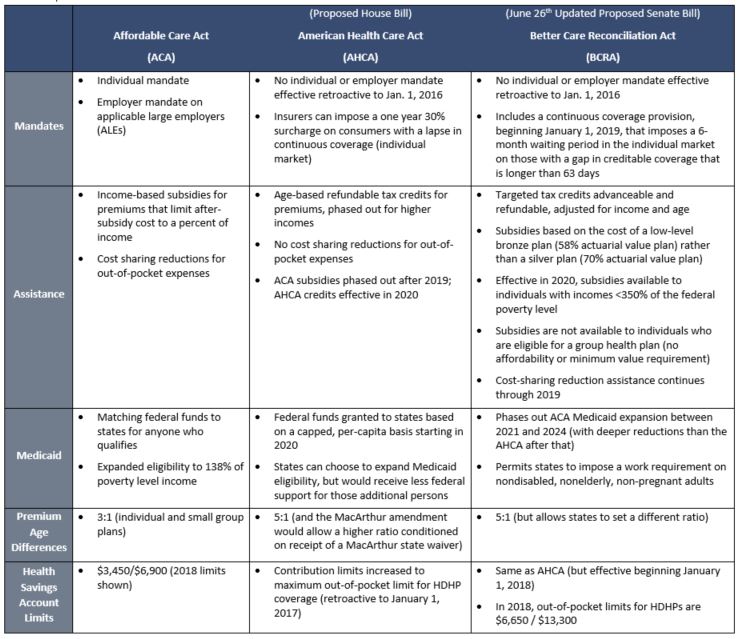
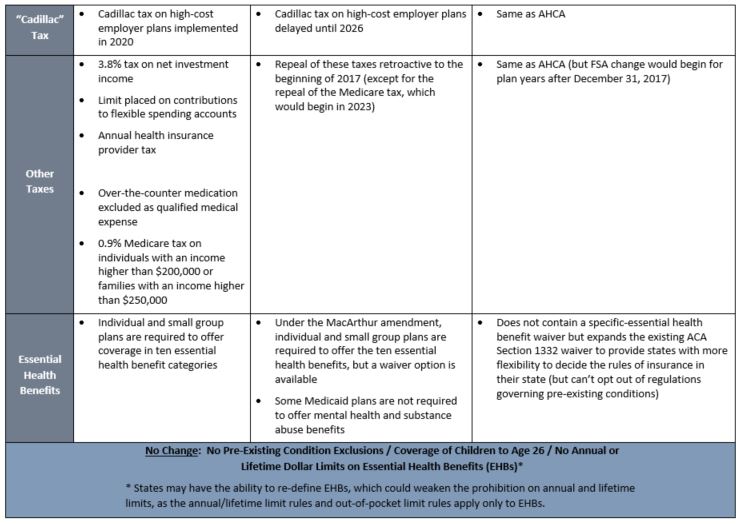
In large part, the BCRA mirrors the House-passed AHCA.  A comparison of the two bills can be found below. Similar to the House bill, the Senate bill would repeal virtually all of the tax increases imposed by the ACA, except for the “Cadillac” tax on high-cost employer-sponsored coverage, which would be delayed through 2025. 

Key Issues for Employers

For employers, the most significant change made by the AHCA to the ACA that was retained by the BCRA is the repeal of the employer mandate penalties effective January 1, 2016.  The BCRA retains other significant AHCA changes for employers, including unlimited flexible spending accounts, and enhancements to health savings accounts (HSAs).   Of note for employers sponsoring fully-insured group health plans, beginning in 2020 the bill requires states to set their own medical loss ratio rebating rules.  It also adds a structure under ERISA (by adding a new Part 8) that would allow for the establishment of association health plans for small businesses or individuals (Small Business Health Plans or SBHPs), allowing them to be treated as large group plans exempt from the community rating and essential health benefit requirements that are currently applicable to small group and individual plans.  This new section of ERISA would preempt any and all state laws that would preclude an insurer from offering coverage in connection with an SBHP and would go into effect one year after enactment (and implementing regulations would be required to be promulgated within six months of enactment).

The addition in the updated June 26th Discussion Draft of a continuous coverage requirement would again require employers to provide written certifications of periods of creditable coverage for the purpose of verifying that the continuous coverage requirements are met.

Also significant is that the bill does not include a provision capping the tax exclusion for employer provided health insurance.  Many employers were concerned that the exclusion would be capped or removed as a way to increase revenue to pay for other tax cuts in the bill.  Nor does the bill repeal the Sections 6055 and 6056 reporting requirements.  It will remain to be seen whether, if the BCRA is passed, the IRS may continue to use the existing ACA information reporting system to determine whether an individual is eligible for a premium tax credit or is prohibited from receiving one in 2018 or 2019 because such an individual has an offer in 2018 or 2019 of affordable, minimum value employer-sponsored coverage.  Or, whether in 2020 and thereafter, the IRS would need information to assess whether an individual has any offer of employer-sponsored coverage to determining eligibility for the premium tax credit.  

Key Issues for Individuals

For individuals, the BCRA would repeal the ACA’s Medicaid expansion, but at a slower rate than proposed by the AHCA and would tighten the eligibility criteria for premium subsidies (beginning in 2020, only those earning up to 350% of the poverty level would qualify rather than the 400% threshold in the ACA); however, subsidies would open up for enrollees below the poverty level living in states that did not expand Medicaid.  The bill would allocate money for cost-sharing subsidies through 2019, which are used to offset the costs for insurers to offer low-income individuals with coverage that has lower out-of-pocket costs.  There had been uncertainty whether these payments would continue, which was causing instability in the individual insurance market.  Higher-income individuals would see relief from various ACA taxes and fees, including the 0.9% Medicare surtax beginning in 2023 and the 3.8% net investment income tax retroactive to the beginning of this year.

Next Steps

The Republicans are trying to pass the bill through the budget reconciliation process since it allows them to avoid a Democratic filibuster and to pass the bill with a simple majority (rather than 60 votes).  However, the Republicans have only 52 Senate seats, which means that to pass, Senator McConnell can only afford to lose 2 votes (Vice President Pence can be the tie breaker).  The bill may be too liberal for some Republican senators and too “harsh” for others (the CBO score released on June 26th states that the BCRA would leave 22 million more uninsured by 2026 than under the ACA), so it remains to be seen whether the bill, as proposed, will pass or whether it will undergo further revisions to ensure passage.  Currently, there are at least 5 Republican senators who have publicly expressed that they would not vote for the bill as currently drafted.  The Republicans will not have much time to sort out any disagreement since Senator McConnell has stated that he intends to call a vote this week before the July 4th recess.   

If the Senate passes a bill, it will either have to be approved by the House (the two chambers would have to reconcile their differences in a conference committee), or the House could pass a new version and send it back to the Senate for approval.

As noted previously, employers and other stakeholders should continue to stay the course on ACA compliance at this time while they monitor for changes as the BCRA continues to make its way through the legislative process. 

Comparison of the ACA, AHCA, and BCRA

The chart below compares some of the significant changes proposed by the BCRA to the ACA and the proposed House bill.
About the Author

This alert was prepared for Benefit Advisors Network by Stacy Barrow.  Mr. Barrow is a nationally recognized expert on the Affordable Care Act.  His firm, Marathas Barrow Weatherhead Lent LLP, is a premier employee benefits, executive compensation and employment law firm.  He can be reached at sbarrow@marbarlaw.com.

This message is a service to our clients and friends. It is designed only to give general information on the developments actually covered. It is not intended to be a comprehensive summary of recent developments in the law, treat exhaustively the subjects covered, provide legal advice, or render a legal opinion.

Benefit Advisors Network and its smart partners are not attorneys and are not responsible for any legal advice. To fully understand how this or any legal or compliance information affects your unique situation, you should check with a qualified attorney.

© Copyright 2017 Benefit Advisors Network. Smart Partners. All rights reserved

Legal Alert: REMINDER: PCORI Fees Due by July 31, 2017

Employers that sponsor self-insured group health plans, including health reimbursement arrangements (HRAs) should keep in mind the upcoming July 31, 2017 deadline for paying fees that fund the Patient-Centered Outcomes Research Institute (PCORI).  As background, the PCORI was established as part of the Affordable Care Act (ACA) to conduct research to evaluate the effectiveness of medical treatments, procedures and strategies that treat, manage, diagnose or prevent illness or injury.  Under the ACA, most employer sponsors and insurers will be required to pay PCORI fees until 2019.

The amount of PCORI fees due by employer sponsors and insurers is based upon the number of covered lives under each “applicable self-insured health plan” and “specified health insurance policy” (as defined by regulations) and the plan or policy year end date. 

  • For plan years that ended between January 1, 2016 and September 30, 2016, the fee is $2.17 per covered life and is due by July 31, 2017.
  • For plan years that ended between October 1, 2016 and December 31, 2016, the fee is $2.26 per covered life and is due by July 31, 2017.

For example, a plan year that ran from October 1, 2015 through September 30, 2016 will pay a fee of $2.17 per covered life.  Calendar year 2016 plans will pay a fee of $2.26 per covered life.

NOTE: The insurance carrier is responsible for paying the PCORI fee on behalf of a fully insured plan.  The employer is responsible for paying the fee on behalf of a self-insured plan, including an HRA.  In general, health FSAs are not subject to the PCORI fee.

Employers that sponsor self-insured group health plans must report and pay PCORI fees using IRS Form 720, Quarterly Federal Excise Tax Return.  

Note that because the PCORI fee is assessed on the plan sponsor of a self-insured plan, it generally should not be included in the premium equivalent rate that is developed for self-insured plans if the plan includes employee contributions.  However, an employer’s payment of PCORI fees is tax deductible as an ordinary and necessary business expense.

Historical Information for Prior Years

  • For plan years that ended between October 1, 2015 and December 31, 2015, the fee was $2.17 per covered life and was due by August 1, 2016.
  • For plan years that ended between January 1, 2015 and September 30, 2015, the fee was $2.08 per covered life and was due by August 1, 2016.
  • For plan years that ended between October 1, 2014 and December 31, 2014, the fee was $2.08 per covered life and was due by July 31, 2015.
  • For plan years that ended between January 1, 2014 and September 30, 2014, the fee was $2 per covered life and was due by July 31, 2015.
  • For plan years that ended between October 1, 2013 and December 31, 2013, the fee was $2 per covered life and was due by July 31, 2014.
  • For plan years that ended between January 1, 2013 and September 30, 2013, the fee was $1 per covered life and was due by July 31, 2014.
  • For plan years that ended between October 1, 2012 and December 31, 2012, the fee was $1 per covered life and was due by July 31, 2013.  

Counting Methods for Self-Insured Plans

Plan sponsors may choose from three methods when determining the average number of lives covered by their plans.

Actual Count method.  Plan sponsors may calculate the sum of the lives covered for each day in the plan year and then divide that sum by the number of days in the year.

Snapshot method.  Plan sponsors may calculate the sum of the lives covered on one date in each quarter of the year (or an equal number of dates in each quarter) and then divide that number by the number of days on which a count was made. The number of lives covered on any one day may be determined by counting the actual number of lives covered on that day or by treating those with self-only coverage as one life and those with coverage other than self-only as 2.35 lives (the “Snapshot Factor method”).

Form 5500 method.  Sponsors of plans offering self-only coverage may add the number of employees covered at the beginning of the plan year to the number of employees covered at the end of the plan year, in each case as reported on Form 5500, and divide by 2.  For plans that offer more than self-only coverage, sponsors may simply add the number of employees covered at the beginning of the plan year to the number of employees covered at the end of the plan year, as reported on Form 5500.

Special rules for HRAs. The plan sponsor of an HRA may treat each participant’s HRA as covering a single covered life for counting purposes, and therefore, the plan sponsor is not required to count any spouse, dependent or other beneficiary of the participant. If the plan sponsor maintains another self-insured health plan with the same plan year, participants in the HRA who also participate in the other self-insured health plan only need to be counted once for purposes of determining the fees applicable to the self-insured plans.


About the Author

This alert was prepared for Benefit Advisors Network by Stacy Barrow.  Mr. Barrow is a nationally recognized expert on the Affordable Care Act.  His firm, Marathas Barrow Weatherhead Lent LLP, is a premier employee benefits, executive compensation and employment law firm.  He can be reached at sbarrow@marbarlaw.com.

This message is a service to our clients and friends. It is designed only to give general information on the developments actually covered. It is not intended to be a comprehensive summary of recent developments in the law, treat exhaustively the subjects covered, provide legal advice, or render a legal opinion.

Benefit Advisors Network and its smart partners are not attorneys and are not responsible for any legal advice. To fully understand how this or any legal or compliance information affects your unique situation, you should check with a qualified attorney.

Legal Alert: House Republicans Pass American Health Care Act; Bill Heads to Senate for Further Consideration

On Thursday, May 4, by a vote of 217 to 213 (with 20 Republicans voting against the bill), the U.S. House of Representatives passed an amended version of the American Health Care Act (AHCA), which repeals and replaces significant portions of the Affordable Care Act (ACA).  

This bill comes several weeks after U.S. House of Representatives’ Speaker Paul Ryan pulled the AHCA from the floor once it was clear that, at that time, the bill was short on votes to pass. In large part, the original bill failed because the more conservative wing of the Republican Party, known as the Freedom Caucus, was against the bill because of its preservation of certain ACA provisions. 

For employers, the most significant change the AHCA makes to the ACA is to repeal the employer mandate penalties effective January 1, 2016.  Other significant changes for employers are unlimited flexible spending accounts, and enhancements to health savings accounts (HSAs).   For individuals, the most significant changes include the repeal of the ACA’s Medicaid expansion and its premium subsidies and cost-sharing reductions for low-income individuals.  Higher-income individuals would see relief from various ACA taxes and fees, including the 0.9% Medicare surtax beginning in 2023 and the 3.8% net investment income tax retroactive to the beginning of this year.

The AHCA has been amended several times since its introduction.  There are two Manager’s amendments (containing Technical and Policy changes), the MacArthur amendment, and the Upton amendment

The MacArthur amendment establishes a “Federal Invisible Risk-Sharing Program” and allows states to submit applications to the Secretary of Health and Human Services to modify certain ACA requirements, such as the essential health benefits standard and age rating restrictions. States would also be permitted to waive the AHCA’s 30 percent premium surcharge for individuals who seek to re-enroll after failing to maintain continuous coverage, defined as a lapse of 63 days or more over the previous 12 months; however, insurers would be able to underwrite based on health status when there has been such a lapse (generally for up to 12 months).  For employers, this may mean again having to issue certificates of creditable coverage.  The Upton amendment would add an additional $8 billion to state risk pools, which are intended to help individuals with pre-existing conditions obtain coverage in states where community rating is not mandatory.  

There was also a companion bill (H.R. 2192) that passed the House along with the AHCA, which eliminates the waiver option in the MacArthur amendment for members of Congress.  The bill ensures that members of Congress and their staff are treated the same as other individuals in a state that receives a MacArthur amendment waiver.

Summary of Key Changes 

The chart below summarizes some of the significant changes made by the AHCA.

MacArthur Amendment

The following chart summarizes the changes made to the AHCA by the MacArthur amendment.

Limited Waiver Option

The limited waiver option in the MacArthur amendment was necessary to secure the votes of the Freedom Caucus.  It has been criticized as potentially allowing states to waive out of the prohibition on pre-existing condition exclusions by allowing underwriting based on health status for those who experience a gap in continuous coverage, which in effect temporarily raises the cost of coverage for individuals with pre-existing conditions.  It remains to be seen whether the AHCA’s high risk pools and invisible risk-sharing program contain enough funding to offset these potential premium increases.

Next Steps

AHCA has yet to be scored by the Congressional Budget Office. It will now go to the Senate where significant changes are expected in order to secure passage (and it is possible that it may not garner enough votes there to pass at all).  In addition, it is not clear that as currently drafted it will meet the requirements to qualify for a simple majority vote under the Senate’s budget reconciliation rules.  Provisions that have no budgetary impact may be removed and AHCA’s tax policies may be required to have sunset dates so that they do not increase deficits outside of the budget window (typically, 10 years).  It may take months before any final legislation is passed and the AHCA may get stalled again as changes will have to go back to the House for approval.  Employers and other stakeholders should stay the course on ACA compliance at this time while they continue to monitor for changes as the AHCA continues to make its way through the legislative process.


About the Author

 This alert was prepared for Benefit Advisors Network by Stacy Barrow.  Mr. Barrow is nationally recognized experts on the Affordable Care Act.  His firm, Marathas Barrow Weatherhead Lent LLP, is a premier employee benefits, executive compensation and employment law firm.  He can be reached at sbarrow@marbarlaw.com.

This message is a service to our clients and friends. It is designed only to give general information on the developments actually covered. It is not intended to be a comprehensive summary of recent developments in the law, treat exhaustively the subjects covered, provide legal advice, or render a legal opinion.

Benefit Advisors Network and its smart partners are not attorneys and are not responsible for any legal advice. To fully understand how this or any legal or compliance information affects your unique situation, you should check with a qualified attorney.

© Copyright 2017 Benefit Advisors Network. Smart Partners. All rights reserved. 

Legal Alert: House Republicans Withdraw the AHCA Before a Planned Vote But Efforts to Repeal Continue

On Friday, March 24, 2017, the U.S. House of Representatives’ Speaker Paul Ryan pulled from the floor the American Health Care Act (AHCA), the proposed legislation to repeal and replace the Affordable Care Act (ACA), once it was clear that the bill was short on votes to pass. Effectively, this means the AHCA will not survive to become law and, at this time, any future efforts to repeal and replace the ACA are uncertain. This may mean, as Speaker Ryan said shortly after the announcement that the bill was withdrawn, “Obamacare is the law of the land. We’re going to be living with Obamacare for the foreseeable future.” However, as of March 28, there have been reports that the House Republican leaders and the Trump administration have started renegotiations on legislation to repeal the ACA. At this time, there are no details about what may be in any renewed repeal legislation or the timing of its release or a vote.

What the AHCA Would Have Done

If enacted, the AHCA would have retroactively repealed the individual and employer mandate penalties, delayed the 40% “Cadillac” tax on employer-sponsored health plans, made significant changes to the ACA insurance coverage and marketplace stabilization provisions, enhanced health savings accounts (HSAs), provided relief from many of the ACA’s taxes and fees, and curtailed Medicaid reforms, among other things.

The AHCA was intended to be Phase I of a three-phase approach to repeal and replace the ACA through the budget reconciliation process, which requires a simple majority vote in Congress. Phase II was envisioned to include regulatory relief by Health and Human Services (HHS) Secretary Thomas Price, and in Phase III legislation would be introduced to repeal the ACA market reforms, permit the sale of insurance across state lines, and effectuate other provisions that could not be addressed through the budget reconciliation process because of the Byrd rule, which limits reconciliation provisions in the Senate to provisions that affect government revenues and outlays.

Why It Failed

In large part, the bill failed because the more conservative wing of the Republican Party, known as the Freedom Caucus, was against the bill because of its preservation of certain ACA provisions. Prior to the vote on the bill, which was initially scheduled for Thursday, changes were introduced (via what was referred to as the “Manager’s Amendment”) to add concessions (such as accelerating the repeal of most of the ACA tax provisions) in the hope that the Freedom Caucus, representing more than 30 members, would vote in favor of the bill. However, when realizing that even those concessions were not enough, additional concessions, including the repeal of the federal “essential health benefits” definition were added. At that point, more moderate Republicans were voicing concerns. Late Thursday, President Trump issued an ultimatum, demanding a vote on Friday and threatening Republicans that the ACA would remain the law if Republicans did not back the AHCA. By Friday afternoon, it was apparent that a compromise could not be reached, and the bill was withdrawn (at President Trump’s request) without going to a vote.

What Does This Mean for Employers

Effectively, at least for the short term, the ACA, including the employer and individual mandates (including associated reporting) remains the law of the land. Until further notice, employers must stay the course on their compliance efforts.

Administrative Relief May Be Forthcoming

Consistent with the President’s Executive Order issued immediately after his taking office, there may be pressure on HHS Secretary Price in the short-term to provide regulatory relief to the extent permitted by the ACA. However, it is unclear whether any such relief will focus on issues facing employer-sponsored group health plans.

Future Legislative Efforts Uncertain

President Trump could remain firm on his ultimatum and not support any future efforts to repeal the ACA and test his theory that it will “explode.” One way the Republicans may help hasten this is by choosing not to pursue a lawsuit filed by Congressional Republicans during the Obama administration that would de-fund the cost-sharing reduction subsidies paid to insurers to reduce out-of-pocket costs for low-income enrollees, which the Republicans have asserted are illegal. In that case, Republicans argued that Congress never actually gave the Obama administration funding for the program that’s being used to pay insurers. A district court judge decided in their favor, but the Obama administration appealed the case. The case was delayed in February and is currently on hold, with an update due in May. Many believe these payments are essential for the stability of the insurance market. It remains to be seen whether the administration will drop the case and Republicans will fund the next round of subsidies in the short-term spending bill due at the end of April in exchange for a commitment by insurance companies not to abandon the market over the next few weeks. Many conservatives may view this course of action as “giving up” on repeal and may not support it unless it is part of a larger repeal and replace effort.

Initially, the Trump administration and other Republican leadership stated that they intended to move on to tax reform and other initiatives at the top of the Trump administration’s agenda. However, there is nothing that could stop Republicans from trying to garner support for another repeal effort, and, in fact, there have been recent reports that the House Republicans and the Trump administration are back in negotiations on repeal legislation. The details and timing of such renewed efforts have yet to be released. It is possible that the Republicans may offer piecemeal legislation to address certain components of the ACA, rather than a complete repeal.

ACA Taxes Repeal May Be Left Out of Any Tax Reform

Taxes associated with the ACA will remain untouched while Congressional Republicans work on reforming the rest of the tax code, House Speaker Ryan said following the March 24 decision to pull the AHCA from a planned House vote. According to the latest Congressional Budget Office report, repeal of the ACA taxes would have reduced revenues by nearly $1 trillion over the next ten years. Republicans believed that repealing the ACA taxes first and being able to offset them with ACA spending cuts would have made tax reform easier. According to Ryan, failure to pass the AHCA “just means the Obamacare taxes stay with Obamacare. We’re going to go fix the rest of the tax code.”

ACA Taxes Repeal May be Funded by Cap on Employer Sponsored Health Coverage

However, ACA tax repeals may be part of the larger tax reform effort if other tax expenditures would be used to finance the repeal. One option that has been suggested is instituting a cap on the exclusion for employer-sponsored health coverage. Initial leaked drafts of the AHCA had included such a provision but were not included when the bill was introduced earlier this month after there was political pressure by employer groups to eliminate it.

While it is not quite clear yet that the dust has settled, employers should proceed with the expectation that the IRS will begin enforcing the employer mandate via the ACA reporting forms, and prepare for the return of the health insurance industry tax (HIT) in 2018 (the HIT affects fully-insured medical, dental and vision plans but was under a one-year moratorium for 2017). Lastly, the Cadillac tax is expected to be effective in 2020, so employers should also continue evaluating how their plans may be impacted. Of course, it’s certainly possible that the Cadillac tax will be delayed again in the future.


About the Authors

About The Authors. This alert was prepared for Benefit Advisors Network by Stacy Barrow and Mitch Geiger. Mr. Barrow and Mr. Geiger are nationally recognized experts on the Affordable Care Act. Their firm, Marathas Barrow & Weatherhead LLP, is a premier employee benefits, executive compensation and employment law firm. They can be reached at sbarrow@marbarlaw.com or mgeiger@marbarlaw.com.

This message is a service to our clients and friends. It is designed only to give general information on the developments actually covered. It is not intended to be a comprehensive summary of recent developments in the law, treat exhaustively the subjects covered, provide legal advice, or render a legal opinion.

Benefit Advisors Network and its smart partners are not attorneys and are not responsible for any legal advice. To fully understand how this or any legal or compliance information affects your unique situation, you should check with a qualified attorney.

© Copyright 2017 Benefit Advisors Network. Smart Partners. All rights reserved.

Legal Alert: House Committees Release Proposed Legislation to Repeal and Replace the ACA

HouseCommitteeOn Monday, March 6, the U.S. House of Representatives Ways and Means and Energy and Commerce Committees released the American Health Care Act (AHCA), their proposed legislation to repeal and replace the Affordable Care Act (ACA) through the budget reconciliation process, which requires a simple majority vote of Congress. Key provisions of the bill, if enacted, would:

•    retroactively repeal the individual and employer mandate penalties to months after December 31, 2015;

•    delay the 40% “Cadillac Tax” on employer-sponsored health plans until 2025 (but would not include a cap on the employer-provided health care tax exclusion, which had been proposed in an earlier leaked draft of the AHCA and which some had expected would replace the Cadillac tax and fund the replacement provisions);

•    make significant changes to the ACA insurance coverage and marketplace stabilization provisions; 

•    enhance health savings accounts (HSAs) and provide a monthly tax credit; 

•    provide relief from many of the ACA’s taxes and fees; and

•    curtail Medicaid reforms.

Preservation of a Majority of ACA’s Protections

The AHCA would preserve a majority of the ACA’s protections.  For example, the following key ACA provisions would remain in place under the terms of the AHCA:

•    out-of-pocket limits on essential health benefits (EHBs) for non-grandfathered plans (currently $7,150 for self-only coverage and $14,300 for family coverage);

•    prohibition on lifetime and annual dollar limits for EHBs;

•    prohibition on pre-existing condition exclusions;

•    coverage for adult children up to age 26;

•    guaranteed availability and renewability of coverage;

•    nondiscrimination rules (on the basis of race, nationality, disability, age or sex); and

•    Prohibition on health status underwriting.

The requirement to offer the EHB package for individual and small group plans also remains in place, although the actuarial value requirement would be repealed. The bill would allow states to permit rates to vary by age with a ratio of 5:1 (instead of the current 3:1 ratio) for plan years beginning on or after January 1, 2018. 

Retroactive Repeal to 2016 of Individual and Employer Mandate Penalties

The AHCA would eliminate both the individual and employer mandate penalties by reducing to “zero” effective retroactively to 2016 the Section 5000A individual shared responsibility tax (“individual mandate”) and the Section 4980H employer shared responsibility tax (“employer mandate”).   Practically, this would mean that individuals who paid the individual mandate penalty for 2016 might be able to request a refund.  Large employers presumably would still be responsible for any penalties for 2015.

The ACA’s reporting requirements under Section 6055 and 6056 are not expressly repealed in the proposed bill.  However, the AHCA does outline a new prospective reporting process (discussed further below), under which employers would indicate an offer of health coverage on the employee’s W-2 tax form, which would make the current reporting redundant.  The Ways and Means section-by-section summary notes that “reconciliation rules limit the ability of Congress to repeal the current reporting, but, when the current reporting becomes redundant and replaced by the reporting mechanism called for in the bill, then the Secretary of the Treasury can stop enforcing reporting that is not needed for taxable purposes.”

Replacing Low-Income Premium Tax Credits with Age-Adjusted Tax Credits Beginning in 2020 

The bill would completely repeal the ACA premium tax credits. In addition, the cost-sharing subsidies paid to insurers that covered low income individuals would be repealed beginning in 2020.

Under current law, the amount a household is required to pay towards their premiums is based on income.  For households with incomes less than 400% of the federal poverty level there are certain limits on the amount the household is required to repay the federal government for the excess premium tax credits.  The legislation would end current income-based caps on excess advance premium tax credits, requiring households that received excess premium tax credits to repay the entire excess amount, regardless of income, for 2018 and 2019.  Under current law, qualified health plans must meet certain requirements for households to be eligible for the premium tax credit.  The bill would also modify the credit so that the credit could be used for certain non-Exchange and “catastrophic-only” coverage. The modified tax credits may not be applied for the purchase of any coverage that includes abortions (but does not prohibit the purchase of a separate policy that includes abortions). The bill also revises the schedule under which an individual’s or family’s share of premiums is determined by adjusting for household income and the age of the individual or family members.

Beginning in 2020, age-adjusted tax credit would be available for individuals purchasing insurance in the individual market, with older individuals receiving larger credits. The tax credit is refundable and advanceable on a monthly-basis to pay for individual market premiums (i.e., not employer coverage) or any unsubsidized COBRA coverage from a former employer. The annual tax credit amount is established as follows per individual: 

•    $2,000 for those under 30;

•    $2,500 for those between 30 and 40;

•    $3,000 for those between 40 and 50;

•    $3,500 for those between 50 and 60; and

•    $4,000 for those over 60. 

The new tax credits would be capped at $14,000 per family and would be adjusted for inflation over time.  In addition, the tax credit begins to phase out when a taxpayer’s modified adjusted gross income reaches $75,000 ($150,000 for joint filers) adjusted annually by the consumer price index plus one percentage point for inflation after 2020. 

To be eligible for the tax credit, the individual may not be eligible for employer-sponsored health care coverage or government coverage such as Medicare or Medicaid.  The proposed legislation would require employers to report on an employee’s Form W-2 for each month of the year whether the employee has an offer of eligible employer-sponsored coverage. Insurers also would continue to have additional coverage reporting obligations regarding off-Exchange coverage for 2018 and 2019, and under a new Section 6050X for coverage that is eligible for the premium tax credit that would be available beginning in 2020.

Repeal of Small Business Tax Credits Beginning in 2020

The ACHA would repeal the ACA’s small business tax credit beginning in 2020.  Between 2018 and 2020, under the proposal, the small business tax credit would generally not be available with respect to a qualified health plan that provides coverage relating to elective abortions.

Preservation of Pre-Existing Conditions and Addition of a Continuous Coverage Requirement Beginning with Open Enrollment in 2019

The proposed legislation does not eliminate the ACA requirement that insurers must offer coverage to individuals without pre-existing condition exclusions.  However, beginning in 2019, the bill would replace the individual mandate with a continuous coverage requirement. To avoid a 30% premium surcharge, individuals would have to prove that they did not have a gap in creditable coverage of at least 63 continuous days during the 12 months preceding coverage. The penalty would last for the remainder of the plan year for special enrollments during 2018 (such as a dependent aging out), and for the 12-month period beginning with the first day of the plan year for 2019 and succeeding years. One practical implication of this requirement may be renewed reporting of HIPAA creditable coverage that existed prior to the ACA’s enactment.

Enhanced HSAs Beginning in 2018

The bill also contains various provisions to encourage use of health savings accounts (HSAs).  The AHCA would: 

•    increase the maximum annual contribution limits on HSAs to match the annual deductible and out-of-pocket expenses under a high deductible health plan (HDHP) (at least $6,550 for individuals and $13,100 for families beginning next year);

•    allow both spouses to make catch-up contributions to the same HSA; and 

•    allow HSAs to cover medical expenses incurred during the first 60 days of HDHP coverage as long as the HSA is established within that 60-day period, with all provisions effective for 2018.

Repeal of Various ACA Taxes

In addition to the individual and employer mandates and small business tax credits discussed above, below is a list of some of the other tax relief provisions in the ACHA, which, if the bill is enacted, would effectively revert these taxes to pre-ACA limits in most cases:

The proposed legislation does not appear to repeal the Patient Center Outcomes Research Insurance (PCORI) fees at this time.  

Medicaid Expansion Curtailed Beginning in 2020

The bill would maintain the ACA Medicaid expansion through Jan. 1, 2020. At that time, enrollment would be frozen and states would no longer be able to admit new enrollees, with the expectation that enrollment would slowly decline as enrollees’ incomes change and they shift off the program. Another significant change to Medicaid under the bill would be a conversion of Medicaid to a “per capita cap” system, where states would get a lump sum from the federal government for each enrollee. By contrast, under current Medicaid funding, the federal government has an open-ended commitment to paying all of a Medicaid enrollee’s health care costs, regardless of how high those costs go. 

Next Steps

The AHCA is only the House Republicans’ initial proposal to repeal and replace the ACA and there is likely to continue to be significant debate over the legislation.  For instance, Sen. Rand Paul (R-Ky.) is among several other conservative senators who oppose the plan to provide income-based tax credits. Additionally, four key Republican senators, Sens. Rob Portman (Ohio), Shelley Moore Capito (W.Va.), Cory Gardner (Colo.) and Lisa Murkowski (Alaska), all from states that opted to expand Medicaid under the ACA, said they would oppose any new plan that does not include stability for Medicaid expansion populations or flexibility for states.

There is currently no Congressional Budget Office (CBO) score for the AHCA, which makes it impossible to determine if the bill complies with congressional PAYGO (pay-as-you-go) requirements. PAYGO compels new spending or tax changes not to add to the federal debt. Under the PAYGO rules a new proposal must either be “budget neutral” or offset with savings derived from existing funds.

Because the GOP leaders are maintaining a path to passage that does not include Democrats, the bill must be limited to the budget reconciliation process to avoid a filibuster and preserve the ability to pass by simple majority in the Senate. A potential problem with budget reconciliation is the Byrd rule which limits reconciliation provisions in the Senate to provisions that affect government revenues and outlays. This severely restricts what the bill is capable of achieving through substantive legislative change. Several provisions of the bill, such as the age rating or continuous coverage requirements, might violate the Byrd rule.

The Byrd rule also means that the bill cannot include several items that have regularly been raised as part of a replacement measure, such as tort reform, nor can it repeal McCarran-Ferguson, which would eliminate the antitrust exemption for insurance, remove states as the primary authority to regulate the industry, and create an insurance market expansion across state lines.

Any final legislation may look very different than the initial AHCA proposal and employers and other stakeholders should stay the course on ACA compliance at this time while they continue to monitor for changes as the AHCA makes its way through the legislative process.


About The Authors

 This alert was prepared for Benefit Advisors Network by Stacy Barrow and Mitch Geiger.  Mr. Barrow and Mr. Geiger are nationally recognized experts on the Affordable Care Act.  Their firm, Marathas Barrow & Weatherhead Lent LLP, is a premier employee benefits, executive compensation and employment law firm.  They can be reached at sbarrow@marbarlaw.com or mgeiger@marbarlaw.com.

This message is a service to our clients and friends. It is designed only to give general information on the developments actually covered. It is not intended to be a comprehensive summary of recent developments in the law, treat exhaustively the subjects covered, provide legal advice, or render a legal opinion.

Benefit Advisors Network and its smart partners are not attorneys and are not responsible for any legal advice. To fully understand how this or any legal or compliance information affects your unique situation, you should check with a qualified attorney.

© Copyright 2017 Benefit Advisors Network. Smart Partners. All rights reserved.