Scrutiny of Independent Contractors in a Biden Administration

The battle and confusion of identifying an independent contractor continues. Jumping across party lines for rules established to benefit employers under the Republican Trump Administration to now halting the advancement of those rules in an effort to benefit employees under the Democratic Biden Administration.

Such as with any new political administration, the incumbent traditionally pend new rules “for the purpose of reviewing any questions of fact, law, and policy the rules may raise.” On January 20, 2021, a memorandum, “Regulatory Freeze Pending Review” was issued by the Biden Administration that proposed delaying rules published in the Federal Register for 60 days as well as the option to re- open for a comments review period from interested parties.

For rules impacting independent contractors, the Department of Labor (DOL) announced on February 3 that it would pend the effective date of the Independent Contractor Status Under the Fair Labor Standards Act (Independent Contractor Rule) from March 8, 2021 to May 7, 2021. Additionally, the DOL withdrew two opinion letters that addressed independent contractors as the opinions were issued based on rules not yet in effect:

  • FLSA-2021-8 regarding independent contractor status for certain distributors of manufacturers food products.
  • FLSA-2021-9 for guidance on control of safety measures for tractor-trailer truck drivers as to whether this affects their independent status and if certain owner-operators are properly classified as independent contractors.

Employers are cautioned that they should not be relying on either the Independent Contractor Rule or the opinions published in these rescinded opinion letters. What does all this posturing between the political parties mean for employers? For purposes of the Independent Contractor Rule, there are three options to choose from:

  1. The rule could take affect even if temporarily;
  2. The rule could be challenged in court by an outside party; or
  3. The rule-making process could be re-opened, and comments accepted.

This third option is what was chosen. The comment period was open until February 24, 2021.

At the heart of the matter for Democrats is workers’ rights for affordable healthcare, fair compensation, safety and health benefits, and other workplace protections along with the right to unionize.

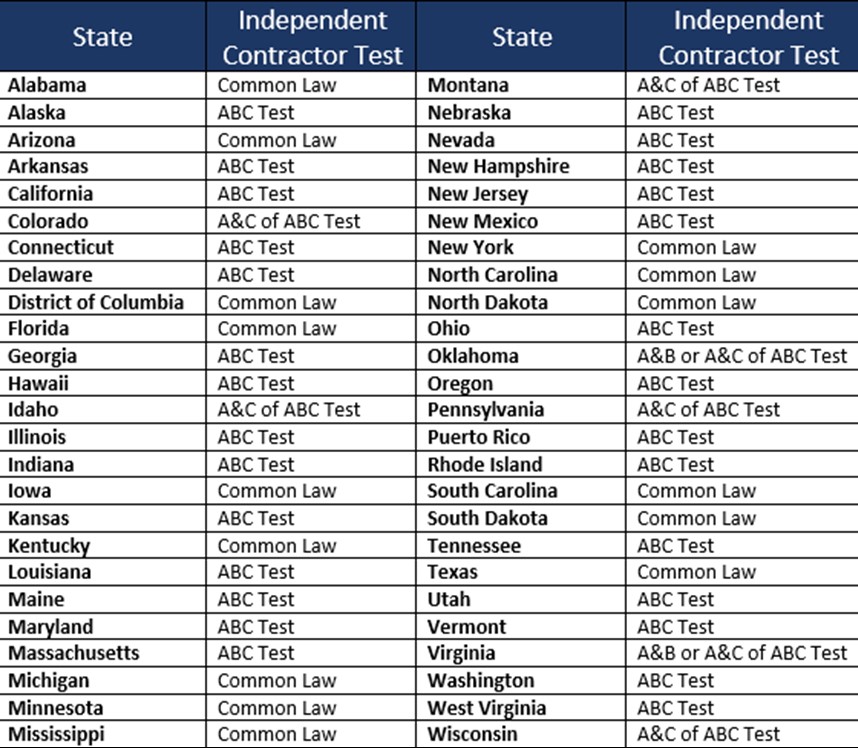
There is no federal standard for defining an independent contractor and many employers have relied upon either:

  1. The Common Law test, used by the Internal Revenue Service, which looks to identify who holds the direction and control of the worker (either the worker or the employer).
  2. The ABC test (used by the DOL) which also looks at the direction and control plus evaluates if the worker engages in a trade, business or occupation similar to what they are doing for an establishment.

Additionally, the following states/cities have passed their own legislation to establish a test for independent contractors, define who is an independent contractor, add protections for independent contractors, define an employee, and/or impose penalties for misclassification:

Virginia – HB1407 effective January 1, 2021

Currently the DOL and the states impose penalties for misclassification of employees as independent contractors. The Biden Administration labor platform is based on “strengthening worker organizing, collective bargaining, and unions.” It is anticipated that we will continue to see a focus on audits and an increase in enforcement penalties for misclassification of employees as independent contractors, as we did during the Obama Administration.

With a position to “aggressively pursue employers who violate labor laws, participate in wage theft, or cheat on their taxes by intentionally misclassifying employees as independent contractors,” employers should revisit their independent contractor arrangements and take measures to ensure that workers are properly classified.

‘Strategic’ Will Be the Word of the Year for 2021

Published by Human Resource Executive, December 2020.

This year has brought HR a host of unprecedented issues to navigate: employee safety concerns, engagement in a newly remote world, legal considerations and even the reshaping of the HR role itself. With all of that change just in the last few months, many HR leaders are looking to 2021 with a bit of trepidation: What’s next?

Bobbi Kloss, director of human capital management services for the Benefit Advisors Network, says HR leaders should be approaching the coming new year with a focus on strategy. Among everything 2020 taught HR leaders, she says, is how key it is to be prepared for everything that could come. Kloss recently spoke with HRE about what she thinks 2021 will bring for HR.

HRE: What was HR’s shining moment in 2020? Conversely, where were mistakes made?

Kloss: HR’s shining moment for 2020 was to be able to simultaneously manage the direction of the workforce to remote work, implement safety protocols within the office and manage the policies for quickly emerging laws to address the needs of the workforce for both employee and continuing business operations.

Individual HR mistakes included failure to be strategically prepared for an event, such as a pandemic, to occur. Just as the federal government is to have a plan for nationwide disasters, we have experienced enough workforce dynamics (outside events that disrupt business continuity)—such as major shifts in the economy, natural disasters, government administration changes, etc.—in our lifetime that have impacted business to know that we should have a plan in place.

Employers learned in 2020 the need for the business culture to represent a communication plan of clear and consistent messaging to employees. Recognizing that employees look to leadership for authoritative direction, HR is able to craft messaging to support an inclusive culture.

HRE: What should be HR leaders’ first priority for 2021?

Kloss: “Strategic” is the key word for 2021.

Be prepared for what lies over the horizon. Become knowledgeable on President-elect Biden’s administration policies and work with the C-suite to have a plan in place to align with the business goals and objectives for the short- and long-term (one, three and five years).Advertisement

Also important for HR leaders is to learn from the lessons of 2020 as to what worked and what needs to be improved. This might include reviewing policies, processes and technologies to create efficiencies that continue to improve upon the culture of the company and positively impact the company’s bottom line.

HRE: Compare HR’s role in large organizations today with a year ago. Will that continue to evolve in 2021?

Kloss: Maintaining relevancy for HR’s place at the C-suite table will continue to evolve. With a focus on the bottom line, the ability to outsource to improve efficiencies and reduce costs is a trend for many organizations across their business units. HR is becoming one of the most outsourced positions.

Overcoming this challenge in HR means that, as human resource professionals, the value brought will be in becoming strategically focused and showing the ROI of the position. This means being aware of the strategic solutions brought to the table and tying these business objectives to the bottom line.

How HR Practices Have Changed During Covid

Published by America’s Benefit Specialist from NAHU, November 2020.

For many organizations, remote work is a new concept. The global pandemic forced countless numbers of employers to rapidly create a work-from-home environment. The speed at which the transition occurred, at different levels of success, allowed many employers to change negative perceptions of remote work, and unveiled benefits that may have been otherwise unthinkable.

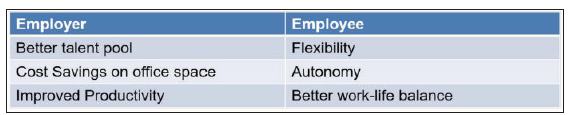
While remote work has been known to produce the following benefits for both employers and employees, the unknown of managing productivity, attendance, and performance has left management skeptical of reaping these rewards.

Against that skepticism, employees quickly rallied to the required change, and productivity was mildly affected for the short term. For employees, the flexibility created a work-life balance they needed and showed management that, with the right resources and accountability measures in place, they could be successful working at home.

Alternatively, there are some employers that continue to see that remote work for a short-term period is tolerable but appreciate the human-to-human interaction of the traditional office environment. There are also
employees who have found working from home challenging and prefer the traditional office environment.

Those employers new to the concept of remote work will find a rhythm. It will be essential, though, for those organizations to have human capital management best practices in place for interviewing and hiring, performance management, and termination of employment to see positive
results prevail.

INTERVIEWING AND HIRING
As employers are finding out, not all employees are suited for remote work. In addition to determining if an applicant has the right qualifications to perform the essential job functions, employers will need to determine if the candidate is capable of long-term success as a remote worker.

Hiring a different skillset with the ability for self-management will require an evaluation of determining if the applicant is:
– a cultural fit for the organization
– an effective communicator
– a great collaborator
– well-organized
– able to manage time efficiently and effectively
– self-disciplined
– able to hold themselves accountable

Behavioral testing tools are beneficial as part of not only the interviewing process in determining long-term success but also should be used throughout the life cycle of the employment for relationship building with both supervisor and the team. Several popular ones exist and are well-vetted behavioral-assessment resources that employers should consider.

It is important to remember that all testing tools, whether behavioral-assessment or skills-based, are just part of the overall interview process and should not be used as the sole criteria for the hiring decision. An organization should be using a combination of interviewing criteria including human resources, the hiring manager, and the team.

PERFORMANCE MANAGEMENT
For a successful remote working relationship, the right resources, tools, and accountability measures should be in place to promote a supportive relationship not only for the employee but also for the success of the managing supervisor.

A trusting management style will be required, and this style is supported by hiring the right candidate and having accountability measures in place that are reflective of the duties of the position. Organizations will need to think beyond the premise that work is getting done if employees are at their desk in an office from 8:00 a.m. until 5:00 p.m., relying instead on the delivery of the established goals for rating performance.

PRODUCTIVITY MANAGEMENT
Productivity management software tools are available. They enable the organization to monitor performance by having the ability to:
• track time
• manage low and high levels of productivity
• maintain IT security
• video-conference for one-to-one supervisor discussions

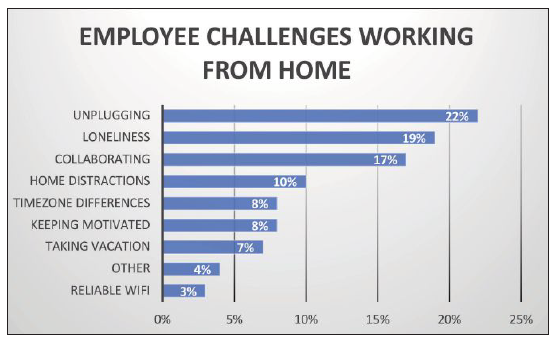
In addition to monitoring tools that give supervisors confidence in employee productivity, striving to overcome employee challenges working from home should be part of the planning process for developing strategies for a successful remote working relationship.

Promoting a work-life balance culture and keeping engaged with management and the team are top priorities for remote workers. With accountability practices in place and the ability to work in many instances at any time of day or night, supervisors need to ensure that the right lifestyle balance is supported.

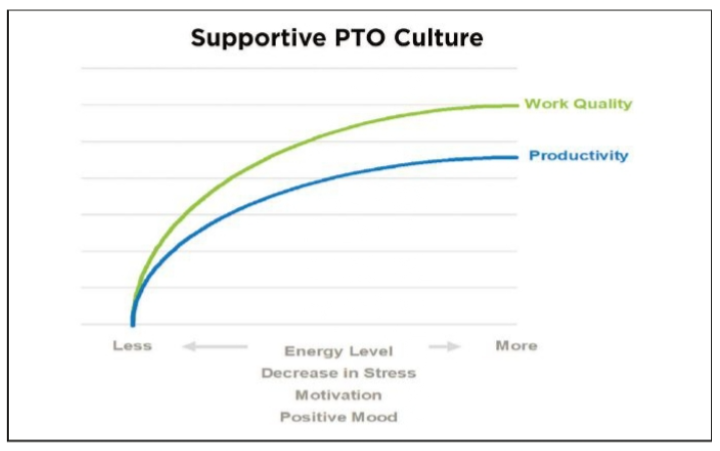
For all employees, but more so with remote workers who are working and living in the same space, encouraging employees to use their allocated time off and unplugging is critical to maintaining productivity, reducing stress, and ensuring the holistic well being of employees. A Work and Wellbeing
survey1 conducted by the American Psychological Association found that the positive effects of returning from paid time off left employees with less stress, increased energy, more motivation, and a positive mood. These resulted in an increase in productivity and quality of work.

The same APA study found that two-thirds of the employees who did not return to a supportive culture of work-life balance saw the positive effects of PTO quickly fade as compared to those who had a supported culture of wellbeing.

Leaders can build a supportive culture by:

  1. Using PTO when sick, for mental health days, and for vacation themselves. The team will look to the leader and traditionally follow in their footsteps. If leaders come to work when ill, that sends a negative image to those who are emulating leadership styles that PTO should
    not be used.
  2. Encouraging others to use PTO and then sharing positive experiences of being away, whether it’s the time spent on vacation or mental-health-day experiences.
  3. Supporting the idea of “unplugging” from all work-related technology, using email out-of-office messaging and apps such as Thrive Away to block time out of the office.
  4. Reviewing workloads and cross-training so the important work has coverage when an individual is out.
  5. Allowing employees the opportunity to have the appropriate time to transition smoothly back into the daily routine.

By guiding an employer to build a supportive wellbeing culture around the PTO benefit, an organization’s trusted health and welfare advisor will be able to show employers a positive net effect of the work-life balance is a workforce that is whole, healthy, and productive. The holistic health of employees leads to the holistic health of the organization.

PERFORMANCE AND TERMINATION OF EMPLOYMENT
Whether it be a deterioration in performance requiring a corrective discussion or a termination of employment, this can be one of the least pleasant responsibilities for any manager. It’s more awkward when done remotely.

When possible, these types of crucial conversations should be done in person. If a worksite is not available, a neutral quiet location is the next best spot. Worth noting, these types of conversations should never take place at an employee’s home or done over emails or text messaging. A local hotel will have smaller conference rooms that can be rented at reasonable costs. When remote travel is not possible, using a virtual conference call would be the next best option.

Managers should be prepared for the conversation with all supporting documentation and, if needed, information regarding any final wage and benefit information, IT security, and return of company property.

RETURN OF COMPANY PROPERTY
It is important employers have a record starting with the date of hire of all assigned company property and have it signed off by the employee. A strategy for the return of the property should be developed before it becomes necessary to collect such property.

It is a best practice for a company to cover related expenses for the employee to return the property to the company. In some instances, it may be appropriate for a third party to intervene to retrieve the property.

New services now being offered through concierge vendors include picking up company property from an employee’s home and returning it to the company. Again, a supervisor should never go to the employee home to personally pick up the property. A neutral service can help defuse any negative situation and work toward the safety of all involved.

1 http://www.apaexcellence.org/assets/general/2018-work-and-wellbeing-survey-results.pdf?_

__________________________________________________________

Bobbi Kloss has served as BAN’s director of human capital management services since 2014. She also oversees all HR-related functions for BAN internal practices. She has a deep understanding of the increasingly complex and diverse HR industry, with more than 20 years of human resource generalist and executive-level human capital management experience. Bobbi began her career as an employment law compliance paralegal for a national PEO after graduating with high honors from the Career Institute for Paralegals. She has a passion for service and has helped establish two nonprofit organizations in Texas, co-founding Teenage Parent Program Scholarships in Houston and founding Heritage Children San Antonio in 2003 to help at-risk youth develop necessary life skills. She currently volunteers her time mentoring women in addictive behavior recovery.

Key Data Resources For HR Pros

Across the Human Resource profession, it is easy to identify two approaches: one applies to performing the tasks at hand and the other is strategic. To most, task-related means performing basic HR functions – the immediate tasks at hand. A strategic focus, alternatively, is when an individual adds value beyond the day-to-day to provide long-term growth for the organization.

As an example, hiring for a replacement position. The task-focused HR professional posts the job, sorts through resumes, conducts phone, and in-person interviews, and hires the most qualified candidate.

Rinse and repeat when the next position needs to be replaced.

When strategically focused, the HR professional looks beyond the task-related aspects of replacing the position and will use data to establish industry comparisons associated with job skills, total rewards, and cultural fit. They will gather and analyze data to develop a solutions-based result to reduce turnover and increase employee engagement and productivity.

When comparing industry and census data with business needs and requirements, one should assess and determine the following (not an exhaustive list):
• Review turnover across company departments;
• Obtain industry-standard turnover ratios;
• Acquire geographic unemployment rates;
• Evaluate industry culture and compare total rewards offerings.

For strategic-minded HR professionals, being able to source and analyze data is very valuable to the ability to attract and retain quality employees. Data helps determine and predict trends, benchmark ourselves within our industry, across geographic lines, and implement best practices for company size and revenue.

Being strategic-minded raises the relevancy of human resources within a business. It enables HR professionals to align the company mission, vision, and goals with its human capital and be instrumental and influential in leading an organization to achieve a healthier business, culture, and people.

While there is a multitude of resources available where national, state, and local workforce data can be obtained, this article provides a brief list and summary (below) of paid and/or free websites where workforce data can be found, including census, industry, demographics, compensation, benefits, gender, ethnicity, promotions data and job titles including the entertainment industry. A suggestion is also to see what association resources are available for specific industries.

The Department of Labor’s Bureau of Labor Statistics produces some of the nation’s economic information.

The Employment Situation News Release presents data from current employment statistics and current population survey programs.

Job Openings and Labor Turnover Survey (JOLTS) program produces data on job openings, hires, and separations. Each state also has its own specific labor statistics available through the State Department of Labor Regional labor market reports such as the Center for Competitive Workforce in the L.A. area.

DATAUSA offers the most comprehensive visualization of U.S. public data.
Statista provides insights and facts across 1,709 industries and over 150 countries.
International Labour Organization provides national information and data on labor laws, standards, policies, and statistics. Country profiles provide also relevant information on ILO projects and programs, publications, and good practices.

Recruiting agencies are also a source of compensation benchmarking.

Additional resources include companies such as:
Willis Towers Watson
Payfactors
Report Linker – with access to data in all market sizes in any sector
IBISWorld – insights and analysis on global industries

Don’t forget the Society for Human Resource Management (SHRM) with membership there is access to both member included and customized benchmarking reports including health and welfare, paid time off, and human capital management.

Whether an HR professional’s budget includes fees for data or not, there is a wealth of information that is readily available. Identifying objectives will guide the appropriate research path. Additionally, reaching out to a trusted benefits advisor should be a starting place for obtaining data. As a true business advisor, they should have access to benchmarking data, and statistical human capital reports for individual industries.

____________________________________________

Bobbi Kloss is the Director of Human Capital Management Services for Benefit Advisors Network – an exclusive, national network of independent employee benefits brokerage and consulting companies. For more information, please visit: www.benefitadvisorsnetwork.com or email the author at bkloss@benefitadvisorsnetwork.com.

Unconscious Bias: A Reality Of The Truth

As published in August/September 2020, issue of Entertainment Human Resources Network.

Bobbi Kloss is the Director of Human Capital Management Services for the Benefit Advisors Network – an exclusive, national network of independent employee benefits brokerage and consulting companies. For more information, please visit: www.benefitadvisorsnetwork.com or email the author at bkloss@benefitadvisorsnetwork.com.

Bobbi will be discussing this topic further on a webinar entitled, HCM Trends: Catalyst to Conversation – Diversity & Inclusion, taking place on September 17, 2020, at 12:00 Noon, Eastern. Andrea Dunn, BAN Agency Administrator, and Michelle Filler, Director of Client Services Forum for BAN, will also be presenting. For more information and to register: https://benefitadvisorsnetwork.com/blog/diversityandinclusionwebinar/

Events shaping our country today including the #MeTooMovement, Black Lives Matter, the disparate impact of Black and Latino populations affected by COVID-19, the Supreme Court decision in BOSTOCK v. CLAYTON COUNTY, GEORGIA recognizing sexual identity within the LGQBT community as a protected sex discrimination class bring a reality of the truth that an honest appraisal of diversity and inclusion in the workplace should occur.

Diversity is as age-old as humankind and refers to the traits and characteristics that make people unique. Differences occur in man versus woman, nationality versus nationality, religion versus religion, race versus race, developmentally or physically disabled versus able-bodied and youth versus the elderly, and in every other way that makes each of us so uniquely designed.

As employers, when we hire employees, we first seek out the best-qualified person to perform the duties of the position. Unknowingly though, we may be establishing a separation in our workforce. We can make assumptions that the best hires are men in engineering positions, Asians in mathematical positions, Indians in IT positions, and women in administrative positions.

These assumptions are unconscious biases.

Secondly, all employers want employees who will work collaboratively to support the culture of the organization. However, organizations receive more than the skills and qualifications of the hired candidate. Once an employee shows up for work, the employer also receives all of the inherent and acquired personality traits of the employee including their “prejudice in favor of or against one thing, person, or group compared with another, usually in a way considered to be unfair.”

These prejudices are unconscious biases.

Both the assumptions and prejudices that are brought into all levels of the workforce can create a division among its employees instead of all working towards common goals.

Protection Against Discrimination

How do these unconscious biases hurt the workplace? When it comes to the workplace where we are hired to work together for the common good of driving the business mission forward we are often at odds with those who we perceive differently. We find that discrimination can occur in every stage of employment including hiring, performance management, pay equity, peer relationships, and supervisory management practices.

The ability of those in the workplace to create an environment in which discriminatory treatment of others who are different is so widespread that federal, state, and local laws exist for the protection of those who are discriminately treated.

Title VII of the Civil Rights Act of 1964 (Title VII), was originally enacted to protect employees against discrimination for race, color, national origin, and religion. Title VII has been amended and other laws passed to add further protection from discriminatory treatment, making it:

Illegal to discriminate against a job applicant or an employee because of the person’s race, color, religion, sex (including pregnancy, gender identity, and sexual orientation), national origin, age (40 or older), disability, or genetic information. It is also illegal to discriminate against a person because the person complained about discrimination, filed a charge of discrimination, or participated in an employment discrimination investigation or lawsuit.

Equal Employment Opportunity (EEO) policies similar to the following begin to set the culture of the company.

Equal Employment Opportunity
The Company is an equal opportunity employer. We will extend equal opportunity to all individuals without regard to race, religion, color, sex (including pregnancy, sexual orientation, and gender identity), national origin, disability, age, genetic information, or any other status protected under applicable federal, state, or local laws. Our policy reflects and affirms the Company’s commitment to the principles of fair employment and the elimination of all discriminatory practices.

Having an EEO policy is not enough. While we all should be treated as equal, diversity and inclusion cultures additionally welcome and promote the uniqueness in each of us and provide the mechanism for a workplace where “all individuals are treated fairly and respectfully, have equal access to opportunities and resources, and can contribute fully to the organization’s success.” Such a commitment would like the following:

Commitment to Diversity & Inclusion
The Company is committed to creating and maintaining a workplace in which all employees have an opportunity to participate and contribute to the success of the business and are valued for their skills, experience, and unique perspectives. This commitment is embodied in company policy and the way we do business and is an important principle of sound business management.

While an organization through its management practices appears to treat all employees as equal, unconscious biases can alternatively provide a real or perceived sense of exclusion in our ability to treat each other non-discriminately. A policy alone cannot eliminate the unconscious biases that exist working against a culture that embodies a workplace where people want to work. How does a company promote and support diversity and inclusion in the workplace?

Employers who are committed to a diverse and inclusive workplace should be prepared to address any barriers that exist within the organization. It will be important to survey all levels of employees for a proper perspective. Having a committee represented by all levels of the company will help to explore ways to make awareness, acceptance, and action relevant and impactful to the dynamics of the organization.