BAN Blog

BAN and PTO Exchange to Give Firms and Employees More Ways to Use Surplus Vacation

FOR IMMEDIATE RELEASE

CONTACT: Jessica Tiller

442-621-7690 or jtiller@pughandtillerpr.com

CLEVELAND, OH (11/19/20) – Benefit Advisors Network (BAN), a national network of independent employee benefit firms, is pleased to announce that it has created a strategic partnership with PTO Exchange, a benefits platform that turns unused paid time off (PTO) hours into liquid assets that can be converted into things employees value – retirement accounts, student loan payments, emergency cash, donations and more.

Under the terms of the new partnership, BAN’s 120+ member firms nationwide will now offer PTO Exchange to their client organizations across the United States.

“There is approximately $65B of unused PTO that is forfeited by employees each year,” says Rob Whalen, CEO of PTO Exchange. “And 2020 is projected to be even worse. COVID-19 has led to employees banking a massive surplus of unused vacation time – up to 34% more, according to industry surveys.”

Continues Whalen, “Our platform gives employees more options to convert that unused vacation into other assets based on their own personal priorities. For employers, we offer a cost-neutral way to extend their current PTO benefit, further support employees, and proactively manage their PTO surplus liability. Particularly at a time when the American workforce needs more options and tools to weather the disruptions caused by COVID-19, we are excited to partner with Benefit Advisors Network.”

Employees can use PTO Exchange to convert unused vacation into: 

  • Retirement savings – allow employees to add to their 401(k) plans;
  • Student loan repayment – provide tuition reimbursement and help to pay down student loans, estimated to total $1.48 trillion in the U.S. today;
  • Emergency expenses – empower the estimated 40% of Americans who cannot cover an unexpected $400 expense;
  • Healthcare –  employees can self-direct to their healthcare savings (HSA) or flexible spending accounts (FSA);
  • Travel – exchange for airfare, hotels and other travel;
  • Leave-sharing – contribute PTO to fellow employees who may need it; and
  • Donations – give to over 1 million charitable organizations in the US.

For employers, benefits include:

  • Extending their current PTO benefit;
  • Providing differentiated benefits to attract and retain talent;
  • Enhancing support for a multi-generational workforce; and
  • Proactively reducing the ballooning surplus PTO liability

“Adding PTO Exchange as a partner strengthens the resources available for our members. Employers who offer as much assistance as possible to the variety of generations in the workforce today are demonstrating that they are an employer of choice. In today’s competitive labor market, employee engagement is critical.  The benefits of having a corporate philosophy – including financial wellness – means support from the workforce to have an efficiently operating business,” says Bobbi Kloss, BAN’s Director of Human Capital Management Services. “PTO Exchange provides such support to an employer’s holistic wellbeing culture.”

“Adding PTO Exchange to our list of reputable partners provides value and strengthens connections with our members, in turn allowing them to be an even greater resource to their employer clients,” says Perry Braun, Executive Director of the Benefit Advisors Network. “It is imperative that brokers today continue to stay on top of the latest technologies that bring value to their clients, while also allowing them to focus on running their business as efficiently as possible.”

Continues Braun, “We look forward to our partnership with PTO Exchange.”

About BAN

Founded in 2002, BAN is an exclusive, premier, national network of independent, employee benefit brokerage and consulting companies. BAN delivers industry leading tools, technology, and expertise to member firms so that they can deliver optimum results to their employee benefit customers. BAN intentionally limits membership because of the highly collaborative interactions. For more information, visit the Company’s website at www.benefitadvisorsnetwork.com.

About PTO Exchange

PTO Exchange is a flexible benefits platform that turns unused paid time off (PTO) hours into liquid assets that can be converted into things employees value – retirement accounts, student loan repayment, travel awards, charitable causes, and more. PTO Exchange helps companies attract & retain talent, reduce balance sheet liabilities, and strengthen community all while employees reclaim lost PTO. PTO Exchange is SOC 2-certified and trusted by Premera Blue Cross, General Atomics, Howard Brown Health, Slalom Consulting, and others. Learn more at www.ptoexchange.com.

How HR Practices Have Changed During Covid

Published by America’s Benefit Specialist from NAHU, November 2020.

For many organizations, remote work is a new concept. The global pandemic forced countless numbers of employers to rapidly create a work-from-home environment. The speed at which the transition occurred, at different levels of success, allowed many employers to change negative perceptions of remote work, and unveiled benefits that may have been otherwise unthinkable.

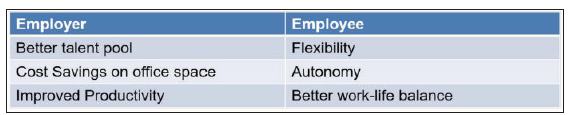
While remote work has been known to produce the following benefits for both employers and employees, the unknown of managing productivity, attendance, and performance has left management skeptical of reaping these rewards.

Against that skepticism, employees quickly rallied to the required change, and productivity was mildly affected for the short term. For employees, the flexibility created a work-life balance they needed and showed management that, with the right resources and accountability measures in place, they could be successful working at home.

Alternatively, there are some employers that continue to see that remote work for a short-term period is tolerable but appreciate the human-to-human interaction of the traditional office environment. There are also
employees who have found working from home challenging and prefer the traditional office environment.

Those employers new to the concept of remote work will find a rhythm. It will be essential, though, for those organizations to have human capital management best practices in place for interviewing and hiring, performance management, and termination of employment to see positive
results prevail.

INTERVIEWING AND HIRING
As employers are finding out, not all employees are suited for remote work. In addition to determining if an applicant has the right qualifications to perform the essential job functions, employers will need to determine if the candidate is capable of long-term success as a remote worker.

Hiring a different skillset with the ability for self-management will require an evaluation of determining if the applicant is:
– a cultural fit for the organization
– an effective communicator
– a great collaborator
– well-organized
– able to manage time efficiently and effectively
– self-disciplined
– able to hold themselves accountable

Behavioral testing tools are beneficial as part of not only the interviewing process in determining long-term success but also should be used throughout the life cycle of the employment for relationship building with both supervisor and the team. Several popular ones exist and are well-vetted behavioral-assessment resources that employers should consider.

It is important to remember that all testing tools, whether behavioral-assessment or skills-based, are just part of the overall interview process and should not be used as the sole criteria for the hiring decision. An organization should be using a combination of interviewing criteria including human resources, the hiring manager, and the team.

PERFORMANCE MANAGEMENT
For a successful remote working relationship, the right resources, tools, and accountability measures should be in place to promote a supportive relationship not only for the employee but also for the success of the managing supervisor.

A trusting management style will be required, and this style is supported by hiring the right candidate and having accountability measures in place that are reflective of the duties of the position. Organizations will need to think beyond the premise that work is getting done if employees are at their desk in an office from 8:00 a.m. until 5:00 p.m., relying instead on the delivery of the established goals for rating performance.

PRODUCTIVITY MANAGEMENT
Productivity management software tools are available. They enable the organization to monitor performance by having the ability to:
• track time
• manage low and high levels of productivity
• maintain IT security
• video-conference for one-to-one supervisor discussions

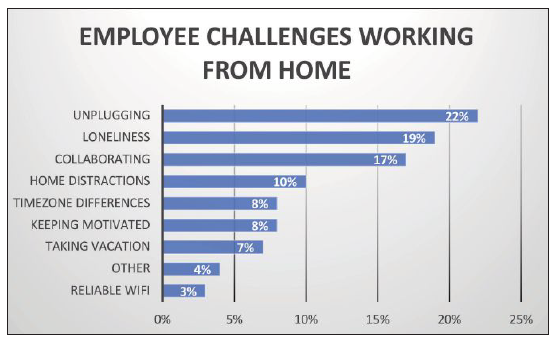
In addition to monitoring tools that give supervisors confidence in employee productivity, striving to overcome employee challenges working from home should be part of the planning process for developing strategies for a successful remote working relationship.

Promoting a work-life balance culture and keeping engaged with management and the team are top priorities for remote workers. With accountability practices in place and the ability to work in many instances at any time of day or night, supervisors need to ensure that the right lifestyle balance is supported.

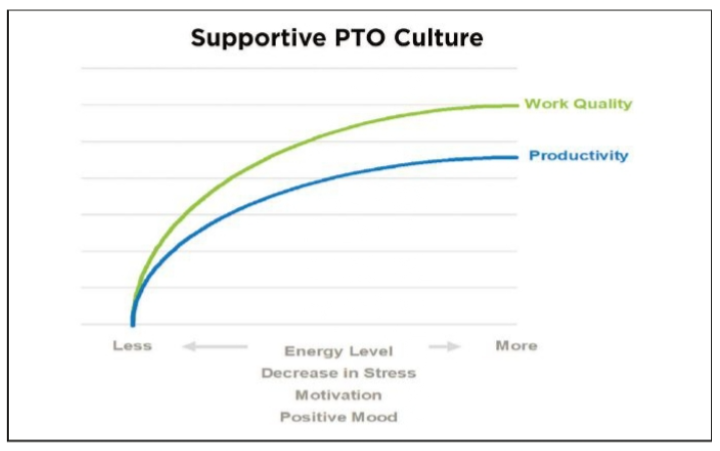
For all employees, but more so with remote workers who are working and living in the same space, encouraging employees to use their allocated time off and unplugging is critical to maintaining productivity, reducing stress, and ensuring the holistic well being of employees. A Work and Wellbeing
survey1 conducted by the American Psychological Association found that the positive effects of returning from paid time off left employees with less stress, increased energy, more motivation, and a positive mood. These resulted in an increase in productivity and quality of work.

The same APA study found that two-thirds of the employees who did not return to a supportive culture of work-life balance saw the positive effects of PTO quickly fade as compared to those who had a supported culture of wellbeing.

Leaders can build a supportive culture by:

  1. Using PTO when sick, for mental health days, and for vacation themselves. The team will look to the leader and traditionally follow in their footsteps. If leaders come to work when ill, that sends a negative image to those who are emulating leadership styles that PTO should
    not be used.
  2. Encouraging others to use PTO and then sharing positive experiences of being away, whether it’s the time spent on vacation or mental-health-day experiences.
  3. Supporting the idea of “unplugging” from all work-related technology, using email out-of-office messaging and apps such as Thrive Away to block time out of the office.
  4. Reviewing workloads and cross-training so the important work has coverage when an individual is out.
  5. Allowing employees the opportunity to have the appropriate time to transition smoothly back into the daily routine.

By guiding an employer to build a supportive wellbeing culture around the PTO benefit, an organization’s trusted health and welfare advisor will be able to show employers a positive net effect of the work-life balance is a workforce that is whole, healthy, and productive. The holistic health of employees leads to the holistic health of the organization.

PERFORMANCE AND TERMINATION OF EMPLOYMENT
Whether it be a deterioration in performance requiring a corrective discussion or a termination of employment, this can be one of the least pleasant responsibilities for any manager. It’s more awkward when done remotely.

When possible, these types of crucial conversations should be done in person. If a worksite is not available, a neutral quiet location is the next best spot. Worth noting, these types of conversations should never take place at an employee’s home or done over emails or text messaging. A local hotel will have smaller conference rooms that can be rented at reasonable costs. When remote travel is not possible, using a virtual conference call would be the next best option.

Managers should be prepared for the conversation with all supporting documentation and, if needed, information regarding any final wage and benefit information, IT security, and return of company property.

RETURN OF COMPANY PROPERTY
It is important employers have a record starting with the date of hire of all assigned company property and have it signed off by the employee. A strategy for the return of the property should be developed before it becomes necessary to collect such property.

It is a best practice for a company to cover related expenses for the employee to return the property to the company. In some instances, it may be appropriate for a third party to intervene to retrieve the property.

New services now being offered through concierge vendors include picking up company property from an employee’s home and returning it to the company. Again, a supervisor should never go to the employee home to personally pick up the property. A neutral service can help defuse any negative situation and work toward the safety of all involved.

1 http://www.apaexcellence.org/assets/general/2018-work-and-wellbeing-survey-results.pdf?_

__________________________________________________________

Bobbi Kloss has served as BAN’s director of human capital management services since 2014. She also oversees all HR-related functions for BAN internal practices. She has a deep understanding of the increasingly complex and diverse HR industry, with more than 20 years of human resource generalist and executive-level human capital management experience. Bobbi began her career as an employment law compliance paralegal for a national PEO after graduating with high honors from the Career Institute for Paralegals. She has a passion for service and has helped establish two nonprofit organizations in Texas, co-founding Teenage Parent Program Scholarships in Houston and founding Heritage Children San Antonio in 2003 to help at-risk youth develop necessary life skills. She currently volunteers her time mentoring women in addictive behavior recovery.


Key Data Resources For HR Pros

Across the Human Resource profession, it is easy to identify two approaches: one applies to performing the tasks at hand and the other is strategic. To most, task-related means performing basic HR functions – the immediate tasks at hand. A strategic focus, alternatively, is when an individual adds value beyond the day-to-day to provide long-term growth for the organization.

As an example, hiring for a replacement position. The task-focused HR professional posts the job, sorts through resumes, conducts phone, and in-person interviews, and hires the most qualified candidate.

Rinse and repeat when the next position needs to be replaced.

When strategically focused, the HR professional looks beyond the task-related aspects of replacing the position and will use data to establish industry comparisons associated with job skills, total rewards, and cultural fit. They will gather and analyze data to develop a solutions-based result to reduce turnover and increase employee engagement and productivity.

When comparing industry and census data with business needs and requirements, one should assess and determine the following (not an exhaustive list):
• Review turnover across company departments;
• Obtain industry-standard turnover ratios;
• Acquire geographic unemployment rates;
• Evaluate industry culture and compare total rewards offerings.

For strategic-minded HR professionals, being able to source and analyze data is very valuable to the ability to attract and retain quality employees. Data helps determine and predict trends, benchmark ourselves within our industry, across geographic lines, and implement best practices for company size and revenue.

Being strategic-minded raises the relevancy of human resources within a business. It enables HR professionals to align the company mission, vision, and goals with its human capital and be instrumental and influential in leading an organization to achieve a healthier business, culture, and people.

While there is a multitude of resources available where national, state, and local workforce data can be obtained, this article provides a brief list and summary (below) of paid and/or free websites where workforce data can be found, including census, industry, demographics, compensation, benefits, gender, ethnicity, promotions data and job titles including the entertainment industry. A suggestion is also to see what association resources are available for specific industries.

The Department of Labor’s Bureau of Labor Statistics produces some of the nation’s economic information.

The Employment Situation News Release presents data from current employment statistics and current population survey programs.

Job Openings and Labor Turnover Survey (JOLTS) program produces data on job openings, hires, and separations. Each state also has its own specific labor statistics available through the State Department of Labor Regional labor market reports such as the Center for Competitive Workforce in the L.A. area.

DATAUSA offers the most comprehensive visualization of U.S. public data.
Statista provides insights and facts across 1,709 industries and over 150 countries.
International Labour Organization provides national information and data on labor laws, standards, policies, and statistics. Country profiles provide also relevant information on ILO projects and programs, publications, and good practices.

Recruiting agencies are also a source of compensation benchmarking.

Additional resources include companies such as:
Willis Towers Watson
Payfactors
Report Linker – with access to data in all market sizes in any sector
IBISWorld – insights and analysis on global industries

Don’t forget the Society for Human Resource Management (SHRM) with membership there is access to both member included and customized benchmarking reports including health and welfare, paid time off, and human capital management.

Whether an HR professional’s budget includes fees for data or not, there is a wealth of information that is readily available. Identifying objectives will guide the appropriate research path. Additionally, reaching out to a trusted benefits advisor should be a starting place for obtaining data. As a true business advisor, they should have access to benchmarking data, and statistical human capital reports for individual industries.

____________________________________________

Bobbi Kloss is the Director of Human Capital Management Services for Benefit Advisors Network – an exclusive, national network of independent employee benefits brokerage and consulting companies. For more information, please visit: www.benefitadvisorsnetwork.com or email the author at bkloss@benefitadvisorsnetwork.com.

IRS Maintains Health FSA Contribution Limit for 2021, Adjusts Other Benefit Limits

On October 26, 2020, the Internal Revenue Service (IRS) released Revenue Procedure 2020-45, which maintains the health flexible spending account (FSA) salary reduction contribution limit from 2020, which is $2,750, for plan years beginning in 2021. Thus, for health FSAs with a carryover feature, the maximum carryover amount is $550 (20% of the $2,750 salary reduction limit) for plan years beginning or ending in 2021. The Revenue Procedure also contains the cost-of-living adjustments that apply to dollar limitations in certain sections of the Internal Revenue Code. 

Qualified Commuter Parking and Mass Transit Pass Monthly Limit

For 2021, the monthly limits for qualified parking and mass transit are $270 each (which remains the same from 2020).

Adoption Assistance Tax Credit Increase

For 2021, the credit allowed for the adoption of a child is $14,440 (up $100 from 2020). The credit begins to phase out for taxpayers with modified adjusted gross income in excess of $216,660 (up $2,140 from 2020) and is completely phased out for taxpayers with modified adjusted gross income of $256,660 or more (up $2,140 from 2020).

Qualified Small Employer Health Reimbursement Arrangement (QSEHRA) Increase

For 2021, reimbursements under a QSEHRA cannot exceed $5,300 (single) / $10,700 (family), an increase of $50 (single) / $100 (family) from 2020.

Reminder: 2021 HSA Contribution Limits and HDHP Deductible and Out-of-Pocket Limits

Earlier this year, the IRS announced the inflation-adjusted amounts for HSAs and high deductible health plans (HDHPs).

The ACA’s out-of-pocket limits for in-network essential health benefits have also increased for 2021.  Note that all non-grandfathered group health plans must contain an embedded individual out-of-pocket limit if the family out-of-pocket limit is above $8,550 (2021 plan years).  Exceptions to the ACA’s out-of-pocket limit rule are also available for certain small group plans eligible for transition relief (referred to as “Grandmothered” plans).  Unless extended, relief for Grandmothered plans ends December 31, 2021.

ACA Reporting Penalties (Forms 1094-B, 1095-B, 1094-C, 1095-C)

The table below describes late filing penalties for ACA reporting.  The 2021 penalty is for returns filed in 2021 for the calendar year 2020, and the 2022 penalty is for returns filed in 2022 for the calendar year 2021.  Note that failure to issue a Form 1095-C when required may result in two penalties, as the IRS and the employee are each entitled to receive a copy.

IRS Extends Deadline for Furnishing Form 1095-C to Employees, Extends Good-Faith Transition Relief for the Final Time

The Internal Revenue Service (IRS) has released Notice 2020-76, which extends the deadline for furnishing 2020 Forms 1095-B and 1095-C to individuals from January 31, 2021, to March 2, 2021.  The Notice also provides penalty relief for good-faith reporting errors and suspends the requirement to issue Form 1095-B to individuals, under certain conditions. 

The due date for filing the forms with the IRS was not extended and remains March 1, 2021 (March 31, 2021, if filed electronically).

The regulations allow employers to request a 30-day extension to furnish statements to individuals by sending a letter to the IRS with certain information, including the reason for the delay; however, because the Notice’s extension of time to furnish the forms is as generous as the 30-day extension contained in the instructions, the IRS will not formally respond to requests for an extension of time to furnish 2020 forms to individuals.  Employers may obtain an automatic 30-day extension for filing with the IRS by filing Form 8809 on or before the due date. An additional 30-day extension is available under certain hardship conditions. The Notice encourages employers who cannot meet the extended due dates to furnish and file as soon as possible and advises that the IRS will take such furnishing and filing into consideration when considering whether to abate penalties for reasonable cause. 

Relief from Furnishing Form 1095-B to Individuals

Due to the individual mandate penalty being reduced to zero starting in 2019, an individual does not need the information on Form 1095-B in order to complete his or her federal tax return. Therefore, the IRS is granting penalty relief for employers who fail to furnish a Form 1095-B to individuals, provided that the reporting entity:

  1. Posts a notice prominently on its website stating that individuals may receive a copy of their 2020 1095-B upon request, accompanied by an email address and a physical address where the request can be sent.  The notice must also include a phone number individuals can use to contact the reporting entity with questions; and
  2. Furnishes an individual with a Form 1095-B within 30 days of a request.

Note that Applicable Large Employers (ALEs) are still required to furnish Form 1095-C to their full-time employees.  They must also complete Part III if the employee is enrolled in self-insured coverage. The relief from furnishing Form 1095-B does not extend to IRS reporting.  Forms 1095-B must still be submitted to the IRS, as applicable. 

In general, this relief from furnishing Form 1095-B applies to insurers and non-ALEs that sponsor self-insured plans, as they complete Form 1095-B for covered participants.

Extension of Good-Faith Relief (Final Year)

As with the calendar year 2015 – 2019 reporting, the IRS will not impose penalties on employers that can show that they made good-faith efforts to comply with the requirements for the calendar year 2020. In determining good faith, the IRS will consider whether employers have made reasonable attempts to comply with the requirements (e.g., gathering and transmitting the necessary data to an agent or testing its ability to transmit information) and the steps that have been taken to prepare for next year’s reporting.  The Notice indicates that the good-faith relief was intended to be transitional relief, and therefore 2020 is the last year the IRS intends to provide this relief.

Note that the good-faith relief applies only to furnishing and filing incorrect or incomplete information, and not to a failure to timely furnish or file. However, if an employer is late filing a return, it may be possible to get penalty abatement for failures that are due to reasonable cause and not willful neglect. In general, to establish reasonable cause the employer must demonstrate that it acted in a responsible manner and that the failure was due to significant mitigating factors or events beyond its control.  The IRS has been enforcing late filing penalties via Letter 972CG, which may include penalties based on failure to file electronically (when required) or failure to file with correct TIN information. As in past years, individuals can file their personal income tax returns without having to attach the relevant Form 1095. Taxpayers should keep these forms in their personal records, even though the federal individual mandate penalty is not applicable for the 2020 filing year.