Legal Alert: IRS Issues Affordability Percentage Adjustment for 2020

The Internal Revenue Service (IRS) has released Rev. Proc. 2019-29, which contains the inflation adjusted amounts for 2020 used to determine whether employer-sponsored coverage is “affordable” for purposes of the Affordable Care Act’s (ACA) employer shared responsibility provisions and premium tax credit program. As shown in the table below, for plan years beginning in 2020, the affordability percentage for employer mandate purposes is indexed to 9.78%. Employer shared responsibility payments are also indexed.
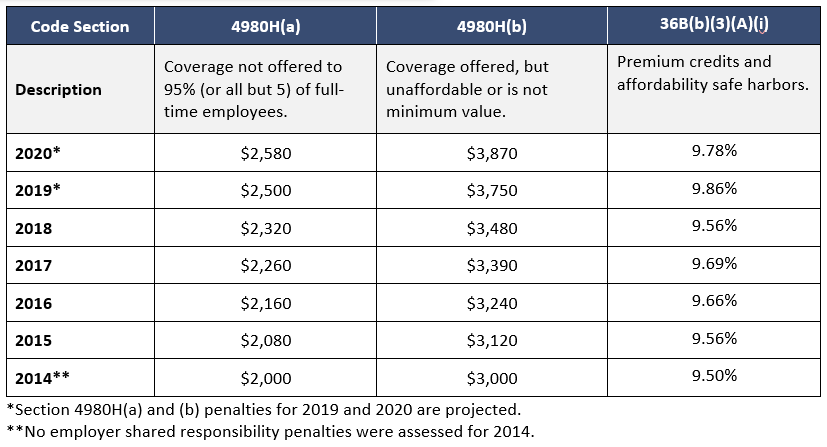
Affordability Percentage Adjustment

Under the ACA, applicable large employers (ALEs) must offer affordable health insurance coverage to full-time employees. If the ALE does not offer affordable coverage, it may be subject to an employer shared responsibility payment. An ALE is an employer that employed 50 or more full-time equivalent employees on average in the prior calendar year. Coverage is considered affordable if the employee’s required contribution for self-only coverage on the employer’s lowest-cost, minimum value plan does not exceed 9.78% of the employee’s household income in 2020 (prior years indexed above). An ALE may rely on one or more safe harbors in determining if coverage is affordable: W-2, Rate of Pay, and Federal Poverty Level.

If the employer’s coverage is not affordable under one of the safe harbors and a full-time employee is approved for a premium tax credit for Marketplace coverage, the employer may be exposed to an employer shared responsibility payment.

Note that as of January 1, 2019, the individual mandate penalty imposed on individual taxpayers for failure to have qualifying health coverage was reduced to $0 under the Tax Cuts and Jobs Act, effectively repealing the individual mandate. Although there is currently a lawsuit challenging the constitutionality of the ACA due to this change to the individual mandate penalty, the employer mandate has not been repealed and the IRS continues to enforce it through Letter 226J. The IRS has recently begun sending letters pertaining to calendar year 2017 reporting.

Next Steps for Employers

Applicable large employers should be aware of the updated affordability percentage for plan years beginning in 2020. Although the affordability percentage has not decreased significantly from 9.86% to 9.78%, employers should consider it along with all other relevant factors when determining contributions.

About the Author. This alert was prepared for Benefit Advisors Network by Stacy Barrow. Mr. Barrow is a nationally recognized expert on the Affordable Care Act. His firm, Marathas Barrow Weatherhead Lent LLP, is a premier employee benefits, executive compensation and employment law firm. He can be reached at sbarrow@marbarlaw.com.

This message is a service to our clients and friends. It is designed only to give general information on the developments actually covered. It is not intended to be a comprehensive summary of recent developments in the law, treat exhaustively the subjects covered, provide legal advice, or render a legal opinion.

Benefit Advisors Network and its members are not attorneys and are not responsible for any legal advice. To fully understand how this or any legal or compliance information affects your unique situation, you should check with a qualified attorney.

© Copyright 2019 Benefit Advisors Network. All rights reserved.

Stop Misuse of Family Benefits

Written by Stephen Miller, CEBS, including comments from Bobbi Kloss, Benefit Advisors Network Director of Human Capital Management Services. Published on SHRM.org, March 27, 2019.

Some workers intentionally abuse family-perk policies, while others are just confused.

United Airlines fired more than 35 employees in March for selling travel passes intended for employees’ immediate relatives. Free or discounted travel is a common family perk in the airline industry, the Chicago Tribune reported. When selling these passes, sometimes for several thousand dollars apiece, employees falsely registered the buyers as their stepparents or domestic partners.

“The rules are there to make sure everyone can enjoy the benefits,” said Danielle Capilla, Chicago-based director of employee benefits compliance at Alera Group, an insurance and financial services firm. Her father, an airline pilot, made sure everyone in her family understood those rules.

Whether misusing travel perks, allowing relatives to drive a company car or extending discounts to people who aren’t eligible for them, those who violate family-perk policies “think they’re not going to get caught,” Capilla said.

“Abuse of employee benefits and perks is a continuous frustration for employers,” added Bobbi Kloss, HR leader at Benefit Advisors Network, a Cleveland-based consortium of health and welfare benefit brokers. “From the CEO and top executives to the line workers, no level of employee is immune from committing abuses.”

Dependent-Eligibility Audits

A common misuse of family benefits occurs when employees add ineligible relations as family members under their employer’s health plan. To combat this practice, 43 percent of employers routinely conduct dependent-eligibility audits of their health plans, according to a recent report from the nonprofit International Foundation of Employee Benefit Plans. When conducting an audit, HR consultancy Mercer estimates that most companies will find 3 percent to 10 percent of plan members to be ineligible. Given that the average annual cost of each covered dependent is $4,570, Mercer found, the expense of covering ineligible dependents can add up quickly.

Capilla encourages employers to conduct dependent audits “every year if there have been issues, and at least every three years otherwise.”

“Not all misuse is intentional,” said Anna Phalen, vice president of account management at Jellyvision, a benefits communication software firm in Chicago. “In some cases, employees may not know they’re stepping over the line, or they may not be aware there are penalties for doing so.”

One reason workers grow confused over dependent eligibility, Phalen noted, is that the Affordable Care Act allows adult children up to age 26 to stay on a parent’s employer-provided health plan, whether they are dependents or not. Also, in recent years, many benefit plans have expanded their definition of eligible dependents to include unmarried partners and stepchildren. These developments, she said, “make it all the more important to clearly articulate the rules on who qualifies.”

Family Leave Misuse

Misuse of time off is also costly for employers, especially for intermittent absences taken under the Family and Medical Leave Act (FMLA) by employees who don’t actually need to attend to their own or a relative’s health needs.

“You can’t solve for every misuse of leave. But you can design your leave program and policies to help deter misuse,” Capilla said. How employers go about that depends on the problems they’re seeing, she said, joking about the “30 percent of the workforce seeking intermittent FMLA on every sunny Friday.”

[SHRM members-only toolkit: Managing Family and Medical Leave]

Clarify What’s Allowed

Employees may have been told about benefits restrictions when they were hired or went through open enrollment, Phalen said, but that information should be reiterated when they make changes to their benefits, such as adding dependents to a family health plan.

When employees receive a thick handbook during onboarding that’s filled with benefits jargon, “it can be overwhelming,” said Bill Gimbel, president of LaSalle Benefits, an insurance brokerage in the Chicago area. Employers should describe their benefits rules “in terms that are simple enough for all employees to understand, yet thorough,” he said. “A detailed handbook may be helpful for your HR team, but a PowerPoint or visual one-sheeter that provides an overview of your benefits offerings may be better for the rest of your employees.”

Taking Action

Intentional abuse of employer benefits can be a firing offense, and, in some cases, employers may want to sue to reclaim the value of misappropriated benefits or press criminal charges.

However, “for abuses, I advise having a ‘strike’ system,” Capilla said, as in two or three strikes and you’re out. “There are honest mistakes that happen. At the same time, you don’t want to swing to the other end and only slap people on the wrist.”

“No matter what is done to tighten the reins, as long as there are unethical people in the workplace, abuse will continue,” Kloss said. Many employers “jump the gun and discontinue the benefit or perk, affecting all employees instead of addressing the behavior of the abuser,” she added. That can lead to employee morale issues, especially when a discontinued benefit made the job particularly attractive.

To reduce benefits fraud, employee benefits professionals recommend these steps:

  • Work with managers. “Lack of well-being—financial, social, emotional and physical wellness—could be driving employees to make bad choices,” Kloss said. Managers may be able to pick up on those situations. Train your managers to identify signs of misuse, Gimbel added. “Educate them on what to look for, and be sure that they report it back to HR.”
  • Use HR software. Software can be used to track the receipt of health providers’ certifications and recertifications for FMLA leave requests, for instance, which can help expose abuses, Gimbel said.
  • Stay organized and be proactive. Regularly track and monitor benefits use, whether through spreadsheets, online forms or HR information systems, Gimbel advised. “If, along the way, your team catches wind of potential benefits misuse, be proactive and address it immediately.”

View the article Stop Misuse of Family Benefits on SHRM.org

Employee Benefit Plan Review

Written by Perry S. Braun, Benefit Advisors Network’s Executive Director. Published in Employee Benefit Plan Review, March/April 2019 issue.

What Can Employer Sponsored Benefit Plans Expect from a Divided Federal Government?

While much of the focus in 2018 came down to the elections, we now have those results and can begin moving forward. But, with a divided Congress what will the impact be on the insurance marketplace, the healthcare delivery system, the advisors and employers that interact (plan, strategize, implement, and execute) and most importantly, the employees that participate in the employer sponsored benefit plan?

Policies: What to Expect
Following the Kavanaugh hearing Senator Jeff Flake commented that he would have voted differently regarding the Federal Bureau of Investigation inquiry if he was running for re-election. This comment paints a picture that our representatives to Congress are concerned with advancing policies that secure their re-election rather than the wellbeing of the constituents they represent. With that backdrop, the status quo will be the likely outcome with regard to the current state of the Affordable Care Act (ACA) and America’s Health Insurance Plans (AHIP) until the 2020 election.

Are there policies/regulations that the parties could agree on? There are two observations assuming any policy change will support two goals – re-election and benefit to their constituents.

One, if there is any change in policy, it could be in a bipartisan approach to address prescription drug cost and the impact of prescription drugs on the health and safety of the community. The national discussion around opioids, the increase in drug prices on certain medications, as well as the lack of generic equivalents are issues that both parties wish to address from a policy perspective.

However, this represents a change on the margins and not a repeal of the program offered through President Obama or the alternative program offered by President Trump. Further, an incremental approach will not have any true and meaningful impact on the cost of healthcare – which is supposed to be the focus. Rather, the focus will be on insurance or premium reform.

The second observation is that while the focus has been on health and healthcare policy – which is really a tremendous amount of energy and no action – there is not an equal amount of attention being given to regulations for employers and advisors to meet, which come with real economic consequences, for example, fines and penalties.

The Next Two Years
So, with no one party in control of Congress and the executive branch, what does the next two years look like? Likely, the parties will be eyeing the 2020 presidential election and one of the key topics will be what the social contract with America looks like.

For example, the “crushing” national debt, cost of healthcare cost, the cost of tuition and the educational debt, and income disparity and burden this has on the vast majority of individuals in this country will push political parties to renew calls to address this situation, 2 March/April 2019 Employee Benefit Plan Review however, their energy to tackle this and their solutions will greatly differ.

The debate may focus on one or more of the following strategies to win over the hearts and minds of the voting public – raise tax revenues, cut government costs, or a combination of both.

If raising tax revenues is chosen, the impact on the individual is important. It is certain that all taxpayers will need to contribute some amount of tax revenue to buy down the debt. But, with the median household income hovering right around $60,000 and the average American household carrying $137,000 in debt, the problem becomes pretty clear: most people are not… [read more]

Industry Predictions for the New Year

Written by Perry Braun, Benefit Advisors Network, and Lisa Allen, Relph Benefits, for America’s Benefit Specialist.


The tail end of 2018 saw the majority of the country focused on the mid-term elections, and with good reason. Those results will impact not only the political landscape, but also every business, organization and individual in the U.S. The impact will be felt in 2019 and beyond. The mid-term elections left us with a divided Congress, with many now asking, “What will the impact be on the insurance marketplace, the healthcare delivery system, the advisors and employers and—most important—the employees that participate in the employer-sponsored benefit plan?”

Read More