Legal Alert: IRS Issues Affordability Percentage Adjustment for 2020

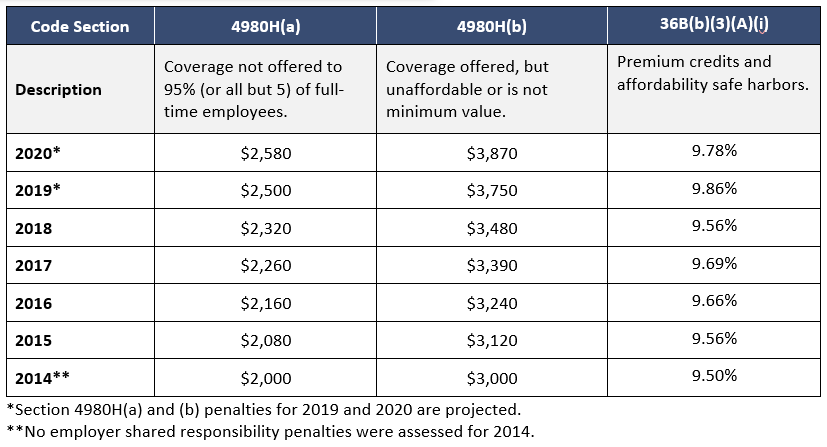
The Internal Revenue Service (IRS) has released Rev. Proc. 2019-29, which contains the inflation adjusted amounts for 2020 used to determine whether employer-sponsored coverage is “affordable” for purposes of the Affordable Care Act’s (ACA) employer shared responsibility provisions and premium tax credit program. As shown in the table below, for plan years beginning in 2020, the affordability percentage for employer mandate purposes is indexed to 9.78%. Employer shared responsibility payments are also indexed.

Affordability Percentage Adjustment

Under the ACA, applicable large employers (ALEs) must offer affordable health insurance coverage to full-time employees. If the ALE does not offer affordable coverage, it may be subject to an employer shared responsibility payment. An ALE is an employer that employed 50 or more full-time equivalent employees on average in the prior calendar year. Coverage is considered affordable if the employee’s required contribution for self-only coverage on the employer’s lowest-cost, minimum value plan does not exceed 9.78% of the employee’s household income in 2020 (prior years indexed above). An ALE may rely on one or more safe harbors in determining if coverage is affordable: W-2, Rate of Pay, and Federal Poverty Level.

If the employer’s coverage is not affordable under one of the safe harbors and a full-time employee is approved for a premium tax credit for Marketplace coverage, the employer may be exposed to an employer shared responsibility payment.

Note that as of January 1, 2019, the individual mandate penalty imposed on individual taxpayers for failure to have qualifying health coverage was reduced to $0 under the Tax Cuts and Jobs Act, effectively repealing the individual mandate. Although there is currently a lawsuit challenging the constitutionality of the ACA due to this change to the individual mandate penalty, the employer mandate has not been repealed and the IRS continues to enforce it through Letter 226J. The IRS has recently begun sending letters pertaining to calendar year 2017 reporting.

Next Steps for Employers

Applicable large employers should be aware of the updated affordability percentage for plan years beginning in 2020. Although the affordability percentage has not decreased significantly from 9.86% to 9.78%, employers should consider it along with all other relevant factors when determining contributions.

About the Author. This alert was prepared for Benefit Advisors Network by Stacy Barrow. Mr. Barrow is a nationally recognized expert on the Affordable Care Act. His firm, Marathas Barrow Weatherhead Lent LLP, is a premier employee benefits, executive compensation and employment law firm. He can be reached at sbarrow@marbarlaw.com.

This message is a service to our clients and friends. It is designed only to give general information on the developments actually covered. It is not intended to be a comprehensive summary of recent developments in the law, treat exhaustively the subjects covered, provide legal advice, or render a legal opinion.

Benefit Advisors Network and its members are not attorneys and are not responsible for any legal advice. To fully understand how this or any legal or compliance information affects your unique situation, you should check with a qualified attorney.

© Copyright 2019 Benefit Advisors Network. All rights reserved.

The 10th Amendment’s Impact on Employee Benefits Today

Written by Perry Braun, Executive Director, Benefit Advisors Network. Published July 11, 2019 on ThinkAdvisor.com.

Maybe, over the next few years, states will have more influence over how your world works.

Remember that civics class you had to take in high school? If so, you might recall that the federal government possesses only those powers delegated to it by the U.S. Constitution. All remaining powers are reserved for the states or the people.

This is the main principle of the 10th Amendment to the Constitution. And for approximately 240 years, there has been a healthy tension between the states and federal government with respect to the authority and role of each.

(Related: How Health Policy Could Wobble (Forward?) Now)

A review of history teaches us that the founding fathers struggled with the tension that exists between states’ rights and a federal government. James Madison and Thomas Jefferson were both advocates for small and limited federal government. Both feared that a large central government would be too close to a monarchy. Alexander Hamilton, whom many suspected of being a monarchist at heart, favored a larger central government. Hamilton feared local democracy because it would allow control by the “masses.”

Since its ratification in 1791 there has always been issues between states’ rights and federal authority. However, over the past 10 years, the tension between the states and federal government has risen dramatically. We are now witnessing the impact of this tension on many policy issues, from sanctuary cities and immigration to health policy (Medicaid, Affordable Care Act) and pro-life/pro-choice policies.

How is this relevant to the employee benefits industry?

The Affordable Care Act (ACA) is illustrative. The federal government enacted a broad law imposing many new requirements on both individuals and states. Many states resisted the implementation of key elements of the ACA and sued in federal courts to either stop or limit the implementation. On one key issue the states were successful: the Medicaid expansion provisions of the ACA, which punished states for not adopting the federal rule by reducing other federal money.

Ruling with the 10th Amendment in mind, the U.S. Supreme Court noted that the federal government is not permitted to “put a gun to the head” of the states to achieve federally mandated results.

The Supreme Court held that states could elect to participate in Medicaid expansion but could not be forced to do so. As a result of that decision (and other similar decisions), during the 10 years that have passed since the law was enacted, the ACA has been, in some observers’ eyes, significantly watered down, resulting in a divergence in implementing (or not implementing) key components of the law at the state level. For example, some states have refused to implement the Medicaid expansion requirements, and some have expanded the eligibility of individuals to participate in Medicaid. Other states took an active interest in the development and introduction of insurance exchanges, while others participated at the absolute bare minimum.

When signed into law, the ACA represented a significant expansion of the federal government into areas that have traditionally been left to… [Read the full article]

Legal Alert: Reminder PCORI Fees Due By July 31, 2019

REMINDER: PCORI Fees Due By July 31, 2019

Employers that sponsor self-insured group health plans, including health reimbursement arrangements (HRAs) should keep in mind the upcoming July 31, 2019 deadline for paying fees that fund the Patient-Centered Outcomes Research Institute (PCORI). As background, the PCORI was established as part of the Affordable Care Act (ACA) to conduct research to evaluate the effectiveness of medical treatments, procedures and strategies that treat, manage, diagnose or prevent illness or injury. Under the ACA, most employer sponsors and insurers will be required to pay PCORI fees until 2019 (the fee does not apply to plan years ending on or after October 1, 2019). For employers with calendar year plans, this July’s payment will be their final PCORI filing.

The amount of PCORI fees due by employer sponsors and insurers is based upon the number of covered lives under each “applicable self-insured health plan” and “specified health insurance policy” (as defined by regulations) and the plan or policy year end date. This year, employers will pay the fee for plan years ending in 2018.

• For plan years that ended between January 1, 2018 and September 30, 2018, the fee is $2.39 per covered life and is due by July 31, 2019.
• For plan years that ended between October 1, 2018 and December 31, 2018, the fee is $2.45 per covered life and is due by July 31, 2019.

For example, a plan year that ran from July 1, 2017 through June 30, 2018 will pay a fee of $2.39 per covered life. Calendar year 2018 plans will pay a fee of $2.45 per covered life.

NOTE: The insurance carrier is responsible for paying the PCORI fee on behalf of a fully insured plan. The employer is responsible for paying the fee on behalf of a self-insured plan, including an HRA. In general, health FSAs are not subject to the PCORI fee.

Employers that sponsor self-insured group health plans must report and pay PCORI fees using IRS Form 720, Quarterly Federal Excise Tax Return. If this is the employer’s last PCORI payment and they do not expect to owe excise taxes that are reportable on Form 720 in future quarters, they may check the “final return” box above Part I of Form 720.

Note that because the PCORI fee is assessed on the plan sponsor of a self-insured plan, it generally should not be included in the premium equivalent rate that is developed for self-insured plans if the plan includes employee contributions. However, an employer’s payment of PCORI fees is tax deductible as an ordinary and necessary business expense.

Historical Information for Prior Years
• For plan years that ended between October 1, 2017 and December 31, 2017, the fee is $2.39 per covered life and is due by July 31, 2018.
• For plan years that ended between January 1, 2017 and September 30, 2017, the fee is $2.26 per covered life and is due by July 31, 2018.
• For plan years that ended between October 1, 2016 and December 31, 2016, the fee is $2.26 per covered life and was due by July 31, 2017.
• For plan years that ended between January 1, 2016 and September 30, 2016, the fee is $2.17 per covered life and was due by July 31, 2017.
• For plan years that ended between October 1, 2015 and December 31, 2015, the fee was $2.17 per covered life and was due by August 1, 2016.
• For plan years that ended between January 1, 2015 and September 30, 2015, the fee was $2.08 per covered life and was due by August 1, 2016.
• For plan years that ended between October 1, 2014 and December 31, 2014, the fee was $2.08 per covered life and was due by July 31, 2015.
• For plan years that ended between January 1, 2014 and September 30, 2014, the fee was $2 per covered life and was due by July 31, 2015.
• For plan years that ended between October 1, 2013 and December 31, 2013, the fee was $2 per covered life and was due by July 31, 2014.
• For plan years that ended between January 1, 2013 and September 30, 2013, the fee was $1 per covered life and was due by July 31, 2014.
• For plan years that ended between October 1, 2012 and December 31, 2012, the fee was $1 per covered life and was due by July 31, 2013.

Counting Methods for Self-Insured Plans

Plan sponsors may choose from three methods when determining the average number of lives covered by their plans.

Actual Count method. Plan sponsors may calculate the sum of the lives covered for each day in the plan year and then divide that sum by the number of days in the year.

Snapshot method. Plan sponsors may calculate the sum of the lives covered on one date in each quarter of the year (or an equal number of dates in each quarter) and then divide that number by the number of days on which a count was made. The number of lives covered on any one day may be determined by counting the actual number of lives covered on that day or by treating those with self-only coverage as one life and those with coverage other than self-only as 2.35 lives (the “Snapshot Factor method”).

Form 5500 method. Sponsors of plans offering self-only coverage may add the number of employees covered at the beginning of the plan year to the number of employees covered at the end of the plan year, in each case as reported on Form 5500, and divide by 2. For plans that offer more than self-only coverage, sponsors may simply add the number of employees covered at the beginning of the plan year to the number of employees covered at the end of the plan year, as reported on Form 5500.

Special rules for HRAs. The plan sponsor of an HRA may treat each participant’s HRA as covering a single covered life for counting purposes, and therefore, the plan sponsor is not required to count any spouse, dependent or other beneficiaries of the participant. If the plan sponsor maintains another self-insured health plan with the same plan year, participants in the HRA who also participate in the other self-insured health plan only need to be counted once for purposes of determining the fees applicable to the self-insured plans.

About the Author. This alert was prepared for Benefit Advisors Network by Stacy Barrow. Mr. Barrow is a nationally recognized expert on the Affordable Care Act. His firm, Marathas Barrow Weatherhead Lent LLP, is a premier employee benefits, executive compensation and employment law firm. He can be reached at sbarrow@marbarlaw.com.

This message is a service to our clients and friends. It is designed only to give general information on the developments actually covered. It is not intended to be a comprehensive summary of recent developments in the law, treat exhaustively the subjects covered, provide legal advice, or render a legal opinion.

Benefit Advisors Network and its smart partners are not attorneys and are not responsible for any legal advice. To fully understand how this or any legal or compliance information affects your unique situation, you should check with a qualified attorney.

© Copyright 2019 Benefit Advisors Network. Smart Partners. All rights reserved.
Legal Alert: Medical Loss Ratio Rebates

Medical Loss Ratio Rebates Under the Affordable Care Act
The U.S. Department of Health and Human Services (“HHS”) has provided guidance on the Affordable Care Act’s (“ACA’s”) medical loss ratio (“MLR”) rule, which requires health insurers to spend a certain percentage of premium dollars on claims or activities that improve health care quality or provide a rebate to policyholders. HHS has released amended and final regulations (the “Regulations”), which govern the distribution of rebates by issuers in group markets. At the same time, the U.S. Department of Labor (“DOL”) issued Technical Release 2011-04 (“TR 2011-04”), which clarifies how rebates will be treated under the Employee Retirement Income Security Act of 1974 (“ERISA”).

Medical Loss Ratio Rule
The MLR rule requires health insurance companies in the group or individual market to provide an annual rebate to enrollees if the insurer’s “medical loss ratio” falls below a certain minimum level—generally, 85 percent in the large group market and 80 percent in the small group or individual market. For these purposes, the numerator of the MLR equals the insurer’s incurred claims and expenditures for activities that improve health care quality, and the denominator equals the insurer’s premium revenue minus federal and state taxes and licensing and regulatory fees.

Defining Group Size
For purposes of the MLR rule, the Affordable Care Act defines “small” and “large” group markets by reference to insurance coverage sold to small employers or large employers. The Affordable Care Act defines a small employer as one that employs 1-100 employees and a large employer as one that employs 101 or more employees. However, states are permitted to limit the definition of a small employer to one that employs 1-50 employees.

Rebates under ERISA
TR 2011-04 clarifies that insurers must provide any rebates to the policyholder of an ERISA plan (typically, the employer). To the extent that a rebate is owed to a group health plan governed by ERISA, any rebates paid to such plan may become “plan assets,” subjecting the policyholder and plan sponsor to special obligations concerning the treatment of the rebates. If the rebates are plan assets, then any individual who has control over the rebates is a “fiduciary” under ERISA and must act accordingly.

To avoid ERISA’s trust requirements, rebates must be used within three months of receipt by the policyholder to provide refunds or pay premiums (for example, directing insurers to apply the rebate toward future participant premium payments or toward benefit enhancements adopted by the plan sponsor).

Treatment of Rebates to Enrollees under ERISA plans
The Regulations require insurers of group health plans to pay rebates directly to the policyholder, who will be responsible for ensuring that employees benefit from the rebates to the extent they contributed to the cost of coverage. Rebates will most often take the form of premium reductions or other reductions in cost-sharing under the plan.

To the extent employees are entitled to a share of a rebate, it is not taxable to them if provided in the form of a premium reduction or other reduction in cost sharing under the plan. Note that if an employee’s pre-tax premium contribution is reduced one month, then his/her paycheck will be slightly higher that month. For example, if an employee’s monthly contribution is $100, but due to a rebate it’s only $95 one month, the extra $5 remains in the employee’s paycheck and is subject to taxes and withholding.

Treatment of Rebates to Employers
In situations where a plan or its trust is the policyholder, the DOL’s position is that the rebates are generally assets of the plan. Generally, the DOL will use “ordinary notions of property rights” as a guide.

In situations where the employer is the policyholder, the employer may, under certain circumstances, retain some or all of the rebates. In such situations, the DOL will look to the terms of the documents governing the plan, including the insurance policy. If these governing documents are unclear, then the DOL will take into consideration the source of funding for the insurance premium payments. In such situations, the amount of a rebate that is not a plan asset (and that the employer may therefore retain) is generally proportional to the amount that the employer contributed to the cost of insurance coverage. For example, if an employer and its employees each pay a fixed percentage of the cost, a percentage of the rebate equal to the percentage of participants’ cost would be attributable to participant contributions. In the event that there are multiple benefit options, a rebate attributable to one benefit option cannot be used to benefit enrollees in another benefit option.

Allocating the Employees’ Share of the Rebate
The portion of the rebate that is considered a plan asset must be handled according to ERISA’s general standards of fiduciary conduct. However, as long as the employer adheres to these standards, it has some discretion when allocating the rebate.

For example, if the employer finds that the cost of distributing shares of a rebate to former participants approximates the amount of the proceeds, the employer may decide to distribute the portion of a rebate attributable to employee contributions to current participants using a “reasonable, fair, and objective” method of allocation. Similarly, if distributing cash payments to participants is not cost-effective (for example, the payments would be de minimis amounts, or would have tax consequences for participants) the employer may apply the rebate toward future premium payments or benefit enhancements. An employer may also “weight” the rebate so that employees who paid a larger share of the premium will receive a larger share of the rebate.

Ultimately, many employers provide the employees’ share of the rebate in the form of a premium reduction or discount to all employees participating in the plan at the time the rebate is distributed. Employers should review all relevant facts and circumstances when determining how the rebate will be distributed.

Lastly, note that employers could potentially draft their plans to be clear that the employer retains all rebates; however, employees receive communications from the carriers that they may receive a rebate, so employers should consider the potential employee relations issues of that approach as well.

Recommendations
Employers should ensure that they have appropriate procedures in place for determining the amount of any MLR rebate issued by an insurer that would be considered “plan assets” under ERISA. Employers may want to revisit how they have treated demutualization proceeds or other rebates for assistance as to how they should treat any MLR rebates.

About the Author. This alert was prepared for Benefit Advisors Network by Stacy Barrow. Mr. Barrow is a nationally recognized expert on the Affordable Care Act. His firm, Marathas Barrow Weatherhead Lent LLP, is a premier employee benefits, executive compensation and employment law firm. He can be reached at sbarrow@marbarlaw.com.

This message is a service to our clients and friends. It is designed only to give general information on the developments actually covered. It is not intended to be a comprehensive summary of recent developments in the law, treat exhaustively the subjects covered, provide legal advice, or render a legal opinion.

Benefit Advisors Network and its smart partners are not attorneys and are not responsible for any legal advice. To fully understand how this or any legal or compliance information affects your unique situation, you should check with a qualified attorney.

© Copyright 2018 Benefit Advisors Network. Smart Partners. All rights reserved.