Legal Alert: IRS Increases Health FSA Contribution Limit for 2019, Adjusts Other Benefit Limits

On November 15, 2018, the Internal Revenue Service (IRS) released Revenue Procedure 2018-57, which raises the health Flexible Spending Account (FSA) salary reduction contribution limit by $50 to $2,700 for plan years beginning in 2019. The Revenue Procedure also contains the cost-of-living adjustments that apply to dollar limitations in certain sections of the Internal Revenue Code.

Qualified Commuter Parking and Mass Transit Pass Monthly Limit Increase

For 2019, the monthly limits for qualified parking and mass transit are $265 each (up $5 from 2018).

Adoption Assistance Tax Credit Increase

For 2019, the credit allowed for adoption of a child is $14,080 (up $270 from 2018). The credit begins to phase out for taxpayers with modified adjusted gross income in excess of $211,160 (up $4,020 from 2018) and is completely phased out for taxpayers with modified adjusted gross income of $251,160 or more (up $4,020 from 2018).

Qualified Small Employer Health Reimbursement Arrangement (QSEHRA) Increase

For 2019, reimbursements under a QSEHRA cannot exceed $5,150 (single) / $10,450 (family), an increase of $100 (single) / $200 (family) from 2018.

Reminder: 2019 HSA Contribution Limits and HDHP Deductible and Out-of-Pocket Limits

Earlier this year, the IRS announced the inflation-adjusted amounts for HSAs and high deductible health plans (HDHPs).

The ACA’s out-of-pocket limits for in-network essential health benefits have also increased for 2019.  Note that all non-grandfathered group health plans must contain an embedded individual out-of-pocket limit within family coverage if the family out-of-pocket limit is above $7,900 (2019 plan years).  Exceptions to the ACA’s out-of-pocket limit rule are also available for certain small group plans eligible for transition relief (referred to as “Grandmothered” plans).  Unless extended, relief for Grandmothered plans ends December 31, 2019.

ACA Reporting Penalties (Forms 1094-B, 1095-B, 1094-C, 1095-C)

The table below describes penalties related to returns filed in the applicable year (e.g., the 2019 penalty is for returns filed in 2019 for calendar year 2018).  Note that failure to issue a Form 1095-C when required may result in two penalties, as the IRS and the employee are each entitled to receive a copy (increased for willful failures, with no cap on the penalty).

About the Author.  This alert was prepared for Benefit Advisors Network by Stacy Barrow.  Mr. Barrow is a nationally recognized expert on the Affordable Care Act.  His firm, Marathas Barrow Weatherhead Lent LLP, is a premier employee benefits, executive compensation and employment law firm.  He can be reached at sbarrow@marbarlaw.com.

This message is a service to our clients and friends. It is designed only to give general information on the developments actually covered. It is not intended to be a comprehensive summary of recent developments in the law, treat exhaustively the subjects covered, provide legal advice, or render a legal opinion.

Benefit Advisors Network and its smart partners are not attorneys and are not responsible for any legal advice. To fully understand how this or any legal or compliance information affects your unique situation, you should check with a qualified attorney.

© Copyright 2018 Benefit Advisors Network. Smart Partners. All rights reserved.

Legal Alert: Medical Loss Ratio Rebates

Medical Loss Ratio Rebates Under the Affordable Care Act
The U.S. Department of Health and Human Services (“HHS”) has provided guidance on the Affordable Care Act’s (“ACA’s”) medical loss ratio (“MLR”) rule, which requires health insurers to spend a certain percentage of premium dollars on claims or activities that improve health care quality or provide a rebate to policyholders. HHS has released amended and final regulations (the “Regulations”), which govern the distribution of rebates by issuers in group markets. At the same time, the U.S. Department of Labor (“DOL”) issued Technical Release 2011-04 (“TR 2011-04”), which clarifies how rebates will be treated under the Employee Retirement Income Security Act of 1974 (“ERISA”).

Medical Loss Ratio Rule
The MLR rule requires health insurance companies in the group or individual market to provide an annual rebate to enrollees if the insurer’s “medical loss ratio” falls below a certain minimum level—generally, 85 percent in the large group market and 80 percent in the small group or individual market. For these purposes, the numerator of the MLR equals the insurer’s incurred claims and expenditures for activities that improve health care quality, and the denominator equals the insurer’s premium revenue minus federal and state taxes and licensing and regulatory fees.

Defining Group Size
For purposes of the MLR rule, the Affordable Care Act defines “small” and “large” group markets by reference to insurance coverage sold to small employers or large employers. The Affordable Care Act defines a small employer as one that employs 1-100 employees and a large employer as one that employs 101 or more employees. However, states are permitted to limit the definition of a small employer to one that employs 1-50 employees.

Rebates under ERISA
TR 2011-04 clarifies that insurers must provide any rebates to the policyholder of an ERISA plan (typically, the employer). To the extent that a rebate is owed to a group health plan governed by ERISA, any rebates paid to such plan may become “plan assets,” subjecting the policyholder and plan sponsor to special obligations concerning the treatment of the rebates. If the rebates are plan assets, then any individual who has control over the rebates is a “fiduciary” under ERISA and must act accordingly.

To avoid ERISA’s trust requirements, rebates must be used within three months of receipt by the policyholder to provide refunds or pay premiums (for example, directing insurers to apply the rebate toward future participant premium payments or toward benefit enhancements adopted by the plan sponsor).

Treatment of Rebates to Enrollees under ERISA plans
The Regulations require insurers of group health plans to pay rebates directly to the policyholder, who will be responsible for ensuring that employees benefit from the rebates to the extent they contributed to the cost of coverage. Rebates will most often take the form of premium reductions or other reductions in cost-sharing under the plan.

To the extent employees are entitled to a share of a rebate, it is not taxable to them if provided in the form of a premium reduction or other reduction in cost sharing under the plan. Note that if an employee’s pre-tax premium contribution is reduced one month, then his/her paycheck will be slightly higher that month. For example, if an employee’s monthly contribution is $100, but due to a rebate it’s only $95 one month, the extra $5 remains in the employee’s paycheck and is subject to taxes and withholding.

Treatment of Rebates to Employers
In situations where a plan or its trust is the policyholder, the DOL’s position is that the rebates are generally assets of the plan. Generally, the DOL will use “ordinary notions of property rights” as a guide.

In situations where the employer is the policyholder, the employer may, under certain circumstances, retain some or all of the rebates. In such situations, the DOL will look to the terms of the documents governing the plan, including the insurance policy. If these governing documents are unclear, then the DOL will take into consideration the source of funding for the insurance premium payments. In such situations, the amount of a rebate that is not a plan asset (and that the employer may therefore retain) is generally proportional to the amount that the employer contributed to the cost of insurance coverage. For example, if an employer and its employees each pay a fixed percentage of the cost, a percentage of the rebate equal to the percentage of participants’ cost would be attributable to participant contributions. In the event that there are multiple benefit options, a rebate attributable to one benefit option cannot be used to benefit enrollees in another benefit option.

Allocating the Employees’ Share of the Rebate
The portion of the rebate that is considered a plan asset must be handled according to ERISA’s general standards of fiduciary conduct. However, as long as the employer adheres to these standards, it has some discretion when allocating the rebate.

For example, if the employer finds that the cost of distributing shares of a rebate to former participants approximates the amount of the proceeds, the employer may decide to distribute the portion of a rebate attributable to employee contributions to current participants using a “reasonable, fair, and objective” method of allocation. Similarly, if distributing cash payments to participants is not cost-effective (for example, the payments would be de minimis amounts, or would have tax consequences for participants) the employer may apply the rebate toward future premium payments or benefit enhancements. An employer may also “weight” the rebate so that employees who paid a larger share of the premium will receive a larger share of the rebate.

Ultimately, many employers provide the employees’ share of the rebate in the form of a premium reduction or discount to all employees participating in the plan at the time the rebate is distributed. Employers should review all relevant facts and circumstances when determining how the rebate will be distributed.

Lastly, note that employers could potentially draft their plans to be clear that the employer retains all rebates; however, employees receive communications from the carriers that they may receive a rebate, so employers should consider the potential employee relations issues of that approach as well.

Recommendations
Employers should ensure that they have appropriate procedures in place for determining the amount of any MLR rebate issued by an insurer that would be considered “plan assets” under ERISA. Employers may want to revisit how they have treated demutualization proceeds or other rebates for assistance as to how they should treat any MLR rebates.

About the Author. This alert was prepared for Benefit Advisors Network by Stacy Barrow. Mr. Barrow is a nationally recognized expert on the Affordable Care Act. His firm, Marathas Barrow Weatherhead Lent LLP, is a premier employee benefits, executive compensation and employment law firm. He can be reached at sbarrow@marbarlaw.com.

This message is a service to our clients and friends. It is designed only to give general information on the developments actually covered. It is not intended to be a comprehensive summary of recent developments in the law, treat exhaustively the subjects covered, provide legal advice, or render a legal opinion.

Benefit Advisors Network and its smart partners are not attorneys and are not responsible for any legal advice. To fully understand how this or any legal or compliance information affects your unique situation, you should check with a qualified attorney.

© Copyright 2018 Benefit Advisors Network. Smart Partners. All rights reserved.

Legal Alert: IRS Issues Affordability Percentage Adjustment for 2019

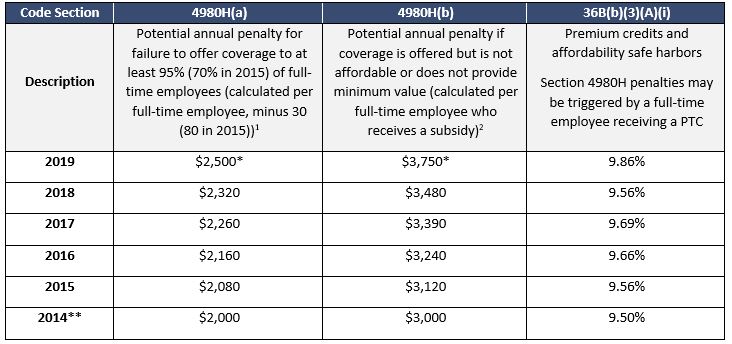
In Rev. Proc. 2018-34, the IRS released the inflation adjusted amounts for 2019 relevant to determining whether employer-sponsored coverage is “affordable” for purposes of the Affordable Care Act’s (“ACA’s”) employer shared responsibility provisions and premium tax credit program.  As shown in the table below, for plan years beginning in 2019, the affordability percentage is 9.86% of an employee’s household income or applicable safe harbor.

* Estimated based on premium adjustment percentage in the 2019 Notice of Benefit and Payment Parameters
**No employer shared responsibility penalties were assessed for 2014.


1 The “A” penalty applies when an ALE fails to offer coverage to at least 95% of its full-time employees (and their children up to age 26) and at least one full-time employee receives a premium credit for marketplace coverage. The requirement is only to offer coverage – no employer contribution or minimum plan design is necessary to avoid the penalty.

2 The “B” penalty applies when the ALE offers coverage to 95% of its full-time employees (and their children up to age 26), but the coverage is either not affordable or does not provide minimum value, and at least one full-time employee receives a premium credit.


Under the ACA, applicable large employers (ALEs) – generally those with 50 or more full-time equivalent employees on average in the prior calendar year – must offer affordable health insurance to full-time employees to avoid an employer shared responsibility payment.  Coverage is “affordable” if the employee’s required contribution for self-only coverage under the employer’s lowest-cost minimum value plan does not exceed 9.5% (as indexed) of the employee’s household income for the year.  In lieu of household income, employers may rely on one or more of the following safe harbor alternatives when assessing whether coverage is affordable:  W-2, Rate of Pay, and Federal Poverty Level.  Each of the three safe harbors refers back to the 9.86% figure in 2019.

The ACA also provides a premium tax credit to assist individuals paying for health coverage in the public marketplace. An individual offered affordable employer-sponsored coverage is generally ineligible for the premium tax credit.  Accordingly, for plan years starting in 2019, if a full-time employee’s required contribution for self-only coverage offered by the employer is more than 9.86% of his or her household income (or applicable safe harbor), the coverage will not be considered affordable for that employee and the employer may be liable for an employer shared responsibility payment if the employee obtains a premium tax credit. 

Note that beginning January 1, 2019, under the Tax Cuts and Jobs Act, the individual mandate penalty imposed on individual taxpayers for failure to have qualifying health coverage was reduced to $0, effectively repealing the individual mandate.  However, despite repeated efforts by the Trump Administration and Congress, the employer mandate has not been repealed and the IRS has begun enforcing the employer mandate by sending Letter 226-J for 2015 informing employers of a potential employer shared responsibility payment. While there continue to be calls to suspend the assessment and repeal the employer mandate, including most recently a letter by industry groups to Treasury and the U.S. Department of Health and Human Services, to date, enforcement has not ceased and the employer mandate remains the law of the land.

Next Steps for Employers

Applicable large employers should be mindful of the updated affordability percentage for plan years beginning in 2019. Given that the affordability percentage has increased significantly from 9.56% to 9.86%, employers should have additional flexibility when setting “affordable” employee contributions.

About the Author.  This alert was prepared for Benefit Advisors Network by Marathas Barrow Weatherhead Lent LLP, a national law firm with recognized experts on the Affordable Care Act.  Contact Peter Marathas or Stacy Barrow at pmarathas@marbarlaw.com or sbarrow@marbarlaw.com.

About the Author

Stacy H. Barrow, Esq., Compliance Director

This alert was prepared by Stacy Barrow. Mr. Barrow is a nationally recognized expert on the Affordable Care Act and BAN’s Compliance Director. His firm, Marathas Barrow Weatherhead Lent LLP, is a premier employee benefits, executive compensation and employment law firm. He can be reached at sbarrow@marbarlaw.com.

This message is a service to our clients and friends. It is designed only to give general information on the developments actually covered. It is not intended to be a comprehensive summary of recent developments in the law, treat exhaustively the subjects covered, provide legal advice, or render a legal opinion.

Benefit Advisors Network and its smart partners are not attorneys and are not responsible for any legal advice. To fully understand how this or any legal or compliance information affects your unique situation, you should check with a qualified attorney.

© Copyright 2018 Benefit Advisors Network. Smart Partners. All rights reserved.

Legal Alert: IRS Adjusts 2018 HSA Contribution Limit – Again

The IRS has announced it is modifying the annual limitation on deductions for contributions to a health savings account (“HSA”) allowed for taxpayers with family coverage under a high deductible health plan (“HDHP”) for the 2018 calendar year. Under Rev. Proc. 2018-27, taxpayers will be allowed to treat $6,900 as the annual limitation, rather than the $6,850 limitation announced in Rev. Proc. 2018-18 earlier this year.

The HSA contribution limit for individuals with family HDHP plan coverage was originally issued as $6,900 last May in Rev. Proc. 2017-37. Earlier this year, the IRS announced a $50 reduction in the maximum deductible amount from $6,900 to $6,850 due to changes made by the Tax Cuts and Jobs Act. 

Due to widespread complaints and comments from individual taxpayers, employers and other major stakeholders, the IRS has decided it is in the best interest of “sound and efficient” tax administration to allow individuals to treat the originally released $6,900 as the 2018 family limit. The IRS acknowledged that many individuals had already made the maximum HSA contribution for 2018 before the deduction limitation was lowered and many other individuals had made annual salary reduction elections for HSA contributions through employers’ cafeteria plans based on the higher limit. Additionally, the costs of modifying various systems to reflect the reduced maximum would be significantly greater than any tax benefit associated with an unreduced HSA contribution.

Rev. Proc. 2018-27 provides guidance for those taxpayers who already took a distribution in 2018 from their HSA based on the reduced maximum limit of $6,850. Anyone who receives a distribution from an HSA in excess of the $6,850 limit may treat that distribution as the result of a “mistake of fact due to reasonable cause.” The portion of a distribution (including earnings) that an individual repays to the HSA by April 15, 2019, will not be included in the individual’s gross income or be subject to the 20% additional tax for non-medical distributions. The repayment will not be subject to the 6% excise tax on excess contributions either. Mistaken distributions that are repaid to an HSA are not required to be reported on Form 1099-SA or Form 8889 and are not required to be reported as additional HSA contributions.

Alternatively, if an individual decides not to repay such a distribution it will not have to be included in gross income or subject to the additional 20% tax as long as the distribution is received by the individual’s 2018 tax return filing due date. This tax treatment, however, does not apply to contributions from an HSA that are attributable to employer contributions if the employer does not include any portion of the contributions in the employee’s wages because the employer treats $6,900 as the annual contribution limit. In that scenario, the distribution would be included in the individual’s gross income and subject to the 20% additional tax unless it was used to pay for qualified medical expenses.  In other words, if the employee withdraws the $50 and does not return it to the HSA, it’s not includible in income or subject to the 20% additional tax unless the $50 is reported as an employer contribution on the employee’s W-2 (in box 12, code W), in which case it would be includible in income and subject to the 20% additional tax.

Employers who previously informed employees that the limit was lowered should consider informing them now about the new limit and repayment option.


About the Author

This alert was prepared for Benefit Advisors Network by Marathas Barrow Weatherhead Lent LLP, a national law firm with recognized experts on the Affordable Care Act.  Contact Peter Marathas or Stacy Barrow at pmarathas@marbarlaw.com or sbarrow@marbarlaw.com.

Stacy H. Barrow, Esq., Compliance Director

This alert was prepared by Stacy Barrow. Mr. Barrow is a nationally recognized expert on the Affordable Care Act and BAN’s Compliance Director. His firm, Marathas Barrow Weatherhead Lent LLP, is a premier employee benefits, executive compensation and employment law firm. He can be reached at sbarrow@marbarlaw.com.

This message is a service to our clients and friends. It is designed only to give general information on the developments actually covered. It is not intended to be a comprehensive summary of recent developments in the law, treat exhaustively the subjects covered, provide legal advice, or render a legal opinion.

Benefit Advisors Network and its smart partners are not attorneys and are not responsible for any legal advice. To fully understand how this or any legal or compliance information affects your unique situation, you should check with a qualified attorney.

Legal Alert: CMS Extension Relief for Non-Compliant Plans through 2019

On April 9, 2018, the Centers for Medicare & Medicaid Services (CMS) announced a one-year extension to the transition policy (originally announced November 14, 2013 and extended several times since) for individual and small group health plans that allows issuers to continue policies that do not meet ACA standards.  The transition policy has been extended to policy years beginning on or before October 1, 2019, provided that all policies end by December 31, 2019.  This means individuals and small businesses may be able to keep their non-ACA compliant coverage through the end of 2019, depending on the policy year.  Carriers may have the option to implement policy years that are shorter than 12 months or allow early renewals with a January 1, 2019 start date in order to take full advantage of the extension.

Background

The Affordable Care Act (ACA) includes key reforms that create new coverage standards for health insurance policies. For example, the ACA imposes modified community rating standards and requires individual and small group policies to cover a comprehensive set of benefits.

Millions of Americans received notices in late 2013 informing them that their health insurance plans were being canceled because they did not comply with the ACA’s reforms. Responding to pressure from consumers and Congress, on Nov. 14, 2013, President Obama announced a transition relief policy for 2014 for non-grandfathered coverage in the small group and individual health insurance markets. If permitted by their states, the transition policy gives health insurance issuers the option of renewing current policies for current enrollees without adopting all of the ACA’s market reforms.

Transition Relief Policy

Under the original transitional policy, health insurance coverage in the individual or small group market that was renewed for a policy year starting between Jan. 1, 2014, and Oct. 1, 2014 (and associated group health plans of small businesses), will not be out of compliance with specified ACA reforms.  These plans are referred to as “grandmothered” plans.

To qualify for the transition relief, issuers must send a notice to all individuals and small businesses that received a cancellation or termination notice with respect to the coverage (or to all individuals and small businesses that would otherwise receive a cancellation or termination notice with respect to the coverage).

The transition relief only applies with respect to individuals and small businesses with coverage that was in effect since 2014. It does not apply with respect to individuals and small businesses that obtain new coverage after 2014. All new plans must comply with the full set of ACA reforms.

One-year Extension

According to CMS, the extension will ensure that consumers have multiple health insurance coverage options and states continue to have flexibility in their markets. Also, like the original transition relief, issuers that renew coverage under the extended transition relief must, for each policy year, provide a notice to affected individuals and small businesses.

Under the transition relief extension, at the option of the states, issuers that have issued policies under the transitional relief in 2014 may renew these policies at any time through October 1, 2019 and affected individuals and small businesses may choose to re-enroll in the coverage through October 1, 2019. Policies that are renewed under the extended transition relief are not considered to be out of compliance with the following ACA reforms:

  • Community premium rating standards, so consumers might be charged more based on factors such as gender or a pre-existing medical condition, and it might not comply with rules limiting age banding (PHS Act section 2701); 
  • Guaranteed availability and renewability (PHS Act sections 2702 & 2703); 
  • If the coverage is an individual market policy, the ban on preexisting medical conditions for adults, so it might exclude coverage for treatment of an adult’s pre-existing medical condition such as diabetes or cancer (PHS Act section 2704);
  • If the coverage is an individual market policy, discrimination based on health status, so consumers may have premium increases based on claims experience or receipt of health care (PHS Act section 2705);
  • Coverage of essential health benefits or limit on annual out-of-pocket spending, so it might not cover benefits such as prescription drugs or maternity care, or might have unlimited cost-sharing (PHS Act section 2707); and
  • Standards for participation in clinical trials, so consumers might not have coverage for services related to a clinical trial for a life-threatening or other serious disease (PHS Act section 2709).

About the Author

This alert was prepared for Benefit Advisors Network by Marathas Barrow Weatherhead Lent LLP, a national law firm with recognized experts on the Affordable Care Act.  Contact Peter Marathas or Stacy Barrow at pmarathas@marbarlaw.com or sbarrow@marbarlaw.com.

Stacy H. Barrow, Esq., Compliance Director

This alert was prepared by Stacy Barrow. Mr. Barrow is a nationally recognized expert on the Affordable Care Act and BAN’s Compliance Director. His firm, Marathas Barrow Weatherhead Lent LLP, is a premier employee benefits, executive compensation and employment law firm. He can be reached at sbarrow@marbarlaw.com.

This message is a service to our clients and friends. It is designed only to give general information on the developments actually covered. It is not intended to be a comprehensive summary of recent developments in the law, treat exhaustively the subjects covered, provide legal advice, or render a legal opinion.

Benefit Advisors Network and its smart partners are not attorneys and are not responsible for any legal advice. To fully understand how this or any legal or compliance information affects your unique situation, you should check with a qualified attorney.

© Copyright 2018 Benefit Advisors Network. Smart Partners. All rights reserved.