IRS Releases Guidance for Employers Offering Individual Coverage HRAs

On September 27, the Internal Revenue Service (IRS) released proposed regulations on the application of the Affordable Care Act’s (ACA) employer shared responsibility provisions to a new type of Health Reimbursement Arrangement (HRA) available starting in 2020.  In June 2019, the Department of Labor, the Department of Health and Human Services, and the Treasury Department (the “Departments”) released a final rule concerning HRAs that can be integrated with individual market coverage or Medicare.  This new type of HRA is referred to as an Individual Coverage HRA, or ICHRA.  The rule, based on an executive order from President Trump in 2017, is intended to increase the usability of HRAs, to expand employers’ ability to offer HRAs to their employees, and to allow HRAs to be used in conjunction with non-group coverage.

The ICHRA rule is effective for plan years beginning on or after January 1, 2020.  The IRS has also proposed regulations to guide employers in determining whether their contribution to an employee’s ICHRA results in an “affordable” offer of coverage under the ACA.  Specifically, the proposed regulations will assist employers who offer ICHRAs in determining the “required employee contribution” for purposes of line 15 of Form 1095-C.  Employers may continue to use the W-2, Rate of Pay, or Federal Poverty Level safe harbors to determine whether their entry in line 15 results in an “affordable” offer of coverage.  (See Example on page 3.)

The proposed regulations are effective for periods after December 31, 2019.  Employers may continue to rely on them during any ICHRA plan year beginning within six months from the publication of any final regulations.  

Proposed Safe Harbors

The proposed regulations offer safe harbors for applicable large employers (ALEs), which are those who employed at least 50 full-time equivalent employees on average in the prior calendar year.  When an employer offers an ICHRA to a full-time employee, the “required employee contribution” to include on line 15 of Form 1095-C is the difference between the self-only amount the employer makes newly available to the employee under the individual coverage HRA for the month (the monthly HRA amount) and the employee’s monthly premium for self-only coverage under the lowest-cost silver plan offered in the Exchange for the rating area in which the employee resides (the PTC affordability plan).

Instead of using the Exchange where the employee resides, an employer may use a location-based safe harbor based on the employee’s primary worksite.  In addition, employers may use a “look back” safe harbor to determine whether the premium for the lowest-cost silver plan self-only coverage should be determined by reference to the current or prior calendar year.  Employers must apply the safe harbors on a consistent basis to all employees within a class.  Employers may use a different safe harbor for different classes of employees.

Location-Based Safe Harbor

As mentioned, the “required employee contribution” to include on line 15 of an employee’s Form 1095-C is the difference between the self-only amount the employer makes newly available to the employee under the individual coverage HRA for the month (the monthly HRA amount) and the employee’s monthly premium for self-only coverage under the lowest-cost silver plan offered in the Exchange for the rating area in which the employee resides (the PTC affordability plan).

Under the location-based safe harbor, an employer may use the lowest-cost silver plan for self-only coverage through the Exchange where the employee’s primary site of employment is located. The employer is not required to use an employee’s actual residence to determine affordability unless the employee’s worksite is his or her home (due to remote or telecommute work).  The primary site of employment is the location the employer expects the employee to perform services on the first day of the plan year or the effective date (the day the employee is eligible to participate in the ICHRA).

Age-Related Issues

The proposed regulations do not establish any specific safe harbors based on age; however, as a practical matter, an employer may use the age of the oldest employee to determine the ICHRA contribution for employees in that class (i.e., take the lowest-cost silver plan based on the age of the oldest employee).  An employer may vary the amount of the ICHRA contribution based on age by no more than a 3:1 ratio between the oldest and youngest participant.  An employer making age-based contributions may use the employee’s age on the first day of the plan year or the first day the employee is eligible to participate in the ICHRA.

Look-Back Month Safe Harbor

An employer may also utilize the look-back month safe harbor when selecting the lowest-cost silver plan.  If the ICHRA operates on a calendar year basis, the employer may use the premium for self-only coverage under the lowest-cost silver plan from January of the prior calendar year.  If the ICHRA operates on a non-calendar basis, the employer may use the monthly premium amount from January of the current calendar year. The difference in the look-back month is attributed to when the Exchange opens and when rates are submitted. The IRS understands that employers generally determine their plans and contributions ahead of time, and wants to ensure employers have the opportunity to make such determinations.  If the employer chooses to use the look-back month safe harbor, the employer must use the employee’s current applicable location and current age, regardless of whether the lowest-cost silver plan is determined based on the current or prior year.

Example:  Location and Look-Back Month Safe Harbor with Calendar Year ICHRA

For 2020, an employer offers all full-time employees and their dependents a calendar year ICHRA with $250 per month available regardless of family size.  All employees have their primary site of employment in City A.  An employee is 40 years old on January 1, 2020, and makes $15/hour.  The applicable monthly premium for the lowest-cost silver plan for a 40-year old offered through the Exchange in City A for January 2019 is $400.  The employer uses the Rate of Pay safe harbor for hourly employees.

In this example, the employee’s “required contribution” for each month of 2020 is the $150 difference between the lowest-cost silver plan ($400) and the employer’s monthly contribution ($250).  Therefore, $150 is the amount reported on Line 15 of Form 1095-C. 

Conclusion: ICHRA Contribution Results in an Affordable Offer

The employer has offered affordable coverage to this employee in 2020 because the required contribution ($150) is less than the Rate of Pay safe harbor for this employee (9.78% × $15 × 130 = $196).

Other Considerations

1094-C/1095-C Reporting

Applicable large employers are still required to perform the required employer mandate reporting (Forms 1094-C and 1095-C). The IRS indicated that reporting exceptions applicable to traditional HRAs integrated with fully insured group health plans will not apply.  The IRS also indicated that additional guidance will be released before the calendar year 2020 reporting is due. If an employer offers affordable coverage under an ICHRA, it is presumed it meets minimum value and will be viewed as an offer of employer-sponsored group health plan coverage.

How to Find the Data

As a way to make determining affordability less burdensome, the proposed regulations state that for plans on the federal Exchange, the Department of Health and Human Services (HHS) has provided a platform for employers to view the lowest-cost silver plans in applicable locations. For plans offered through a state Exchange, the IRS stated that HHS will work with the states to implement a similar platform.  If the employer uses the platform to determine affordability, it may rely on the information posted. 

Section 105(h) Nondiscrimination    

An ICHRA, as a self-funded plan, is required to satisfy Section 105(h) nondiscrimination testing; however, an ICHRA that only reimburses insurance premiums and not medical expenses is not subject to Section 105(h). Although different classes are allowed, the ICHRA cannot discriminate in favor of highly compensated individuals. The proposed regulations provide that an ICHRA that satisfies the 3:1 age variation exception will not be discriminatory under Section 105(h) solely due to the variation based on age.  Without the exception, Section 105(h) prohibits the maximum limit attributable to employer contributions to an HRA from being modified by reason of a participant’s age.  The proposed regulations also provide that if the maximum dollar amount under an ICHRA varies for participants within a class of employees, or varies between classes of employees, then with respect to that variance, the ICHRA does not violate Section 105(h) so long as the maximum dollar amount only varies as permitted under the ICHRA rules.

Allowing Pre-Tax Contributions to Individual Market Coverage

The proposed regulations address the extent to which an employer can allow an employee to make pre-tax contributions towards his/her individual plan. The proposed regulations do not permit employees to take the salary reduction to purchase qualified health plans through the Exchange, which is expressly prohibited by the ACA. If an employee purchases an individual health plan off-Exchange (such as going directly to a carrier), an employer may allow employees to pay pre-tax for the portion of the premium not covered by the ICHRA.  If an employer wants to allow pre-tax contributions, it must determine whether the individual coverage was purchased on-Exchange or off-Exchange, in order to determine if the deductions can be taken pre-tax.

What Employers Should Expect Next

Employers who are contemplating offering an ICHRA should consult with qualified ERISA counsel.  There are additional requirements and guidelines an employer will need to meet in order to comply with all the requirements applicable to these new arrangements. The Departments also anticipate the release of additional guidance in the future.

__________________________________________________

About the Author. This alert was prepared by Stacy Barrow. Mr. Barrow is a nationally recognized expert on the Affordable Care Act. His firm, Marathas Barrow Weatherhead Lent LLP, is a premier employee benefits, executive compensation, and employment law firm. He can be reached at sbarrow@marbarlaw.com.

This email is a service to our clients and friends. It is designed only to give general information on the developments actually covered. It is not intended to be a comprehensive summary of recent developments in the law, treat exhaustively the subjects covered, provide legal advice, or render a legal opinion.

Benefit Advisors Network and its members are not attorneys and are not responsible for any legal advice. To fully understand how this or any legal or compliance information affects your unique situation, you should check with a qualified attorney.


© Copyright 2019 Benefit Advisors Network. All rights reserved.

Legal Alert: Departments Adopt Non-Enforcement Policy on Drug Manufacturer Coupons

On August 26, 2019, the Departments of Labor (DOL), Health and Human Services (HHS), and Treasury released an FAQ that provides guidance to employers, plan sponsors and health insurance issuers regarding a recent HHS regulation that could be read to require group health plans to treat prescription drug manufacturers’ coupons as employee cost-sharing for purposes of the ACA’s out-of-pocket limits, for plan years beginning in 2020. Currently, the ACA’s out-of-pocket limits for plan years beginning in 2019 are $7,900 individual / $15,800 family. The guidance in the FAQ is effective immediately, and provides that the Departments will not initiate enforcement action against a group health plan or issuer if the plan excludes the value of drug manufacturers’ coupons from the ACA’s annual limitation on cost-sharing, even in circumstances in which there is no medically appropriate generic equivalent available.

The Departments have determined that HHS will address the interplay between manufacturers’ coupons and out-of-pocket limits in future guidance.

Overview

In its 2020 Notice of Benefit and Payment Parameters (2020 NBPP), HHS stated that drug manufacturers’ support to plan participants—in the form of discounts or coupons—“[is] not required to be counted” toward the cost-sharing limit of participants when a generic version is not available. Due to the strong negative inference in the rule (i.e., that coupons should count toward the participant’s out-of-pocket limit if a generic version is not available), the Departments received requests for clarification on whether group health plans and insurers are required to count the coupon or discount toward the annual cost-sharing with plan participants if a generic equivalent is not available.

If read to require a manufacturer’s coupon to count toward the out-of-pocket limit, the most significant complication with the HHS rule is that it could disrupt Health Savings Account (HSA) eligibility for individuals who participate in a High Deductible Health Plan (HDHP). If the drug discounts were to apply before the individual satisfies his or her deductible, it could impact eligibility to contribute to an HSA. In fact, under Q/A-9 of IRS Notice 2004-50, discounts for drugs or coupons from manufacturers or providers should not be counted when determining if an individual has met their minimum annual deductible requirements under an HDHP.

The issue arises due to the possible conflict between the 2020 NBPP and IRS Notice 2004-50. If a group health plan is required to count drug coupons or discounts towards out-of-pocket limits, the plan would no longer be HSA-qualified because it would not comply with the requirement under Notice 2004-50 to disregard drug discounts and other manufacturers’ and providers’ discounts in determining if the minimum deductible for an HDHP has been satisfied and only allow amounts actually paid by the individual to be taken into account for that purpose.

Non-Enforcement Policy

Due to the potential impact on HSA eligibility and conflict between NBPP 2020 and the IRS Notice, the Departments have concluded that further rulemaking surrounding this issue must occur before enforcement can begin. HHS has decided to undertake the rulemaking in the NBPP for 2021 that will be released next year. Until this rulemaking occurs, the Departments will not initiate enforcement action against group health plans or issuers who exclude the value of drug coupons or discounts from the out-of-pocket limit, including in circumstances in which there is no medically appropriate generic equivalent available.

Impact on Employers

Until further guidance is issued, employers, plan sponsors and health insurance issuers may continue to exclude the value of prescription drug manufacturer coupons from participant cost-sharing under the ACA’s out-of-pocket limit rules, regardless of whether a medically appropriate generic equivalent is available. In 2019, HHS released the proposed 2020 NBPP in January and the final 2020 NBPP in April. A similar schedule is likely to be followed in 2020 for the 2021 NBPP.

About the Author. This alert was prepared for [INSERT AGENCY NAME] by Stacy Barrow. Mr. Barrow is a nationally recognized expert on the Affordable Care Act. His firm, Marathas Barrow Weatherhead Lent LLP, is a premier employee benefits, executive compensation and employment law firm. He can be reached at sbarrow@marbarlaw.com.

This email is a service to our clients and friends. It is designed only to give general information on the developments actually covered. It is not intended to be a comprehensive summary of recent developments in the law, treat exhaustively the subjects covered, provide legal advice, or render a legal opinion.

Benefit Advisors Network and its members are not attorneys and are not responsible for any legal advice. To fully understand how this or any legal or compliance information affects your unique situation, you should check with a qualified attorney.
© Copyright 2019 Benefit Advisors Network. All rights reserved.
Legal Alert: IRS Issues Affordability Percentage Adjustment for 2020

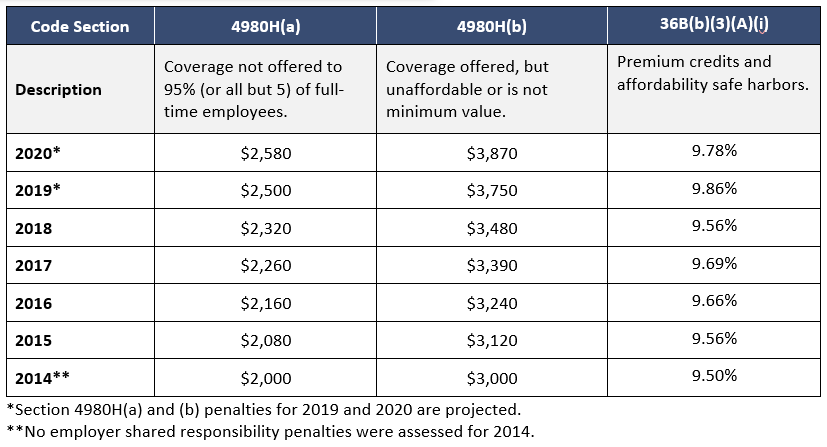
The Internal Revenue Service (IRS) has released Rev. Proc. 2019-29, which contains the inflation adjusted amounts for 2020 used to determine whether employer-sponsored coverage is “affordable” for purposes of the Affordable Care Act’s (ACA) employer shared responsibility provisions and premium tax credit program. As shown in the table below, for plan years beginning in 2020, the affordability percentage for employer mandate purposes is indexed to 9.78%. Employer shared responsibility payments are also indexed.

Affordability Percentage Adjustment

Under the ACA, applicable large employers (ALEs) must offer affordable health insurance coverage to full-time employees. If the ALE does not offer affordable coverage, it may be subject to an employer shared responsibility payment. An ALE is an employer that employed 50 or more full-time equivalent employees on average in the prior calendar year. Coverage is considered affordable if the employee’s required contribution for self-only coverage on the employer’s lowest-cost, minimum value plan does not exceed 9.78% of the employee’s household income in 2020 (prior years indexed above). An ALE may rely on one or more safe harbors in determining if coverage is affordable: W-2, Rate of Pay, and Federal Poverty Level.

If the employer’s coverage is not affordable under one of the safe harbors and a full-time employee is approved for a premium tax credit for Marketplace coverage, the employer may be exposed to an employer shared responsibility payment.

Note that as of January 1, 2019, the individual mandate penalty imposed on individual taxpayers for failure to have qualifying health coverage was reduced to $0 under the Tax Cuts and Jobs Act, effectively repealing the individual mandate. Although there is currently a lawsuit challenging the constitutionality of the ACA due to this change to the individual mandate penalty, the employer mandate has not been repealed and the IRS continues to enforce it through Letter 226J. The IRS has recently begun sending letters pertaining to calendar year 2017 reporting.

Next Steps for Employers

Applicable large employers should be aware of the updated affordability percentage for plan years beginning in 2020. Although the affordability percentage has not decreased significantly from 9.86% to 9.78%, employers should consider it along with all other relevant factors when determining contributions.

About the Author. This alert was prepared for Benefit Advisors Network by Stacy Barrow. Mr. Barrow is a nationally recognized expert on the Affordable Care Act. His firm, Marathas Barrow Weatherhead Lent LLP, is a premier employee benefits, executive compensation and employment law firm. He can be reached at sbarrow@marbarlaw.com.

This message is a service to our clients and friends. It is designed only to give general information on the developments actually covered. It is not intended to be a comprehensive summary of recent developments in the law, treat exhaustively the subjects covered, provide legal advice, or render a legal opinion.

Benefit Advisors Network and its members are not attorneys and are not responsible for any legal advice. To fully understand how this or any legal or compliance information affects your unique situation, you should check with a qualified attorney.

© Copyright 2019 Benefit Advisors Network. All rights reserved.

Legal Alert: IRS Expands HSA Preventive Care Safe Harbor to Include Chronic Conditions

On July 17, 2019, the Internal Revenue Service (IRS) released Notice 2019-45, which expands the definition of preventive care benefits that can be provided by a high deductible health plan (HDHP) to include certain chronic conditions.  The guidance in the Notice may be relied upon immediately.  In general, most HDHP participants may establish and contribute to a health savings account (HSA), unless there is disqualifying coverage—such as having other medical benefits available besides preventive care before the minimum annual deductible is satisfied.

Overview

Under Section 223(c) of the Internal Revenue Code (Code), an HSA-qualified HDHP is not required to impose a deductible for certain preventive care services. This preventive care safe harbor includes services such as annual physicals, well-childcare, and immunizations. Notably, prior to the Notice, preventive care did not include any service to treat existing illnesses, injuries, or conditions. Likewise, drugs or medications were treated as preventive care only when taken by a person who has developed risk factors for a disease that has not yet manifested itself or has not yet become clinically apparent (i.e., the individual is asymptomatic) or when the drugs are taken to prevent the recurrence of a disease from which a person has recovered.

Ultimately, the goal of the preventive care safe harbor is to encourage HDHP participants to receive routine care with a lower cost barrier, which should lead to better health outcomes. By expanding the list of medical services that can be classified as preventive care, the IRS recognizes that cost barriers for care have resulted in some individuals with certain chronic conditions failing to seek care that would prevent exacerbation of their condition, which can lead to consequences such as amputation, blindness, heart attacks, and strokes that require considerably more extensive medical intervention.

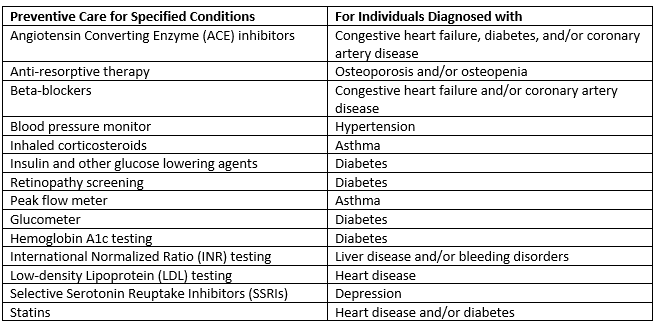
In the Notice, the IRS expands the definition of preventive care to include coverages for specific chronic illnesses, in order to encourage necessary care and mitigate the consequences of not receiving care. It is also pursuant to President Trump’s executive order released on June 24, 2019, which instructs the agencies to allow HSAs to cover other low-cost preventive care to help maintain health statuses of participants with chronic illnesses. Such conditions will be considered preventive care only if the care is for one of the conditions listed below, and only when the care occurs for the purpose of preventing exacerbation of the condition or development of a new, secondary condition. Any care, services, or conditions not listed within the Notice (or other IRS guidance) will not be treated as preventive care and will not be permitted under the preventive care safe harbor.

Preventive Care under Code Section 223 now includes the following care and conditions:

HSA Preventive Care Safe Harbor Chronic Conditions

Impact on Employers and Plan Participants

Employers and plan sponsors that offer an HSA-qualified HDHP, and their participating employees, should understand which conditions and services are now included under the preventive care definition. While use of the expanded safe harbor is voluntary, we expect that many plans will adopt it. The expanded safe harbor could benefit employers—especially those with self-funded plans—and allow for further cost-savings by covering chronic illnesses before a deductible is met.

This message is a service to our clients and friends. It is designed only to give general information on the developments actually covered. It is not intended to be a comprehensive summary of recent developments in the law, treat exhaustively the subjects covered, provide legal advice, or render a legal opinion.

About the Author.  This alert was prepared for Benefit Advisors Network by Stacy Barrow.  Mr. Barrow is a nationally recognized expert on the Affordable Care Act.  His firm, Marathas Barrow Weatherhead Lent LLP, is a premier employee benefits, executive compensation and employment law firm.  He can be reached at sbarrow@marbarlaw.com.

Legal Alert: President Trump Issues Executive Order Encouraging Transparency in Pricing and Expanding Consumer-Directed Arrangements


On June 24, 2019, President Trump issued an Executive Order intending to develop price and quality transparency initiatives to ensure that healthcare patients can make well-informed decisions about their care. This is part of the consumer-driven healthcare initiative, which has been a focus of government and patient groups alike to have more transparency regarding the cost of services from hospitals and other healthcare providers, as well as expanding the ability to use certain pre-tax health spending arrangements. The goal is to help consumers to make better informed decisions regarding their healthcare. It is also intended to address so-called “surprise billing,” which can expose patients to unexpected medical bills. The Executive Order directs federal agencies to promulgate regulations and issue guidance to meet these objectives.

Transparency in Prices


The Executive Order instructs the Department of Health and Human Services (HHS) to promulgate regulations requiring hospitals to publicly post standard price information for services rendered in an easy-to-read format. The regulations should mandate the disclosure of standard charge information for services, supplies, and any other fees that apply to the hospital and its employees. HHS may also use the Executive Order to create regulations for other providers and self-funded health plans to also post standard costs for services and supplies. The objective of such disclosure is to allow patients to make more informed decisions about the cost of services and goods if the patient goes to a certain healthcare facility. If a patient understands the cost and quality of services, they could avoid unexpected costs. It could also facilitate further analysis regarding the cost differentials between facilities and providers. The standard costs posted must be regularly updated, in order to provide accurate, up-to-date pricing. The Executive Order also requires the agencies to monitor the hospitals, providers, and plans for compliance.

Increased Access to Healthcare Information


The Executive Order directs applicable agencies to increase de-identified claims data to give researchers, providers, and other parties more information and access to taxpayer-funded healthcare programs. Such parties could create better educational materials for consumers by being able to access more aggregated public data.

Enhancing Patient Control over Healthcare


This provision of the Executive Order directs the Secretary of Treasury to propose regulations to help patients who have high deductible health plans (HDHPs). Part of the guidance would allow HDHPs to cover low-cost preventive care, before the deductible, for medical care that helps maintain health status for individuals with chronic conditions. Currently, drugs or medications used to treat other existing illnesses, injuries, or conditions are not considered permitted “preventive care” for Health Savings Account (HSA) purposes.

The directive also includes expanding the definition of eligible medical expenses under the Internal Revenue Code to include expenses related to certain types of arrangements, such as direct primary care and healthcare sharing ministries. Furthermore, the carryover allowance for health flexible spending arrangements would also be increased, from the current $500 limit. This could enable consumers to better reserve pre-tax money to help further fund their own healthcare costs.

Surprise Billing


Building upon the proposals already occurring in federal agencies and Congress, the Executive Order further directs the agencies to report to the President any additional steps that can be taken to help control surprise billing issues. Surprise billing often occurs when an individual goes to a facility that is in-network with his or her plan, but a provider giving certain services is not part of the facility contract. This means that the patient could be charged for out-of-network provider services because it is not covered under their health plan, regardless of the facility being in-network. The patient is then responsible for an unexpected bill. Some of the previously proposed changes for surprise billing include changes to out-of-network reimbursement when a facility is in-network under the health plan, especially for emergency services.

Current Impact on Employers


The Executive Order does not make any changes to existing regulations; it directs agencies to propose and create regulations associated with the Executive Order. Employers, plan sponsors, and administrators should be ready to implement new changes as they occur in the future. Consumers, plan sponsors, and employers alike may benefit from these regulations as the increase of information provides further education to plan participants and help them make more well-informed decisions concerning their healthcare.

About the Author

This alert was prepared for Benefit Advisors Network by Stacy Barrow. Mr. Barrow is a nationally recognized expert on the Affordable Care Act. His firm, Marathas Barrow Weatherhead Lent LLP, is a premier employee benefits, executive compensation, and employment law firm. He can be reached at sbarrow@marbarlaw.com.