Agencies Push Pause Button on Enforcement of MHPAEA 2024 Final Rule


On May 15, 2025, the Department of Labor, Department of Health and Human Services, and the Treasury Department (collectively, the “Agencies”) released a statement regarding the Agencies’ recent request for abeyance of a lawsuit filed by the ERISA Industry Committee (“ERIC”) in the U.S. District Court for the District of Columbia that challenged certain aspects of Mental Health Parity and Addiction Equity Act (MHPAEA) Final Rule (“2024 Final Rule”) relating to nonquantitative treatment limitation comparative analyses (“NQTL analyses”). While the lawsuit is in abeyance, the  Agencies indicted that they intend to review the 2024 Final Rule in light of President Trump’s recent Executive Order 14219 (“Ensuring Lawful Governance and Implementing the President’s Department of Government Efficiency Deregulatory Initiative”) which requires the Agencies to identify regulations which, among other things, may impose undue burdens on small businesses or significant costs on private parties. During this time, the Agencies will consider whether the 2024 Final Rule will be rescinded or modified through agency regulatory processes, including notice and comment periods. 

 The statement also expresses the Agencies’ policy that the 2024 Final Rule will not be enforced prior to 18 months following the end of the ERIC lawsuit. As set forth in the statement, this only applies to provisions of the 2024 Final Rule that were added since the 2013 MHPAEA final rule was implemented by the Agencies. It does NOT impact the statutory provisions of the Consolidated Appropriations Act, 2021 (“CAA 2021”) which imposes written MHPAEA comparative analyses on plan sponsors. Accordingly, employers are still required to maintain written NQTL analyses pursuant to the CAA 2021; however, the comparative analyses will not include some of the data collection, design and application, and fiduciary certification requirements included in the 2024 Final Rule at this time. 

 Agency Statement 

The Agencies’ statement indicates that they intend to take a broader look at the their future enforcement approach under the MHPAEA, including the statutory provisions in the CAA 2021, and, until they decide which direction to go (through the rulemaking process, which will take place within 18 months after the ERIC lawsuit is resolved), plans and issuers should rely on the MHPAEA final rules released in 2013, FAQs About Mental Health and Substance Use Disorder Parity Implementation and the Consolidated Appropriations Act, 2021 Part 45, and other Agency sub regulatory guidance related to the MHPAEA. 

 Next Steps for Employers 

Employers who sponsor group medical plans subject to MHPAEA MUST still complete NQTL analyses pursuant to the CAA 2021. The Agencies’ nonenforcement policy does not relieve employers of this requirement, nor does it mean that the Agencies will not enforce the written comparative analyses requirements under the CAA 2021. Instead, employers will use prior guidance from the agencies that was used by employers from February 15, 2022 until January 1, 2025 when the 2024 Final Rule became effective.  This means: 

  • Employers with fully insured plans subject to MHPAEA should continue to communicate with their carriers to ensure the carrier is performing the NQTL analyses. 
  • Employers with self-insured plans subject to MHPAEA (generally, those with more than 50 employees) should ensure their contract with their third party administrator (TPA) requires that the TPA complete and/or provide all of the data necessary for another party to complete the NQTL analyses, and that the TPA will assist in providing any and all additional data requested by the DOL in the event of an audit. 
  • Employers who have any carved-out coverages subject to MHPAEA should ensure the TPA for those benefits is assisting with and/or completing NQTL analyses relative to the specific benefits involved. For example, if the employer has a self-funded medical plan with a separate prescription drug benefit administered by a pharmacy benefit manager (“PBM”), the employer should ensure the PBM is performing or assisting a qualified service provider who is performing and documenting the comparative analyses related to the prescription drug benefits. 
  • Employers should be prepared to submit the plan’s comparative analyses to the DOL or plan participants upon request. 


______________________________ 


About the Author. This alert was prepared for [Agency Name] by Barrow Lent LLP, a national law firm with recognized experts on the Affordable Care Act and Consolidated Appropriations Act. Contact Stacy Barrow or Nicole Quinn-Gato at sbarrow@marbarlaw.com or nquinngato@marbarlaw.com. 


The information provided in this alert is not, is not intended to be, and shall not be construed to be, either the provision of legal advice or an offer to provide legal services, nor does it necessarily reflect the opinions of the agency, our lawyers, or our clients. This is not legal advice. No client-lawyer relationship between you and our lawyers is or may be created by your use of this information. Rather, the content is intended as a general overview of the subject matter covered. This agency and Barrow Lent LLP are not obligated to provide updates on the information presented herein. Those reading this alert are encouraged to seek direct counsel on legal questions.  


© 2025 Barrow Lent LLP. All Rights Reserved. 
IRS Releases 2026 HSA Contribution Limits and HDHP Deductible and Out-of-Pocket Limits

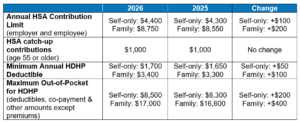
In Rev. Proc. 2025-19, the IRS released the inflation-adjusted amounts for 2026 relevant to Health Savings Accounts (HSAs) and high deductible health plans (HDHPs). The table below summarizes those adjustments and other applicable limits.

Out-of-Pocket Limits Applicable to Non-Grandfathered Plans

The ACA’s out-of-pocket limits for in-network essential health benefits have also been announced and have increased for 2026.


Note that all non-grandfathered group health plans must contain an embedded individual out-of-pocket limit within family coverage if the family out-of-pocket limit is above $10,150 (2026 plan years) or $9,200 (2025 plan years). Exceptions to the ACA’s out-of-pocket limit rule have been available for certain non-grandfathered small group plans eligible for transition relief (referred to as “Grandmothered” plans) since policy years renewed on or after January 1, 2014.  Each year, CMS has extended this transition relief for any Grandmothered plans that have been continually renewed since on or after January 1, 2014.  However, in its March 23, 2022 Insurance Standards Bulletin, CMS announced that the limited nonenforcement policy will remain in effect until CMS announces that such coverage must come into compliance with relevant requirements.   Thus, we will no longer see annual transition relief announced.

Next Steps for Employers

As employers prepare for the 2026 plan year, they should keep in mind the following rules and ensure that any plan materials and participant communications reflect the new limits:

  • HSA-qualified family HDHPs cannot have an embedded individual deductible that is lower than the minimum family deductible of $3,400.
  • The out-of-pocket maximum for family coverage for an HSA-qualified HDHP cannot be higher than $17,000.

All non-grandfathered plans (whether HDHP or non-HDHP) must cap out-of-pocket spending at $10,150 for any covered person. A family plan with an out-of-pocket maximum in excess of $10,150 can satisfy this rule by embedding an individual out-of-pocket maximum in the plan that is no higher than $10,150. This means that for the 2026 plan year, an HDHP subject to the ACA out-of-pocket limit rules may have a $8,500 (self-only) / $17,000 (family) out-of-pocket limit (and be HSA-compliant) so long as there is an embedded individual out-of-pocket limit in the family tier no greater than $10,150 (so that it is also ACA-compliant).


About the Author. This alert was prepared for [Agency Name] by Barrow Lent LLP, a national law firm with recognized experts on the Affordable Care Act and Consolidated Appropriations Act. Contact Stacy Barrow or Nicole Quinn-Gato at sbarrow@marbarlaw.com or nquinngato@marbarlaw.com.


The information provided in this alert is not, is not intended to be, and shall not be construed to be, either the provision of legal advice or an offer to provide legal services, nor does it necessarily reflect the opinions of the agency, our lawyers, or our clients. This is not legal advice. No client-lawyer relationship between you and our lawyers is or may be created by your use of this information. Rather, the content is intended as a general overview of the subject matter covered. This agency and Barrow Lent LLP are not obligated to provide updates on the information presented herein. Those reading this alert are encouraged to seek direct counsel on legal questions.


© 2025 Barrow Lent LLP. All Rights Reserved.

Reminder: RxDC Reporting Due June 1st


With the 2024 reference year RxDC reporting deadline approaching in June, plan sponsors should re-familiarize themselves with the reporting requirements. The 2024 reference year RxDC Reporting Instructions have been released, though there were no changes to the reporting requirements or data elements from last year.

As a reminder, the Consolidated Appropriations Act, 2021 includes a provision that requires group health plans and health insurance issuers (collectively “plans and issuers”) to report certain specified data related to prescription drug and other health care spending. The first RxDC report (for 2020 and 2021) was due on January 31, 2023, with the reports for 2022 and 2023 due on June 1, 2023 and June 1, 2024, respectively. The deadline to submit reporting for calendar year 2024 is June 1, 2025 (and continues each June 1st thereafter).

Next Steps for Employers

In anticipation of the June 1, 2025 deadline, plan sponsors may receive communications from their carriers, TPAs, PBMs and other vendors regarding their expectations for completing the reporting. In our experience, carriers, TPAs, PBMs, and other vendors have varying requirements and expectations of what they need from plan sponsors to successfully complete the reporting, and some may delegate some of the reporting responsibility to the plan sponsor. For example, if your insurance company, TPA, or PBM sent you a survey or questionnaire to collect information about plan numbers, premium, or funding types, it is likely that they are reporting the P2 and D1 files on your behalf. Therefore, we recommend the following:

  • Respond to any requests for information you may receive and coordinate with your vendors to understand their expectations to ensure all reporting is completed in full on behalf of the plan. Note: Some carriers require responses by early March.
  • If your vendor sent you an email or letter asking you to create a HIOS account or stating that they will not submit P2 and D1 on your behalf, that means you must submit P2 and D1 directly to CMS (or engage a third-party to submit them for you). Thus, you and/or a third party submitting P2 or D1 on your behalf will need to follow the RxDC Reporting Instructions and timely complete the submission.

______________________________


About the Author. This alert was prepared by Barrow Lent LLP, a national law firm with recognized experts on ERISA, Affordable Care Act.  Contact Stacy Barrow or Nicole Quinn-Gato at sbarrow@marbarlaw.com or nquinngato@marbarlaw.com.

The information provided in this alert is not, is not intended to be, and shall not be construed to be, either the provision of legal advice or an offer to provide legal services, nor does it necessarily reflect the opinions of the agency, our lawyers, or our clients. This is not legal advice. No client-lawyer relationship between you and our lawyers is or may be created by your use of this information. Rather, the content is intended as a general overview of the subject matter covered. This agency and Barrow Lent LLP are not obligated to provide updates on the information presented herein. Those reading this alert are encouraged to seek direct counsel on legal questions.

© 2025 Barrow Lent LLP. All Rights Reserved.

New ACA-Related Laws Provide More Flexibility to Employers


On Monday, December 23, 2024, President Biden signed into law two bills, H.R. 3797 (the “Paperwork Reduction Act”) and H.R. 3801 (the “Employer Reporting Improvement Act”),which will positively impact applicable large employers (“ALEs”) and other entities required to furnish forms 1095-B or 1095-C to individuals.

Background
Under the Affordable Care Act, ALEs (i.e., employers who have employed an average of 50 or more full-time equivalent employees in the prior year) must file forms 1094-C and 1095-C with the IRS and furnish forms 1095-C to full time employees. In addition, sponsors of self-funded plans must furnish forms to covered individuals. The furnishing deadline is generally March 1 of each year.

Further, the IRS issues a penalty letter (Letter 226J) when an employee of an ALE receives a premium tax credit for Marketplace coverage and the ALE reports the employee as full-time without a qualified reason as to why affordable health insurance was not offered. An ALE’s response to Letter 226J is generally due 30 days from the date of Letter 226J. If the ALE does not respond timely to Letter 226J or any reminder letter, the IRS will assess the amount of the proposed penalty and issue a notice and demand for payment.

Summary of the New Laws
The Paperwork Reduction Act considers employers to meet their requirement to furnish form 1095-B or 1095-C to employees if the following conditions are met:

  • The employer or reporting entity (e.g., insurance carrier) provides a clear, conspicuous, and accessible notice that any individual who is otherwise required to receive the form 1095-B or 1095-C can request a copy, and
  • The employee can request a copy of the form, which the employer or reporting entity must provide no later than the later of:
    • January 31 of the year following the calendar year for which the return was required to be made, or
    • 30 days after the date of such request.


The Paperwork Reduction Act is effective for calendar year 2024 forms that are required to be furnished to employees in 2025.

The Employer Reporting Improvement Act allows employers to provide form 1095-B or 1095-C to individuals electronically if they have consented to receive it electronically. It also allows employers to use an individual’s date of birth, in lieu of a social security number, if the social security number is not available when completing the forms, except when reporting the employee on form 1095-C.

In addition, the Employer Reporting Improvement Act provides employers more time to respond to IRS ESRP letters. In many cases, employers are given approximately 30 days to respond to an initial ESRP letter from the IRS; however, the new law requires the IRS to give employers 90 days to respond to the initial letter before the IRS can take any action against the ALE. This gives employers significantly more time to review Letter 226J and gather the necessary data to prepare an appeal. The law applies to assessments proposed in taxable years beginning after the enactment of the law, so initial Letters 226J sent after December 23, 2024. It will not extend the deadline for Letters 226J already sent to employers before December 23, 2024.

Finally, the Employer Reporting Improvement Act established a 6-year statute of limitations, beginning from the date the forms 1094-C and 1095-C were required to be filed (or the date they were filed if filed after the filing deadline) for the IRS to seek an ESRP. This portion of the law is effective for the 2024 tax year forms (which are due in 2025) and beyond.

Next Steps for Employers
While these new laws are currently effective, it is important to note that none of these changes impact an ALE’s obligation to (1) offer affordable, minimum essential coverage meeting minimum value requirements to its full-time employees, or (2) file forms 1094-C and 1095-C with the IRS by the applicable filing deadline.

ALEs are, however, afforded more flexibility when furnishing these forms to their employees or former employees, and more time is permitted when responding to initial IRS ESRP letters.
Further, while ALEs are given more time to respond to IRS Letters 226J, they should ensure they have a process in place to identify the letters, ensure the letters are routed to the appropriate person at the company, and timely respond to the letters.

Thus, ALEs and other reporting entities such as sponsors of small, self-funded plans should:

  • Be aware of the changes applicable to using an individual’s birthdate in lieu of a social security number when completing the filing.
  • Work with their filing vendors to determine whether they can amend current contracts to eliminate the mail furnishing provisions if they do not want to furnish the forms by mail.
  • If they will be furnishing the forms or notice electronically, work with their filing vendor, payroll provider, or their benefit administration system to notify individuals of how and where to access their form 1095-B or 1095-C.
  • Ensure they have processes in place to ensure any Letters 226J are appropriately and timely routed to the correct department and responded to timely.
  • Also, because this does not change an ALE’s obligation to file forms 1094-C and 1095-C with the IRS, they should recall that all forms must be filed electronically for any company that files 10 or more returns with the IRS, which includes most tax forms required to be filed by the company.

___________________________________________________

About the Author. This alert was prepared by Barrow Weatherhead Lent LLP, a national law firm with recognized experts on the Affordable Care Act and Consolidated Appropriations Act. Contact Stacy Barrow or Nicole Quinn-Gato at sbarrow@marbarlaw.com or nquinngato@marbarlaw.com.

The information provided in this alert is not, is not intended to be, and shall not be construed to be, either the provision of legal advice or an offer to provide legal services, nor does it necessarily reflect the opinions of the agency, our lawyers, or our clients. This is not legal advice. No client-lawyer relationship between you and our lawyers is or may be created by your use of this information. Rather, the content is intended as a general overview of the subject matter covered. This agency and Barrow Weatherhead Lent LLP are not obligated to provide updates on the information presented herein. Those reading this alert are encouraged to seek direct counsel on legal questions.

© 2024 Barrow Weatherhead Lent LLP. All Rights Reserved.

IRS Releases PCORI Fee For Plan Years Ending Before October 1, 2025 


The IRS has released Notice 2024-83, which sets the applicable PCORI fee for plan years ending between October 1, 2024 and September 30, 2025 at $3.47 per covered life.

The PCORI fee helps fund the Patient-Centered Outcomes Research Trust, which was established as part of the Affordable Care Act (ACA) to conduct research to evaluate the effectiveness of medical treatments, procedures and strategies that treat, manage, diagnose or prevent illness or injury.  Under the ACA, most employer sponsors and insurers were required to pay PCORI fees until 2019 or 2020, as it only applied to plan years ending on or before September 30, 2019.  However, the PCORI fee was extended to plan years ending on or before September 30, 2029 as part of the Further Consolidated Appropriations Act, 2020.

The amount of PCORI fees due by employer sponsors and insurers is based upon the number of covered lives under each “applicable self-insured health plan” and “specified health insurance policy” (as defined by regulations) and the plan or policy year end date.  The fee must be paid on or before July 31st each year.  The fees due by July 31, 2025 are for plan years ending in 2024 and are as follows:

  • For plan years ending between January 1, 2024 and September 30, 2024, the fee is $3.22 per covered life.
  • For plan years ending between October 1, 2024 and December 31, 2024, the fee is $3.47 per covered life.


Insurance carriers are responsible for calculating and paying the PCORI fee for fully insured plans.  The employer is responsible for paying the fee on behalf of a self-insured plan, including an HRA.  In general, health FSAs are not subject to the PCORI fee.

Employers that sponsor self-insured group health plans must report and pay PCORI fees using the second quarter IRS Form 720, Quarterly Federal Excise Tax Return.  The second quarter form is generally not released by the IRS until the second quarter of the applicable filing year (usually in or around May of the applicable filing year).  Therefore, the Form 720 used for the 2024 filing deadline will not likely be available until around May 2025, and employers who sponsor self-insured group health plans subject to the PCORI fee must wait to file until the correct Form 720 is available.

The average number of covered lives for the plan year is generally calculated using the snapshot, snapshot factor, actual count, or Form 5500 method.  These counting methods will be described in more detail in a future alert as we approach the 2025 filing deadline.

Also note that because the PCORI fee is assessed on the plan sponsor of a self-insured plan, it generally should not be included in the premium equivalent rate that is developed for self-insured plans if the plan includes employee contributions.  However, an employer’s payment of PCORI fees is tax deductible as an ordinary and necessary business expense.

Next Steps for Employers

There is no action that is required by employers at this time as the applicable Form 720 will not be available until late Spring 2025.

In the meantime, if an employer believes they may have failed to file PCORI fees for one or more plan years prior to the plan year ending in 2024, they would need to file the Form 720 for the 2nd quarter of the applicable filing year that applies to the plan year missed.  For example, if they missed filing their PCORI fees for the plan year ending in 2023 plan year, they would use the 2nd quarter Form 720 for 2024.  Historical forms can be located on the IRS website.  We recommend consulting with counsel to discuss the historical filing process.

______________________________________

About the Author.  This alert was prepared by Barrow Weatherhead Lent LLP, a national law firm with recognized experts on the Affordable Care Act.  Contact Stacy Barrow or Nicole Quinn-Gato at sbarrow@marbarlaw.com or nquinngato@marbarlaw.com.

The information provided in this alert is not, is not intended to be, and shall not be construed to be, either the provision of legal advice or an offer to provide legal services, nor does it necessarily reflect the opinions of the agency, our lawyers or our clients.  This is not legal advice.  No client-lawyer relationship between you and our lawyers is or may be created by your use of this information.  Rather, the content is intended as a general overview of the subject matter covered.  This agency and Barrow Weatherhead Lent LLP are not obligated to provide updates on the information presented herein.  Those reading this alert are encouraged to seek direct counsel on legal questions.

© 2024 Barrow Weatherhead Lent LLP.  All Rights Reserved.