Legal Alert: HHS Proposes Revisions to ACA Section 1557 Regulations

At the end of May, the Department of Health and Human Services (HHS) released a proposed rule to revise regulations previously released under Section 1557 of the Affordable Care Act (ACA). The HHS goal with the proposed rule is to remove what the department views as redundancies and inconsistencies with other laws, as well as reduce confusion.

Changes in Compliance with Section 1557 Proposed Rule

ACA Section 1557 applies to “covered entities” – i.e., health programs or activities that receive “federal funding” from HHS (except Medicare Part B payments), including state and federal Marketplaces. Examples include hospitals, health clinics, community health centers, group health plans, health insurance issuers, physician’s practices, nursing facilities, etc.

Under current rules, “covered entities” include employers with respect to their own employee health benefit programs if the employer is principally engaged in providing or administering health programs or activities (i.e., hospitals, physician practices, etc.), or the employer receives federal funds to fund the employer’s health benefit program. Group health plans themselves are subject to the rule if they receive federal funds from HHS (e.g., Medicare Part D Subsidies, Medicare Advantage). In other words, employers who aren’t principally engaged in providing health care or health coverage generally aren’t subject to these rules directly unless they sponsor an employee health benefit program that receives federal funding through HHS, such as a retiree medical plan that participates in the Medicare Part D retiree drug subsidy program.

The most prominent proposed change is to the provision in Section 1557 which provides protections against discrimination on the basis of race, color, national origin, sex, age, and disability in certain health programs or activities. HHS’ proposed regulation would revise the definition of discrimination “on the basis of sex” that currently includes termination of pregnancy, sex stereotyping, and gender identity. The proposed rule, if finalized, would remove gender identity, stereotyping, and pregnancy termination as protected categories under Section 1557—though they will remain protected under other civil rights laws and regulations.

Certain compliance requirements on covered entities will also change, including the narrowing the scope of who Section 1557 regulates. Entities not principally engaged in healthcare will be subject to Section 1557 only to the extent they are funded by HHS. Entities whose primary business is providing healthcare will also be regulated if they receive federal financial assistance. A “health program or activity” specifically would not include employee benefit programs, including short-term plans and self-funded ERISA plans as long as they do not receive funding from HHS. The proposed rule also regulates insurance carriers only with respect to products for which the carrier receives federal financial assistance; the current rule regulates all products if the carrier received federal funding for at least one product.

Additionally, more flexible standards concerning individuals with limited English proficiency are proposed, including revising the “tagline” requirement. The tagline requirement requires distributing certain notices in 15 different languages in every “significant” publication associated with a health plan (anything larger than a brochure or postcard). HHS views this requirement as being too costly without data to back up that the taglines are beneficial. If the proposed rule is finalized, the tagline requirement will be eliminated.

Although there are provisions and definitions that will be changed or eliminated, parts of Section 1557 will remain intact. Likewise, HHS expects other agencies and departments to oversee and enforce nondiscrimination laws that will no longer be under HHS purview.

What to Expect Next

HHS is required to allow public comments on the proposed rule until approximately July 23, 2019. Once public commenting is closed and considered, HHS will likely release a final rule with answers to certain comments unless there are major changes to the proposed rule.

Until the proposed rule is finalized, employers who are covered entities (or whose plans are covered entities) should continue to treat termination of pregnancy, sex stereotyping, and gender identity as protected categories in relation to health programs and activities. Likewise, all other areas of Section 1557 should continue to be followed, including who is regulated and the tagline requirement. States and localities may give greater protections so it is important to keep in mind that there may be further requirements under those local laws and regulations.

About the Author. 

This alert was prepared for Benefit Advisors Network by Stacy Barrow.  Mr. Barrow is a nationally recognized expert on the Affordable Care Act.  His firm, Marathas Barrow Weatherhead Lent LLP, is a premier employee benefits, executive compensation, and employment law firm.  He can be reached at sbarrow@marbarlaw.com.
Legal Alert: CMS Extends Transition Relief for Non-Compliant Plans through 2020

On March 25, 2019, the Centers for Medicare & Medicaid Services (CMS) announced a one-year extension to the transition policy (originally announced November 14, 2013 and extended five times since) for individual and small group health plans that allows issuers to continue policies that do not meet ACA standards. The transition policy has been extended to policy years beginning on or before October 1, 2020, provided that all policies end by December 31, 2020. This means individuals and small businesses may be able to keep their non-ACA compliant coverage through the end of 2020, depending on the policy year. Carriers may have the option to implement policy years that are shorter than 12 months or allow early renewals with a January 1, 2020 start date in order to take full advantage of the extension.

Background
The Affordable Care Act (ACA) includes key reforms that create new coverage standards for health insurance policies. For example, the ACA imposes modified community rating standards and requires individual and small group policies to cover a comprehensive set of benefits.
Millions of Americans received notices in late 2013 informing them that their health insurance plans were being canceled because they did not comply with the ACA’s reforms. Responding to pressure from consumers and Congress, on Nov. 14, 2013, President Obama announced a transition relief policy for 2014 for non-grandfathered coverage in the small group and individual health insurance markets. If permitted by their states, the transition policy gives health insurance issuers the option of renewing current policies for current enrollees without adopting all of the ACA’s market reforms.

Transition Relief Policy
Under the original transitional policy, health insurance coverage in the individual or small group market that was renewed for a policy year starting between Jan. 1, 2014, and Oct. 1, 2014 (and associated group health plans of small businesses), will not be out of compliance with specified ACA reforms. These plans are referred to as “grandmothered” plans.
To qualify for the transition relief, issuers must send a notice to all individuals and small businesses that received a cancellation or termination notice with respect to the coverage (or to all individuals and small businesses that would otherwise receive a cancellation or termination notice with respect to the coverage).
The transition relief only applies with respect to individuals and small businesses with coverage that was in effect since 2014. It does not apply with respect to individuals and small businesses that obtain new coverage after 2014. All new plans must comply with the full set of ACA reforms.

One-year Extension
According to CMS, the extension will ensure that consumers have multiple health insurance coverage options and states continue to have flexibility in their markets. Also, like the original transition relief, issuers that renew coverage under the extended transition relief must, for each policy year, provide a notice to affected individuals and small businesses.
Under the transition relief extension, at the option of the states, issuers that have issued policies under the transitional relief in 2014 may renew these policies at any time through October 1, 2020 and affected individuals and small businesses may choose to re-enroll in the coverage through October 1, 2020. Policies that are renewed under the extended transition relief are not considered to be out of compliance with the following ACA reforms:

• community premium rating standards, so consumers might be charged more based on factors such as gender or a pre-existing medical condition, and it might not comply with rules limiting age banding (PHS Act section 2701);
• guaranteed availability and renewability (PHS Act sections 2702 & 2703);
• if the coverage is an individual market policy, the ban on preexisting medical conditions for adults, so it might exclude coverage for treatment of an adult’s pre-existing medical condition such as diabetes or cancer (PHS Act section 2704);
• if the coverage is an individual market policy, discrimination based on health status, so consumers may have premium increases based on claims experience or receipt of health care (PHS Act section 2705);
• coverage of essential health benefits or limit on annual out-of-pocket spending, so it might not cover benefits such as prescription drugs or maternity care, or might have unlimited cost-sharing (PHS Act section 2707); and
• standards for participation in clinical trials, so consumers might not have coverage for services related to a clinical trial for a life-threatening or other serious disease (PHS Act section 2709).

About the Author. This alert was prepared for Benefit Advisors Network by Stacy Barrow.  Mr. Barrow is a nationally recognized expert on the Affordable Care Act.  His firm, Marathas Barrow Weatherhead Lent LLP, is a premier employee benefits, executive compensation and employment law firm.  He can be reached at sbarrow@marbarlaw.com.

District Court Judge in Texas Strikes Down the ACA – But Law Remains in Effect for Now

On Friday, December 14, a federal judge in Texas issued a partial ruling that strikes down the entire Affordable Care Act (ACA) as unconstitutional. The White House has stated that the law will remain in place, however, pending the appeal process. The case, Texas v. U.S., will be appealed to the U.S. Court of Appeals for the Fifth Circuit in New Orleans, and then likely to the U.S. Supreme Court.

The plaintiffs in Texas (a coalition of twenty states) argue that since the Tax Cuts and Jobs Act zeroed out the individual mandate penalty, it can no longer be considered a tax. Accordingly, because the U.S. Supreme Court upheld the ACA in 2012 by saying the individual mandate was a legitimate use of Congress’s taxing power, eliminating the tax penalty imposed by the mandate renders the individual mandate unconstitutional. Further, the individual mandate is not severable from the ACA in its entirety. Thus, the ACA should be found unconstitutional and struck down.

The court in Texas agreed, finding that the individual mandate can no longer be fairly read as an exercise of Congress’s Tax Power and is still impermissible under the Interstate Commerce Clause—meaning it is unconstitutional. Also, the court found the individual mandate is essential to and inseverable from the remainder of the ACA, which would include not only the patient protections (no annual limits, coverage of pre-existing conditions) but the premium tax credits, Medicaid expansion, and of course the employer mandate and ACA reporting.

Several states such as Massachusetts, New York and California have since intervened to defend the law. They argue that, if Congress wanted to repeal the law it would have done so. The Congressional record makes it clear Congress was voting only to eliminate the individual mandate penalty in 2019; the record indicates that they did not intend to strike down the entire ACA.

It is worth noting that the Trump administration filed a brief early in 2018 encouraging the court to uphold the ACA but strike down the provisions relating to guaranteed issue and community rating.

The ACA has largely survived more than 70 repeal attempts and two visits to the U.S. Supreme Court. We anticipate it will survive this one too, in time. While the Supreme Court lineup has changed, all five justices who upheld the ACA in 2012 are still on the bench. Moreover, the Supreme Court may be reluctant to strike down a federal law as expansive as the ACA, particularly when it has been in place for nearly nine years and affects millions of people. Notably, the Supreme Court was not required to rule on the “severability” issue in 2012. Given a strong tradition of the Supreme Court to avoid, if possible, broad rulings of unconstitutionality in established laws, it is not unlikely that the current Court, if this case makes it that far, will find a way to hold that even if the Court’s 2012 logic with respect to the individual mandate is no longer applicable, the rest of the law is severable and saved, thus avoiding once again a broad ruling on the ACA’s constitutional soundness. The bottom line: employers should continue to comply with the ACA, as its provisions (including the employer mandate and associated reporting) remain the law for the foreseeable future.

About the Author

This alert was prepared for Benefit Advisors network by Stacy Barrow. Mr. Barrow is a nationally recognized expert on the Affordable Care Act. His firm, Marathas Barrow Weatherhead Lent LLP, is a premier employee benefits, executive compensation and employment law firm. He can be reached at sbarrow@marbarlaw.com.

This message is a service to our clients and friends. It is designed only to give general information on the developments actually covered. It is not intended to be a comprehensive summary of recent developments in the law, treat exhaustively the subjects covered, provide legal advice, or render a legal opinion.

Benefit Advisors Network and its smart partners are not attorneys and are not responsible for any legal advice. To fully understand how this or any legal or compliance information affects your unique situation, you should check with a qualified attorney.

© Copyright 2018 Benefit Advisors Network. Smart Partners. All rights reserved.


IRS Releases 2019 HSA Contribution Limits and HDHP Deductible and Out-of-Pocket Limits

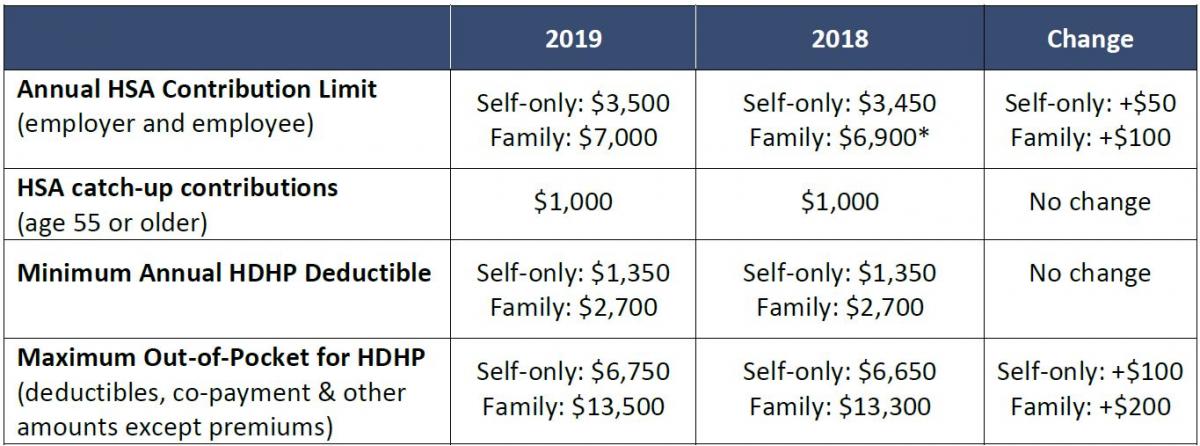
In Rev. Proc. 2018-30, the IRS released 2019 HSA Contribution Limits regarding inflation-adjusted amounts for 2019 relevant to HSAs and high deductible health plans (HDHPs).  The table below summarizes those adjustments and other applicable limits.

* After reducing the cap $50 in Rev. Proc. 2018-18 in March 2018 due to changes made by the Tax Cuts and Jobs Act, the IRS granted relief in Rev. Proc. 2018-27, restoring the limit back to the original 2018 level. We do not anticipate that the 2019 HSA annual family contribution limit will change as it did for this year.

Out-of-Pocket Limits Applicable to Non-Grandfathered Plan

The ACA’s out-of-pocket limits for in-network essential health benefits have also been announced and have increased for 2019 contribution limits.

Note that all non-grandfathered group health plans must contain an embedded individual out-of-pocket limit within family coverage if the family out-of-pocket limit is above $7,900 (2019 plan years) or $7,350 (2018 plan years).  Exceptions to the ACA’s out-of-pocket limit rule are available for certain small group plans eligible for transition relief (referred to as “Grandmothered” plans).  A one-year extension of transition relief was recently announced extending the transition relief to policy years beginning on or before October 1, 2019, provided that all policies end by December 31, 2019.

Next Steps for Employers

As employers prepare for the 2019 plan year, they should keep in mind the following rules and ensure that any plan materials and participant communications reflect the new limits: 

  • HDHPs cannot have an embedded family deductible that is lower than the minimum HDHP family deductible of $2,700.
  • The out-of-pocket maximum for family coverage for an HDHP cannot be higher than $13,500.
  • All non-grandfathered plans (whether HDHP or non-HDHP) must cap out-of-pocket spending at $7,900 for any covered person.  A family plan with an out-of-pocket maximum in excess of $7,900 can satisfy this rule by embedding an individual out-of-pocket maximum in the plan that is no higher than $7,900. This means that for the 2019 plan year, an HDHP subject to the ACA out-of-pocket limit rules may have a $6,750 (self-only)/$13,500 (family) out-of-pocket limit (and be HSA-compliant) so long as there is an embedded individual out-of-pocket limit in the family tier no greater than $7,900 (so that it is also ACA-compliant).

About the Author

Stacy H. Barrow, Esq., Compliance Director

This alert was prepared by Stacy Barrow. Mr. Barrow is a nationally recognized expert on the Affordable Care Act and BAN’s Compliance Director. His firm, Marathas Barrow Weatherhead Lent LLP, is a premier employee benefits, executive compensation and employment law firm. He can be reached at sbarrow@marbarlaw.com.

This content is a service to our clients and friends. It is designed only to give general information on the developments actually covered. It is not intended to be a comprehensive summary of recent developments in the law, treat exhaustively the subjects covered, provide legal advice, or render a legal opinion.

Benefit Advisors Network and its smart partners are not attorneys and are not responsible for any legal advice. To fully understand how this or any legal or compliance information affects your unique situation, you should check with a qualified attorney.                                                                                     

© Copyright 2018 Benefit Advisors Network. Smart Partners. All rights reserved.

REMINDER: PCORI Fees Due By July 31, 2018

Employers that sponsor self-insured group health plans, including health reimbursement arrangements (HRAs) should keep in mind the upcoming July 31, 2018 deadline for paying fees that fund the Patient-Centered Outcomes Research Institute (PCORI).  As background, the PCORI was established as part of the Affordable Care Act (ACA) to conduct research to evaluate the effectiveness of medical treatments, procedures and strategies that treat, manage, diagnose or prevent illness or injury.  Under the ACA, most employer sponsors and insurers will be required to pay PCORI fees until 2019 (the fee does not apply to plan years ending on or after October 1, 2019).

The amount of PCORI fees due by employer sponsors and insurers is based upon the number of covered lives under each “applicable self-insured health plan” and “specified health insurance policy” (as defined by regulations) and the plan or policy year end date.  This year, employers will pay the fee for plan years ending in 2017.

  • For plan years that ended between January 1, 2017 and September 30, 2017, the fee is $2.26 per covered life and is due by July 31, 2018.
  • For plan years that ended between October 1, 2017 and December 31, 2017, the fee is $2.39 per covered life and is due by July 31, 2018.

For example, a plan year that ran from July 1, 2016 through June 30, 2017 will pay a fee of $2.26 per covered life.  Calendar year 2017 plans will pay a fee of $2.39 per covered life.

NOTE: The insurance carrier is responsible for paying the PCORI fee on behalf of a fully insured plan.  The employer is responsible for paying the fee on behalf of a self-insured plan, including an HRA.  In general, health FSAs are not subject to the PCORI fee.

Employers that sponsor self-insured group health plans must report and pay PCORI fees using IRS Form 720, Quarterly Federal Excise Tax Return.  

Note that because the PCORI fee is assessed on the plan sponsor of a self-insured plan, it generally should not be included in the premium equivalent rate that is developed for self-insured plans if the plan includes employee contributions.  However, an employer’s payment of PCORI fees is tax deductible as an ordinary and necessary business expense.

Historical Information for Prior Years

  • For plan years that ended between October 1, 2016 and December 31, 2016, the fee is $2.26 per covered life and was due by July 31, 2017.
  • For plan years that ended between January 1, 2016 and September 30, 2016, the fee is $2.17 per covered life and was due by July 31, 2017.
  • For plan years that ended between October 1, 2015 and December 31, 2015, the fee was $2.17 per covered life and was due by August 1, 2016.
  • For plan years that ended between January 1, 2015 and September 30, 2015, the fee was $2.08 per covered life and was due by August 1, 2016.
  • For plan years that ended between October 1, 2014 and December 31, 2014, the fee was $2.08 per covered life and was due by July 31, 2015.
  • For plan years that ended between January 1, 2014 and September 30, 2014, the fee was $2 per covered life and was due by July 31, 2015.
  • For plan years that ended between October 1, 2013 and December 31, 2013, the fee was $2 per covered life and was due by July 31, 2014.
  • For plan years that ended between January 1, 2013 and September 30, 2013, the fee was $1 per covered life and was due by July 31, 2014.
  • For plan years that ended between October 1, 2012 and December 31, 2012, the fee was $1 per covered life and was due by July 31, 2013.   

Counting Methods for Self-Insured Plans

Plan sponsors may choose from three methods when determining the average number of lives covered by their plans.

Actual Count method.  Plan sponsors may calculate the sum of the lives covered for each day in the plan year and then divide that sum by the number of days in the year.

Snapshot method Plan sponsors may calculate the sum of the lives covered on one date in each quarter of the year (or an equal number of dates in each quarter) and then divide that number by the number of days on which a count was made. The number of lives covered on any one day may be determined by counting the actual number of lives covered on that day or by treating those with self-only coverage as one life and those with coverage other than self-only as 2.35 lives (the “Snapshot Factor method”).

Form 5500 method Sponsors of plans offering self-only coverage may add the number of employees covered at the beginning of the plan year to the number of employees covered at the end of the plan year, in each case as reported on Form 5500, and divide by 2.  For plans that offer more than self-only coverage, sponsors may simply add the number of employees covered at the beginning of the plan year to the number of employees covered at the end of the plan year, as reported on Form 5500.

Special rules for HRAs. The plan sponsor of an HRA may treat each participant’s HRA as covering a single covered life for counting purposes, and therefore, the plan sponsor is not required to count any spouse, dependent or other beneficiary of the participant. If the plan sponsor maintains another self-insured health plan with the same plan year, participants in the HRA who also participate in the other self-insured health plan only need to be counted once for purposes of determining the fees applicable to the self-insured plans.


About the Author

 Stacy H. Barrow, Esq., Compliance Director

This alert was prepared by Stacy Barrow. Mr. Barrow is a nationally recognized expert on the Affordable Care Act and BAN’s Compliance Director. His firm, Marathas Barrow Weatherhead Lent LLP, is a premier employee benefits, executive compensation and employment law firm. He can be reached at sbarrow@marbarlaw.com.

This post is a service to our clients and friends. It is designed only to give general information on the developments actually covered. It is not intended to be a comprehensive summary of recent developments in the law, treat exhaustively the subjects covered, provide legal advice, or render a legal opinion.

Benefit Advisors Network and its smart partners are not attorneys and are not responsible for any legal advice. To fully understand how this or any legal or compliance information affects your unique situation, you should check with a qualified attorney.

© Copyright 2018 Benefit Advisors Network. Smart Partners. All rights reserved.