Congress Expected to Pass Spending Bill that Repeals Three Major ACA Taxes, Extends PCORI

On December 17, 2019, the House and Senate agreed to a bipartisan legislative package of spending bills to avoid a government shutdown.  This package of bills is collectively referred to as the Further Consolidated Appropriations Act, 2020 (the “Act”). The Act has passed the House and is expected to pass the Senate by December 20.  The president has agreed to sign the Act, which includes a permanent repeal of three Affordable Care Act (ACA) taxes: the tax on high-cost health plans (the so-called “Cadillac Tax”), the Health Insurance Tax (HIT tax), and the medical device tax. Overall, the repeal of these ACA taxes may result in at least $300 billion in lost revenue to the government; however, the bill brings relief to employers and consumers, who may have experienced tax payments, increased health premiums and other costs. The repeal of the HIT tax is effective as of January 1, 2021, and the medical device tax is repealed as of January 1, 2020. The Cadillac Tax was already delayed until 2022 and thus will never take effect. The Patient-Centered Outcomes Research Institute (“PCORI”) fee has also been extended to 2029 (i.e., it will apply to plan years ending on or before September 30, 2029).

PCORI Fee Extension

The PCORI fee has been extended to plan years ending on or before September 30, 2029. PCORI fee extensions have been discussed frequently and have been included in previously introduced bills, such as the Protecting Access to Information for Effective and Necessary Treatment and Services Act (PATIENTS Act) that was approved by the House Ways and Means Committee in June 2019. The amount due per life covered under a policy will be adjusted annually, as it has been previously. Insurers of fully insured health plans and employers with self-funded group health plans will continue to have to pay this fee until 2029 or 2030 (depending on plan year).

The PCORI was established as part of the ACA to conduct research to evaluate the effectiveness of medical treatments, procedures, and strategies that treat, manage, diagnose, or prevent illness or injury. The research considers both the effectiveness of the treatment, as well as an individual’s decisions and outlook regarding the treatment.

The Cadillac Tax

The Cadillac tax is a 40% tax on the cost of health coverage offered by employers that exceeds a certain amount. For 2019, those thresholds were $11,200 for single and $30,100. If the total cost of coverage (including pre-tax FSA/HSA/HRA contributions) exceeded the threshold, the 40% tax would apply. The Cadillac Tax was intended to raise revenue for the ACA while encouraging employers to offer less generous benefits that would purportedly lead to wage increases. It was also meant to help lower healthcare costs and overutilization by offering less robust coverage. The tax has been repeatedly delayed since the inception of the ACA. It was originally intended to be effective in 2018 but was delayed twice, first until 2020 then until 2022. Therefore, it will never take effect. Both Republicans and Democrats alike have moved for repealing the Cadillac Tax.

With the repeal of the Cadillac tax, employers offering generous health plans no longer have to be concerned with being subject to a tax after a certain point. Likewise, the tax could have disproportionately affected lower-income employees as well as unions, as more generous benefits are often negotiated instead of pay raises. Similarly, states where insurance is more expensive in general—such as Alaska—would have also seen a greater negative effect if the Cadillac tax moved forward.

The HIT Tax

The Health Insurance Tax—also known as the HIT Tax (the “t” being redundant)—is essentially a sales tax on insurance. The tax was in effect from 2014 – 2016 and in 2018 but was suspended in 2017 and 2019 as a result of lobbying. It is repealed effective as of January 1, 2021. Therefore, it is in effect for 2020. In general, the HIT tax is an annual fee charged to insurance companies that provide medical, dental, or vision policies. The tax is divided among the insurers, based on their value and market share of business, focusing on the premium amount. When passed through to employers, the HIT tax was typically in the range of 2% to 4% premium.

With the repeal of the HIT tax, insurers can be focused on providing benefits and charging premiums that are not related to having a tax associated with how much is made from the premium amount. While this may not have a direct correlation with premium increases, there could be some reprieve associated with the repeal of this particular tax.

The Medical Device Tax

The ACA’s medical device tax is a 2.3% excise tax on medical devices—such as hospital beds or an MRI machine—that are sold within the United States. The tax is imposed on the manufacturer, producer, or importer of the device. The Act repeals the medical device tax effective January 1, 2020.  The tax was in effect from 2013 to 2015 and has been suspended from 2016 through 2019.

The medical device tax had bipartisan support for repeal, caused by concerns that the tax would chill research efforts, increase price of devices in order to recover lost profit, and discourage certain sales. There was also a concern that the tax could cause lost jobs, due to cutting back on staff in order to compensate for having to pay for the tax. One study states that 29,000 jobs were lost while the tax was in effect.

What to Expect Next

Although the Act has not yet passed the Senate or been signed by the president, it will likely be effective before the end of the year. With the repeal of these taxes, there will need to be recalculations on the cost of the administering the ACA, as well as well as overall effect on the tax system within the United States. The repeal of these taxes come as a relief to many; however, the upcoming election in 2020 could have an effect on where the nation goes from here. Next year may bring additional legislation regarding surprise billing or drug pricing reform.  

____________________________________

About the Author.  This alert was prepared by Stacy Barrow.  Mr. Barrow is a nationally recognized expert on the Affordable Care Act.  His firm, Marathas Barrow Weatherhead Lent LLP, is a premier employee benefits, executive compensation and employment law firm.  He can be reached at sbarrow@marbarlaw.com.
IRS Extends Deadline for Furnishing Form 1095-C, Extends Good-Faith Transition Relief

The Internal Revenue Service (IRS) has released Notice 2019-63, which extends the deadline for furnishing 2019 Forms 1095-B and 1095-C to individuals from January 31, 2020, to March 2, 2020.  The Notice also provides penalty relief for good-faith reporting errors and suspends the requirement to issue Form 1095-B to individuals, under certain conditions. 

The due date for filing the forms with the IRS was not extended and remains February 28, 2020 (March 31, 2020, if filed electronically).

The draft instructions to Forms 1094-C and 1095-C allow employers to request a 30-day extension to furnish statements to individuals by sending a letter to the IRS with certain information, including the reason for delay. However, because the Notice’s extension of time to furnish the forms is as generous as the 30-day extension contained in the instructions, the IRS will not formally respond to requests for an extension of time to furnish 2019 Forms 1095-B or 1095-C to individuals. 

Employers may still obtain an automatic 30-day extension for filing with the IRS by filing Form 8809 on or before the forms’ due date. An additional 30-day extension is available under certain hardship conditions. The Notice encourages employers who cannot meet the extended due dates to furnish and file as soon as possible and advises that the IRS will take such furnishing and filing into consideration when determining whether to abate penalties for reasonable cause. 

Relief from Furnishing Form 1095-B to Individuals

Due to the individual mandate penalty being reduced to zero starting in 2019, an individual does not need the information on Form 1095-B in order to complete his or her federal tax return. Therefore, the IRS is granting penalty relief for employers who fail to furnish a Form 1095-B to individuals, provided that the reporting entity:

  1. Posts a notice prominently on its website stating that individuals may receive a copy of their 2019 1095-B upon request, accompanied by an email address, phone number and a physical address the request can be sent; and
  2. Furnishes an individual with a Form 1095-B within 30 days of a request.

Note that Applicable Large Employers (ALEs) are still required to furnish Form 1095-C to their full-time employees.  They must also complete Part III if the employee is enrolled in self-insured coverage. The relief from furnishing Form 1095-B does not extend to IRS reporting.  Forms 1095-B must still be submitted to the IRS, as applicable. 

In general, this relief from furnishing Form 1095-B applies to insurers and non-ALEs that sponsor self-insured plans, as they complete Form 1095-B for covered participants.

Extension of Good-Faith Relief

As with the calendar year 2015 – 2018 reporting, the IRS will not impose penalties on employers that can show that they made good-faith efforts to comply with the requirements for the calendar year 2019. In determining good faith, the IRS will consider whether employers have made reasonable attempts to comply with the requirements (e.g., gathering and transmitting the necessary data to an agent or testing its ability to transmit information) and the steps that have been taken to prepare for next year’s reporting.

Note that the relief applies only to furnishing and filing incorrect or incomplete information, and not to a failure to timely furnish or file. However, if an employer is late filing a return, it may be possible to get penalty abatement for failures that are due to reasonable cause and not willful neglect. In general, to establish reasonable cause the employer must demonstrate that it acted in a responsible manner and that the failure was due to significant mitigating factors or events beyond its control.  The IRS has been enforcing late filing penalties via Letter 972CG, which may include penalties based on failure to file electronically (when required) or failure to file with correct TIN information.

As in past years, individuals can file their personal income tax returns without having to attach the relevant Form 1095. Taxpayers should keep these forms in their personal records, even though the federal individual mandate penalty is not applicable for the 2019 filing year.

_________________________________________________________

About the Author.  This alert was prepared by Stacy Barrow, Esq.  Mr. Barrow is a nationally recognized expert on the Affordable Care Act.  His firm, Marathas Barrow Weatherhead Lent LLP, is a premier employee benefits, executive compensation, and employment law firm.  He can be reached at sbarrow@marbarlaw.com.
IRS Releases Draft 2019 ACA Reporting Forms and Instructions

The IRS has released draft forms and instructions for the 2019 B-Series and C-Series reporting forms (Forms 1094-B, 1095-B, 1094-C and 1095-C) used by employers and coverage providers to report certain information to full-time employees and the Internal Revenue Service (IRS).

As background, the Affordable Care Act (ACA) added Sections 6055 and 6056 to the Internal Revenue Code. These sections require employers, plans, and health insurance issuers to report health coverage information to the IRS and to participants annually. Section 6055 reporting requirements apply to insurers, employers that sponsor self-insured group health plans, and other entities that provide minimum essential coverage (such as multiemployer plans). Section 6056 reporting requirements apply to “applicable large employers” or “ALEs” (generally, employers with 50 or more full-time employees) and require reporting of health care coverage provided to the employer’s full-time employees.

Reporting under Sections 6055 and 6056 involves two sets of forms:  the “B-Series” (Forms 1094-B and 1095-B); and the “C-Series” (Forms 1094-C and 1095-C).  Each includes a transmittal form (Form 1094-B or 1094-C), which serves as a cover page and provides aggregate information, and an individualized form (Form 1095-B or 1095-C) for each employee for whom the employer is required to report.  

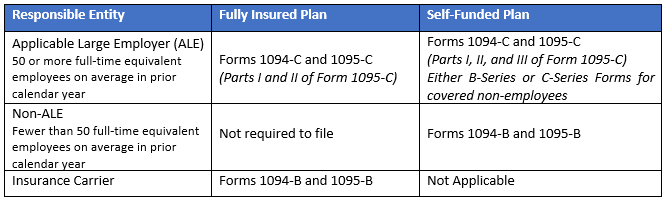
The forms for the calendar year 2019 are due to employees by January 31, 2020. Forms are due to the IRS by February 28, 2020, if filing by paper and by March 31, 2020, if filing electronically.  The forms that must be filed and distributed depend on whether the employer is an ALE and the type of coverage provided. Employers filing 250 or more of a particular form are required to file with the IRS electronically. The following table summarizes the responsible parties and forms applicable to the ACA’s reporting requirements. 

The following table summarizes the responsible parties and forms applicable to the ACA’s reporting requirements.

2019 Draft Instructions

The draft forms and instructions can be found here:

The draft instructions reflect the newly increased penalty structure (generally leaving the penalty at $270 per return but increasing the penalty cap from $3.275 million to $3.339 million). 

Note Regarding 2019 Form 1095-C, Line 15. 

The section 4980H “affordability” safe harbor percentage threshold is adjusted to 9.86% for plan years beginning in 2019, up from 9.56%.

Employers should continue to work closely with their insurance broker and other trusted advisors when determining how their organization will address the reporting requirements. Unless extended, 1095-C and 1095-B forms for the 2019 calendar year are due to participants by January 31, 2020. Forms 1094/1095-C and 1094/1095-B are due to the IRS by February 28, 2020, if filing by paper and by March 31, 2020, if filing electronically.  Employers should endeavor to file timely, as the IRS has begun enforcing penalties against employers who have failed to file timely or file electronically when required.

About the Author.  This alert was prepared by Stacy Barrow.  Mr. Barrow is a nationally recognized expert on the Affordable Care Act.  His firm, Marathas Barrow Weatherhead Lent LLP, is a premier employee benefits, executive compensation, and employment law firm.  He can be reached at sbarrow@marbarlaw.com.

IRS Increases Health FSA Contribution Limit for 2020, Adjusts Other Benefit Limits

On November 6, 2019, the Internal Revenue Service (IRS) released Revenue Procedure 2019-44, which raises the health Flexible Spending Account (FSA) salary reduction contribution limit by $50 to $2,750 for plan years beginning in 2020. The Revenue Procedure also contains the cost-of-living adjustments that apply to dollar limitations in certain sections of the Internal Revenue Code. 

Qualified Commuter Parking and Mass Transit Pass Monthly Limit Increase

For 2020, the monthly limits for qualified parking and mass transit are $270 each (up $5 from 2019).

Adoption Assistance Tax Credit Increase

For 2020, the credit allowed for adoption of a child is $14,300 (up $220 from 2019). The credit begins to phase out for taxpayers with modified adjusted gross income in excess of $214,520 (up $3,360 from 2019) and is completely phased out for taxpayers with modified adjusted gross income of $254,520 or more (up $3,360 from 2019).

Qualified Small Employer Health Reimbursement Arrangement (QSEHRA) Increase

For 2020, reimbursements under a QSEHRA cannot exceed $5,250 (single) / $10,600 (family), an increase of $100 (single) / $150 (family) from 2019.

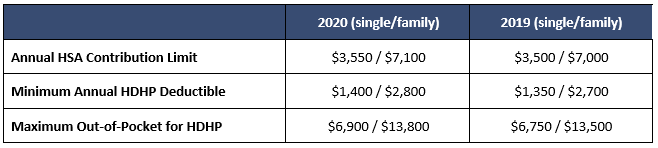
Reminder: 2020 HSA Contribution Limits and HDHP Deductible and Out-of-Pocket Limits

Earlier this year, the IRS announced the inflation-adjusted amounts for HSAs and high deductible health plans (HDHPs).

The ACA’s out-of-pocket limits for in-network essential health benefits have also increased for 2020.  Note that all non-grandfathered group health plans must contain an embedded individual out-of-pocket limit within family coverage if the family out-of-pocket limit is above $8,150 (2020 plan years).  Exceptions to the ACA’s out-of-pocket limit rule are also available for certain small group plans eligible for transition relief (referred to as “Grandmothered” plans).  Unless extended, relief for Grandmothered plans ends December 31, 2020.

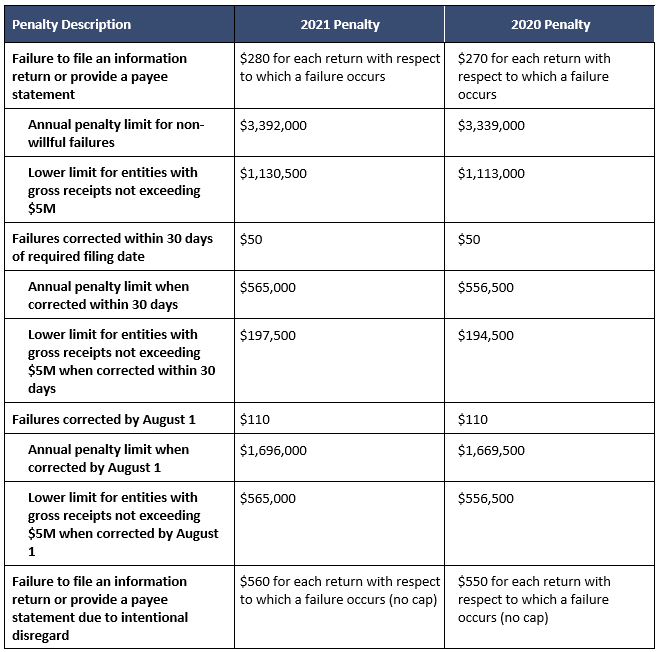
ACA Reporting Penalties (Forms 1094-B, 1095-B, 1094-C, 1095-C)

The table below describes penalties related to returns filed in the applicable year (e.g., the 2020 penalty is for returns filed in 2020 for calendar year 2019).  Note that failure to issue a Form 1095-C when required may result in two penalties, as the IRS and the employee are each entitled to receive a copy (increased for willful failures, with no cap on the penalty).

About the Author. This alert was prepared by Stacy Barrow. Mr. Barrow is a nationally recognized expert on the Affordable Care Act. His firm, Marathas Barrow Weatherhead Lent LLP, is a premier employee benefits, executive compensation, and employment law firm. He can be reached at sbarrow@marbarlaw.com.
This email is a service to our clients and friends. It is designed only to give general information on the developments actually covered. It is not intended to be a comprehensive summary of recent developments in the law, treat exhaustively the subjects covered, provide legal advice, or render a legal opinion.

Benefit Advisors Network and its members are not attorneys and are not responsible for any legal advice. To fully understand how this or any legal or compliance information affects your unique situation, you should check with a qualified attorney.


© Copyright 2019 Benefit Advisors Network. All rights reserved.

IRS Releases Guidance for Employers Offering Individual Coverage HRAs

On September 27, the Internal Revenue Service (IRS) released proposed regulations on the application of the Affordable Care Act’s (ACA) employer shared responsibility provisions to a new type of Health Reimbursement Arrangement (HRA) available starting in 2020.  In June 2019, the Department of Labor, the Department of Health and Human Services, and the Treasury Department (the “Departments”) released a final rule concerning HRAs that can be integrated with individual market coverage or Medicare.  This new type of HRA is referred to as an Individual Coverage HRA, or ICHRA.  The rule, based on an executive order from President Trump in 2017, is intended to increase the usability of HRAs, to expand employers’ ability to offer HRAs to their employees, and to allow HRAs to be used in conjunction with non-group coverage.

The ICHRA rule is effective for plan years beginning on or after January 1, 2020.  The IRS has also proposed regulations to guide employers in determining whether their contribution to an employee’s ICHRA results in an “affordable” offer of coverage under the ACA.  Specifically, the proposed regulations will assist employers who offer ICHRAs in determining the “required employee contribution” for purposes of line 15 of Form 1095-C.  Employers may continue to use the W-2, Rate of Pay, or Federal Poverty Level safe harbors to determine whether their entry in line 15 results in an “affordable” offer of coverage.  (See Example on page 3.)

The proposed regulations are effective for periods after December 31, 2019.  Employers may continue to rely on them during any ICHRA plan year beginning within six months from the publication of any final regulations.  

Proposed Safe Harbors

The proposed regulations offer safe harbors for applicable large employers (ALEs), which are those who employed at least 50 full-time equivalent employees on average in the prior calendar year.  When an employer offers an ICHRA to a full-time employee, the “required employee contribution” to include on line 15 of Form 1095-C is the difference between the self-only amount the employer makes newly available to the employee under the individual coverage HRA for the month (the monthly HRA amount) and the employee’s monthly premium for self-only coverage under the lowest-cost silver plan offered in the Exchange for the rating area in which the employee resides (the PTC affordability plan).

Instead of using the Exchange where the employee resides, an employer may use a location-based safe harbor based on the employee’s primary worksite.  In addition, employers may use a “look back” safe harbor to determine whether the premium for the lowest-cost silver plan self-only coverage should be determined by reference to the current or prior calendar year.  Employers must apply the safe harbors on a consistent basis to all employees within a class.  Employers may use a different safe harbor for different classes of employees.

Location-Based Safe Harbor

As mentioned, the “required employee contribution” to include on line 15 of an employee’s Form 1095-C is the difference between the self-only amount the employer makes newly available to the employee under the individual coverage HRA for the month (the monthly HRA amount) and the employee’s monthly premium for self-only coverage under the lowest-cost silver plan offered in the Exchange for the rating area in which the employee resides (the PTC affordability plan).

Under the location-based safe harbor, an employer may use the lowest-cost silver plan for self-only coverage through the Exchange where the employee’s primary site of employment is located. The employer is not required to use an employee’s actual residence to determine affordability unless the employee’s worksite is his or her home (due to remote or telecommute work).  The primary site of employment is the location the employer expects the employee to perform services on the first day of the plan year or the effective date (the day the employee is eligible to participate in the ICHRA).

Age-Related Issues

The proposed regulations do not establish any specific safe harbors based on age; however, as a practical matter, an employer may use the age of the oldest employee to determine the ICHRA contribution for employees in that class (i.e., take the lowest-cost silver plan based on the age of the oldest employee).  An employer may vary the amount of the ICHRA contribution based on age by no more than a 3:1 ratio between the oldest and youngest participant.  An employer making age-based contributions may use the employee’s age on the first day of the plan year or the first day the employee is eligible to participate in the ICHRA.

Look-Back Month Safe Harbor

An employer may also utilize the look-back month safe harbor when selecting the lowest-cost silver plan.  If the ICHRA operates on a calendar year basis, the employer may use the premium for self-only coverage under the lowest-cost silver plan from January of the prior calendar year.  If the ICHRA operates on a non-calendar basis, the employer may use the monthly premium amount from January of the current calendar year. The difference in the look-back month is attributed to when the Exchange opens and when rates are submitted. The IRS understands that employers generally determine their plans and contributions ahead of time, and wants to ensure employers have the opportunity to make such determinations.  If the employer chooses to use the look-back month safe harbor, the employer must use the employee’s current applicable location and current age, regardless of whether the lowest-cost silver plan is determined based on the current or prior year.

Example:  Location and Look-Back Month Safe Harbor with Calendar Year ICHRA

For 2020, an employer offers all full-time employees and their dependents a calendar year ICHRA with $250 per month available regardless of family size.  All employees have their primary site of employment in City A.  An employee is 40 years old on January 1, 2020, and makes $15/hour.  The applicable monthly premium for the lowest-cost silver plan for a 40-year old offered through the Exchange in City A for January 2019 is $400.  The employer uses the Rate of Pay safe harbor for hourly employees.

In this example, the employee’s “required contribution” for each month of 2020 is the $150 difference between the lowest-cost silver plan ($400) and the employer’s monthly contribution ($250).  Therefore, $150 is the amount reported on Line 15 of Form 1095-C. 

Conclusion: ICHRA Contribution Results in an Affordable Offer

The employer has offered affordable coverage to this employee in 2020 because the required contribution ($150) is less than the Rate of Pay safe harbor for this employee (9.78% × $15 × 130 = $196).

Other Considerations

1094-C/1095-C Reporting

Applicable large employers are still required to perform the required employer mandate reporting (Forms 1094-C and 1095-C). The IRS indicated that reporting exceptions applicable to traditional HRAs integrated with fully insured group health plans will not apply.  The IRS also indicated that additional guidance will be released before the calendar year 2020 reporting is due. If an employer offers affordable coverage under an ICHRA, it is presumed it meets minimum value and will be viewed as an offer of employer-sponsored group health plan coverage.

How to Find the Data

As a way to make determining affordability less burdensome, the proposed regulations state that for plans on the federal Exchange, the Department of Health and Human Services (HHS) has provided a platform for employers to view the lowest-cost silver plans in applicable locations. For plans offered through a state Exchange, the IRS stated that HHS will work with the states to implement a similar platform.  If the employer uses the platform to determine affordability, it may rely on the information posted. 

Section 105(h) Nondiscrimination    

An ICHRA, as a self-funded plan, is required to satisfy Section 105(h) nondiscrimination testing; however, an ICHRA that only reimburses insurance premiums and not medical expenses is not subject to Section 105(h). Although different classes are allowed, the ICHRA cannot discriminate in favor of highly compensated individuals. The proposed regulations provide that an ICHRA that satisfies the 3:1 age variation exception will not be discriminatory under Section 105(h) solely due to the variation based on age.  Without the exception, Section 105(h) prohibits the maximum limit attributable to employer contributions to an HRA from being modified by reason of a participant’s age.  The proposed regulations also provide that if the maximum dollar amount under an ICHRA varies for participants within a class of employees, or varies between classes of employees, then with respect to that variance, the ICHRA does not violate Section 105(h) so long as the maximum dollar amount only varies as permitted under the ICHRA rules.

Allowing Pre-Tax Contributions to Individual Market Coverage

The proposed regulations address the extent to which an employer can allow an employee to make pre-tax contributions towards his/her individual plan. The proposed regulations do not permit employees to take the salary reduction to purchase qualified health plans through the Exchange, which is expressly prohibited by the ACA. If an employee purchases an individual health plan off-Exchange (such as going directly to a carrier), an employer may allow employees to pay pre-tax for the portion of the premium not covered by the ICHRA.  If an employer wants to allow pre-tax contributions, it must determine whether the individual coverage was purchased on-Exchange or off-Exchange, in order to determine if the deductions can be taken pre-tax.

What Employers Should Expect Next

Employers who are contemplating offering an ICHRA should consult with qualified ERISA counsel.  There are additional requirements and guidelines an employer will need to meet in order to comply with all the requirements applicable to these new arrangements. The Departments also anticipate the release of additional guidance in the future.

__________________________________________________

About the Author. This alert was prepared by Stacy Barrow. Mr. Barrow is a nationally recognized expert on the Affordable Care Act. His firm, Marathas Barrow Weatherhead Lent LLP, is a premier employee benefits, executive compensation, and employment law firm. He can be reached at sbarrow@marbarlaw.com.

This email is a service to our clients and friends. It is designed only to give general information on the developments actually covered. It is not intended to be a comprehensive summary of recent developments in the law, treat exhaustively the subjects covered, provide legal advice, or render a legal opinion.

Benefit Advisors Network and its members are not attorneys and are not responsible for any legal advice. To fully understand how this or any legal or compliance information affects your unique situation, you should check with a qualified attorney.


© Copyright 2019 Benefit Advisors Network. All rights reserved.