DOL Releases Model Notices and Other Resources Related to COBRA Premium Assistance

On April 7, 2021, the U.S. Department of Labor (DOL) released a link to its webpage dedicated to the COBRA premium assistance authorized under the American Rescue Plan Act, 2021 (ARPA), the third COVID-19 stimulus bill.  The webpage includes model notices, frequently asked questions, and related information.  With the exception of the model notices, the guidance appears targeted towards impacted workers, leaving many employer-related questions unanswered.  This alert summarizes the recent guidance and model notices.

What does ARPA Provide and Who is an Assistance Eligible Individual?

Among other things, the ARPA provides a 100% subsidy for COBRA premiums for group health plans (other than health FSAs) from April 1, 2021 through September 30, 2021 for assistance eligible individuals (AEIs).  AEIs are employees and their family members who are:

  • eligible for, and enroll in, COBRA (or state mini-COBRA) due to a reduction in hours or involuntary termination of employment;
  • not eligible for other group health plan coverage or Medicare; and
  • still within their maximum COBRA continuation coverage period (generally, 18 months). 

AEIs include individuals newly eligible for COBRA between April 1, 2021 and September 30, 2021, individuals who were in their COBRA election period as of April 1, 2021, and individuals who would be AEIs but whose COBRA coverage lapsed due to non-payment prior to April 1, 2021.  AEIs also include any qualified beneficiaries, such as family members, who did not elect COBRA continuation coverage when first eligible.  Generally, this means an employee (and their qualified beneficiaries) with a COBRA start date on or after November 1, 2019, would have one or more months of eligibility for the COBRA subsidy.  Therefore, employers should identify any employees involuntarily terminated or whose hours were reduced on or after October 1, 2019, as potential AEIs.  

In its guidance, the DOL provided a non-exhaustive list of examples of a “reduction in hours” that would make an impacted employee eligible for premium assistance, including a reduction due to (1) change in a business’s hours or operation, (2) transition from full-time to part-time, (3) taking a temporary leave of absence, or (4) participating in a lawful labor strike.  To qualify as a reduction in hours (as opposed to a termination of employment) the DOL specified that individuals must remain an employee at the time hours are reduced, including during any leave of absence.

Further, the DOL clarified that if an AEI is eligible for coverage under a spouse’s plan (other than excepted benefits, a qualified small employer health reimbursement arrangement (QSEHRA), or a health flexible spending arrangement (FSA)), then they are not eligible for  premium assistance; however, if they are currently enrolled in the Marketplace or other individual coverage, they can elect COBRA, drop their Marketplace or other individual coverage (prospectively), and receive the premium assistance. 

The DOL also noted that individuals may be eligible for a special enrollment period to enroll in coverage through the Marketplace or to enroll in individual coverage after COBRA premium assistance ends.

How Much Time Does an AEI Have to Elect COBRA, and When is COBRA Effective?

AEIs must be offered at least a 60-day window within which to elect COBRA coverage, which begins on the date an applicable required notice is provided to the AEI (on or after April 1, 2021). 

COBRA coverage elected during the subsidy period will be effective April 1, 2021 (for qualifying events occurring prior to April 1), and employees are not required to elect retroactive to the date of their qualifying event or any other date prior to April 1, 2021, nor are they required to pay outstanding premiums for prior periods of coverage in order to secure premium assistance.

In its guidance, the DOL clarifies that the extension of certain deadlines due to the COVID-19 National Emergency, such as those articulated in EBSA Disaster Relief Notices from 2020 and 2021 and the joint rules issued by the DOL and IRS, does not apply to the 60-day window for AEIs to elect subsidized COBRA coverage.  Accordingly, if an AEI misses the 60-day deadline to elect COBRA, none of the COVID-19 related extensions apply.

What Are the Notice Requirements?

The ARPA requires employers (or insurers or plan administrators, as applicable) to provide certain notices to impacted employees and beneficiaries as summarized below.

  • Model General Notice and COBRA Continuation Coverage Election Notice.  Individuals who become eligible to elect COBRA during the subsidy period (i.e., they become COBRA eligible between April 1, 2021 – September 30, 2021) must be provided a notice that describes the availability of the premium assistance. The notice requirement may be satisfied by using the model notice linked above, amending existing notices, or by including a separate attachment.  If an employer creates its own notice or amends existing notices, the notice must include the following:
    • the forms necessary for establishing eligibility for premium assistance;
    • the name, address, and telephone number to contact the plan administrator and any other person maintaining relevant information in connection with such premium assistance;
    • a description of the extended election period;
    • a description of the obligation of the qualified beneficiary to notify the plan when they are no longer eligible for a subsidy and the associated penalty for failure to do so;
    • a description, displayed in a prominent manner, of the right to a subsidized premium and any conditions thereon; and
    • a description of the option to enroll in different coverage if the employer so permits.

Insurers of fully-insured plans that are subject to state mini-COBRA (in lieu of federal COBRA) laws may use a separate, Alternative Model Election Notice.

  • Notice of Extended Election Period. Individuals who had a qualifying event (due to reduction in hours or involuntary termination) prior to April 1, 2021 and are in their COBRA election period on April 1, 2021 (including any COVID-19-related extensions), or who would be AEIs but whose COBRA coverage lapsed due to non-payment prior to April 1, 2021 must be provided a Notice of Extended Election Period by May 31, 2021 and have 60 days to elect COBRA after the date the notice is provided to them. 
  • Notice of Subsidy Expiration.Within 15-45 days before an AEI’s premium assistance expires, the AEI must be provided with a notice informing them that the subsidy period is ending, including the date the expiration and that the individual may be eligible for coverage without any premium assistance through COBRA or coverage under a group health plan.  This notice, however, is not required if the subsidy is ending due to the individual becoming eligible for another group health plan or Medicare.
  • Summary of the COBRA Premium Assistance Provisions.This must be attachedto the model general notice and notice of extended election period. The Summary contains important information about the rules for premium assistance. To apply for premium assistance, AEIs must complete the “Request for Treatment as an AEI” form within the Summary and return it to their plan or employer. If an AEI has not yet elected COBRA continuation coverage, they may send this form along with their election form. If the AEI is already enrolled in COBRA, they may send this form in separately.

Similar to the deadline for AEIs to elect COBRA, the FAQ guidance states that the COVID-19 deadline extensions do not apply to the deadline for employers, insurers, or plan administrators to provide any of the above notices.  Notably, the DOL indicated that excise taxes of up to $100 per qualified beneficiary or $200 per family per day may be imposed under the Internal Revenue Code if an employer or multiemployer plan fails to comply with the ARPA requirements.

Can AEIs Change Coverage Options?

Under ARPA, employers may, but are not required to, allow AEIs to select new plans available to similarly situated active employees if the premium for such different coverage does not exceed the premium for coverage in which such individual was enrolled at the time such qualifying event occurred and the different coverage is not coverage consisting only of excepted benefits (e.g., dental or vision), or coverage under a health FSA or QSEHRA. 

If an employer chooses to allow a change in coverage options, they must notify individuals of their opportunity to change coverage.  Individuals have 90 days from the date they are notified by the employer of the option to elect a different plan to change their coverage. 

How do Employers Access the Tax Credit for the COBRA Premium Assistance?

Employers are entitled to an advanceable, refundable tax credit against Medicare payroll taxes (1.45%) to pay for coverage during the subsidy period. The DOL will provide forms and instructions for employers to apply for the credit, though the forms were not included in the COBRA premium subsidies webpage.

What Questions Remain?

As referenced previously, the DOL’s guidance is mostly targeted towards AEIs. Therefore, many questions for employers remain. It is unclear when any further guidance will be issued at this time, though the hope is that some or all of the below will be addressed for the benefit of employers, insurers, and plan administrators:

  • Further guidance for PEOs and multiemployer (union) plans;
  • Instructions (and directions about the specific forms to be used) for employers to apply for tax credits;
  • Guidance for companies that are undergoing or recently underwent a merger or acquisition; and
  • Guidance for severance arrangements, though the DOL’s Model General Notice includes a peculiar and vague instruction to individuals who receive a severance package from their former employer (wherein the employer pays some or all of the COBRA premiums), encouraging the former employee to contact the DOL “to discuss your options.”  As the model is just a model, employers may want to remove this provision when tailoring it for use.

Next Steps

Employers have until May 31, 2021 to send their required General Notice or Notice of Extended Election Period to AEIs.  Accordingly, they should work with their COBRA administrator to ensure all AEIs have been identified, that the administrator is prepared to timely provide all required notices, and that they have processes in place to identify AEIs who are approaching their maximum coverage period, so they can be notified when assistance is ending.  Further, if the employer intends to allow AEIs to change their coverage, they should work with the administrator to notify individuals and instruct them how to change their plan, as well as the applicable deadline to request the change.
Congress Passes the American Rescue Plan Act

Congress has passed, and President Biden has signed, the American Rescue Plan Act, 2021 (ARPA), the third COVID-19 stimulus bill.  This new $1.9 trillion stimulus package includes several health and welfare benefits-related provisions relevant to employers and plan sponsors, as summarized below. 

FFCRA Paid Leave Extended and Enhanced

While COVID-19 vaccines are starting to become more readily available, the pandemic continues. In recognition, Congress extended through September 30, 2021, the refundable payroll tax credits for emergency paid sick leave (EPSL) and extended family and medical leave (E-FMLA), which were enacted pursuant to the Families First Coronavirus Response Act.  As with the extension through March 31, 2021 under the second stimulus package (the Consolidated Appropriations Act, 2021), only the tax credits are extended, which means compliance with the EPSL or E-FMLA requirements is voluntary for employers after December 31, 2020. 

The ARPA expands FFCRA leave in several ways for employers who choose to offer it from April 1, 2021 through September 30, 2021: 

  • The 10-day limit for EPSL resets as of April 1, 2021. Employees were previously limited to 80 hours from April 1, 2020 through March 31, 2021. 
    • Paid leave continues to be limited to $511 per day ($5,110 total) for an employee’s own illness or quarantine (paid at the employee’s regular rate), and $200 per day ($2,000 total) for leave to care for others (paid at two-thirds of the employee’s regular rate).
  • A new “trigger” is added under both the EPSL and E-FMLA provisions.  Employees qualify for leave if they are:
    • seeking or awaiting the results of a diagnostic test for, or a medical diagnosis of, COVID-19, and the employee has been exposed to COVID–19 or the employee’s employer has requested such test or diagnosis;
    • obtaining immunization related to COVID–19; or
    • recovering from any injury, disability, illness, or condition related to such immunization.
    • MBWL Note:  The ability of an employer to receive a tax credit for providing paid time off for an employee to receive the vaccine is a clear indication of the federal government’s desire to facilitate employees receiving a vaccine.
  • Leave under the E-FMLA provision is increased from $10,000 to $12,000, with $12,000 being the maximum an employer may claim for an employee in 2021.
  • Leave under the E-FMLA provision is expanded to be available for any EPSL-qualifying reason, which is when an employee is unable to work or telework because the employee: 
    • is subject to a federal, state, or local quarantine or isolation order related to COVID-19;
    • has been advised by a health care provider to self-quarantine due to concerns related to COVID-19;
    • has COVID-19 symptoms and is seeking medical diagnosis;
    • is caring for an individual who is subject to a quarantine or isolation order;
    • is caring for a child if the school or day care center has been closed, or the child-care provider is unavailable, due to COVID-19 precautions; or
    • is experiencing any other substantially similar condition specified by the regulatory agencies.
  • E-FMLA leave taken on or after April 1, 2021 is not subject to the 10-day elimination period that applied previously under FFCRA.
    • An employee’s eligibility for E-FMLA may depend on when they used E-FMLA previously and how the employer establishes its 12-month FMLA period (e.g., calendar year, fixed period, measure-forward, or “rolling” 12 months).
  • For leave taken on or after April 1, 2021, the employers may take a credit against Medicare payroll tax only (1.45%); however, the credit continues to be refundable.
    • ESPL and E-FMLA credits are available for qualified health plan expenses and for the employer’s share of Medicare and Social Security taxes.
  • ARPA clarifies that refundable credits may be received by state and local governments that are tax exempt under Code 501(a).
  • ARPA adds a new nondiscrimination requirement that eliminates the credit for any employer that discriminates in favor of highly compensated employees, full-time employees, or employees based on tenure.

Dependent Care Assistance Program Limit Increase

In February, the IRS released Notice 2021-15, which provides guidance related to the relief for health FSAs and dependent care assistance programs (DCAPs) contained in the second stimulus bill. Unfortunately, the Notice failed to clarify with any certainty whether an employee may be taxed on any DCAP reimbursements in excess of $5,000 for the calendar year.  That issue is now settled by the ARPA, which increases the DCAP exclusion from $5,000 to $10,500 (from $2,500 to $5,250 in the case of a separate return filed by a married individual) for 2021. This relief is only available for calendar year 2021; however, it also implies that an employee could elect to increase their DCAP election to the newly available $10,500 limit for 2021 (based on the relief in Notice 2021-15).  A DCAP must be amended by the end of the 2021 plan year to take advantage of the increased exclusion limit.

Temporary Premium Tax Credit Enhancements

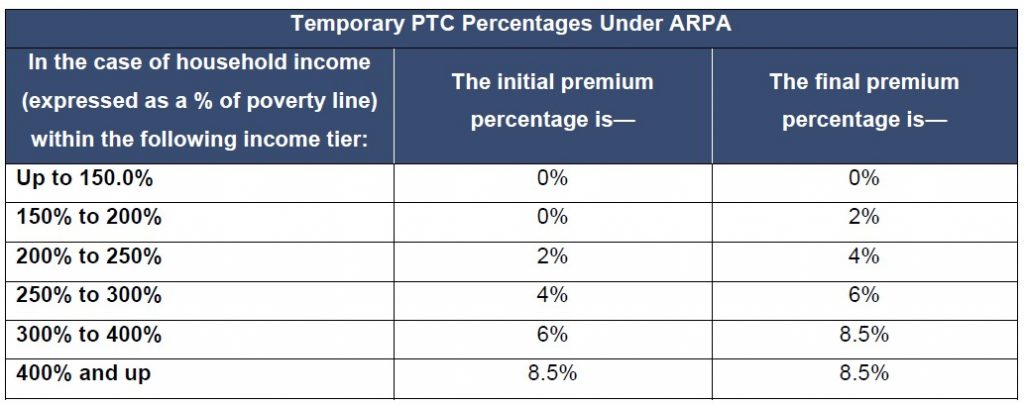
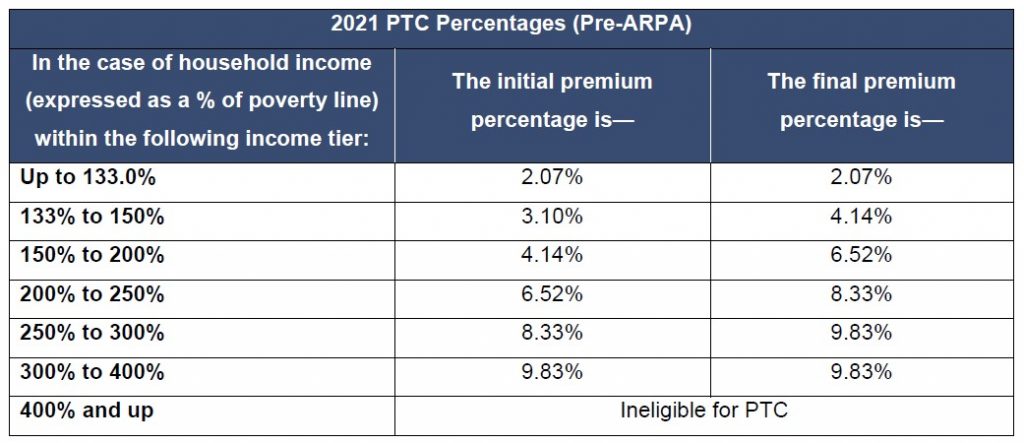
The Affordable Care Act’s premium tax credit program is significantly enhanced for 2021 and 2022. The existing income limit of 400% of the federal poverty level, after which individuals will no longer qualify for a premium tax credit, is lifted for 2021 and 2022. In addition, the applicable percentage of household income that individuals must pay for Marketplace coverage has been reduced at all income levels.  Special rules also apply to those individuals receiving unemployment compensation during 2021.  MBWL Note: The increased eligibility for premium tax credits makes it ever more important for applicable large employers (ALEs) to offer affordable, minimum value coverage to their full-time employees to avoid potential penalty exposure.

COBRA Subsidy

The ARPA provides significant assistance to employees and their families who are eligible for COBRA (or state mini-COBRA) due to an involuntary termination of employment or reduction in hours.  The law provides a 100% subsidy for COBRA premiums from April 1, 2021 through September 30, 2021. The subsidy applies to group health plans other than health FSAs.

Employers who are subject to COBRA under ERISA (private employers) or the PHS Act (state and local governmental employers) are responsible for complying with the COBRA subsidy provisions.  Insurance companies are responsible for complying with the COBRA subsidy provisions for insured group health plans that are not subject to federal COBRA (e.g., when state “mini-COBRA” requirements apply to small plans that are not subject to federal COBRA, or to large group plans after federal COBRA is exhausted). 

Additional highlights include:

  • The subsidy applies to an “assistance eligible individual” (AEI) who is any COBRA qualified beneficiary who is eligible for, and elects, COBRA during the period of April 1, 2021 through September 30, 2021, due to an involuntary termination of employment or reduction in hours.  (The reduction in hours is not required to be involuntary.)
  • AEIs must be offered at least a 60-day window within which to elect COBRA coverage.
    • The 60-day period begins April 1, 2021 and ends 60 days after the date the notice is provided to the individual.
    • AEIs include individuals in their COBRA election period, and individuals who would be AEIs but whose COBRA coverage lapsed due to non-payment prior to April 1, 2021.
    • MBWL Note: Many AEIs will still be within their COBRA election period as a result of the Department of Labor’s disaster relief (Notice 2021-01).
  • COBRA coverage elected during the subsidy period will be effective April 1, 2021; employees are not required to elect retroactive to the date of their qualifying event or any other date prior to April 1, 2021, nor are they required to pay outstanding premiums for prior periods of coverage in order to secure subsidized coverage.
  • Employers will be entitled to an advanceable, refundable tax credit against Medicare payroll taxes (1.45%) to pay for coverage during the subsidy period. The DOL will provide forms and instructions for employers to apply for the credit.
    • Additional guidance is expected for multiemployer (union) plans and professional employer organizations (PEOs).
  • The subsidy is available until the first to occur of:
    • the qualified beneficiary becoming eligible for other group health plan coverage (other than coverage consisting only of excepted benefits, such as dental or vision, coverage under a health FSA, or coverage under a qualified small employer health reimbursement arrangement (QSEHRA));
    • the qualified beneficiary becoming eligible for Medicare;
    • the end of the qualified beneficiary’s maximum COBRA duration; or
    • September 30, 2021.
  • Qualified beneficiaries who fail to notify the plan that they are no longer assistance-eligible can be liable for a $250 penalty, which may be waived if the failure was due to reasonable cause and not willful neglect. An intentional failure can result in a penalty of $250 or 110% of the amount of premium assistance received, if greater.
  • Employers may allow currently enrolled AEIs to select new plans.  An individual has 90 days from the date they are notified of the enrollment option to elect a different plan.  This option is available only if:
    • the premium for such different coverage does not exceed the premium for coverage in which such individual was enrolled at the time such qualifying event occurred;
    • the different coverage in which the individual elects to enroll is coverage that is also offered to similarly situated active employees; and
    • the different coverage is not coverage consisting only of excepted benefits, such as dental or vision, coverage under a health FSA, or coverage under a QSEHRA.
  • Required Notices to Individuals
    • General Notice / Notice of Subsidy Availability. Individuals who become eligible to elect COBRA during the subsidy period (April 1, 2021 – September 30, 2021) must be provided a notice that describes the availability of the premium assistance. The notice requirement may be satisfied by amending existing notices or by including a separate attachment. The notice must include:
      • the forms necessary for establishing eligibility for premium assistance;
      • the name, address, and telephone number to contact the plan administrator and any other person maintaining relevant information in connection with such premium assistance;
      • a description of the extended election period;
      • a description of the obligation of the qualified beneficiary to notify the plan when they are no longer eligible for a subsidy and the associated penalty for failure to do so;
      • a description, displayed in a prominent manner, of the right to a subsidized premium and any conditions thereon; and
      • a description of the option to enroll in different coverage if the employer so permits.
    • Notice of Extended Election Period. AEIs must be offered at least a 60-day window within which to elect COBRA coverage.
      • The 60-day period begins April 1, 2021 and ends 60 days after the date the notice is provided to the individual.
      • This includes:
        • individuals terminated on or after April 1, 2021;
        • individuals in their COBRA election period on April 1, 2021 (including any COVID-19-related extensions); and
        • individuals who would be AEIs but whose COBRA coverage lapsed due to non-payment prior to April 1, 2021.
    • Notice of Subsidy Expiration.Informs AEIs that the subsidy period is ending. 
    • The notice must disclose that:
      • premium assistance for the individual will expire soon and the date of such expiration;
      • the individual may be eligible for coverage without any premium assistance through COBRA or coverage under a group health plan.
    • The subsidy expiration notice is not required if the subsidy is ending due to the individual becoming eligible for another group health plan or Medicare.
    • This notice must be provided not more than 45 days but no less than 15 days before the premium assistance ends.
    • Model Notices.TheDOLmust issue model notices of subsidy availability and extended election period within 30 days of enactment, and a model notice of subsidy expiration within 45 days of the law’s enactment.

What Does This Mean For Employers?

Employers and plan sponsors should consider whether they will adopt the extended FFCRA leave provisions and/or use them to incentivize employees to receive a COVID-19 vaccine. They should also ensure their COBRA vendors are prepared to assist in identifying and notifying assistance eligible individuals within 60 days of April 1, 2021.  The DOL also plans to provide outreach consisting of public education and enrollment assistance relating to premium assistance. Their outreach will target employers, group health plan administrators, public assistance programs, States, insurers, and other entities as the DOL deems appropriate. The outreach will include an initial focus on those individuals eligible for an extended election period. We also expect the DOL and other agencies to issue guidance on various issues related to the subsidy in the coming weeks.

__________________________________

About the Authors.  This alert was prepared by Marathas Barrow Weatherhead Lent LLP, a national law firm with recognized experts on the Affordable Care Act.  Contact Stacy Barrow or Nicole Quinn-Gato at sbarrow@marbarlaw.com or nquinngato@marbarlaw.com.

This post is a service to our clients and friends.  It is designed only to give general information on the developments actually covered.  It is not intended to be a comprehensive summary of recent developments in the law, treat exhaustively the subjects covered, provide legal advice, or render a legal opinion.

Benefit Advisors Network and its members are not attorneys and are not responsible for any legal advice.  To fully understand how this or any legal or compliance information affects your unique situation, you should check with a qualified attorney.

© Copyright 2021 Benefit Advisors Network. All rights reserved.

IRS Provides Guidance on FSA Relief Authorized in the Consolidated Appropriations Act, Grants Other Cafeteria Plan Relief

We are just weeks shy of the one-year anniversary of the President’s declaration of the COVID-19 National Emergency, and the COVID-19 National and Public Health Emergencies are still in effect.  As a result of the long-term impact of the pandemic, many employees faced forfeiting their unused health FSA and dependent care assistance program (DCAP) funds at the end of the 2020 plan year.

As a result, and as we previously reported, a second stimulus relief bill (the Consolidated Appropriated Act, 2021) was signed into law on December 27, 2020, which provided much-needed relief for health FSAs and DCAPs.  On February 18, 2021, the IRS released Notice 2021-15, which provides additional guidance related to the relief in the stimulus bill as well as further relief for cafeteria plans and HRAs.  The guidance and relief are summarized in more detail below.

IRS Guidance Related to the Second Stimulus Bill (CAA, 2021)

Health FSA and DCAP Carryovers – The stimulus bill authorized employers offering a DCAP or health FSA to allow participants to carry over all unused DCAP and health FSA contributions or benefits remaining at the end of the 2020 plan year to the 2021 plan year.  Notice 2021-15 clarifies that:

  • Employers may require employees to make an election in the 2021 or 2022 plan year to access the carryover from the previous plan year.
  • The carryover relief applies to all health FSAs, including limited purpose health FSAs.
  • If an employee uses the mid-year election change relief discussed elsewhere in this alert to prospectively elect to participate in the health FSA mid-year, the employee can access the full amount of their carryover from 2020 retroactive to January 1, 2021.
  • Employers can restrict the amount employees can carryover, i.e., they do not have to allow the full unused amount from 2020 or 2021. Employers need to specify the limit to employees in the plan amendment and any communications to employees.
  • Employers may allow employees to opt out of the carryover to preserve HSA eligibility.
  • The amount carried over may be from multiple plan years, i.e., if an employee has a remaining balance at the end of the 2020 plan year and it is still remaining after the end of the 2021 plan year, it will be accessible during the 2022 plan year (as a carryover) if the employer adopts the carryover relief for the 2021 plan year.

Extended Grace Period – Employers offering a DCAP or health FSA may extend the grace period for using any benefits or contributions remaining at the end of a plan year ending in 2020 or 2021 to 12 months after the end of the applicable plan year.  The Notice clarifies that:

  • The extended grace period is available for up to 12 months, meaning employers may elect a shorter period of time.
  • The relief applies to both general purpose and limited purpose health FSAs.
  • For purposes of HSA eligibility, employers can permit employees to opt out of the extended grace period.

Spend Down – Similar to DCAPs, employers offering a health FSA may allow participants who cease participation during the 2020 or 2021 plan year to continue to be reimbursed from any unused benefits through the end of the plan year (and applicable grace period) in which participation ceased.  In Notice 2021-15, the IRS clarified the following:

  • Employers do not have to allow employees who terminate mid-year to spend down for the remainder of the plan year.  Instead, they can adopt a shorter period of time.
  • The spend-down can be used for anyone who terminates employment, loses eligibility for the plan due to a reduction in hours, or loses eligibility because they made a new election during calendar year 2020 or 2021. 
  • Even if the employer adopts the spend-down relief, it must still offer COBRA for individuals with an underspent health FSA account.  The COBRA premium established by the employer cannot include the amount carried over or available due to the extended grace period relief.

DCAP Reimbursement for Children Who Turned 13 During the Pandemic – Employers offering DCPAs in plan years with open enrollments that ended on or before January 31, 2020 may choose to reimburse employees for dependent care expenses for children who turned 13 during the pandemic. The relief applies for the subsequent plan year (e.g., calendar year 2021 plans) to the extent the employee has a balance at the end of the 2020 plan year after any relief adopted by the employer.  The IRS clarified that:

  • The employer may adopt this relief without also adopting the extended grace period or carryover.

Health FSA and DCAP Election Changes – Employers offering a health FSA or DCAP may allow employees to make prospective election changes (subject to annual limitations) to their 2021 contributions without experiencing a change in status event. The IRS clarified the following:

  • Employers may allow employees to make the following changes on a prospective basis:
    • Revoke an election
    • Make one or more elections; or
    • Increase or decrease an existing election

If an employee elects to revoke DCAP or health FSA expenses, the employer may not refund any contributions to employees.  The employer may choose to treat the contributions made before the elections are revoked the following ways:

  • The contributions may remain available to reimburse medical or dependent care expenses incurred for the rest of the plan year;
  • The contributions are only available to reimburse expenses incurred before the revocation takes effect (and not later incurred expenses); or
  • The contributions are forfeited.

If the employer takes the second or third approaches listed above, then the health FSA is no longer treated as HSA-disqualifying coverage.  Therefore, an impacted employee could begin participating in an HSA as soon as health FSA participation is terminated.

Other FSA Clarifications

The IRS further clarified that employers may adopt an extended grace period or carryover, but not both.  Employers can adopt some, all, or none of the FSA relief provided under the stimulus bill.  The relief is also available to employers who previously did not offer a carryover or grace period – they can adopt them for the 2020 and 2021 plan years so employees may benefit from the relief.

Further, the employer can adopt relief for some, but not all health FSA or DCAP participants, subject to nondiscrimination rules; however, any amount carried over or the extended grace period will not be taken into account for purposes of nondiscrimination testing. 

Additionally, the IRS clarified that, for purposes of the relief, employers may amend the plan to allow employees to make a mid-year election to be covered by a general purpose health FSA for part of the year and a limited purpose health FSA for the remainder of the year. If the employee does so, then any permissible HSA contribution is based on the number of months the employee was covered under the limited purpose health FSA.  Further, unused amounts in the limited purpose health FSA can be transferred to the general purpose health FSA or vice versa; however, the general purpose or limited purpose health FSA can only reimburse applicable (based on the type of health FSA), allowable expenses incurred after the change in coverage, respectively. If, under the relief, an employee makes a mid-year election change from an HDHP to a non-HDHP mid-year and elects to participate in a health FSA, then the health FSA must be operated as a limited purpose health FSA for the months the employee was otherwise HSA-eligible, and then may operate as a general purpose health FSA for the remaining months (when the employee was not enrolled in HDHP coverage).

Finally, the IRS clarified that in no instance can an employee receive a refund of any unused FSA contributions in cash or in another form of taxable or non-taxable benefits.

Unfortunately, the IRS failed to clarify with any certainty whether an employee may be taxed on any DCAP reimbursements in excess of $5,000 for the calendar year.  While the relief provides that the annual limits under Section 129(a) of the Code apply to amounts contributed to the DCAP for the plan year, not the amounts reimbursed or available for reimbursement, if the employer adopts the extended grace period or carryover, this does not directly answer the question.  The guidance does, however, clarify that the W-2, Box 10 amount for the DCAP does not need to be adjusted to take into account the amount available in the extended grace period or carryover.  We also note that the American Rescue Plan Act of 2021, a bill to enact President Biden’s COVID-19 relief package, includes a provision that, if passed, would increase the DCAP exclusion from $5,000 to $10,500 (from $2,500 to $5,250 in the case of a separate return filed by a married individual) for 2021.

Additional IRS Relief

Notice 2021-15 also includes additional relief for cafeteria plans and HRAs. 

Election Changes for Health Coverage – Similar to the IRS’ initial COVID-19 relief issued last year in Notice 2020-29, Notice 2021-15 allows employers to amend their cafeteria plan to allow employees to make mid-year election changes with respect to employer-sponsored health coverage. Specifically, employers may allow employees to do the following on a prospective basis:

  • Make a new election if the employee initially declined coverage;
  • Revoke an existing election and make a new election to enroll in different health coverage sponsored by the employer; or
  • Revoke an existing election on a prospective basis, provided that the employee attests in writing that the employee is enrolled, or immediately will enroll, in other health coverage not sponsored by the employer.

As was the case in 2020, the employer can adopt all, some, or none of this relief.  Employers can limit the number of election changes permitted and/or designate a time period during which such changes can be made, and the employer may limit the ability of employees to change from one type of health plan to another. Finally, the employee may not revoke an existing election for comprehensive health coverage by attesting to enrollment in a limited purpose dental and/or vision plan.

HRAs and FSAs

Pursuant to the CARES Act, employers were permitted to amend their plans to allow HRAs, health FSAs to reimburse expenses incurred for over-the-counter drugs without a prescription, as well as menstrual care products effective January 1, 2020. These expenses can also be reimbursed under HSAs and Archer MSAs.  In the Notice, the IRS permits employers to amend their cafeteria plans (for purposes of the health FSA) and HRAs to reimburse these expenses effective January 1, 2020.

What Does This Mean For Employers

Pursuant to Notice 2021-15, employers must amend their plan to adopt any of these changes no later than the last day of the first calendar year beginning after the end of the plan year in which the amendment is effective.  In other words, employers must amend a calendar year 2020 plan by December 31, 2021, and a calendar year 2021 plan by December 31, 2022.  In the meantime, the employer must communicate these changes to employees and must operate the plan in accordance with the changes between the time the amendment is effective and when it is ultimately adopted by the employer.  Employers should effectively communicate the changes to employees and ensure they operate in accordance with those communicated changes, including any limits they intend to impose. 

How Many Years Is A One Year Extension? DOL Clarifies its Disaster Relief Guidance

The Department of Labor (DOL) has released Notice 2021-01, which clarifies the end date for the relief provided in April 2020 under Notice 2020-01. Per the latest guidance, individuals (and plans) are granted relief based on their own fact-specific timeframes and, therefore, may still take advantage of the relief beyond February 28, 2021 until the earlier of (a) 1 year from the date they were first eligible for relief, or (b) 60 days after the announced end of the COVID-19 National Emergency.

As background, in April 2020 the DOL announced that certain deadlines under ERISA were suspended starting March 1, 2020 until 60 days after the announced end of the COVID-19 National Emergency or such other date determined by the agencies (the “Outbreak Period”). The following deadlines applicable to participants and beneficiaries are tolled (paused) during the Outbreak Period:

  • The 30-day period (or 60-day period, if applicable) to request a HIPAA special enrollment;
  • The 60-day period for electing COBRA continuation coverage;
  • The date/deadline for making COBRA premium payments;
  • The deadline for individuals to notify the plan of a COBRA qualifying event or determination of disability;
  • The deadline within which employees can file a benefit claim, or a claimant can appeal an adverse benefit determination, under the group health plan or disability plan claims procedures described in the plan;
  • The deadline for claimants to file a request for an external review after receipt of an adverse benefit determination or final internal adverse benefit determination; and
  • The deadline for a claimant to file information to perfect a request for external review upon finding that the request was not complete.

Certain deadlines impacting employers/plan sponsors were also extended, such as the deadline to provide a COBRA election notice, among others. This alert focuses on the deadlines applicable to participants, as we recommend employers send any required notices as soon as practicable despite any extensions available from the DOL.

Section 518 of ERISA allows the DOL to suspend deadlines for a period of up to one year due to a declared public health emergency.  Generally, that would mean because the relief was announced effective March 1, 2020, it would end after February 28, 2021. However, the DOL (in coordination with IRS and HHS) has interpreted the one-year relief to apply on an individual or plan basis.  Accordingly, individuals and plans are granted relief for their own fact-specific timeframes and, therefore, may still take advantage of relief beyond February 28, 2021 until the earlier of (a) 1 year from the date they were first eligible for relief, or (b) 60 days after the announced end of the National Emergency (the end of the Outbreak Period).

For example, if an employee was required to make a COBRA election by March 1, 2020, they have until the earlier of March 1, 2021 or the end of the Outbreak Period to elect COBRA. Likewise, if someone was required to elect COBRA by March 1, 2021, they will have until the earlier of March 1, 2022 or the end of the Outbreak Period to make an election. 

The guidance emphasizes the importance of notifying participants and beneficiaries regarding this relief and how it impacts them. The guidance provides the following examples:

  • If a plan administrator or other responsible plan fiduciary knows, or should reasonably know, that the end of the relief period for an individual action is exposing a participant or beneficiary to a risk of losing protections, benefits, or rights under the plan, then they should send a notice regarding the end of the relief period.
  • Any required plan disclosures issued prior to or during the pandemic may need to be reissued or amended if they failed to provide accurate information regarding the time in which participants and beneficiaries were required to take action, e.g., COBRA election notices and claims procedure notices.
  • Plan sponsors of group health plans should consider ways to ensure that participants and beneficiaries who are losing coverage under their group health plans are made aware of other coverage options that may be available to them, including the opportunity to obtain coverage through the Health Insurance Marketplace in their state. 

What Does This Mean For Employers and Group Health Plan Sponsors? In an already complicated world, things just became increasingly more complicated.  Employers should work with their third-party administrators, such as COBRA vendors, to ensure any notices previously provided to individuals are updated pursuant to the new guidance.  This includes any COBRA general notices, election notices, grace period notices, SPDs, or other plan materials that may articulate the incorrect deadlines to individuals.  Further, employers and administrators should ensure participants and beneficiaries are adequately notified prior to their individualized relief is coming to an end.

EEOC Issues Notice of Proposed Rulemaking Related to Wellness Programs

EEOC Issues Notice of Proposed Rulemaking Related to Wellness Programs

Since 2019, employers faced uncertainty regarding the status of wellness program incentives under the ADA and GINA. On January 7, 2021, the EEOC issued a Notice of Proposed Rulemaking on Wellness Programs Under the ADA and GINA that addresses this issue. The proposed rules deviate somewhat from prior EEOC guidance and positions.  

Specifically, the proposed rules apply the ADA’s insurance “safe harbor” to health contingent wellness programs offered as part of, or qualified as, an employer-sponsored group health plan, thereby segregating them from health contingent wellness programs offered to all employees, regardless of their participation in the employer’s health plan.  Instead, the latter are lumped in with non-health contingent wellness programs (i.e., wellness programs that involve a disability-related inquiry or medical exam but are not activity-based or outcome-based) and subject to the ADA wellness rules. 

Consistent with the EEOC’s announcement in the summer of 2020, the proposed rules require any incentives provided for participatory wellness programs and/or wellness programs not offered as part of a group health plan to be “de minimis.”  If the rules are finalized as proposed, employers may no longer rely upon the 30% (or 50% for smoking cessation) limit on incentives for these types of programs. 

Finally, the proposed rules amend the GINA regulations by, among other things, limiting wellness program incentives for employees who complete health risk assessments that contain information about their spouse or dependents’ family medical history or other genetic information to a similar de minimis amount. 

The proposed rules are described in more detail below.

Background

As background, under the ADA, wellness programs that involve a disability-related inquiry or a medical examination must be “voluntary.”  Similar requirements exist under GINA when there are requests for an employee’s family medical history (typically as part of a health risk assessment).  For years, the EEOC had declined to provide specific guidance on the level of incentive that may be provided under the ADA, and their informal guidance suggested that any incentive could render a program “involuntary.”  In 2016, after years of uncertainty on the issue, the agency released rules on wellness incentives that resembled, but did not mirror, the 30% limit established under U.S. Department of Labor (DOL) regulations applicable to health-contingent employer-sponsored wellness programs.  While the regulations appeared to be a departure from the EEOC’s previous position on incentives, they were welcomed by employers as providing a level of certainty.

However, the rules were subsequently challenged by the AARP, which alleged that the final regulations were inconsistent with the meaning of “voluntary” as that term was used in ADA and GINA.  After much back and forth in the lawsuit, in December 2017, the court vacated, effective January 1, 2019, the portions of the final regulations that the EEOC issued in 2016 under the ADA and GINA addressing wellness program incentives.  This was, in most part, due to the timing proposed by the EEOC to develop new regulations. 

Accordingly, since January 1, 2019, employers have been operating with little guidance or clarity regarding whether incentives provided for participatory wellness programs would be agreeable to the EEOC.

EEOC Proposed Wellness Regulations

ADA Proposed Wellness Regulations

The EEOC’s proposed rule seeks to amend two sections of the ADA regulations, related medical examinations and inquiries, and the insurance safe harbor.  In the preamble to the proposed rule, the EEOC recognizes that the meaning of “voluntary” is in the eye of the beholder but takes the position that if incentives are too high, then employees may feel coerced to disclose protected medical information in order to be rewarded or avoid a penalty.  Accordingly, participatory wellness programs that include a disability-related inquiry and/or a medical examination or health-contingent programs that are not part of, or do not qualify as, a group health plan must not impose terms that would adversely affect the terms, conditions, or privileges of employment for employees who do not participate and, therefore, must limit incentives to a de minimis amount.

While “de minimis” is not specifically defined, the EEOC provides some examples to help guide employers, including:

  • Providing a water bottle
  • Providing a gift card of “modest” value

Items the EEOC indicates would not be de minimis include:

  • Providing a $50 a month premium reduction for completing a health risk assessment
  • Paid airline tickets
  • Annual gym memberships

The EEOC requested comments on the types of incentives that should/should not be considered de minimis.

The proposed rules list four factors that can be used to determine whether a wellness program is “part of” a group health plan:

  1. the program is only offered to employees who are enrolled in an employer-sponsored health plan;
  2. any incentive offered is tied to cost-sharing or premium reductions (or increases) under the group health plan;
  3. the program is offered by a vendor that has contracted with the group health plan or issuer; and
  4. the program is a term of coverage under the group health plan.

The proposed rules included other protections for employees.  Specifically, they (1) prohibit employers from retaliating, interfering with, coercing, intimidating, or threatening employees, such as coercing them to participate in the program or threatening disciplinary action if they don’t participate, (2) protect employee confidential information obtained by a participatory wellness program or a health-contingent wellness program that is not part of the group health plan by requiring information collected to be aggregated in a form that does not disclose, and is not reasonably likely to disclose, the identity of specific individuals, (3) with limited exceptions specific to carrying out wellness program functions, prohibit the employer from requiring the employee to agree to the sale or disclosure of medical information or waive confidentiality protections under the ADA to participate in the program; and (4) clarify that employers must still comply with other federal civil rights laws.

Finally, because the EEOC is now proposing a de minimis incentive standard for most wellness programs, it no longer believes that it is necessary to require employers to issue a unique ADA notice that describes, among other things, the type of medical information that will be obtained and the purposes for which the information will be used.

GINA Proposed Wellness Regulations

Under the proposed GINA rules, employers may provide de minimis incentives to employees who complete health risk assessments that contain information about their spouse or dependents’ family medical history or other genetic information.  The EEOC uses the same examples of what would be de minimis under the ADA for purposes of GINA, such as providing a water bottle or a modest gift card. 

The proposed rule does not prohibit an employer from offering a greater incentive (i.e., a non-de minimis incentive) to employees who provide their own genetic information as long as the employer makes it voluntary for the employee to complete the questions regarding genetic information (and the instructions clearly indicate which questions are voluntary), or to an employee who completes a health risk assessment that includes genetic information, if the employee participates in a disease management program, other program that promotes a healthy lifestyle, and/or meet a particular health goal, as long as the programs are also offered to individuals with current health conditions or health risks. 

The EEOC uses an example of an employer who offers $150 for completion of a health risk assessment which requests information about family medical history or other genetic information but makes it clear that the incentive is available regardless of whether the employee completes any questions related to genetic information.  The assessment identifies which questions are related to genetic information.  Employees can earn $150 if they disclose family medical history and participate in a program designed to encourage weight loss or a healthy lifestyle; however, if the employee does not want to complete the questions related to genetic information, they can still earn the $150 if they attain a certain health outcome by participating in other activities.  The incentive complies with GINA.

What’s Next for Employers?

The wellness regulations are proposed at this time and it is uncertain when they will be finalized; however, if history is any indication, any final regulations will be challenged in court.  While employers are not required to make any changes to their wellness programs at this time, they should continue to monitor developments and work with employee benefits counsel when designing their wellness programs.  Release of final regulations may be further delayed if the Biden administration freezes new rules pending further review. 

________________________________________________________________

About the Authors.  This alert was prepared by Marathas Barrow Weatherhead Lent LLP, a national law firm with recognized experts on the Affordable Care Act.  Contact Stacy Barrow or Nicole Quinn-Gato at sbarrow@marbarlaw.com or nquinngato@marbarlaw.com