BAN Blog

Legal Alert: Court Requires EEOC to Substantiate 30% Limit on Wellness Program Incentives

On August 22, 2017, a federal court in the District of Columbia ordered the Equal Employment Opportunity Commission (EEOC) to reconsider the limits it placed on wellness program incentives under final regulations the agency issued last year under the Americans with Disabilities Act (ADA) and the Genetic Information Nondiscrimination Act (GINA).  As part of the final regulations, the EEOC set a limit on incentives under wellness programs equal to 30% of the total cost of self-only coverage under the employer’s group health plan.  The court found that the EEOC did not properly consider whether the 30% limit on incentives would ensure the program remained “voluntary” as required by the ADA and GINA and sent the regulations back to the EEOC for reconsideration.

In the meantime, to avoid “potentially widespread disruption and confusion” the court decided that the final regulations would remain in place while the EEOC determines how it will proceed (e.g., provide support for its regulations, appeal the decision, or change the regulations). As background, under the ADA, wellness programs that involve a disability-related inquiry or a medical examination must be “voluntary.”  Similar requirements exist under GINA when there are requests for an employee’s family medical history (typically as part of a health risk assessment).  For years, the EEOC had declined to provide specific guidance on the level of incentive that may be provided under the ADA, and their informal guidance suggested that any incentive could render a program “involuntary.”  In 2016, after years of uncertainty on the issue, the agency released rules on wellness incentives that resemble, but do not mirror, the 30% limit established under U.S. Department of Labor (DOL) regulations applicable to health-contingent employer-sponsored wellness programs.  While the regulations appeared to be a departure from the EEOC’s previous position on incentives, they were welcomed by employers as providing a level of certainty.

However, the American Association for Retired Persons (AARP) sued the EEOC in 2016, alleging that the final regulations were inconsistent with the meaning of “voluntary” as that term was used in ADA and GINA.  AARP asked the court for injunctive relief, which would have prohibited the rule from taking effect in 2017.  The court denied AARP’s request in December 2016, finding that AARP failed to demonstrate that its members would suffer irreparable harm from either the ADA or the GINA rule, and that AARP was unlikely to succeed on the merits.  This was due in part to the fact that the administrative record was not then available for the court’s review.

In its recent decision, the court reviewed the administrative record and found the EEOC’s regulations were arbitrary and capricious, in that the EEOC failed to provide a reasoned explanation for its decision to interpret the term “voluntary” to permit a 30% incentive level.  As part of its analysis, the court evaluated numerous reasons the EEOC gave for choosing the 30% level and noted that, having chosen to define “voluntary” in financial terms (30% of the cost of self-only coverage), the EEOC “does not appear to have considered any factors relevant to the financial and economic impact the rule is likely to have on individuals who will be affected by the rule.”

The court has allowed the final regulations to remain in place while the EEOC determines how it will proceed, to avoid disruption to employers and others who have relied on them.  If the court had vacated the regulations, employers would have been at risk of violating the ADA despite having designed their wellness programs to comply with the 30% limit on incentives. 

Next Steps and Impact on Employers

It is unknown at this time how the EEOC will respond to the court’s decision. If the EEOC wishes to continue its application of the rule, it will need to supplement the administrative record with some evidence that participation in a wellness program remains “voluntary” even when an employer can penalize employees 30% of the total cost of coverage if they don’t participate.  However, the EEOC may decide, instead, to withdraw its rule or promulgate new rules lowering the incentive limit (further distancing it from the HIPAA limits).  It is likely that any new rules would provide for a transition period during which employers would be able to review and revise their wellness programs so that they comply.  Given that the Trump Administration’s nomination for EEOC Commission Chair awaits Senate confirmation, it may be a considerable amount of time until the EEOC decides how to proceed, leaving employers without the clarity they desire on this issue. 

It is also possible, though given other priorities unlikely, that Congress may intervene to pass legislation harmonizing the ADA with the HIPAA/ACA rules, which would render the court’s decision moot. 

In the short term, employers may continue to rely on the EEOC’s final regulations.  Wellness programs designed to comply with existing rules, specifically the 30% cap, are unlikely to be challenged by the federal governmental agencies.  However, it is possible the court’s decision may open the door for employees to bring a private lawsuit against an employer challenging under the ADA the “voluntariness” of a wellness program that includes an incentive up to the 30% limit.  One would expect that any employer facing such an action would defend it arguing its good faith reliance on the EEOC’s regulation.

In the longer term, employers are again faced with uncertainty as to their wellness program incentives.  Employers designing and maintaining wellness programs should continue to monitor developments and work with employee benefits counsel to ensure their wellness programs comply with all applicable laws.  


About the Author

This alert was prepared by Stacy Barrow.  Mr. Barrow is a nationally recognized expert on the Affordable Care Act.  His firm, Marathas Barrow Weatherhead Lent LLP, is a premier employee benefits, executive compensation and employment law firm.  He can be reached at sbarrow@marbarlaw.com.

This message is a service to our clients and friends. It is designed only to give general information on the developments actually covered. It is not intended to be a comprehensive summary of recent developments in the law, treat exhaustively the subjects covered, provide legal advice, or render a legal opinion.

Benefit Advisors Network and its smart partners are not attorneys and are not responsible for any legal advice. To fully understand how this or any legal or compliance information affects your unique situation, you should check with a qualified attorney.

© Copyright 2017 Benefit Advisors Network. Smart Partners. All rights reserved
Legal Alert: Senate Republicans Release Updated Discussion Draft of ACA Repeal Bill

On Thursday, June 22, 2017, Senate Majority Leader Mitch McConnell of Kentucky released a 142-page healthcare “Discussion Draft” of legislation, called the Better Care Reconciliation Act of 2017 (BCRA), which is the Senate version of the Affordable Care Act (ACA) “repeal-and-replace” legislation American Health Care Act (AHCA) passed by the U.S. House of Representatives last month.  An updated “Discussion Draft” of the BCRA was released on June 26, 2017 with the intention of calling for a vote on the bill before the Fourth of July recess. However, Senator McConnell had to delay that vote after it became clear that it would not get the 51 votes required under the Budget Reconciliation rules to pass.  A further updated Discussion Draft of the BCRA was released on July 13, 2017.  A summary of the updated July 13 draft of the BCRA by the U.S. Senate Committee on the Budget is available here and a section-by-section summary of the July 13 version is available here and here.

The July 13 Discussion Draft largely mirrors the previous draft and its primary revisions are unlikely to have a significant impact on employer-sponsored group health plan coverage.  The revisions to the BCRA in the July 13 Discussion Draft are intended to garner enough support from certain key swing votes by senators who previously expressed reservations about supporting the prior version after the Congressional Budget Office previously reported that it would leave 22 million more uninsured by 2026 than under the ACA while providing tax cuts to the wealthy.  Primary revisions in this most recent version include:

  • Addition of a provision that would allow people to use their health savings accounts (HSAs) to pay for individual market health coverage to the extent that premiums exceed any tax credit amounts allowed under the law;
  • Revisions to keep the 3.8% net investment income tax and 0.9% Medicare payroll tax, which previous versions had proposed repealing;
  • Additional funding for state-based reforms that are intended to help cover out-of-pocket costs and additional funding for opioid programs;
  • Addition of a provision that would allow all individuals purchasing health insurance in the individual market the option to purchase a lower premium catastrophic plan (that covers at least 3 primary care visits a year) effective plan years beginning on or after January 1, 2019 and allow individuals to use premium tax credits towards the purchase of such catastrophic plans; and
  • Addition of a provision developed by Senator Ted Cruz (R-TX) that would allow insurers to offer non-Exchange plans that do not comply with many of the ACA mandates so long as the insurer offers “sufficient minimum coverage” through a public Exchange that remains subject to federal mandates in the ACA.  Because the policies that meet the ACA mandates would likely attract individuals with adverse health conditions, the bill would create a fund to make payments to insurers for the costs of covering high risk individuals enrolled in such plans. 

Except for the taxes noted above and the “Cadillac” tax on high-cost employer-sponsored coverage, which would be delayed through 2025, the updated Senate bill would repeal virtually all of the tax increases imposed by the ACA, including the individual and employer mandates, effective as of January 1, 2016.

The major substantive change in the prior updated Discussion Draft released on June 26 was to add a new Section 206, beginning in 2019, that would subject an individual who has a break in continuous “creditable coverage” for 63 days or more in the prior year to a six-month waiting period (in the individual market) before coverage begins.  This provision remains unchanged in the current version of the bill and is intended to provide an incentive for young and healthier individuals to maintain health insurance since the bill would eliminate the individual mandate.  The AHCA proposed imposing a 30% surcharge on those without continuous creditable coverage, but there were concerns over whether that provision could pass Senate parliamentary rules.

The Congressional Budget Office is expect to release its score of the legislation next week and, if there are enough votes, a formal debate of the bill on the Senate floor could follow.  It remains unclear whether the Republicans will be able to secure enough votes to advance the bill.  It has already been reported that Senator Rand Paul (R-KY) and Senator Susan Collins (R-ME) intend to vote against beginning debate next week.   Also on July 13, Senators Bill Cassidy (R-LA) and Lindsey Graham (R-SC) announced that they are developing an “alternative” health plan that would keep much of the federal taxes in place (though it would repeal the individual and employer mandates) and would send much of the federal tax dollars to the states to control.

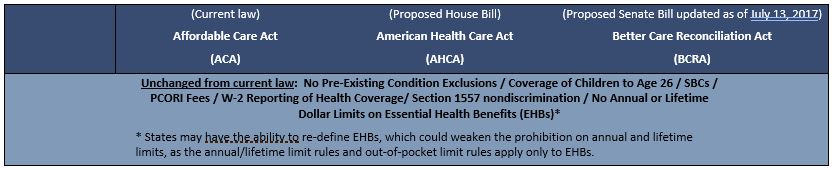
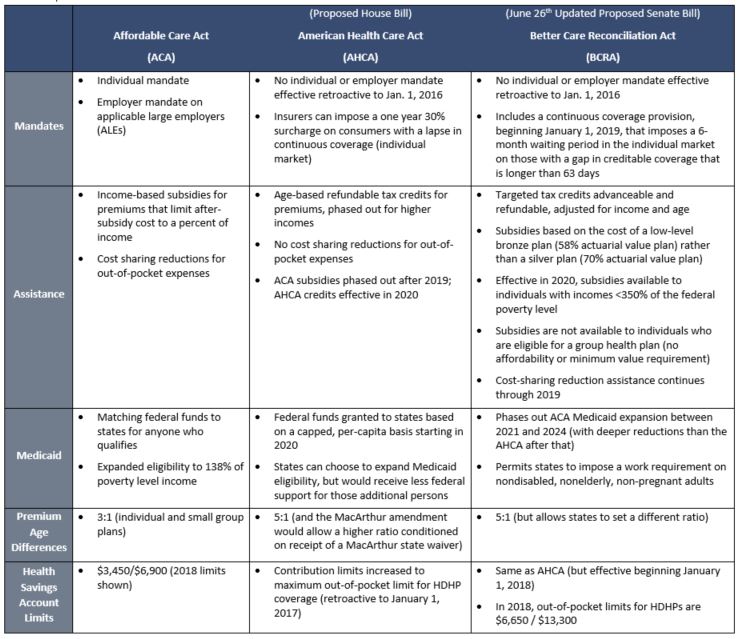
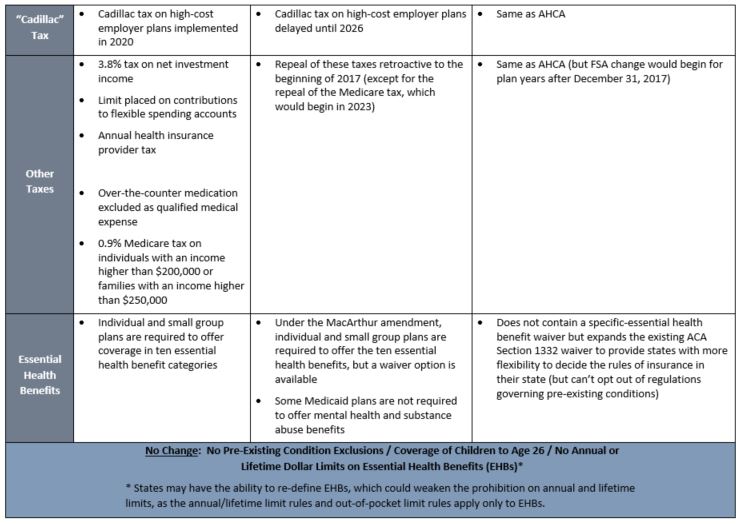
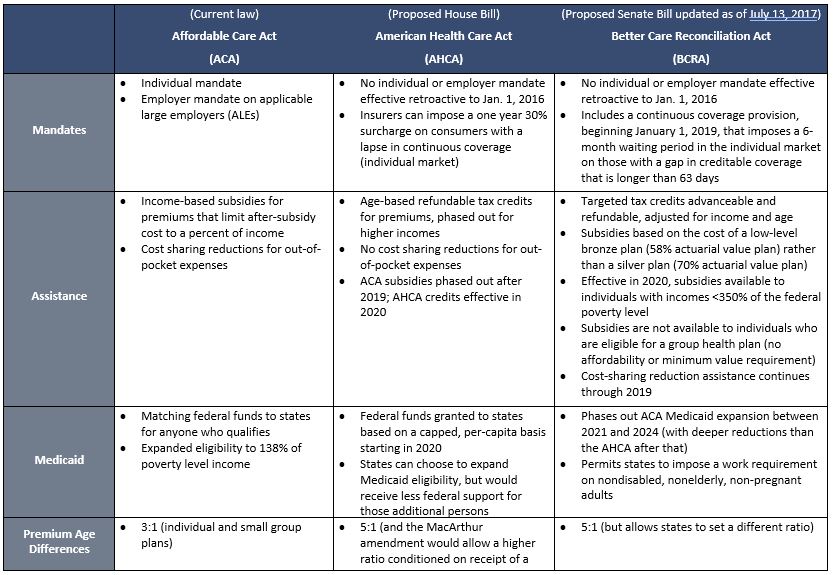
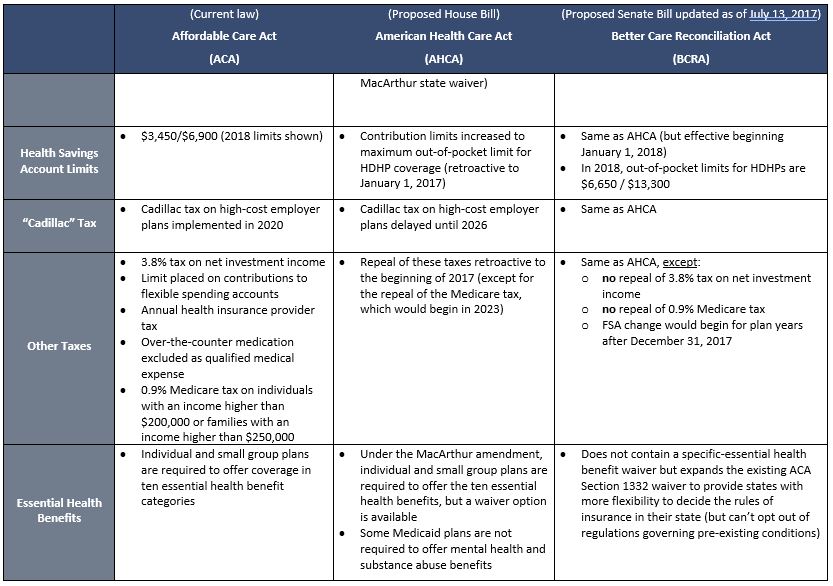
A comparison of the House passed AHCA and the updated versions of the Senate bills can be found below. 

Key Issues for Employers

As noted above, the most recent Discussion Draft of the BCRA largely mirrors the previous draft and the primary revisions to the prior versions are unlikely to significantly impact employer-sponsored group health plan coverage.  For employers, the most significant change made by the AHCA to the ACA that was retained by the various versions of the BCRA is the repeal of the employer mandate penalties effective January 1, 2016.  The updated BCRA retains other significant AHCA changes for employers, including unlimited flexible spending accounts, and enhancements to health savings accounts (HSAs).

Of note for employers sponsoring fully-insured group health plans, beginning in 2020 the updated bill retains the provision from the prior version that requires states to set their own medical loss ratio rebating rules.  It also retains the provision from the prior version that would add a structure under ERISA (by adding a new Part 8) that would allow for the establishment of association health plans for small businesses or individuals (Small Business Health Plans or SBHPs), allowing them to be treated as large group plans exempt from the community rating and essential health benefit requirements that are currently applicable to small group and individual plans.  This new section of ERISA would preempt any and all state laws that would preclude an insurer from offering coverage in connection with an SBHP and would go into effect one year after enactment (and implementing regulations would be required to be promulgated within six months of enactment).

Also significant is that the updated bill does not include a provision capping the tax exclusion for employer provided health insurance.  Many employers were concerned that the exclusion would be capped or removed as a way to increase revenue to pay for other tax cuts in the bill.  Nor does the bill repeal the Sections 6055 and 6056 reporting requirements.  It will remain to be seen whether, if the BCRA is passed, the IRS may continue to use the existing ACA information reporting system to determine whether an individual is eligible for a premium tax credit or is prohibited from receiving one in 2018 or 2019 because such an individual has an offer in 2018 or 2019 of affordable, minimum value employer-sponsored coverage.  Or, whether in 2020 and thereafter, the IRS would need information to assess whether an individual has any offer of employer-sponsored coverage to determine eligibility for the premium tax credit. 

Other provisions of the ACA that are not changed by either the House AHCA or any of the Senate proposals are: 

  • W-2 reporting of health coverage;
  • Comparative effectiveness research fees paid annually to fund the Patient-Centered Outcomes Research Institute (PCORI) through 2019;
  • Group health plan coverage mandates (e.g., dependents to age 26, no annual or lifetime limits);
  • Rules for non-grandfathered group health plans (e.g., coverage of preventive services with no cost-sharing, external appeals, etc.);
  • Summary of Benefits and Coverage (SBCs); and
  • Section 1557 nondiscrimination rules.

Key Issues for Individuals

For individuals, while the July 13th Discussion Draft of the BCRA includes some revisions to Medicaid, like the prior version, it would repeal the ACA’s Medicaid expansion, but at a slower rate than proposed by the AHCA and would tighten the eligibility criteria for premium subsidies (beginning in 2020, only those earning up to 350% of the poverty level would qualify rather than the 400% threshold in the ACA); however, subsidies would open up for enrollees below the poverty level living in states that did not expand Medicaid.  The bill would allocate money for cost-sharing subsidies through 2019, which are used to offset the costs for insurers to offer low-income individuals with coverage that has lower out-of-pocket costs.  There had been uncertainty whether these payments would continue, which was causing instability in the individual insurance market.  

However, under the July 13 Discussion Draft of the Senate bill, higher-income individuals would not see relief from the 0.9% Medicare surtax or the 3.8% net investment income tax that in prior versions of both the House and Senate bill would have been repealed.

Next Steps

The Republicans are trying to pass the bill through the budget reconciliation process since it allows them to avoid a Democratic filibuster and to pass the bill with a simple majority (rather than 60 votes).  However, the Republicans have only 52 Senate seats, which means that to pass, Senator McConnell can only afford to lose 2 votes (Vice President Pence can be the tie breaker).  It remains to be seen whether the most recent changes to appease the bill’s critics will be enough to move the bill forward for debate on the Senate floor, where it is expected that senators will propose amendments.  As noted above, it has been reported that Senators Paul Rand and Susan Collins have already stated that they intend to vote against letting the bill go forward and Senators Lindsey Graham and Bill Cassidy announced that they are working on an alternative health plan, further complicating the process.  

Majority Leader Senator McConnell recently decided to delay the Senate’s August recess so that the Senate could continue to work on legislation including the BCRA.  If the Senate passes a bill, it will either have to be approved by the House (the two chambers would have to reconcile their differences in a conference committee), or the House could pass a new version and send it back to the Senate for approval.

Comparison of the ACA, AHCA, and BCRA

The chart below compares some of the significant changes proposed by the BCRA to the ACA and the proposed House bill.

Employers and other stakeholders should continue to stay the course on ACA compliance at this time while they monitor for changes as the BCRA continues to make its way through the legislative process.


About the Author

 This alert was prepared for Benefit Advisors Network by Stacy Barrow.  Mr. Barrow is a nationally recognized expert on the Affordable Care Act.  His firm, Marathas Barrow Weatherhead Lent LLP, is a premier employee benefits, executive compensation and employment law firm.  He can be reached at sbarrow@marbarlaw.com.

This message is a service to our clients and friends. It is designed only to give general information on the developments actually covered. It is not intended to be a comprehensive summary of recent developments in the law, treat exhaustively the subjects covered, provide legal advice, or render a legal opinion.

Benefit Advisors Network and its smart partners are not attorneys and are not responsible for any legal advice. To fully understand how this or any legal or compliance information affects your unique situation, you should check with a qualified attorney.

© Copyright 2017 Benefit Advisors Network. Smart Partners. All rights reserved. 

Legal Alert: Senate Republicans Release Healthcare Bill; Largely Mirroring House Bill but with Some Key Differences

On Thursday, June 22, 2017, Senate Majority Leader Mitch McConnell of Kentucky released a 142-page healthcare “Discussion Draft” of legislation, called the Better Care Reconciliation Act of 2017 (BCRA), which is the Senate version of the Affordable Care Act (ACA) “repeal-and-replace” legislation American Health Care Act (AHCA) passed by the U.S. House of Representatives last month.  An updated “Discussion Draft” of the BRCA was released on June 26, 2017.  A summary of the updated June 26 draft of the BCRA by the U.S. Senate Committee on the Budget is available here and a section-by-section summary of the June 26th version is available here.

The major substantive change in the updated Discussion Draft released on June 26 was to add a new Section 206, beginning in 2019, that would subject an individual who has a break in continuous “creditable coverage” for 63 days or more in the prior year to a six-month waiting period (in the individual market) before coverage begins.  This provision is intended to provide an incentive for young and healthier individuals to maintain health insurance since the bill would eliminate the individual mandate.  The AHCA proposed imposing a 30% surcharge on those without continuous creditable coverage, but there were concerns over whether that provision could pass Senate parliamentary rules.

The unveiling of the Senate bill comes after weeks of drafting by a small group of Senate Republican leadership behind closed doors that has frustrated Democrats and left out many Republicans from the drafting process.  The Congressional Budget Office released its score of the legislation on June 26, 2017, finding that the updated Discussion Draft of the BCRA would leave 22 million more uninsured by 2026 than under the ACA (versus 23 million under the AHCA).  Senator McConnell is pushing for a Senate vote by the end of this week before the Fourth of July recess.  It is unclear whether the Republicans will be able to secure enough votes to pass the bill because at least five Republican senators – Sens. Rand Paul (KY), Ron Johnson (WI), Mike Lee (UT), Ted Cruz (TX), and, most recently, Dean Heller (NV) – have publicly expressed their unwillingness to vote for it as currently drafted.  Other senators are still reviewing but have expressed concerns (e.g., Senator Rob Portman of Ohio regarding the Medicaid policies and Senator Mike Rounds of South Dakota on group market issues).

In large part, the BCRA mirrors the House-passed AHCA.  A comparison of the two bills can be found below. Similar to the House bill, the Senate bill would repeal virtually all of the tax increases imposed by the ACA, except for the “Cadillac” tax on high-cost employer-sponsored coverage, which would be delayed through 2025. 

Key Issues for Employers

For employers, the most significant change made by the AHCA to the ACA that was retained by the BCRA is the repeal of the employer mandate penalties effective January 1, 2016.  The BCRA retains other significant AHCA changes for employers, including unlimited flexible spending accounts, and enhancements to health savings accounts (HSAs).   Of note for employers sponsoring fully-insured group health plans, beginning in 2020 the bill requires states to set their own medical loss ratio rebating rules.  It also adds a structure under ERISA (by adding a new Part 8) that would allow for the establishment of association health plans for small businesses or individuals (Small Business Health Plans or SBHPs), allowing them to be treated as large group plans exempt from the community rating and essential health benefit requirements that are currently applicable to small group and individual plans.  This new section of ERISA would preempt any and all state laws that would preclude an insurer from offering coverage in connection with an SBHP and would go into effect one year after enactment (and implementing regulations would be required to be promulgated within six months of enactment).

The addition in the updated June 26th Discussion Draft of a continuous coverage requirement would again require employers to provide written certifications of periods of creditable coverage for the purpose of verifying that the continuous coverage requirements are met.

Also significant is that the bill does not include a provision capping the tax exclusion for employer provided health insurance.  Many employers were concerned that the exclusion would be capped or removed as a way to increase revenue to pay for other tax cuts in the bill.  Nor does the bill repeal the Sections 6055 and 6056 reporting requirements.  It will remain to be seen whether, if the BCRA is passed, the IRS may continue to use the existing ACA information reporting system to determine whether an individual is eligible for a premium tax credit or is prohibited from receiving one in 2018 or 2019 because such an individual has an offer in 2018 or 2019 of affordable, minimum value employer-sponsored coverage.  Or, whether in 2020 and thereafter, the IRS would need information to assess whether an individual has any offer of employer-sponsored coverage to determining eligibility for the premium tax credit.  

Key Issues for Individuals

For individuals, the BCRA would repeal the ACA’s Medicaid expansion, but at a slower rate than proposed by the AHCA and would tighten the eligibility criteria for premium subsidies (beginning in 2020, only those earning up to 350% of the poverty level would qualify rather than the 400% threshold in the ACA); however, subsidies would open up for enrollees below the poverty level living in states that did not expand Medicaid.  The bill would allocate money for cost-sharing subsidies through 2019, which are used to offset the costs for insurers to offer low-income individuals with coverage that has lower out-of-pocket costs.  There had been uncertainty whether these payments would continue, which was causing instability in the individual insurance market.  Higher-income individuals would see relief from various ACA taxes and fees, including the 0.9% Medicare surtax beginning in 2023 and the 3.8% net investment income tax retroactive to the beginning of this year.

Next Steps

The Republicans are trying to pass the bill through the budget reconciliation process since it allows them to avoid a Democratic filibuster and to pass the bill with a simple majority (rather than 60 votes).  However, the Republicans have only 52 Senate seats, which means that to pass, Senator McConnell can only afford to lose 2 votes (Vice President Pence can be the tie breaker).  The bill may be too liberal for some Republican senators and too “harsh” for others (the CBO score released on June 26th states that the BCRA would leave 22 million more uninsured by 2026 than under the ACA), so it remains to be seen whether the bill, as proposed, will pass or whether it will undergo further revisions to ensure passage.  Currently, there are at least 5 Republican senators who have publicly expressed that they would not vote for the bill as currently drafted.  The Republicans will not have much time to sort out any disagreement since Senator McConnell has stated that he intends to call a vote this week before the July 4th recess.   

If the Senate passes a bill, it will either have to be approved by the House (the two chambers would have to reconcile their differences in a conference committee), or the House could pass a new version and send it back to the Senate for approval.

As noted previously, employers and other stakeholders should continue to stay the course on ACA compliance at this time while they monitor for changes as the BCRA continues to make its way through the legislative process. 

Comparison of the ACA, AHCA, and BCRA

The chart below compares some of the significant changes proposed by the BCRA to the ACA and the proposed House bill.


About the Author

This alert was prepared for Benefit Advisors Network by Stacy Barrow.  Mr. Barrow is a nationally recognized expert on the Affordable Care Act.  His firm, Marathas Barrow Weatherhead Lent LLP, is a premier employee benefits, executive compensation and employment law firm.  He can be reached at sbarrow@marbarlaw.com.

This message is a service to our clients and friends. It is designed only to give general information on the developments actually covered. It is not intended to be a comprehensive summary of recent developments in the law, treat exhaustively the subjects covered, provide legal advice, or render a legal opinion.

Benefit Advisors Network and its smart partners are not attorneys and are not responsible for any legal advice. To fully understand how this or any legal or compliance information affects your unique situation, you should check with a qualified attorney.

© Copyright 2017 Benefit Advisors Network. Smart Partners. All rights reserved
Legal Alert: REMINDER: PCORI Fees Due by July 31, 2017

Employers that sponsor self-insured group health plans, including health reimbursement arrangements (HRAs) should keep in mind the upcoming July 31, 2017 deadline for paying fees that fund the Patient-Centered Outcomes Research Institute (PCORI).  As background, the PCORI was established as part of the Affordable Care Act (ACA) to conduct research to evaluate the effectiveness of medical treatments, procedures and strategies that treat, manage, diagnose or prevent illness or injury.  Under the ACA, most employer sponsors and insurers will be required to pay PCORI fees until 2019.

The amount of PCORI fees due by employer sponsors and insurers is based upon the number of covered lives under each “applicable self-insured health plan” and “specified health insurance policy” (as defined by regulations) and the plan or policy year end date. 

  • For plan years that ended between January 1, 2016 and September 30, 2016, the fee is $2.17 per covered life and is due by July 31, 2017.
  • For plan years that ended between October 1, 2016 and December 31, 2016, the fee is $2.26 per covered life and is due by July 31, 2017.

For example, a plan year that ran from October 1, 2015 through September 30, 2016 will pay a fee of $2.17 per covered life.  Calendar year 2016 plans will pay a fee of $2.26 per covered life.

NOTE: The insurance carrier is responsible for paying the PCORI fee on behalf of a fully insured plan.  The employer is responsible for paying the fee on behalf of a self-insured plan, including an HRA.  In general, health FSAs are not subject to the PCORI fee.

Employers that sponsor self-insured group health plans must report and pay PCORI fees using IRS Form 720, Quarterly Federal Excise Tax Return.  

Note that because the PCORI fee is assessed on the plan sponsor of a self-insured plan, it generally should not be included in the premium equivalent rate that is developed for self-insured plans if the plan includes employee contributions.  However, an employer’s payment of PCORI fees is tax deductible as an ordinary and necessary business expense.

Historical Information for Prior Years

  • For plan years that ended between October 1, 2015 and December 31, 2015, the fee was $2.17 per covered life and was due by August 1, 2016.
  • For plan years that ended between January 1, 2015 and September 30, 2015, the fee was $2.08 per covered life and was due by August 1, 2016.
  • For plan years that ended between October 1, 2014 and December 31, 2014, the fee was $2.08 per covered life and was due by July 31, 2015.
  • For plan years that ended between January 1, 2014 and September 30, 2014, the fee was $2 per covered life and was due by July 31, 2015.
  • For plan years that ended between October 1, 2013 and December 31, 2013, the fee was $2 per covered life and was due by July 31, 2014.
  • For plan years that ended between January 1, 2013 and September 30, 2013, the fee was $1 per covered life and was due by July 31, 2014.
  • For plan years that ended between October 1, 2012 and December 31, 2012, the fee was $1 per covered life and was due by July 31, 2013.  

Counting Methods for Self-Insured Plans

Plan sponsors may choose from three methods when determining the average number of lives covered by their plans.

Actual Count method.  Plan sponsors may calculate the sum of the lives covered for each day in the plan year and then divide that sum by the number of days in the year.

Snapshot method.  Plan sponsors may calculate the sum of the lives covered on one date in each quarter of the year (or an equal number of dates in each quarter) and then divide that number by the number of days on which a count was made. The number of lives covered on any one day may be determined by counting the actual number of lives covered on that day or by treating those with self-only coverage as one life and those with coverage other than self-only as 2.35 lives (the “Snapshot Factor method”).

Form 5500 method.  Sponsors of plans offering self-only coverage may add the number of employees covered at the beginning of the plan year to the number of employees covered at the end of the plan year, in each case as reported on Form 5500, and divide by 2.  For plans that offer more than self-only coverage, sponsors may simply add the number of employees covered at the beginning of the plan year to the number of employees covered at the end of the plan year, as reported on Form 5500.

Special rules for HRAs. The plan sponsor of an HRA may treat each participant’s HRA as covering a single covered life for counting purposes, and therefore, the plan sponsor is not required to count any spouse, dependent or other beneficiary of the participant. If the plan sponsor maintains another self-insured health plan with the same plan year, participants in the HRA who also participate in the other self-insured health plan only need to be counted once for purposes of determining the fees applicable to the self-insured plans.


About the Author

This alert was prepared for Benefit Advisors Network by Stacy Barrow.  Mr. Barrow is a nationally recognized expert on the Affordable Care Act.  His firm, Marathas Barrow Weatherhead Lent LLP, is a premier employee benefits, executive compensation and employment law firm.  He can be reached at sbarrow@marbarlaw.com.

This message is a service to our clients and friends. It is designed only to give general information on the developments actually covered. It is not intended to be a comprehensive summary of recent developments in the law, treat exhaustively the subjects covered, provide legal advice, or render a legal opinion.

Benefit Advisors Network and its smart partners are not attorneys and are not responsible for any legal advice. To fully understand how this or any legal or compliance information affects your unique situation, you should check with a qualified attorney.

Legal Alert: House Republicans Pass American Health Care Act; Bill Heads to Senate for Further Consideration

On Thursday, May 4, by a vote of 217 to 213 (with 20 Republicans voting against the bill), the U.S. House of Representatives passed an amended version of the American Health Care Act (AHCA), which repeals and replaces significant portions of the Affordable Care Act (ACA).  

This bill comes several weeks after U.S. House of Representatives’ Speaker Paul Ryan pulled the AHCA from the floor once it was clear that, at that time, the bill was short on votes to pass. In large part, the original bill failed because the more conservative wing of the Republican Party, known as the Freedom Caucus, was against the bill because of its preservation of certain ACA provisions. 

For employers, the most significant change the AHCA makes to the ACA is to repeal the employer mandate penalties effective January 1, 2016.  Other significant changes for employers are unlimited flexible spending accounts, and enhancements to health savings accounts (HSAs).   For individuals, the most significant changes include the repeal of the ACA’s Medicaid expansion and its premium subsidies and cost-sharing reductions for low-income individuals.  Higher-income individuals would see relief from various ACA taxes and fees, including the 0.9% Medicare surtax beginning in 2023 and the 3.8% net investment income tax retroactive to the beginning of this year.

The AHCA has been amended several times since its introduction.  There are two Manager’s amendments (containing Technical and Policy changes), the MacArthur amendment, and the Upton amendment

The MacArthur amendment establishes a “Federal Invisible Risk-Sharing Program” and allows states to submit applications to the Secretary of Health and Human Services to modify certain ACA requirements, such as the essential health benefits standard and age rating restrictions. States would also be permitted to waive the AHCA’s 30 percent premium surcharge for individuals who seek to re-enroll after failing to maintain continuous coverage, defined as a lapse of 63 days or more over the previous 12 months; however, insurers would be able to underwrite based on health status when there has been such a lapse (generally for up to 12 months).  For employers, this may mean again having to issue certificates of creditable coverage.  The Upton amendment would add an additional $8 billion to state risk pools, which are intended to help individuals with pre-existing conditions obtain coverage in states where community rating is not mandatory.  

There was also a companion bill (H.R. 2192) that passed the House along with the AHCA, which eliminates the waiver option in the MacArthur amendment for members of Congress.  The bill ensures that members of Congress and their staff are treated the same as other individuals in a state that receives a MacArthur amendment waiver.

Summary of Key Changes 

The chart below summarizes some of the significant changes made by the AHCA.

MacArthur Amendment

The following chart summarizes the changes made to the AHCA by the MacArthur amendment.

Limited Waiver Option

The limited waiver option in the MacArthur amendment was necessary to secure the votes of the Freedom Caucus.  It has been criticized as potentially allowing states to waive out of the prohibition on pre-existing condition exclusions by allowing underwriting based on health status for those who experience a gap in continuous coverage, which in effect temporarily raises the cost of coverage for individuals with pre-existing conditions.  It remains to be seen whether the AHCA’s high risk pools and invisible risk-sharing program contain enough funding to offset these potential premium increases.

Next Steps

AHCA has yet to be scored by the Congressional Budget Office. It will now go to the Senate where significant changes are expected in order to secure passage (and it is possible that it may not garner enough votes there to pass at all).  In addition, it is not clear that as currently drafted it will meet the requirements to qualify for a simple majority vote under the Senate’s budget reconciliation rules.  Provisions that have no budgetary impact may be removed and AHCA’s tax policies may be required to have sunset dates so that they do not increase deficits outside of the budget window (typically, 10 years).  It may take months before any final legislation is passed and the AHCA may get stalled again as changes will have to go back to the House for approval.  Employers and other stakeholders should stay the course on ACA compliance at this time while they continue to monitor for changes as the AHCA continues to make its way through the legislative process.


About the Author

 This alert was prepared for Benefit Advisors Network by Stacy Barrow.  Mr. Barrow is nationally recognized experts on the Affordable Care Act.  His firm, Marathas Barrow Weatherhead Lent LLP, is a premier employee benefits, executive compensation and employment law firm.  He can be reached at sbarrow@marbarlaw.com.

This message is a service to our clients and friends. It is designed only to give general information on the developments actually covered. It is not intended to be a comprehensive summary of recent developments in the law, treat exhaustively the subjects covered, provide legal advice, or render a legal opinion.

Benefit Advisors Network and its smart partners are not attorneys and are not responsible for any legal advice. To fully understand how this or any legal or compliance information affects your unique situation, you should check with a qualified attorney.

© Copyright 2017 Benefit Advisors Network. Smart Partners. All rights reserved.