BAN Blog

Legal Alert: DOL Announces April 1 Applicability of Final Disability Plan Claims Procedure Regulations

The U.S. Department of Labor (DOL) announced its decision for April 1, 2018, as the applicability date for ERISA-covered employee benefit plans to comply with a final rule (released in December 2016) that imposes additional procedural protections (similar to those that apply to health plans) when dealing with claims for disability benefits.  In October 2017, the DOL had announced a 90-day delay of the final rule, which was scheduled to apply to claims for disability benefits under ERISA-covered benefit plans that were filed on or after January 1, 2018. 

Effective Date

While the DOL’s news release indicates that the DOL has decided on an April 1 applicability date for the final rule, the regulatory provision modified by the 90-day delay specified that the final rule will apply to claims filed “after April 1, 2018.”

Plans Subject to the Final Rule

The final rule applies to plans (either welfare or retirement) where the plan conditions the availability of disability benefits to the claimant upon a showing of disability. For example, if a claims adjudicator must make a determination of disability in order to decide a claim, the plan is subject to the final rule. Generally, this would include benefits under a long-term disability plan or a short-term disability plan to the extent that it is governed by ERISA.  

However, the following short-term disability benefits are not subject to ERISA and, therefore, are not subject to the final rule:

  • Short-term disability benefits that are paid pursuant to an employer’s payroll practices (i.e., paid out of the employer’s general assets on a self-insured basis with no employee contributions); and 
  • Short-term disability benefits that are paid pursuant to an insurance policy maintained solely to comply with a state-mandated disability law (for example, in California, New Jersey, New York, and Rhode Island).

In addition, if benefits are conditioned on a finding of a disability made by a third-party other than the plan itself (such as the Social Security Administration or insurer/third-party administrator of the employer’s long-term disability plan), then a claim for such benefits is not treated as a disability claim and is also not subject to the final rule. For example, if a retirement plan’s determination of disability is conditioned on the determination of disability under the plan sponsor’s long-term disability plan, then the retirement plan is not subject to the final rule (but the final rule would apply to the underlying long-term disability plan). 

Overview of the Final Rule

The DOL has published a Fact Sheet that provides an overview of the new requirements, which include the following:

  • New Disclosure Requirements. New benefit denial notices that include a complete discussion of why the plan denied a claim and the standards it used in making the decision;
  • Right to Claim File and Internal Protocols.  New statement required in benefit denial notices that regarding claimant’s entitlement to receive, upon request, the entire claim file and other relevant documents and inclusion of internal rules, guidelines, protocols, standards, or other similar criteria used in denying a claim (or a statement that none were used).
  • Right to Review and Respond to New Information Before Final Decision.  Plans may not deny benefits on appeal based on new or additional evidence or rationales that were not included when the benefit was denied at the claims stage, unless the claimant is given notice and a fair opportunity to respond.
  • Avoidance of Conflicts of Interest. Claims and appeals must be adjudicated in a manner designed to ensure independence and impartiality of the persons involved in making the decision. For example, a claims adjudicator or medical or vocational expert cannot be hired, promoted, terminated, or compensated based on the likelihood of such person denying benefit claims.
  • Deemed Exhaustion of Claims and Appeal Procedures.  If a plan does not adhere to all claims processing rules, the claimant is deemed to have exhausted the administrative remedies available under the plan, unless the violation was the result of a minor error and other conditions are met.
  • Certain Coverage Rescissions are Subject to the Claim Procedure Protections.  Rescissions of coverage, including retroactive terminations due to alleged misrepresentation of fact (e.g., errors in the application for coverage) must be treated as adverse benefit determinations, which trigger the plan’s appeals procedures.  Rescissions for non-payment of premiums are not covered by this provision.
  • Communication Requirements in Non-English Languages. Language assistance for non-English speaking claimants are required under some circumstances.

Next Steps

Before April 2018, employers should:

  • Identify which benefit plans (in addition to long-term disability) it sponsors are subject to the final rule (and consider whether to amend any plan that currently triggers the new rules to rely on the disability determinations of another plan to avoid having to comply with the final rule);
  • For any plan subject to the final rule, review and revise claims and appeal procedures prior to April if the plan is not already in compliance with the new rule;
  • Update participant communications, such as summary plan descriptions and claim and appeal notices, as needed; and
  • Discuss administration of disability benefits with any third-party administrators and insurers to ensure compliance.

About the Author

This alert was prepared for Benefit Advisors Network by Marathas Barrow Weatherhead Lent LLP, a national law firm with recognized experts on the Affordable Care Act.  Contact Peter Marathas, Stacy Barrow or Tzvia Feiertag.

Stacy H. Barrow, Esq., Compliance Director

This alert was prepared by Stacy Barrow. Mr. Barrow is a nationally recognized expert on the Affordable Care Act and BAN’s Compliance Director. His firm, Marathas Barrow Weatherhead Lent LLP, is a premier employee benefits, executive compensation and employment law firm. He can be reached at sbarrow@marbarlaw.com.

This message is a service to our clients and friends. It is designed only to give general information on the developments actually covered. It is not intended to be a comprehensive summary of recent developments in the law, treat exhaustively the subjects covered, provide legal advice, or render a legal opinion.

Benefit Advisors Network and its smart partners are not attorneys and are not responsible for any legal advice. To fully understand how this or any legal or compliance information affects your unique situation, you should check with a qualified attorney.

© Copyright 2018 Benefit Advisors Network. Smart Partners. All rights reserved. 

Hypertension Redefined

Implications for Brokers and Employers

Background:  Clinical Factors

Prehypertension and Hypertension (“HTN”) are important issues for health plans, providers, and individuals.  Because of high prevalence, the potential for dangerous costly complications, and the availability of effective treatments, HTN has been an important “target” for guideline development.

Key facts illustrating the importance of HTN for costs and health status are:

  1. HTN is common:  In the U.S. 80% of men and 85% of women over 75 years of age have HTN.  Nearly 1 billion individuals worldwide have Stage 2 hypertension (the most severe stage).
  2. Because of the increasing prevalence of risk factors for HTN (such as inactivity and overweight/obesity), the prevalence and consequences of HTN are expected to increase.
  3. HTN is the second (after smoking) most important condition driving preventable deaths in the U.S.
  4. HTN is a leading risk factor for downstream conditions (coronary artery disease, heart failure, stroke and kidney failure) that result in significant costs, morbidity, mortality, and disability.
  5. The probability of developing a dangerous downstream condition increases in direct relationship to increasing blood pressure. 
  6. Although direct diagnosis and treatment (drug) costs related to HTN itself are relatively low, costs for significant conditions caused by HTN (for example, renal failure and dialysis or rehab and nursing home care after a stroke) hypertension are high, and significant disability often results.
  7. There is now convincing evidence that adequately controlling blood pressure in individuals with HTN results in decreases in the incidence of complications of the disorder.

Guideline Summary

A new national guideline for detection, evaluation, and treatment of high blood pressure[1] has just been published. As a new national evidence-based standard, the new guideline will have a major impact on the ways in which HTN is diagnosed and treated.  

Because of the complexity of the (200 page) guideline, adoption will most likely be incremental, occurring over several years.  We anticipate that health plans, providers, and disease management and biometric screening firms will “readjust” their HTN norms.

In general, the guideline establishes new (lower) blood pressure targets for diagnosis and treatment of HTN and adds new treatment modalities, including lifestyle modification for individuals just above the BP threshold.   Consistent with the new cholesterol treatment guidelines; the cardiac risk score is now a mandatory factor in deciding whether to institute drug treatment.

Another important change is the recommendation for ambulatory home continuous BP monitoring as a component of the diagnosis and monitoring of HTN.

These changes have important health management and financial implications for both brokers and employers.

What are the Specific Changes?

The most important changes in the new guideline are:

  1. Lowering of the threshold for diagnosis of prehypertension (elevated BP) and HTN.
  2. Elimination of a higher HTN threshold for older adults.
  3. Lowering of the “treatment target” BP.
  4. Addition of ambulatory (home) BP monitoring as recommended diagnostic and disease management service for the diagnosis and treatment of elevated BP and HTN.
  5. Addition of lifestyle modification as a strongly recommended treatment modality.

What are the Implications for Brokers and Employers?

The guideline will result in major changes in the diagnosis and treatment of HTN.  These changes have important implications for employer groups:

  1. The “baseline” is being reset (to 120/80).   Because of a lower threshold for diagnosis of elevated blood pressure, it is estimated that the new guideline will result in 46% of adults carrying a diagnosis of elevated BP or HTN.  This will make comparison (to prior period values) of new biometric, utilization, drug use, and diagnosis-related cost data difficult.
  2. Application of the new treatment guidelines will result in an additional 2% (or more) of all adults (4.2 million individuals in the U.S.) receiving drug treatment for elevated blood pressure.  Plans with “maintenance drug” member cost share forgiveness will experience higher cost increases than plans with “standard” formulary designs.
  3. Because of the complexity of the new guidelines and inclusion of factors that cannot be abstracted from claims data (for example, cardiac risk), some gaps in care metrics (for HTN) will become more difficult or impossible to quantify.  Some gap scores will not be comparable to prior periods.
  4. Ambulatory (home) blood pressure monitoring is now recommended as a routine important/essential procedure for treatment-monitoring for all patients with suspected or existing HTN. This will cause increases in professional and medical equipment costs for diagnosis and treatment of HTN in adults.  Coverage and member cost share issues will need to be addressed. 
  5. Telemedicine is now recommended as an adjunct to home monitoring in adults with established HTN.  Coverage and member cost share issues will need to be addressed.  Plans not currently offering a telemedicine benefit may need to consider doing so.
  6. Lifestyle risk factor modification is an intrinsic treatment component of the new guideline for all individuals with BP >120/80.  This may result in increased costs due to increased demand for health plan or 3rd party vendor services.
  7. If a 3rd party (lifestyle, risk, or disease management vendor contract is in place, contract terms may change.  The likelihood of this occurring will depend on existing vendor contract terms.
  8. Until health plans “catch up” with the new guidelines, members may receive denials for home monitoring and telemedicine costs.  We would expect increases in member appeals and the communication “burden” on employers.

In summary, Employers and Brokers should expect that an increased percentage of members will be diagnosed with preHTN or HTN, that costs for diagnosis and treatment of members with these disorders will rise, and that additional diagnostic and treatment services will need to be covered by plans.

Background: Guideline Development

Since 1977, HTN diagnosis and treatment guidelines have been developed and published by the Joint National Committee on Detection, Evaluation, and Treatment of High Blood Pressure (the “JNC”).  Members of this Committee have historically been appointed by the National Heart, Lung, and Blood Institute (“NHLBI”; part of the National Institutes of Health).

The most recent comprehensive Blood Pressure guideline (JNC7) was published in 2003.  The JNC began work on modifications to this guideline (“JNC7”) in 2008.  In 2013, before the final updated guideline was published, NHBLI disbanded the JNC and transferred responsibility for development of CVD prevention guidelines to the American Heart Association and the American College of Cardiology. 

In 2014, the AHA and ACC (in partnership with nine other professional societies) began work on a new national blood pressure guideline.  The ACC/AHA 2017 guideline has now been published (November 2017), and is the most comprehensive BP guideline since JNC7 and modifications to it proposed (but never universally adopted) in the 2008 – 2013 time-frame.

[1] High Blood Pressure:  hypertension or “HTN”.


About the Author

Dr. Bruce Campbell is the Chief Medical Director of BAN, where he brings over 25 years of executive experience in healthcare, information technology, and managed care to the membership.

He has held executive staff and operating positions in healthcare services companies, managed care plans, integrated delivery systems, medical groups, and healthcare information technology companies. His background includes having served as a Senior Vice President of Operations and the Chief Medical Officer of a national managed care company, and tenure as the Chairperson of the Audit Committee of the Board of Directors of a public company operating Medicare Special Needs Plans and disease management programs.

Legal Alert: Employee Benefit Changes in the Tax Cuts and Job Acts of 2017

On December 22, 2017, President Trump signed what is popularly known as the Tax Cuts and Jobs Act (H.R. 1) (the “Bill”), overhauling America’s tax code for both individuals and corporations and providing the most sweeping changes to the U.S. Tax Code since 1986. The House and Senate Conference Committee provided a Policy Highlights of the major provisions of the Bill, and the Joint Committee on Taxation provided a lengthy explanation of the Bill.

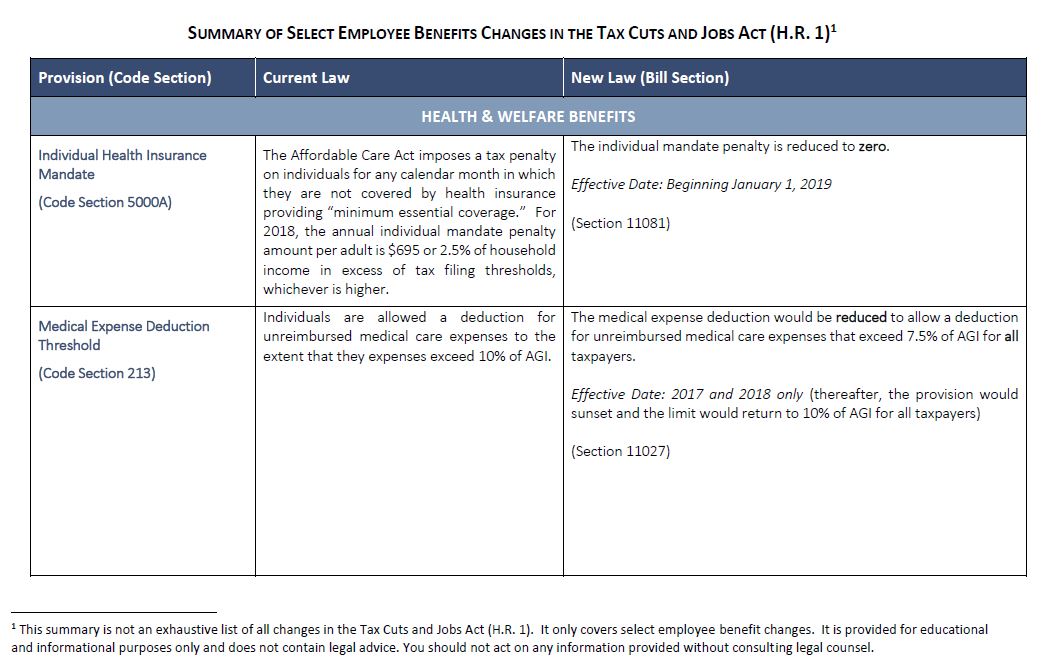
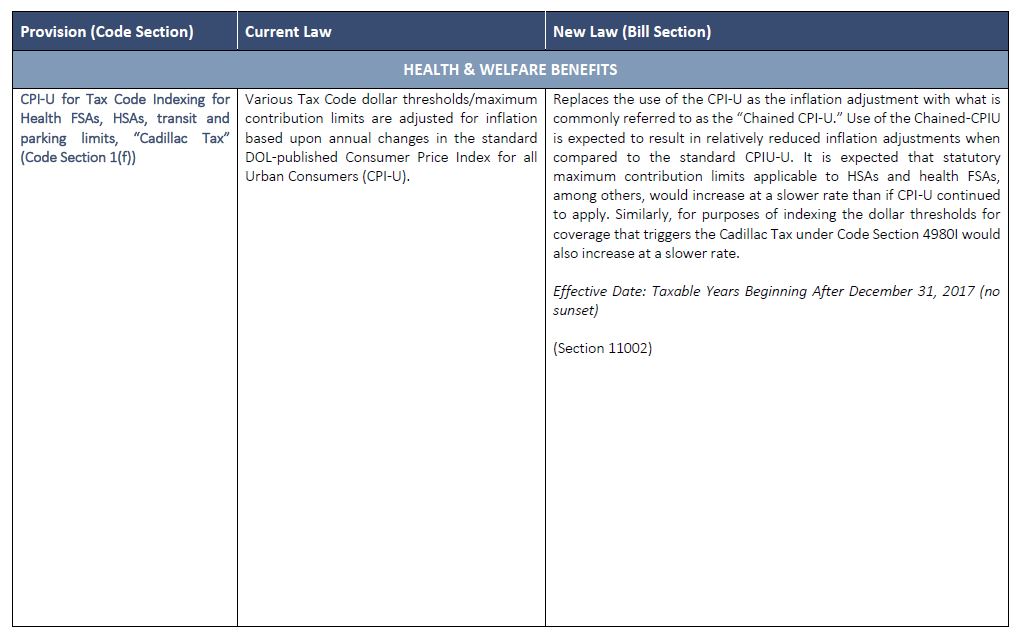
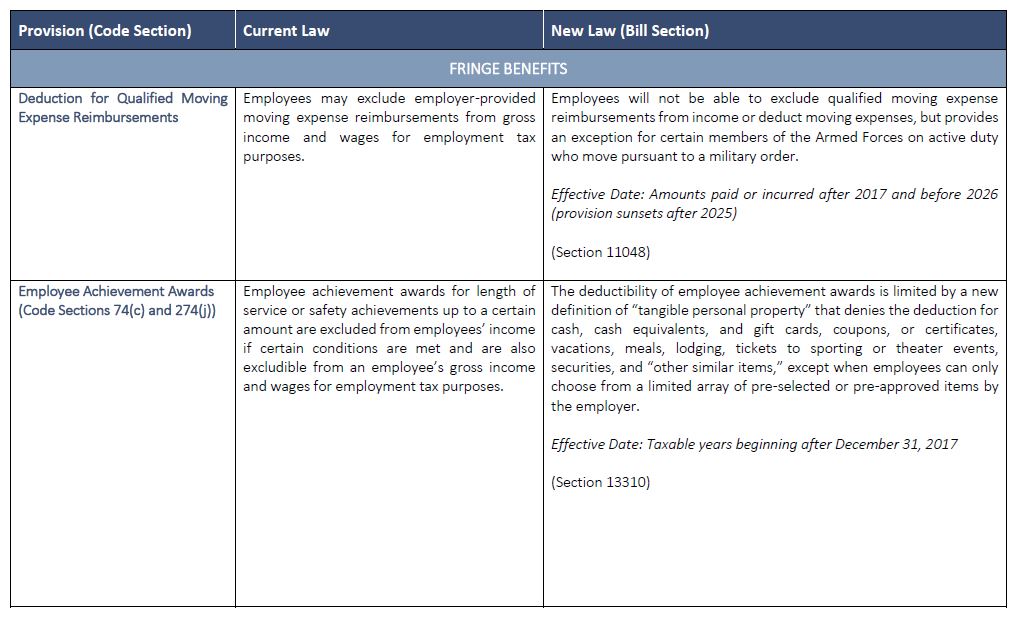
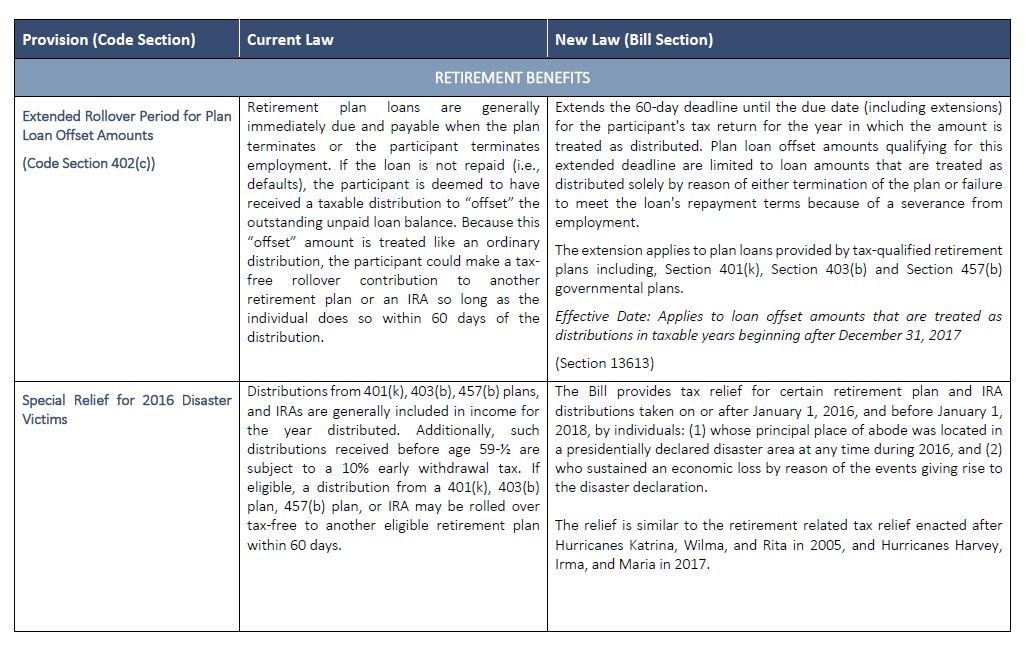
Compared to initial proposals, the final Bill generally does not make significant changes to employee benefits. The chart that follows highlights certain broad-based health and welfare, fringe and retirement plan benefit provisions of the Bill (comparing them to current law). Notable changes include:

  • Repeal of the Individual Mandate penalty beginning in 2019;
  • Elimination/changes of employer deductions for certain fringe benefits, including qualified transportation fringes, moving expenses, and meals/entertainment;
  • New tax credit for employers that pay qualifying employee while on family and medical leave, as described by the Family Medical Leave Act;
  • Extended rollover periods for deemed distributions of retirement plan loans; and
  • Tax relief for retirement plan distributions to relieve 2016 major disasters.

In addition, the Bill makes certain narrowly-tailored changes (which we did not include in the chart that follows) impacting only certain types of employers or compensation. For instance, the Bill:

  • Modifies the $1 million compensation deduction limitation under Code Section 162(m) for publicly traded companies (expanding the type of compensation which will be applied against the limitation, the individuals who will be considered covered employees, and the type of employers that will be subject to the limitation), with transition relief for certain performance-based compensation arrangements pursuant to “written binding contracts” in effect as of November 2, 2017, so long as such arrangements are not “modified in any material respect”; and
  • Creates a new “qualified equity grant” by adding a new Code Section 83(i), which allows employees of non-publicly traded companies to elect to defer taxation of stock options and restricted stock units (“RSUs”) for up to five years after the exercise of such stock options or the vesting of RSUs.

The Bill also has specific provisions impacting employers that are tax-exempt organizations. For instance, it imposes a new excise tax for highly compensated non-profit employees, and changes the way non-profits calculate unrelated business income tax (UBIT).

What’s Not Changing

ACA Employer Mandate & Reporting

While the individual mandate penalty has been reduced to zero beginning in 2019, at this time, the employer mandate and employer reporting requirements under the Affordable Care Act (ACA) remain in effect.

In addition, there were no changes to other ACA taxes and requirements. For example, the bill does not eliminate (or delay) the 40% excise tax on high-cost plans (Cadillac Tax) that is scheduled to be effective beginning in 2020, nor does it eliminate the comparative effectiveness research fees paid annually to fund the Patient-Centered Outcomes Research Institute (PCORI) through 2019. However, the Trump Administration has indicated its intention to renew ACA repeal and replace efforts in 2018, which may result in additional changes at a later date.

It has been recently reported that Republican legislators are targeting a further delay of two ACA-created taxes – a 2.3% excise tax on medical devices, and an annual fee imposed on health insurers known as the HIT tax – for inclusion in a spending bill that must be passed by January 19. Both of these taxes are scheduled to go into effect beginning in 2018 after a delay was incorporated in a 2015 year-end tax extenders deal. Employer groups have been lobbying for an elimination or delay of the Cadillac Tax and relief on the employer mandate. It remains to be seen whether these tax relief items will be included as part of a spending bill later this month.

FSAs, HSAs, Adoption Assistance and Education Assistance Programs

Earlier versions of the Bill in both the House and Senate included provisions that would have significantly impacted the tax treatment of many employee benefits. However, the final Bill makes no changes to the tax treatment of HSAs, dependent care FSAs, health FSAs, adoption assistance programs, or qualified education assistance programs. Although, it has been reported that repealing restrictions on using FSAs, HSAs and other account-based plans to purchase over-the-counter medications could also be considered during negotiation of the spending bill.

Unsubsidized/Pre-Tax Qualified Transportation Fringe Benefits

While the Bill eliminated the employer deduction for qualified transportation fringe benefits, this change would appear to have the most impact on employers who subsidize transit and parking expenses since they may no longer claim a deduction for subsidized transit expenses (but such amounts would still be exempt for payroll tax purposes). For the majority of employers who do not subsidize transit expenses but offer pre-tax qualified transportation fringe programs that allow employees to enter into salary reduction agreements and receive transit expense reimbursements on a tax-free basis, the Bill should not have an impact on those programs. Tax-exempt employers will be taxed on the value of providing qualified transportation fringe benefits (such as payments for mass transit) by treating the funds used to pay for the benefits as UBIT.

For the majority of employers who do not subsidize transit expenses but offer pre-tax qualified transportation fringe programs that allow employees to enter into salary reduction agreements and receive transit expense reimbursements on a tax-free basis, the Bill should not have an impact on those programs. Employees may continue to receive transit expenses (other than bicycle commuting expenses) on a tax-free basis under such programs.

Structural Changes to Qualified Retirement Plans and Deferred Compensation Plans

In addition, there were no major changes to the general structure of qualified retirement plans, such as the “Rothification” of pre-tax deferrals in 401(k) plans, nor reductions in the limits that could be contributed tax-free. Nor were other changes that were initially proposed in the House version of the bill to retirement provisions (e.g., changing the minimum age of in-service distribution in retirement plans, modifying non-discrimination rules for “soft-frozen” defined benefit plans, and changes to 401(k) and 403(b) hardship withdrawal rules) included in the final bill.

Earlier versions of the Bill would have also completely upended how deferred compensation by companies to executives is paid by taxing such compensation when it vested. But this provision did not survive in the final Bill.

Next Steps

Only time will tell the full impact of the Bill on employers and employees. For instance, the repeal of the individual mandate beginning in 2019 may result in fewer “healthy” individuals enrolling in health coverage, resulting in increased premiums. Fewer individuals may enroll in Exchange coverage, reducing potential employer mandate penalty (both “A” and “B”) exposure, which is triggered when a full-time employee receives a premium subsidy for Exchange coverage.

Given the changes to the corporate tax rates, it remains to be seen whether employers will alter how they compensate their employees, particularly, highly compensated employees, and how they will handle their pension, 401(k)/profit sharing plans, and other employee benefits.

In addition, it is likely that there will be a correction bill (and IRS guidance) in 2018 to address unintended consequences, omissions, ambiguities, and drafting errors in the Bill. We will continue to monitor for further legislative and other developments impacting employee benefits as a result of the passage of the Bill.

In the meantime, we suggest that employers work with their payroll departments and vendors, accountants, finance, counsel and other advisors to assess the impact of the Bill to its benefit programs and implement necessary changes to their systems and practices.

About the Authors

This alert was prepared for Benefit Advisors Network by Marathas Barrow Weatherhead Lent LLP, a national law firm with recognized experts on the Affordable Care Act. Contact Peter Marathas, Stacy Barrow or Tzvia Feiertag.

This message is a service to our clients and friends. It is designed only to give general information on the developments actually covered. It is not intended to be a comprehensive summary of recent developments in the law, treat exhaustively the subjects covered, provide legal advice, or render a legal opinion.

Benefit Advisors Network and its smart partners are not attorneys and are not responsible for any legal advice. To fully understand how this or any legal or compliance information affects your unique situation, you should check with a qualified attorney.

Company Culture is the First Draw for Candidates

In today’s workplace, there is a convergence of forces that are creating challenges to an employer’s ability to attract and retain qualified employees. As we all know, employees are the lifeblood of any good company. Without them, a company simply does not exist. In fact, Sir Richard Branson, Founder of The Virgin Group has been quoted as saying, “Take Care of Your Employees and They’ll Take Care of Your Business.”

But why does this matter? Because over 70% of US employees are disengaged, according to Gallup, costing businesses up to $550 billion in lost productivity per year while $11 billion is lost annually to employee turnover. These figures should certainly perk up everyone in an HR or management position.

In the first of this three-part series, we will look at two key driving forces in today’s workforce that are making it challenging for an employer to not only recruit top talent, but to keep an employee engaged once they are hired. The first is the low unemployment rate and the second is the new majority generation in the workforce today: Millennials. It is estimated that 51% of Millenials are planning to leave their company in the next two years, compared to 37% of GenXers and 25% of Boomers.

Throughout this series, a number of points will be explored and discussed fully, including the two primary conditions that exist today that can disrupt HR recruiting and retention management practices. Interestingly, when these practices operate simultaneously they can wreak havoc on an organization. Another point that will be developed is the impact these two forces have on employers, as well as suggested ways that employers could be responding to this convergence. Also discussed in this series will be how a health and welfare advisor is positioned in today’s market with a diversification of HR offerings to meet their client’s needs to respond to these challenges.

The Convergence of Forces

A key employment indicator for job growth and unemployment is found at the Bureau of Labor Statistic (BLS), a division of the Department of Labor providing statistics in labor economics, showing employment growth, pay and benefits, and other economic labor data. Employers can use these statistics to see where the labor market is currently at as well as determining trends. Statistics are available both nationally and statewide and there is the ability to drill down into the information by market segments (i.e. local and industry as well as see what the available workforce population looks like). 

The below BLS Unemployment Rate statistics, as of June 2017, indicate that we have had a declining unemployment rate. While slowly decreasing since its 10-year recession high of 10% in October 2009, it has reached a record 10-year low of 4.3% in May 2017. Meaning there are less people available for the open jobs. 

Company Culture 1BLS statistics also show that the available labor force is impacted not only by the population that is available to work but also by the population that is moving out of the labor force, such as baby-boomers heading into retirement. According to Pew Research Center 10,000 boomers reach age 65 every day. While the Baby Boomers are moving out, the Millennials are moving in. In 2015 the Millennials moved full swing to become the largest generation in the workforce. By 2030, Millennials will make up 75% of the workforce.

Additional statistics that employers need to consider are focused on turnover, which has increased nearly 35%. Employees are averaging about four years at a given company, as reported by a recent Willis Towers and Watson Study. According to the Conference Board 2016 Job Satisfaction Survey only 49.6% of US workers are satisfied with their jobs. The survey findings state “the rapidly declining unemployment rate, combined with increased hiring, job openings, and quits, signals a seller’s market, where the employer demand for workers is growing faster than the available supply.”

What does this mean for employers?

We have a tight labor market coupled with a new generation moving into the workforce. The Csuite is asking Human Resources for ways to remain relevant in order to attract top talent and keep employees at the organization in today’s highly competitive market.

Human Resources knows that individually employers cannot change a declining unemployment rate, but they can work with the challenges it brings in the competition for talented labor. Employers have to compete either locally, statewide, or nationally for employees. Traditionally, they have offered an attractive compensation and benefits package to position themselves as an employer of choice.

Yet, employers today are finding that this way of operating is no longer effective. Salary and benefits do not seem to have the same draw that they used to for attracting top talent. A recent Korn-Ferry employer study found that while five years ago the benefits package was the carrot to hiring employees, today, company culture is the first draw for candidates. The second attraction for a candidate is career progression or the ability to move up in the company and the compensation package, which used to be the priority among employees, is now third place in a candidate’s priority.


About the Author

Bobbi Kloss is the Director of Human Capital Management Services for the Benefit Advisors Network, a national network of independent employee benefit brokerage and consulting companies. For more information, please visit: www.benefitadvisorsnetwork.com or email the author at bkloss@benefitadvisorsnetwork.com.

Legal Alert: Court Vacates EEOC’s Wellness Program Incentives Rules Effective January 1, 2019

In an opinion dated December 20, 2017, in American Association for Retired Persons (AARP) v. EEOC, the federal court in the District of Columbia vacated, effective January 1, 2019, the portions of the final regulations that the EEOC issued last year under the Americans with Disabilities Act (ADA) and the Genetic Information Nondiscrimination Act (GINA) addressing wellness program incentives.  The current regulations will remain effective for 2018 while the EEOC reconsiders and promulgates new rules.

Background

As background, under the ADA, wellness programs that involve a disability-related inquiry or a medical examination must be “voluntary.”  Similar requirements exist under GINA when there are requests for an employee’s family medical history (typically as part of a health risk assessment).  For years, the EEOC had declined to provide specific guidance on the level of incentive that may be provided under the ADA, and their informal guidance suggested that any incentive could render a program “involuntary.”  In 2016, after years of uncertainty on the issue, the agency released rules on wellness incentives that resemble, but do not mirror, the 30% limit established under U.S. Department of Labor (DOL) regulations applicable to health-contingent employer-sponsored wellness programs.  While the regulations appeared to be a departure from the EEOC’s previous position on incentives, they were welcomed by employers as providing a level of certainty.

However, the AARP sued the EEOC in 2016, alleging that the final regulations were inconsistent with the meaning of “voluntary” as that term was used in ADA and GINA.  AARP asked the court for injunctive relief, which would have prohibited the rule from taking effect in 2017.  The court denied AARP’s request in December 2016, finding that AARP failed to demonstrate that its members would suffer irreparable harm from either the ADA or the GINA rule, and that AARP was unlikely to succeed on the merits.  This was due in part to the fact that the administrative record was not then available for the court’s review.

In August 2017, the court ordered the EEOC to reconsider the limits it placed on wellness program incentives under final regulations under the ADA and GINA.  As part of the final regulations, the EEOC set a limit on incentives under wellness programs equal to 30% of the total cost of self-only coverage under the employer’s group health plan.  The court found that the EEOC did not properly consider whether the 30% limit on incentives would ensure the program remained “voluntary” as required by the ADA and GINA and sent the regulations back to the EEOC for reconsideration.  To avoid “potentially widespread disruption and confusion,” the court decided at that time that the final regulations would remain in place while the EEOC determined how it would proceed. 

In September 2017, the EEOC filed a status report with the court stating that the EEOC did not intend to issue new proposed regulations until August 2018, did not intend to issue final rules until August 2019, and did not expect the new rules to take effect until early 2021.

Current Decision

In its recent decision, the court found that the EEOC’s proposed timetable to reissue new regulations was not timely enough. The court was concerned about the slow timeframe that the EEOC proposed for devising a replacement rule. “If left to its own devices, … EEOC will not have a new rule ready to take effect for over three years—not what the Court envisioned when it assumed that the Commission could address its errors ‘in a timely manner.’”  

The court thought that vacating the rule for a 2018 effective date would be disruptive. But “there is plenty of time for employers to develop their 2019 wellness plans with knowledge that the Rules have been vacated.” In addition, the court reasoned, “[i]t is far from clear that EEOC will view a 30% incentive level as sufficiently voluntary upon reexamination of the evidence presented to it.”

In a separate order (also issued on December 20, 2017), the court ordered the EEOC to provide a status report to the court and to the AARP no later than March 30, 2018. In its opinion, the court said it would “hold EEOC to its intended deadline of August 2018 for the issuance of a notice of proposed rulemaking. But an agency process that will not generate applicable rules until 2021 is unacceptable. Therefore, EEOC is strongly encouraged to move up its deadline for issuing the notice of proposed rulemaking, and to engage in any other measures necessary to ensure that its new rules can be applied well before the current estimate of sometime in 2021.”

Impact on Employers

For 2018, employers may continue to rely on the EEOC’s final regulations.  Wellness programs designed to comply with existing rules, specifically the 30% cap, are unlikely to be challenged by the federal governmental agencies.  However, it is possible the court’s decision may open the door for employees to bring a private lawsuit against an employer challenging under the ADA the “voluntariness” of a wellness program that includes an incentive up to the 30% limit.  One would expect that any employer facing such an action would defend it arguing its good faith reliance on the EEOC’s regulation.       

For 2019 and beyond, employers are again faced with uncertainty as to their wellness program incentives.  Employers designing and maintaining wellness programs should continue to monitor developments, including the issuance of any new wellness program regulations, and work with employee benefits counsel to ensure their wellness programs comply with all applicable laws.  


About the Authors

This alert was prepared for Benefit Advisors Network by Marathas Barrow Weatherhead Lent LLP, a national law firm with recognized experts on the Affordable Care Act.  Contact Peter Marathas or Stacy Barrow at pmarathas@marbarlaw.com or sbarrow@marbarlaw.com.

This message is a service to our clients and friends. It is designed only to give general information on the developments actually covered. It is not intended to be a comprehensive summary of recent developments in the law, treat exhaustively the subjects covered, provide legal advice, or render a legal opinion.

Benefit Advisors Network and its smart partners are not attorneys and are not responsible for any legal advice. To fully understand how this or any legal or compliance information affects your unique situation, you should check with a qualified attorney.

© Copyright 2017 Benefit Advisors Network. Smart Partners. All rights reserved