BAN Blog

HR Trends: Are you prepared for job candidates to ask, “Why should I work here?”

Here are three areas HR leaders should be thinking about as they aim to attract talented employees (and keep their existing ones) in 2019.

The stars have aligned for today’s job seekers: unemployment is at historic lows and job openings are plentiful. For millennials in particular, the urge to seek out a new role is strong. Their expectations of the workplace are unlike those of older generations–they want job satisfaction and work/life balance.

If you think millennials’ expectations are high, just wait. “Gen Z are the ones driving the technology that is being used,” Bobbi Kloss, director of Benefit Advisors Network’s Human Capital Management team told attendees at a recent webinar on 2019 HR trends. “These are your AI thinkers, and they want information so much faster, so much more intelligently based. They’re looking for the opportunity to shine. They want that faster career track progression, they want to be that leader within an organization.”

What all this adds up to, said Kloss, is that “at any given time, 50 percent of your workforce may be thinking, I’m not really happy here.”

So what is an employer to do? This is one problem that can’t be… [Read more]


Article by Emily Payne |October 1, 2018| BenefitsPRO.com

Culture vs. Discrimination in the Workplace

“Employee turnover at all-time highs.” “Lowest unemployment rates in 18 years.”

Discrimination in the Workplace vs. Culture, do these headlines sound familiar? They should, as they have dominated the business news media and the Human Resources forums for the past year. The facts behind these headlines are a reflection of the challenges that all employers are having in their ability to attract and retain employees, including 3.9% unemployment rate; employee turnover 35% times more than previous generations; and compensation and benefits the third most important aspect of what attracts Millennials.

These converging forces of a tight labor market and generational influences has left the challenge of competing for candidates keeping HR up at night. Savvy employers know that they need to change their strategies in order to be considered an employer of choice. The tactic of only offering a competitive compensation and comprehensive benefit package is outdated. The candidates are now driving the interview asking, “Why should I work here?” Employers need to show how they elevate themselves above (or at least equal to) the competition with innovation, teamwork, career progression, holistic wellness and being technology driven. These are the faces of the culture that are[continue reading]

The article above was written by Bobbi Kloss and featured in Los Angeles Advertising Human Resource Professionals and on the Entertainment Human Resources Network

Bobbi Kloss is the Director of Human Capital Management Services for the Benefit Advisors Network, a national network of independent employee benefit brokerage and consulting companies. For more information, please visit: benefitadvisorsnetwork.com or email the author at
bkloss@benefitadvisorsnetwork.com.

Attraction and Retention: A Culture for Employee Engagement (Part 3)

In Part 1 of our three-part series from the October 2017 newsletter, Company Culture is the First Draw for Candidates, we explored the converging forces that are creating a competitive labor market for employers. At 4.1% – the lowest unemployment rates in 10 years based on January 2018 Bureau of Labor Statistics data – employers are concerned with the scarcity of talent. In Part 2 from the February 2018 newsletter Company Culture is the First Draw for Millennials we took a deeper dive into the characteristics of past and current generations and how advancement in technology is the driving mindset of the generations that carries over into the workplace.

The ability to attract and retain quality employees is always a top-of-the-list business objective for any employer. How well a business runs is dependent upon the workforce being productive. With the tight labor market and one of the highest turnovers in generations, how can an employer establish a culture of employee engagement to not only attract but retain their employees? Let’s first look at the value your organization places on its employees.

Back to Basics – Elevate HR within Your Organization

You can generally tell how an organization perceives their employees by looking at the HR Department. A company’s Human Resource Department should be a strategic partner with the CSuite, connecting the employees to the mission and the goals of the company as well as to the success and challenges in meeting those goals. Why?

When the C-Suite is working off a defined, continuously updated business plan, the direction of the company is established, the needs of each department within the company can be identified, and the ability to attract and retain a workforce is mapped out, budgeted, and executed upon
through HR. Everyone is rowing the boat in the same direction. The following graphic shows what this would look like.

A challenge for management, and one which HR should be adept at being able to guide the organization through, is directing the employee through the trials of the outside world that they bring inside to the workplace. Physical ailments, financial struggles, emotional turmoil and social
disconnections are a part of everyday life. No matter how hard we try, they affect our productivity.

An HR Department can work to ascertain today’s needs, as well as future needs, and engage with their benefits provider for necessary resources. As the health and welfare agency’s role has expanded to not only select a competitive benefits package but also provide education and additional resources to help an employee maximize their plans in all areas of holistic wellness and work-life balance.

A Two-Way Positive Communication Street

For an effective culture of employee engagement to occur, it comes in knowing that for an employee they are defining job satisfaction as a mutual relationship based upon values of trust, respect, and appreciation. How does this look?

Employee engagement articles will name benefit after benefit and program after program that employers should implement for an effective employee engagement program. These include but are not limited to onboarding programs, flexible work hours, non-traditional worksites, pets on the
worksite, job sharing company volunteerism opportunities, wellness programs, student debt reduction plans, borrow forward on paychecks, recognition, and rewards programs.

I would agree that these are all great possibilities for an organization to survey and determine if any of or combination of these and other benefits/programs work for their needs. Employers, be forewarned though, you can pile on these benefits and many more and they can all be meaningless if there is not first a value-based system established built upon mutual trust, respect, and appreciation between employer and employees. This begins with an environment that respects each person for who they are.

There are many lessons that we learned from the Me-Too movement that developed off the sweeping sexual harassment allegations throughout the movie Industry. First, discrimination and harassment still rampantly exist in this country. Another lesson is that within today’s generation, both males and females are uniting to say this must stop!

Employers must not allow these behaviors to continue. Not only is discrimination and harassment behavior illegal but it is also costing employers thousands upon thousands of dollars for violations of EEOC regulations. The EEOC investigated over 84,254 workplace discrimination
charges, obtaining $398 million for victims and 6,696 sexual harassment charges with $46.9 million in monetary benefits for victims of sexual harassment. These behaviors are toxic to the work environment and can harm a company’s reputation in the community, which affects its ability to
attract and retain employees.

Employers must have not only a written policy and continuous management and employee training, but an environment must exist that says, “We prohibit discrimination and harassment and we will ensure that the policy is upheld.” All the written policies in the world will not help an
employer – from the CEO to the employees – if all are not working in harmony to support the policy.

What are next steps?

Now that your employee value system is established, and HR is supported to meet that value system, an employer can now look at the needs of its workplace to determine what benefits and programs will support those needs. Communication needs to continue. Employers should be surveying their employees so that they can build a foundation of policies, tools and resources including benefits and programs that are not only compliant but based off meeting today’s needs and future needs. Again, an advisor can guide you through this process. Helping you balance the needs of the employees against the strategic business objectives of the organization an advisor will assist an employer to establish programs that drive the organization forward with engaged employees.

Then HR should manage your expectations of your programs. Once your programs are implemented, they may not immediately provide a return on your investment. Continuous communication, feedback, and retooling will need to occur for long-term success.

Today, turnover costs a company anywhere from six-to-nine months of an employee’s salary, according to SHRM. With unemployment at 4% and millennial turnover already at 34% more than the average, why wouldn’t an employer start employee engagement with recognizing the value of
their employees and elevating the HR Department to support the value? Seems like a no-brainer.


About the Author

Bobbi Kloss is the Director of Human Capital Management Services for the Benefit Advisors Network, a national network of independent employee benefit brokerage and consulting companies. For more information, please email the author at bkloss@benefitadvisorsnetwork.com.

Legal Alert: IRS Issues Affordability Percentage Adjustment for 2019

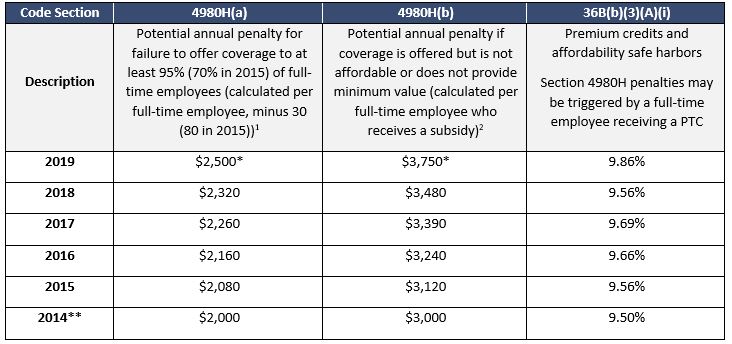
In Rev. Proc. 2018-34, the IRS released the inflation adjusted amounts for 2019 relevant to determining whether employer-sponsored coverage is “affordable” for purposes of the Affordable Care Act’s (“ACA’s”) employer shared responsibility provisions and premium tax credit program.  As shown in the table below, for plan years beginning in 2019, the affordability percentage is 9.86% of an employee’s household income or applicable safe harbor.

* Estimated based on premium adjustment percentage in the 2019 Notice of Benefit and Payment Parameters
**No employer shared responsibility penalties were assessed for 2014.


1 The “A” penalty applies when an ALE fails to offer coverage to at least 95% of its full-time employees (and their children up to age 26) and at least one full-time employee receives a premium credit for marketplace coverage. The requirement is only to offer coverage – no employer contribution or minimum plan design is necessary to avoid the penalty.

2 The “B” penalty applies when the ALE offers coverage to 95% of its full-time employees (and their children up to age 26), but the coverage is either not affordable or does not provide minimum value, and at least one full-time employee receives a premium credit.


Under the ACA, applicable large employers (ALEs) – generally those with 50 or more full-time equivalent employees on average in the prior calendar year – must offer affordable health insurance to full-time employees to avoid an employer shared responsibility payment.  Coverage is “affordable” if the employee’s required contribution for self-only coverage under the employer’s lowest-cost minimum value plan does not exceed 9.5% (as indexed) of the employee’s household income for the year.  In lieu of household income, employers may rely on one or more of the following safe harbor alternatives when assessing whether coverage is affordable:  W-2, Rate of Pay, and Federal Poverty Level.  Each of the three safe harbors refers back to the 9.86% figure in 2019.

The ACA also provides a premium tax credit to assist individuals paying for health coverage in the public marketplace. An individual offered affordable employer-sponsored coverage is generally ineligible for the premium tax credit.  Accordingly, for plan years starting in 2019, if a full-time employee’s required contribution for self-only coverage offered by the employer is more than 9.86% of his or her household income (or applicable safe harbor), the coverage will not be considered affordable for that employee and the employer may be liable for an employer shared responsibility payment if the employee obtains a premium tax credit. 

Note that beginning January 1, 2019, under the Tax Cuts and Jobs Act, the individual mandate penalty imposed on individual taxpayers for failure to have qualifying health coverage was reduced to $0, effectively repealing the individual mandate.  However, despite repeated efforts by the Trump Administration and Congress, the employer mandate has not been repealed and the IRS has begun enforcing the employer mandate by sending Letter 226-J for 2015 informing employers of a potential employer shared responsibility payment. While there continue to be calls to suspend the assessment and repeal the employer mandate, including most recently a letter by industry groups to Treasury and the U.S. Department of Health and Human Services, to date, enforcement has not ceased and the employer mandate remains the law of the land.

Next Steps for Employers

Applicable large employers should be mindful of the updated affordability percentage for plan years beginning in 2019. Given that the affordability percentage has increased significantly from 9.56% to 9.86%, employers should have additional flexibility when setting “affordable” employee contributions.

About the Author.  This alert was prepared for Benefit Advisors Network by Marathas Barrow Weatherhead Lent LLP, a national law firm with recognized experts on the Affordable Care Act.  Contact Peter Marathas or Stacy Barrow at pmarathas@marbarlaw.com or sbarrow@marbarlaw.com.

About the Author

Stacy H. Barrow, Esq., Compliance Director

This alert was prepared by Stacy Barrow. Mr. Barrow is a nationally recognized expert on the Affordable Care Act and BAN’s Compliance Director. His firm, Marathas Barrow Weatherhead Lent LLP, is a premier employee benefits, executive compensation and employment law firm. He can be reached at sbarrow@marbarlaw.com.

This message is a service to our clients and friends. It is designed only to give general information on the developments actually covered. It is not intended to be a comprehensive summary of recent developments in the law, treat exhaustively the subjects covered, provide legal advice, or render a legal opinion.

Benefit Advisors Network and its smart partners are not attorneys and are not responsible for any legal advice. To fully understand how this or any legal or compliance information affects your unique situation, you should check with a qualified attorney.

© Copyright 2018 Benefit Advisors Network. Smart Partners. All rights reserved.

The DOL’s PAID Program: Everything you need to know

The Department of Labor’s Wage and Hour Division (DOL-WHD) recently announced its Payroll Audit Independent Determination (PAID) program to assist employers in determining their compliance status to the Fair Labor Standards (FLSA). The PAID program is a six-month voluntary pilot program which FLSA–covered employers can participate in to self-audit their compliance with the overtime and minimum wage provisions of the FLSA. An employer who has a claim under investigation, in litigation, arbitration, or one where an employee’s attorney has initiated communication is not eligible to [Read the Full Article]

Article published on BenefitsPro.com, May 29, 2018