BAN Blog

Holistic Wellness: Why it matters now

With the tight labor market and new generations in the workforce, the C-suite should be asking what they can do to remain relevant.


Written by Perry Braun, Executive Director of Benefit Advisors Network, and Bobbi Kloss, Director of Human Capital Management Services. BenefitsPro.com, February 11th, 2019.


Life happens. Things happen every day that we rarely give a second thought to as we go about our daily routines.

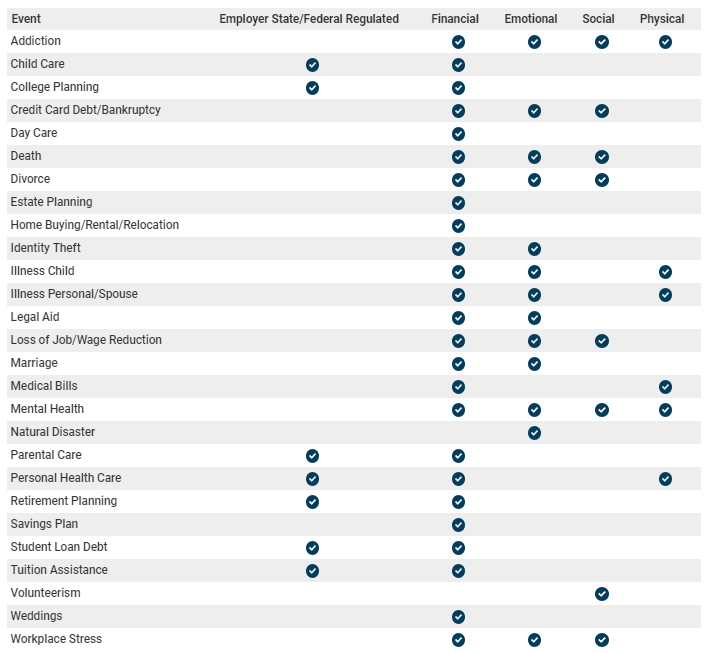
High impact life events are another story. Not only do they disrupt our daily routine, but they can stop us dead in our tracks and affect every aspect of our lives: physically, emotionally, financially and even socially. Even planning for an expected event can seem to be overwhelming and disruptive.

Holistic Wellness – High Impact Life Events

When a high impact life event happens to an employee, the effects can ripple throughout the workplace. The distractions of the event can cause performance issues, absenteeism and presenteeism. Supervisors and HR traditionally have dealt with these issues through corrective actions, up to and including termination of employment. But changing workforce dynamics show us why employers need… [Read More]

New Benefit Lets Employees Trade PTO for Student Loan Relief


Written by Steven Miller, CEBS, with insights provided by Bobbi Kloss, BAN Director of Human Capital Management Services.


Employers seek creative ways to ease student loan burdens

Employers continue to roll out new ways to provide workers with student debt relief. Insurance firm Unum, for instance, announced in January that it will let employees exchange accrued but unused paid time off (PTO) for payments against their student loans.

“This innovative solution gives U.S. employees a choice to use their benefits in ways that work best for them,” stated Carl Gagnon, Unum’s assistant vice president of global financial well-being and retirement programs. The option will be available to any of Unum’s U.S. employees who have student debt, including parents who have taken out loans for their children.

Employers are “finding creative solutions for people to tackle this challenging issue,” said Ashwini Srikantiah, vice president for student debt programs at Fidelity Investments, which is managing Unum’s student debt relief program.

Starting their first year at Unum, full-time employees receive 28 days of PTO, including holidays and personal days, with additional PTO available over time, Gagnon said. Each year, employees can carry over up to five days (40 hours) of unused paid time. Starting in January 2020, participants in the student debt relief program will be able to transfer up to 40 hours of carryover PTO into a payment against student debt.

“Instead of deferring those [accrued PTO] days to take an extra-long vacation in the future, Unum’s benefit will provide employees with an extra payment toward their debt, which is at the forefront” of their financial concerns, said Brian Carlson, vice president for wealth management at benefits broker GCG Financial, an Alera Company, in Deerfield, Ill.

Addressing a Need

“We’re seeing increased demand for student loan repayment benefits both from employers that want to offer it and from employees electing it as a voluntary benefit,” said Jeff Oldham, senior vice president, BenefitsPlace Distribution, at Benefitfocus, a cloud-based benefits management platform firm based in Charleston, S.C. “The solutions we’ve commonly seen from employers include making direct contributions toward the loan amount or connecting employees to lenders offering lower-than-average interest rates to refinance or bundle their loans. The utilization of unused PTO to fund student debt demonstrates a creative way to tackle the issue.”

Bobbi Kloss, director of human capital management services for the Benefit Advisors Network, a Cleveland-based consortium of health and welfare benefit brokers, praised [Read More]

Industry Predictions for the New Year

Written by Perry Braun, Benefit Advisors Network, and Lisa Allen, Relph Benefits, for America’s Benefit Specialist.


The tail end of 2018 saw the majority of the country focused on the mid-term elections, and with good reason. Those results will impact not only the political landscape, but also every business, organization and individual in the U.S. The impact will be felt in 2019 and beyond. The mid-term elections left us with a divided Congress, with many now asking, “What will the impact be on the insurance marketplace, the healthcare delivery system, the advisors and employers and—most important—the employees that participate in the employer-sponsored benefit plan?”

Read More

District Court Judge in Texas Strikes Down the ACA – But Law Remains in Effect for Now

On Friday, December 14, a federal judge in Texas issued a partial ruling that strikes down the entire Affordable Care Act (ACA) as unconstitutional. The White House has stated that the law will remain in place, however, pending the appeal process. The case, Texas v. U.S., will be appealed to the U.S. Court of Appeals for the Fifth Circuit in New Orleans, and then likely to the U.S. Supreme Court.

The plaintiffs in Texas (a coalition of twenty states) argue that since the Tax Cuts and Jobs Act zeroed out the individual mandate penalty, it can no longer be considered a tax. Accordingly, because the U.S. Supreme Court upheld the ACA in 2012 by saying the individual mandate was a legitimate use of Congress’s taxing power, eliminating the tax penalty imposed by the mandate renders the individual mandate unconstitutional. Further, the individual mandate is not severable from the ACA in its entirety. Thus, the ACA should be found unconstitutional and struck down.

The court in Texas agreed, finding that the individual mandate can no longer be fairly read as an exercise of Congress’s Tax Power and is still impermissible under the Interstate Commerce Clause—meaning it is unconstitutional. Also, the court found the individual mandate is essential to and inseverable from the remainder of the ACA, which would include not only the patient protections (no annual limits, coverage of pre-existing conditions) but the premium tax credits, Medicaid expansion, and of course the employer mandate and ACA reporting.

Several states such as Massachusetts, New York and California have since intervened to defend the law. They argue that, if Congress wanted to repeal the law it would have done so. The Congressional record makes it clear Congress was voting only to eliminate the individual mandate penalty in 2019; the record indicates that they did not intend to strike down the entire ACA.

It is worth noting that the Trump administration filed a brief early in 2018 encouraging the court to uphold the ACA but strike down the provisions relating to guaranteed issue and community rating.

The ACA has largely survived more than 70 repeal attempts and two visits to the U.S. Supreme Court. We anticipate it will survive this one too, in time. While the Supreme Court lineup has changed, all five justices who upheld the ACA in 2012 are still on the bench. Moreover, the Supreme Court may be reluctant to strike down a federal law as expansive as the ACA, particularly when it has been in place for nearly nine years and affects millions of people. Notably, the Supreme Court was not required to rule on the “severability” issue in 2012. Given a strong tradition of the Supreme Court to avoid, if possible, broad rulings of unconstitutionality in established laws, it is not unlikely that the current Court, if this case makes it that far, will find a way to hold that even if the Court’s 2012 logic with respect to the individual mandate is no longer applicable, the rest of the law is severable and saved, thus avoiding once again a broad ruling on the ACA’s constitutional soundness. The bottom line: employers should continue to comply with the ACA, as its provisions (including the employer mandate and associated reporting) remain the law for the foreseeable future.

About the Author

This alert was prepared for Benefit Advisors network by Stacy Barrow. Mr. Barrow is a nationally recognized expert on the Affordable Care Act. His firm, Marathas Barrow Weatherhead Lent LLP, is a premier employee benefits, executive compensation and employment law firm. He can be reached at sbarrow@marbarlaw.com.

This message is a service to our clients and friends. It is designed only to give general information on the developments actually covered. It is not intended to be a comprehensive summary of recent developments in the law, treat exhaustively the subjects covered, provide legal advice, or render a legal opinion.

Benefit Advisors Network and its smart partners are not attorneys and are not responsible for any legal advice. To fully understand how this or any legal or compliance information affects your unique situation, you should check with a qualified attorney.

© Copyright 2018 Benefit Advisors Network. Smart Partners. All rights reserved.
 

How Health Policy Could Wobble (Forward?) Now

Published in Think Advisor, written by Perry Braun, Executive Director of Benefit Advisors Network.

While much of the focus in 2018 came down to the elections, we now have those results and can begin moving forward.

But, with a divided Congress, what will the impact be on the health insurance marketplace, the health care delivery system, the advisors and employers that interact (plan, strategize, implement and execute) with health benefits, and, most importantly, the employees that participate in the employer-sponsored benefit plans?

The Policy Landscape
Following the Kavanaugh hearing Sen. Jeff Flake commented that he would have voted differently regarding the FBI investigation if he was running for re-election. This comment paints a picture that our representatives to Congress are concerned with advancing policies that secure their re-election rather than the well-being of their constituents that they represent. With that backdrop, the status quo will be the likely outcome with regard to the current state of the Affordable Care Act (ACA), and America’s group health plans, until… [read more]