BAN Blog

IRS Releases Draft 2019 ACA Reporting Forms and Instructions

The IRS has released draft forms and instructions for the 2019 B-Series and C-Series reporting forms (Forms 1094-B, 1095-B, 1094-C and 1095-C) used by employers and coverage providers to report certain information to full-time employees and the Internal Revenue Service (IRS).

As background, the Affordable Care Act (ACA) added Sections 6055 and 6056 to the Internal Revenue Code. These sections require employers, plans, and health insurance issuers to report health coverage information to the IRS and to participants annually. Section 6055 reporting requirements apply to insurers, employers that sponsor self-insured group health plans, and other entities that provide minimum essential coverage (such as multiemployer plans). Section 6056 reporting requirements apply to “applicable large employers” or “ALEs” (generally, employers with 50 or more full-time employees) and require reporting of health care coverage provided to the employer’s full-time employees.

Reporting under Sections 6055 and 6056 involves two sets of forms:  the “B-Series” (Forms 1094-B and 1095-B); and the “C-Series” (Forms 1094-C and 1095-C).  Each includes a transmittal form (Form 1094-B or 1094-C), which serves as a cover page and provides aggregate information, and an individualized form (Form 1095-B or 1095-C) for each employee for whom the employer is required to report.  

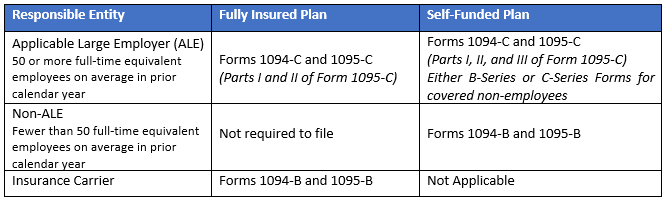
The forms for the calendar year 2019 are due to employees by January 31, 2020. Forms are due to the IRS by February 28, 2020, if filing by paper and by March 31, 2020, if filing electronically.  The forms that must be filed and distributed depend on whether the employer is an ALE and the type of coverage provided. Employers filing 250 or more of a particular form are required to file with the IRS electronically. The following table summarizes the responsible parties and forms applicable to the ACA’s reporting requirements. 

The following table summarizes the responsible parties and forms applicable to the ACA’s reporting requirements.

2019 Draft Instructions

The draft forms and instructions can be found here:

The draft instructions reflect the newly increased penalty structure (generally leaving the penalty at $270 per return but increasing the penalty cap from $3.275 million to $3.339 million). 

Note Regarding 2019 Form 1095-C, Line 15. 

The section 4980H “affordability” safe harbor percentage threshold is adjusted to 9.86% for plan years beginning in 2019, up from 9.56%.

Employers should continue to work closely with their insurance broker and other trusted advisors when determining how their organization will address the reporting requirements. Unless extended, 1095-C and 1095-B forms for the 2019 calendar year are due to participants by January 31, 2020. Forms 1094/1095-C and 1094/1095-B are due to the IRS by February 28, 2020, if filing by paper and by March 31, 2020, if filing electronically.  Employers should endeavor to file timely, as the IRS has begun enforcing penalties against employers who have failed to file timely or file electronically when required.

About the Author.  This alert was prepared by Stacy Barrow.  Mr. Barrow is a nationally recognized expert on the Affordable Care Act.  His firm, Marathas Barrow Weatherhead Lent LLP, is a premier employee benefits, executive compensation, and employment law firm.  He can be reached at sbarrow@marbarlaw.com.

IRS Increases Health FSA Contribution Limit for 2020, Adjusts Other Benefit Limits

On November 6, 2019, the Internal Revenue Service (IRS) released Revenue Procedure 2019-44, which raises the health Flexible Spending Account (FSA) salary reduction contribution limit by $50 to $2,750 for plan years beginning in 2020. The Revenue Procedure also contains the cost-of-living adjustments that apply to dollar limitations in certain sections of the Internal Revenue Code. 

Qualified Commuter Parking and Mass Transit Pass Monthly Limit Increase

For 2020, the monthly limits for qualified parking and mass transit are $270 each (up $5 from 2019).

Adoption Assistance Tax Credit Increase

For 2020, the credit allowed for adoption of a child is $14,300 (up $220 from 2019). The credit begins to phase out for taxpayers with modified adjusted gross income in excess of $214,520 (up $3,360 from 2019) and is completely phased out for taxpayers with modified adjusted gross income of $254,520 or more (up $3,360 from 2019).

Qualified Small Employer Health Reimbursement Arrangement (QSEHRA) Increase

For 2020, reimbursements under a QSEHRA cannot exceed $5,250 (single) / $10,600 (family), an increase of $100 (single) / $150 (family) from 2019.

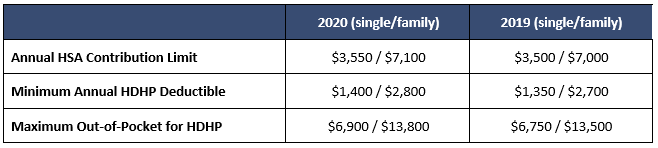
Reminder: 2020 HSA Contribution Limits and HDHP Deductible and Out-of-Pocket Limits

Earlier this year, the IRS announced the inflation-adjusted amounts for HSAs and high deductible health plans (HDHPs).

The ACA’s out-of-pocket limits for in-network essential health benefits have also increased for 2020.  Note that all non-grandfathered group health plans must contain an embedded individual out-of-pocket limit within family coverage if the family out-of-pocket limit is above $8,150 (2020 plan years).  Exceptions to the ACA’s out-of-pocket limit rule are also available for certain small group plans eligible for transition relief (referred to as “Grandmothered” plans).  Unless extended, relief for Grandmothered plans ends December 31, 2020.

ACA Reporting Penalties (Forms 1094-B, 1095-B, 1094-C, 1095-C)

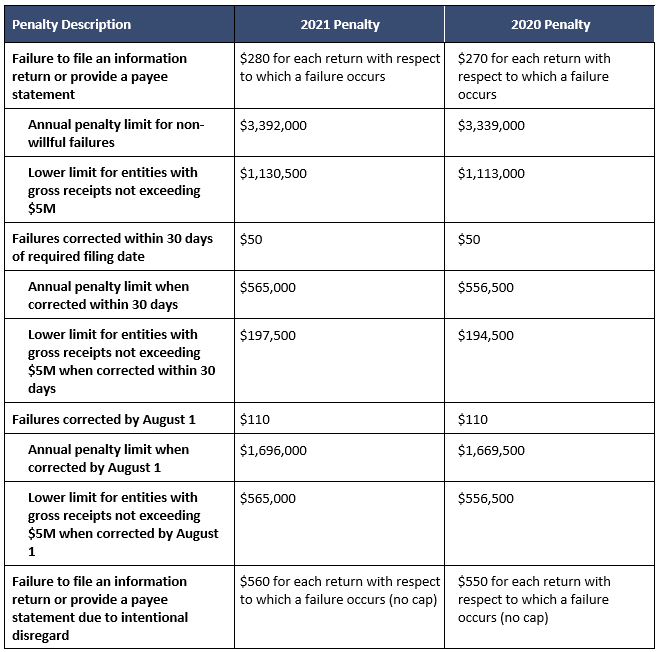
The table below describes penalties related to returns filed in the applicable year (e.g., the 2020 penalty is for returns filed in 2020 for calendar year 2019).  Note that failure to issue a Form 1095-C when required may result in two penalties, as the IRS and the employee are each entitled to receive a copy (increased for willful failures, with no cap on the penalty).

About the Author. This alert was prepared by Stacy Barrow. Mr. Barrow is a nationally recognized expert on the Affordable Care Act. His firm, Marathas Barrow Weatherhead Lent LLP, is a premier employee benefits, executive compensation, and employment law firm. He can be reached at sbarrow@marbarlaw.com.

This email is a service to our clients and friends. It is designed only to give general information on the developments actually covered. It is not intended to be a comprehensive summary of recent developments in the law, treat exhaustively the subjects covered, provide legal advice, or render a legal opinion.

Benefit Advisors Network and its members are not attorneys and are not responsible for any legal advice. To fully understand how this or any legal or compliance information affects your unique situation, you should check with a qualified attorney.


© Copyright 2019 Benefit Advisors Network. All rights reserved.
IRS Releases Guidance for Employers Offering Individual Coverage HRAs

On September 27, the Internal Revenue Service (IRS) released proposed regulations on the application of the Affordable Care Act’s (ACA) employer shared responsibility provisions to a new type of Health Reimbursement Arrangement (HRA) available starting in 2020.  In June 2019, the Department of Labor, the Department of Health and Human Services, and the Treasury Department (the “Departments”) released a final rule concerning HRAs that can be integrated with individual market coverage or Medicare.  This new type of HRA is referred to as an Individual Coverage HRA, or ICHRA.  The rule, based on an executive order from President Trump in 2017, is intended to increase the usability of HRAs, to expand employers’ ability to offer HRAs to their employees, and to allow HRAs to be used in conjunction with non-group coverage.

The ICHRA rule is effective for plan years beginning on or after January 1, 2020.  The IRS has also proposed regulations to guide employers in determining whether their contribution to an employee’s ICHRA results in an “affordable” offer of coverage under the ACA.  Specifically, the proposed regulations will assist employers who offer ICHRAs in determining the “required employee contribution” for purposes of line 15 of Form 1095-C.  Employers may continue to use the W-2, Rate of Pay, or Federal Poverty Level safe harbors to determine whether their entry in line 15 results in an “affordable” offer of coverage.  (See Example on page 3.)

The proposed regulations are effective for periods after December 31, 2019.  Employers may continue to rely on them during any ICHRA plan year beginning within six months from the publication of any final regulations.  

Proposed Safe Harbors

The proposed regulations offer safe harbors for applicable large employers (ALEs), which are those who employed at least 50 full-time equivalent employees on average in the prior calendar year.  When an employer offers an ICHRA to a full-time employee, the “required employee contribution” to include on line 15 of Form 1095-C is the difference between the self-only amount the employer makes newly available to the employee under the individual coverage HRA for the month (the monthly HRA amount) and the employee’s monthly premium for self-only coverage under the lowest-cost silver plan offered in the Exchange for the rating area in which the employee resides (the PTC affordability plan).

Instead of using the Exchange where the employee resides, an employer may use a location-based safe harbor based on the employee’s primary worksite.  In addition, employers may use a “look back” safe harbor to determine whether the premium for the lowest-cost silver plan self-only coverage should be determined by reference to the current or prior calendar year.  Employers must apply the safe harbors on a consistent basis to all employees within a class.  Employers may use a different safe harbor for different classes of employees.

Location-Based Safe Harbor

As mentioned, the “required employee contribution” to include on line 15 of an employee’s Form 1095-C is the difference between the self-only amount the employer makes newly available to the employee under the individual coverage HRA for the month (the monthly HRA amount) and the employee’s monthly premium for self-only coverage under the lowest-cost silver plan offered in the Exchange for the rating area in which the employee resides (the PTC affordability plan).

Under the location-based safe harbor, an employer may use the lowest-cost silver plan for self-only coverage through the Exchange where the employee’s primary site of employment is located. The employer is not required to use an employee’s actual residence to determine affordability unless the employee’s worksite is his or her home (due to remote or telecommute work).  The primary site of employment is the location the employer expects the employee to perform services on the first day of the plan year or the effective date (the day the employee is eligible to participate in the ICHRA).

Age-Related Issues

The proposed regulations do not establish any specific safe harbors based on age; however, as a practical matter, an employer may use the age of the oldest employee to determine the ICHRA contribution for employees in that class (i.e., take the lowest-cost silver plan based on the age of the oldest employee).  An employer may vary the amount of the ICHRA contribution based on age by no more than a 3:1 ratio between the oldest and youngest participant.  An employer making age-based contributions may use the employee’s age on the first day of the plan year or the first day the employee is eligible to participate in the ICHRA.

Look-Back Month Safe Harbor

An employer may also utilize the look-back month safe harbor when selecting the lowest-cost silver plan.  If the ICHRA operates on a calendar year basis, the employer may use the premium for self-only coverage under the lowest-cost silver plan from January of the prior calendar year.  If the ICHRA operates on a non-calendar basis, the employer may use the monthly premium amount from January of the current calendar year. The difference in the look-back month is attributed to when the Exchange opens and when rates are submitted. The IRS understands that employers generally determine their plans and contributions ahead of time, and wants to ensure employers have the opportunity to make such determinations.  If the employer chooses to use the look-back month safe harbor, the employer must use the employee’s current applicable location and current age, regardless of whether the lowest-cost silver plan is determined based on the current or prior year.

Example:  Location and Look-Back Month Safe Harbor with Calendar Year ICHRA

For 2020, an employer offers all full-time employees and their dependents a calendar year ICHRA with $250 per month available regardless of family size.  All employees have their primary site of employment in City A.  An employee is 40 years old on January 1, 2020, and makes $15/hour.  The applicable monthly premium for the lowest-cost silver plan for a 40-year old offered through the Exchange in City A for January 2019 is $400.  The employer uses the Rate of Pay safe harbor for hourly employees.

In this example, the employee’s “required contribution” for each month of 2020 is the $150 difference between the lowest-cost silver plan ($400) and the employer’s monthly contribution ($250).  Therefore, $150 is the amount reported on Line 15 of Form 1095-C. 

Conclusion: ICHRA Contribution Results in an Affordable Offer

The employer has offered affordable coverage to this employee in 2020 because the required contribution ($150) is less than the Rate of Pay safe harbor for this employee (9.78% × $15 × 130 = $196).

Other Considerations

1094-C/1095-C Reporting

Applicable large employers are still required to perform the required employer mandate reporting (Forms 1094-C and 1095-C). The IRS indicated that reporting exceptions applicable to traditional HRAs integrated with fully insured group health plans will not apply.  The IRS also indicated that additional guidance will be released before the calendar year 2020 reporting is due. If an employer offers affordable coverage under an ICHRA, it is presumed it meets minimum value and will be viewed as an offer of employer-sponsored group health plan coverage.

How to Find the Data

As a way to make determining affordability less burdensome, the proposed regulations state that for plans on the federal Exchange, the Department of Health and Human Services (HHS) has provided a platform for employers to view the lowest-cost silver plans in applicable locations. For plans offered through a state Exchange, the IRS stated that HHS will work with the states to implement a similar platform.  If the employer uses the platform to determine affordability, it may rely on the information posted. 

Section 105(h) Nondiscrimination    

An ICHRA, as a self-funded plan, is required to satisfy Section 105(h) nondiscrimination testing; however, an ICHRA that only reimburses insurance premiums and not medical expenses is not subject to Section 105(h). Although different classes are allowed, the ICHRA cannot discriminate in favor of highly compensated individuals. The proposed regulations provide that an ICHRA that satisfies the 3:1 age variation exception will not be discriminatory under Section 105(h) solely due to the variation based on age.  Without the exception, Section 105(h) prohibits the maximum limit attributable to employer contributions to an HRA from being modified by reason of a participant’s age.  The proposed regulations also provide that if the maximum dollar amount under an ICHRA varies for participants within a class of employees, or varies between classes of employees, then with respect to that variance, the ICHRA does not violate Section 105(h) so long as the maximum dollar amount only varies as permitted under the ICHRA rules.

Allowing Pre-Tax Contributions to Individual Market Coverage

The proposed regulations address the extent to which an employer can allow an employee to make pre-tax contributions towards his/her individual plan. The proposed regulations do not permit employees to take the salary reduction to purchase qualified health plans through the Exchange, which is expressly prohibited by the ACA. If an employee purchases an individual health plan off-Exchange (such as going directly to a carrier), an employer may allow employees to pay pre-tax for the portion of the premium not covered by the ICHRA.  If an employer wants to allow pre-tax contributions, it must determine whether the individual coverage was purchased on-Exchange or off-Exchange, in order to determine if the deductions can be taken pre-tax.

What Employers Should Expect Next

Employers who are contemplating offering an ICHRA should consult with qualified ERISA counsel.  There are additional requirements and guidelines an employer will need to meet in order to comply with all the requirements applicable to these new arrangements. The Departments also anticipate the release of additional guidance in the future.

__________________________________________________

About the Author. This alert was prepared by Stacy Barrow. Mr. Barrow is a nationally recognized expert on the Affordable Care Act. His firm, Marathas Barrow Weatherhead Lent LLP, is a premier employee benefits, executive compensation, and employment law firm. He can be reached at sbarrow@marbarlaw.com.

This email is a service to our clients and friends. It is designed only to give general information on the developments actually covered. It is not intended to be a comprehensive summary of recent developments in the law, treat exhaustively the subjects covered, provide legal advice, or render a legal opinion.

Benefit Advisors Network and its members are not attorneys and are not responsible for any legal advice. To fully understand how this or any legal or compliance information affects your unique situation, you should check with a qualified attorney.


© Copyright 2019 Benefit Advisors Network. All rights reserved.
Final Rule Released – U. S. Department of Labor

White-Collar Exemption and Overtime

Reporting that 1.3 million workers will now become eligible for overtime pay, the Department of Labor (DOL) has released its final rule to update the exemption requirements of the Executive, Administrative and Professional Employee (EAP) as well as Highly Compensation Executive (HCE) classifications.

After overcoming many hurdles, injunction enjoined and invalidation, the DOL released its final rules yesterday with an effective date of January 1, 2020. Additionally, the 2016 final rule that was declared invalid by the United State Court of Appeals for the Fifth Circuit has been rescinded by the DOL.

Settling below the original published salary level and just slightly higher than the most recently proposed the DOL raised the nation’s exempt salary threshold from $455 per week/$23,660 annually to $684 per week/$35,568 annually.  As a reminder, this is the first time since 2004 that the salary level has been increased.  As previously published, these newest final regulations do not include any adjustment to the standard duties test for these “White Collar” Exemptions.

There are also no changes in overtime rules for Police Officers, Fire Fighters, Paramedics, Nurses, Laborers including non-management and production line employees, and non-management in maintenance, construction, and similar occupations. However, new or “special” salary levels have been released for both employees in the motion picture industry and certain U. S. territories.

Additionally, the new regulations will increase the salary threshold for certain HCEs from $100,000 to $107,000. It is important for employers to note that an HCE must be paid at least the weekly standard salary amount of $684.00 without nondiscretionary bonus, incentive pay or commissions. Non-discretionary bonus, incentive pay, or commission may be counted toward the annual salary requirement of $107,000.00.

Employers will still be able to use a nondiscretionary bonus, incentive pay, or commissions to satisfy up to 10% of the standard salary level for EAP classifications and as previously stated for meeting the annual salary requirement for HCEs. These payments must be paid annually or on a more frequent basis in order to be eligible. A one-time “catch-up payment of up to 10% of the total standard salary level may be made within one pay period of the end of the 52-week pay period for those employees who have not earned enough to maintain their exempt status. This makeup payment only counts toward the previous 52-week salary amount and not for the salary in the year that it was paid.

I continue to promote that the following actions steps can help employers determine the impact on their organization and encourage that they should be promptly initiated for the effective date of January 1, 2020:

  1. Identify employees currently classified as exempt who will fail the new salary test.
  2. Model potential costs based on possible response (e.g. raise pay to new threshold level, reclassify as nonexempt and pay overtime, or lower pay to offset overtime requirement).
  3. Review job descriptions and tasks of impacted positions to determine if certain exempt tasks and responsibilities may be reassigned or maintained with the current position.
  4. Consider how pay changes or other changes in job assignments may impact your organization (e.g., pay compression with next level, supervisory career paths).
  5. Develop administrative implementation plans including payroll and HRIS systems, in order to ensure compliance and maintain compliance with the three-year automatic update provisions.

If employers find that certain positions no longer meet the standards set out in the white-collar exemption, they are required to either (1) readjust duties and compensations to re-qualify their employee or, (2) the position(s) need to be reclassified as non-exempt and the employee(s) are required to receive overtime pay for all hours worked over 40 hours in a workweek.

Misclassifications in these white-collar exemption’s categories happen often. As employers apply the final salary guidelines, also know that salary level is just one criterion for exemption from overtime. The standards duties test can be hard to apply especially for administrative and lower-level management positions. These positions typically carry non-exempt duties and can be difficult to classify as exempt duties with the confines of the DOL regulations. Since, these groups consistently average over 40 hours a workweek – pushing upwards of 50- 60 hours, employers will need to ensure that the positions are correctly categorized as exempt from the overtime provisions of the FLSA applying both the salary threshold and the standard duties test.

Penalties for misclassification of employees range from recovery of back wages and an equal amount of liquidated damages. The DOL may also litigate and recommend criminal prosecution.  Employers who willfully violate or repeatedly violate the wage laws (Fair Labor Standards Act) may be assessed civil monetary penalties and more for child labor violations. Employees who file a complaint or who participate in a claim are also protected from retaliation.

Employers should also continue to monitor Wage and Hour laws as the DOL aims to update the salary requirements on a more frequent basis. This has been written into the final rules with the DOL using the notice and comment rule-making procedure.

Is the Worksite Disrupting our Employees’ Emotional Wellbeing?

Written by Bobbi Kloss, Director of Human Capital Management Services, Benefit Advisors Network. Published in the August/September issues of Los Angeles Advertising Human Resources Professionals and Entertainment Human Resources Network.

Mindfulness, employee engagement, employer of choice and holistic wellness are all relatively new adjectives being used to describe a 21st Century workplace culture. An employer can have a considerable amount of control when implementing marketplace solutions for creating these positive environments conducive to attracting and retaining employees (i.e. robust compensation package, an onboarding process, and communication tools). What though can an employer do to support a positive workplace culture when its own workplace behaviors are creating “high impact life events” for employees?

High impact life events differ from everyday life events that we as a general population rarely give a second thought to. We get up, we go to work. If the car has a flat tire, we stop and put air in the tire; we run out of milk, we make an extra grocery store stop. We move through our daily routines almost mechanically.

High impact life events are another story. When a high impact life event occurs, whether they be a joyous occasion or a somber event, they not only disrupt our daily routine, but an event can stop us dead in our tracks and affect us physically, financially and in many instances, emotionally. Many of these high impact life events take place outside of the workplace yet can bring disruption into the workplace when we as an employee attempt to navigate through the circumstances i.e. loss of a loved one, an unexpected illness, even those happy occasions such as marriage or the birth or adoption of a child. Any of these situations can cause stress, “a response of our body to any demand for change” to occur.

The workplace can even be the instigator of high impact life events, for example, events such as a loss of a job, failure to get a promotion, discrimination in the workplace, workplace bullying, unsafe
working conditions, unclear and inconsistent supervisor communication and directives, having too many responsibilities but little authority or control to… [Read the entire article]